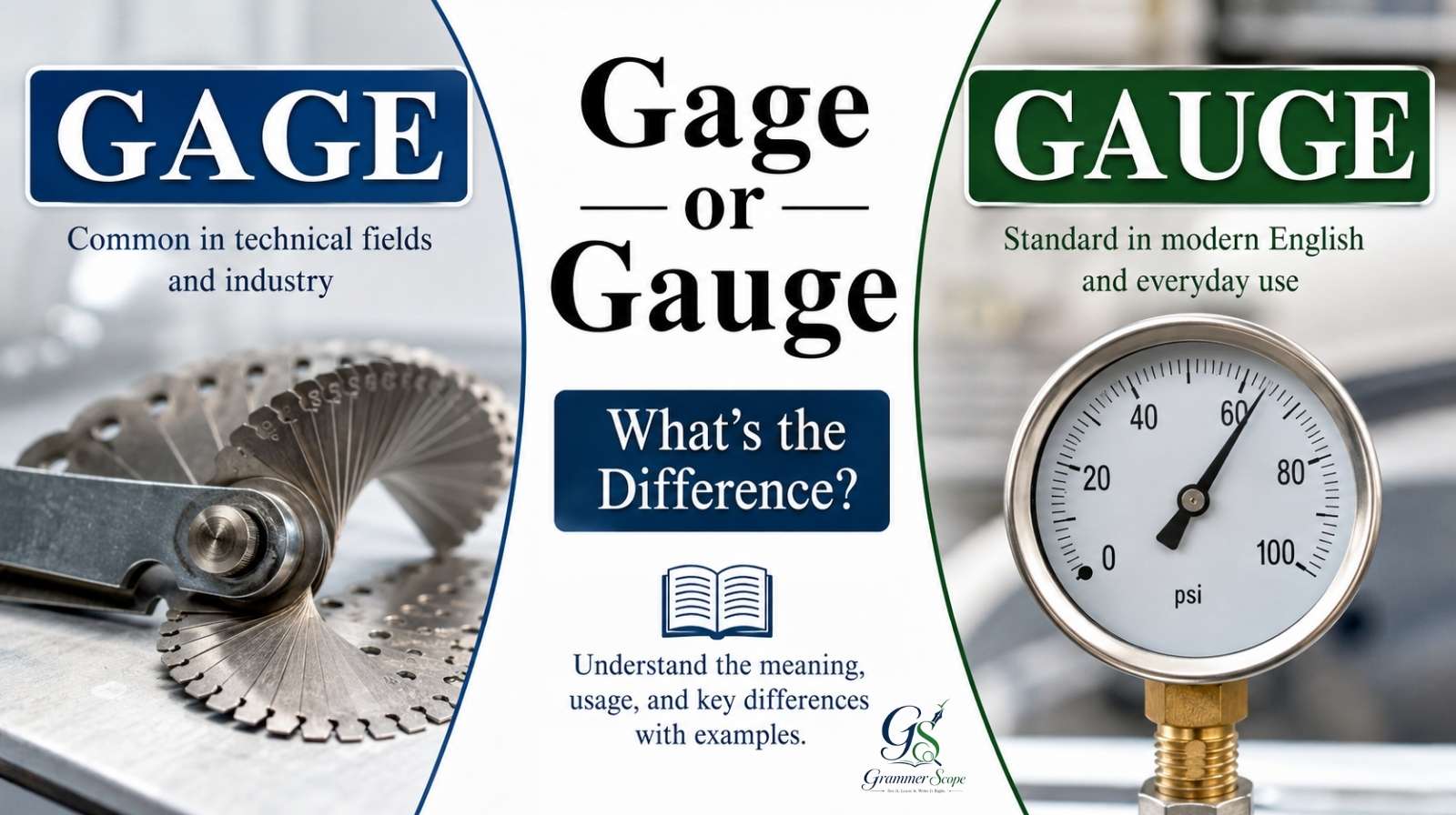
Have you ever seen the words gage or gauge used interchangeably and wondered which one is correct? You’re not alone. Many writers, students, professionals, and even native English speakers get confused when they encounter these two similar-looking words.
The confusion becomes even greater because both terms appear in dictionaries, technical documents, engineering manuals, and everyday writing. So, are they the same word? Is one correct and the other wrong? Or do they have different meanings altogether?
In this guide, you’ll learn the exact difference between gage and gauge, discover when to use each term, explore real-world examples, and avoid common mistakes. By the end, you’ll know which spelling fits your situation and why.
Understanding Gage and Gauge
The short answer is simple:
Gauge is the standard and most commonly accepted spelling in modern English.
Gage is an alternative spelling that survives mainly in specific industries, technical fields, and historical contexts.
Although the words often refer to the same concept, their usage differs significantly depending on context.
What Does Gauge Mean?
The word gauge generally refers to:
- A measuring instrument
- A standard of measurement
- The act of estimating or judging something
Examples:
- Check the fuel gauge before driving.
- The mechanic used a pressure gauge.
- It’s difficult to gauge customer satisfaction accurately.
In modern English, this is the spelling you’ll encounter most frequently.
What Does Gage Mean?
The word gage has two primary uses:
- An alternative spelling of gauge in some technical industries.
- A historical word meaning a pledge, challenge, or guarantee.
Examples:
- The manufacturer specifies a steel sheet gage of 20.
- In medieval literature, a knight might throw down a gage as a challenge.
Today, most readers recognize gauge more readily than gage.
Why Are Both Spellings Still Used?
The spelling variation dates back centuries. Over time, English standardized around gauge, but some industries continued using gage because it appeared in older specifications, manufacturing standards, and engineering documents.
As a result, both spellings still exist, though one is much more common than the other.
Read More: Commit vs Comit: Correct Spelling And Usage Guide
Gage vs Gauge: Key Differences at a Glance
The following table highlights the primary distinctions.
| Feature | Gauge | Gage |
|---|---|---|
| Modern Standard English | Yes | Rare |
| Dictionary Accepted | Yes | Yes |
| Everyday Writing | Common | Uncommon |
| Technical Manufacturing Use | Common | Sometimes |
| Historical Usage | Yes | Yes |
| Reader Familiarity | Very High | Lower |
| Preferred in General Content | Yes | No |
Quick Rule to Remember
If you’re unsure which spelling to use, choose gauge.
In most situations, it is the safest and most widely accepted option.
When Should You Use Gauge?
For nearly all modern writing situations, gauge is the preferred choice.
In General Communication
Use gauge when writing:
- Blog posts
- Articles
- Emails
- Academic papers
- Marketing content
Examples:
- We need a better way to gauge customer demand.
- The weather station uses a rainfall gauge.
- Investors often gauge market sentiment.
In Scientific and Technical Writing
Many technical disciplines also favor gauge.
Examples include:
- Tire pressure gauge
- Rain gauge
- Thickness gauge
- Vacuum gauge
Because most readers recognize this spelling instantly, it improves clarity and professionalism.
In Business Writing
Companies frequently use gauge as a verb.
Examples:
- Gauge customer satisfaction.
- Gauge employee engagement.
- Gauge market trends.
This usage has become standard across industries.
When Should You Use Gage?
Although less common, gage still appears in specific circumstances.
Manufacturing and Engineering Contexts
Certain engineering standards and manufacturing documents continue using gage.
Examples:
- Wire gage
- Sheet metal gage
- Thickness gage
Some organizations maintain the spelling because of historical industry standards.
Historical and Legal Contexts
Historically, a gage referred to:
- A pledge
- A challenge
- A guarantee
Example:
A knight might throw down a gage to challenge an opponent.
Although rarely used today, this meaning appears in older literature and legal documents.
Brand and Industry Preferences
Some companies intentionally use gage because it aligns with their historical terminology or product naming conventions.
In these cases, following the organization’s preferred spelling is appropriate.
Read More: Suing or Sueing: Which Spelling Is Correct?
The Origins of Gage and Gauge
Understanding the history helps explain why both spellings survived.
The word traces back to Old French and Middle English. Over centuries, spelling variations were common because English lacked standardized rules.
As dictionaries and educational systems evolved, gauge gradually became the dominant spelling.
However, industries such as manufacturing, metalworking, and engineering had already adopted gage in specifications and technical references. Those traditions continued even after gauge became the standard form.
Today, most style guides recommend gauge, but technical exceptions remain.
Evolution Timeline
| Period | Common Usage |
|---|---|
| Middle English | Multiple spellings |
| 16th–18th Century | Gage and Gauge both used |
| 19th Century | Gauge becomes dominant |
| 20th Century | Gauge standardized in general English |
| Modern Day | Gauge preferred, Gage survives in niche industries |
Real-Life Example: How a Manufacturing Company Avoided Costly Errors
A metal fabrication company in North America experienced repeated ordering mistakes when purchasing sheet steel from multiple suppliers.
The purchasing team used the term gauge in some documents and gage in others. While employees assumed the terms were interchangeable, several suppliers interpreted specifications differently because internal naming conventions varied.
One order involved sheet metal listed as “20 gauge” in an email and “20 gage” in a production document. Although the measurements technically referred to the same thickness standard, inconsistencies created confusion during processing and quality checks.
The company eventually conducted a documentation audit. Engineers reviewed hundreds of technical specifications and found numerous instances where spelling inconsistencies caused uncertainty among vendors and new employees.
To solve the problem, management introduced a company-wide style guide.
The guide required:
- Gauge for general communication.
- Gage only when quoting industry standards or manufacturer specifications.
- Consistent terminology across procurement, engineering, and production teams.
Within six months, documentation-related errors decreased significantly. Training became easier, supplier communication improved, and project delays caused by specification misunderstandings dropped.
This example demonstrates why understanding the difference between gage and gauge is more than a grammar issue. In technical environments, consistency directly affects efficiency and accuracy.
Industry Data and Language Trends (2025–2026)
Recent language usage trends continue to show overwhelming preference for gauge.
Key Findings
- Major dictionaries list gauge as the primary spelling.
- Most educational institutions teach gauge as the standard form.
- Online publishing platforms overwhelmingly favor gauge.
- Search engine data consistently shows significantly higher search volume for gauge-related terms.
- Technical industries remain the primary source of ongoing gage usage.
What This Means for Writers
If your audience includes:
- Students
- Consumers
- Business professionals
- General readers
Then gauge should almost always be your preferred spelling.
Using the standard form improves readability and aligns with modern language expectations.
Common Mistakes People Make
Many writers unintentionally misuse these terms.
Mistake 1: Assuming Gage Is Wrong
Gage is not incorrect.
It is a recognized English word with historical and technical legitimacy.
Mistake 2: Using Gage in General Content
While technically acceptable, it may appear unusual to readers.
Gauge is usually the better choice.
Mistake 3: Ignoring Industry Standards
Some technical documents specifically require gage.
Always follow industry requirements when applicable.
Mistake 4: Mixing Both Spellings
Switching between gage and gauge within the same document can create confusion.
Choose one standard and remain consistent.
How to Choose the Correct Spelling
Follow this simple checklist.
Use Gauge If:
✔ You’re writing for a general audience
✔ You’re creating online content
✔ You’re publishing articles or blogs
✔ You’re writing business documents
✔ You’re unsure which spelling to choose
Use Gage If:
✔ You’re following an industry standard
✔ You’re quoting historical material
✔ You’re referencing a manufacturer’s terminology
✔ A technical specification specifically uses gage
For most people, gauge is the correct choice.
Read More: Carrer vs Career: The Correct Spelling Explained
Mini Quiz: Gage or Gauge
Mini Quiz 1: Which Spelling Is the Modern Standard?
Question:
Which spelling is most commonly used in modern English writing?
A) Gage
B) Gauge
C) Both are equally common
D) Neither
Answer:
✅ B) Gauge
Gauge is the standard spelling used in most modern writing, including blogs, business documents, and academic content.
Mini Quiz 2: Spot the Correct Sentence
Question:
Which sentence uses the preferred modern spelling?
A) Check the fuel gage before driving.
B) Check the fuel gauge before driving.
Answer:
✅ B) Check the fuel gauge before driving.
In everyday English, “gauge” is the preferred and widely recognized spelling.
Mini Quiz 3: True or False?
Question:
“Gage” is not a real English word.
Answer:
❌ False
Gage is a legitimate English word. It is commonly found in certain technical industries and historical contexts.
Mini Quiz 4: Industry Challenge
Question:
In which field might you still commonly see the spelling “gage”?
A) Cooking blogs
B) Travel guides
C) Manufacturing and engineering
D) Social media marketing
Answer:
✅ C) Manufacturing and engineering
Many technical standards and industrial documents continue to use the spelling “gage.”
Mini Quiz 5: Fill in the Blank
Question:
It’s difficult to ______ customer satisfaction accurately.
A) Gage
B) Gauge
Answer:
✅ B) Gauge
When used as a verb meaning “to estimate” or “to measure,” gauge is the preferred spelling.
Mini Quiz 6: Quick History Check
Question:
Why do both spellings still exist today?
A) They were created by different countries.
B) They developed from historical spelling variations.
C) One is a typo that became popular.
D) Nobody knows.
Answer:
✅ B) They developed from historical spelling variations.
Both words share historical roots, but gauge became the dominant spelling over time.
Mini Quiz 7: What Would You Choose?
Question:
You’re writing a blog post for a general audience. Which spelling should you use?
A) Gage
B) Gauge
Answer:
✅ B) Gauge
For most readers, gauge is clearer, more familiar, and aligns with modern English standards.
Mini Quiz 8: Final Knowledge Test
Question:
Which statement is correct?
A) Gage and gauge always have different meanings.
B) Gauge is generally preferred in modern English, while gage survives in some technical contexts.
C) Gage is always wrong.
D) Gauge is only used in engineering.
Answer:
✅ B) Gauge is generally preferred in modern English, while gage survives in some technical contexts.
References
Frequently Asked Questions
Q1: Is gage a real word?
A: Yes. Gage is a legitimate English word recognized by major dictionaries. However, it is far less common than gauge.
Q2: Which spelling is more correct: gage or gauge?
A: Gauge is the standard modern spelling and is generally considered the preferred option.
Q3: Why do engineers sometimes use gage?
A: Certain engineering and manufacturing industries retain historical terminology that includes the spelling gage.
Q4: Can I use gage and gauge interchangeably?
A: In many situations, yes. However, gauge is usually the better choice for general writing.
Q5: Is gage outdated?
A: Not entirely. While uncommon in everyday language, it remains relevant in some technical and industrial applications.
Q6: Which spelling should bloggers use?
A: Bloggers should almost always use gauge because it aligns with modern usage and reader expectations.
Q7: Does Google recognize both spellings?
A: Yes. Search engines understand both terms, but gauge typically receives significantly more searches and broader usage.
Conclusion
When comparing gage or gauge, the answer is straightforward: gauge is the standard spelling used in modern English, while gage remains an accepted alternative in certain technical, industrial, and historical contexts.
For everyday communication, business writing, academic work, and online publishing, gauge is usually the safest and most professional choice. However, if you’re working with engineering specifications, manufacturing standards, or historical documents, you may encounter and occasionally need to use the spelling gage.
The key is consistency. Understand your audience, follow industry conventions when necessary, and choose the spelling that best fits your context.
By applying these guidelines, you’ll confidently know when to use gage and when to use gauge, helping your writing remain accurate, professional, and easy to understand.
Explore More Helpful Articles
- As Well or Aswell – Which One Is Correct?
- Lable or Label: Which Spelling Is Correct?
- Goodmorning or Good Morning: Which One Is Correct?
Ready to improve your English? Read more guides on Grammer Scope

Bilal Khalid is a professional blogger specializing in grammar guides and practical writing tips. He helps readers improve clarity, accuracy, and confidence in communication through simple explanations, actionable advice, and easy-to-follow strategies for everyday and professional writing.