Have you ever written a sentence such as “She has showed me the results” and then wondered whether it should be “She has shown me the results”? Or perhaps you have hesitated between “He showed me the way” and “He shown me the way.”
If so, you are dealing with a very common English grammar question: shown vs showed.
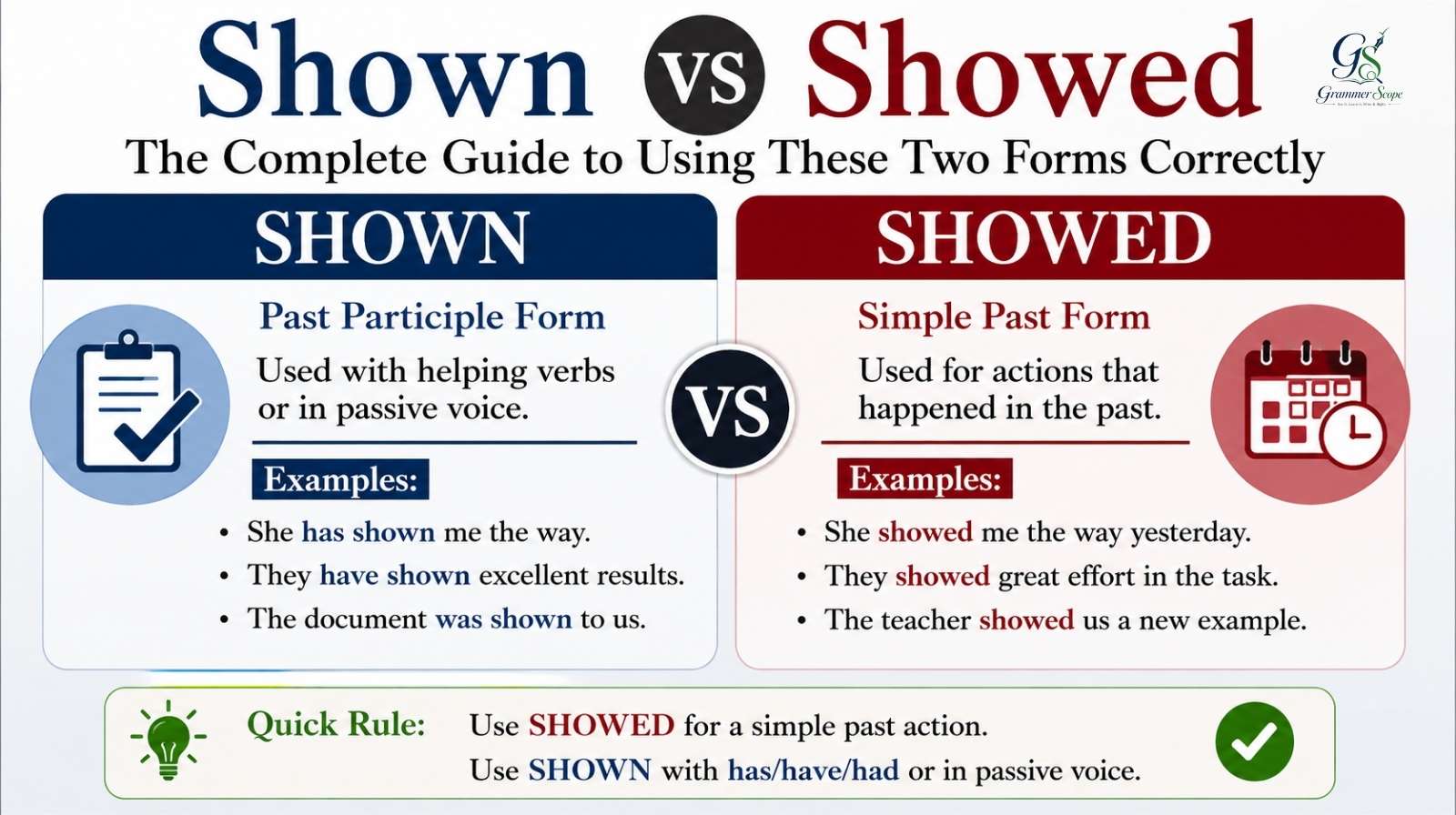
Both words come from the verb show, and both are legitimate forms. The confusion happens because they do not normally perform the same grammatical job. Showed is the simple past form, while shown is primarily the past participle. That small difference affects how each word works in a sentence.
The good news is that you do not need to memorize dozens of complicated rules. Once you understand the role of helping verbs and the difference between the simple past and past participle, choosing between shown and showed becomes much easier.
In this guide, you will learn exactly when to use showed, when to use shown, why “has showed” is usually not the preferred form in standard English, how passive sentences work, and how native-style examples can help you make the correct choice quickly.
What Is the Difference Between Shown and Showed?
The simplest way to understand shown vs showed is to remember that showed is normally the simple past tense, while shown is the past participle of show.
Showed Is the Simple Past Form
Use showed when you are describing an action that happened in the past.
For example:
- She showed me her new apartment.
- We showed our guests around the city.
- He showed the teacher his homework.
- The results showed a significant improvement.
- I showed them the photograph yesterday.
Notice something important: these sentences do not need has, have, or had before showed. The word itself tells us that the action happened in the past.
The basic pattern is:
Subject + showed + object
For example:
Maria showed her brother the letter.
The action occurred in the past, so showed is the natural choice.
Shown Is the Past Participle
Shown is primarily the past participle of show. It is commonly used with auxiliary or helping verbs such as has, have, had, be, been, and related forms.
Examples include:
- She has shown remarkable patience.
- They have shown excellent results.
- He had shown me the document before the meeting.
- The evidence was shown to the jury.
- The results have been shown to be reliable.
The structure changes depending on the tense or voice, but the key idea remains the same: shown usually needs a grammatical structure that calls for a past participle.
The Quickest Rule to Remember
If you are talking about a completed past action without a helping verb, showed is normally correct.
I showed him the picture.
If you are using a perfect tense or passive construction, shown is normally required.
I have shown him the picture.
The picture was shown to the audience.
This distinction solves most shown vs showed questions.
When Should You Use Showed?
Showed is the form you normally need when show is the main verb in the simple past tense.
Showed for a Completed Past Action
Use showed when something happened at a definite or understood time in the past.
Examples:
She showed me her new car last Saturday.
The teacher showed us an interesting video yesterday.
Daniel showed his friends the photograph.
The presentation showed how the system worked.
The report showed that sales had increased.
The action is presented simply as something that happened. There is no need for has, have, or had.
Showed With Time Expressions
Words and phrases such as yesterday, last week, last year, two days ago, in 2025, earlier this morning, and when I was younger often point toward the simple past.
For example:
- The study showed a clear difference in 2025.
- She showed me the message yesterday.
- The chart showed a sharp increase last month.
- He showed great courage during the incident.
However, a time expression alone does not mechanically determine the tense. The sentence’s overall meaning and structure still matter.
Compare:
The report showed a problem last year.
with:
The report has shown a problem repeatedly over the years.
The first sentence focuses on a completed past situation. The second uses the present perfect to connect past evidence with the present.
Showed in Questions and Negative Sentences
The same rule applies when using did.
After did, use the base form show, not showed.
Correct:
Did she show you the results?
Incorrect:
Did she showed you the results?
Correct:
He did not show me the document.
Incorrect:
He did not showed me the document.
Why? Because did already carries the past tense. Adding showed would mark the past twice.
This is an especially useful rule for English learners.
Read More: Trailer or Trailor: Which Spelling Is Correct?
When Should You Use Shown?
Use shown when the grammar of the sentence requires a past participle, especially with perfect tenses and passive constructions.
Shown With Has, Have, or Had
One of the easiest ways to recognize shown is to look for has, have, or had.
Examples:
She has shown great improvement.
They have shown strong interest in the project.
He had shown me the evidence before the meeting.
The research has shown a connection between the two factors.
We had shown them the correct procedure earlier.
These are perfect constructions. The auxiliary verb carries the tense, while shown functions as the past participle.
This is why the sentence:
She has showed me the report.
is generally replaced in standard English by:
She has shown me the report.
Shown in the Present Perfect
The present perfect uses has/have + past participle.
For show:
has/have + shown
Examples:
- The study has shown promising results.
- She has shown excellent leadership.
- Researchers have shown that the method can work.
- The experience has shown us what matters most.
The present perfect often connects a past event with the present or describes experience without focusing on one finished past time.
Compare:
The experiment showed a surprising result yesterday.
The experiment has shown surprising results in several trials.
The first sentence points to a particular past event. The second emphasizes a result or pattern that remains relevant.
Shown in the Past Perfect
The past perfect uses had + past participle.
Therefore:
had + shown
Examples:
She had shown me the letter before I left.
The company had shown strong growth before the market changed.
He had already shown that he understood the process.
The past perfect is useful when one past event happened before another past event.
For example:
By the time the manager arrived, the employee had shown the documents to the team.
The showing happened first; the manager’s arrival happened later.
Shown in the Passive Voice
Shown is also common in passive constructions.
The passive voice generally uses a form of be + past participle.
Examples:
The results were shown on the screen.
The film was shown at the festival.
The evidence was shown to the committee.
The photographs were shown to the visitors.
Here, the subject receives the action rather than performing it.
This is an important reason why “was showed” is normally incorrect in standard English when you mean that something was presented or displayed.
Correct:
The video was shown to the students.
Incorrect:
The video was showed to the students.
The auxiliary was is followed by the past participle shown in this passive structure.
Read More: Knaw or Gnaw: Correct Spelling Explained (2026)
Shown vs Showed: A Simple Comparison
Understanding the difference becomes much easier when the two forms are placed side by side.
| Form | Grammatical Role | Typical Structure | Example |
|---|---|---|---|
| show | Base form | can/will/to + show | I will show you. |
| showed | Simple past | subject + showed | She showed me the photo. |
| shown | Past participle | has/have/had + shown | She has shown me the photo. |
| shown | Passive | be + shown | The photo was shown to us. |
| showing | Present participle | be + showing | She is showing us the photo. |
The Three-Form Pattern
A useful way to memorize the verb is:
show → showed → shown
Compare it with another irregular verb:
go → went → gone
You would say:
I went there yesterday.
but:
I have gone there before.
Likewise:
I showed him the document yesterday.
but:
I have shown him the document before.
This pattern helps you recognize why showed and shown cannot normally be swapped freely.
A Fast Decision Checklist
When you are unsure, ask yourself these questions:
- Is the sentence describing a simple completed past action? → showed
- Does the sentence contain has or have? → shown
- Does it contain had for a past perfect construction? → shown
- Is it passive with was/were/been? → Usually shown
- Does the sentence use did? → Use the base form show, not showed
- Is show being used after to? → show
For example:
She ___ me the answer yesterday.
Answer: showed
She has ___ me the answer.
Answer: shown
The answer was ___ to the class.
Answer: shown
Did she ___ you the answer?
Answer: show
Read More: Repore or Rapport: Which Spelling Is Correct? (2026 Guide)
Common Mistakes With Shown and Showed
Many errors involving these forms are caused by focusing on the word itself instead of looking at the entire verb phrase.
Mistake 1: “Has Showed”
Incorrect in standard usage:
She has showed me the results.
Preferred:
She has shown me the results.
The reason is straightforward: has requires the past participle in the present perfect, and that form is shown.
Mistake 2: “Had Showed”
Incorrect:
He had showed us the photographs.
Preferred:
He had shown us the photographs.
The structure is had + past participle, so shown is the appropriate form.
Mistake 3: “Was Showed”
Incorrect in the ordinary passive construction:
The presentation was showed to the audience.
Correct:
The presentation was shown to the audience.
The passive pattern requires a form of be followed by a past participle.
Mistake 4: “Did Showed”
Incorrect:
Did you showed her the message?
Correct:
Did you show her the message?
Because did already marks the past tense, the main verb returns to its base form.
Mistake 5: Using “Shown” Alone for a Simple Past Action
Incorrect:
Yesterday, she shown me the results.
Correct:
Yesterday, she showed me the results.
Without a helping verb that calls for the past participle, shown does not normally work as the simple past form.
Read More: Amount or Ammount: Which Spelling Is Correct? (2026)
A Real-Life Example: Choosing the Right Form in Professional Writing
Imagine that a marketing manager is preparing a quarterly report for a company. During the meeting, she explains that customer research produced some interesting findings.
She writes:
“The survey showed that customers preferred the simpler design.”
That sentence is correct because the writer is referring to a completed research finding. Showed is the simple past form, and the sentence presents the survey’s result as something the research revealed.
Later, she adds:
“The survey has shown that customers consistently prefer simpler designs.”
This sentence has a slightly different focus. The present perfect has shown connects the previous research with the current understanding of customer preferences. The writer is not merely talking about one finished moment in the past; the evidence remains relevant now.
Then she describes what happened during the presentation:
“The results were shown to the management team.”
Here, shown is correct because the sentence is passive. The management team received the presentation of the results.
Finally, she asks a colleague:
“Did you show the updated chart to the director?”
Again, the correct form is show, not showed, because did already carries the past tense.
This small example demonstrates why memorizing one form as “the correct one” is not enough. Showed and shown are both correct, but their grammatical environments are different.
A useful editing habit is to stop and examine the complete verb phrase rather than looking only at the word immediately before the blank. Ask whether you are dealing with simple past, present perfect, past perfect, or passive voice.
That approach is much more reliable than trying to decide based on which word “sounds right.”
2025–2026 Data: Why Grammar Accuracy Still Matters
Grammar questions such as shown vs showed may look small, but accurate verb forms remain an important part of effective English communication.
A 2025 research project on automated grammatical assessment for English learners described a large-scale learner-English dataset used for spoken-language assessment and grammatical-error correction. The related Speak & Improve Challenge 2025 work involved approximately 315 hours of second-language English learner speech, including a 55-hour subset with manual transcriptions and error annotations.
That figure is useful context: English-learning research continues to devote substantial resources to identifying and improving grammatical accuracy rather than treating grammar as a minor concern.
Another 2025 study examining English-language writing and AI-assisted composition also highlighted the importance of learners’ ability to write accurately and coherently in their own words.
For everyday writers, the lesson is simple. You do not need to master every grammatical term before you can write well. But understanding high-frequency distinctions such as showed vs shown can make your writing more precise, professional, and easier to understand.
In practical terms, learning one verb pair properly can also teach you a larger grammatical principle: English verb forms change according to the tense and structure of the sentence, not simply according to what sounds familiar.
Read More: Tacet or Tacit: What’s The Difference And Which One Should You Use?
Regional and Usage Notes About Showed and Shown
There is one additional detail worth knowing.
Major dictionaries recognize shown as the standard past participle of show. Some dictionaries also record showed as an alternative past participle in certain varieties or uses of English.
That does not mean you should randomly substitute showed for shown in formal writing.
For learners, students, academic writers, and professional communicators, the safest standard pattern is:
show → showed → shown
Therefore, write:
She has shown us the evidence.
rather than:
She has showed us the evidence.
Likewise:
The evidence was shown to the committee.
rather than:
The evidence was showed to the committee.
English naturally contains variation, and real-world speech may sometimes differ from formal edited English. Nevertheless, if your goal is clear, conventional, and widely accepted English, shown is the best choice as the past participle.
Read More: Dysregulated vs Disregulated: Correct Usage Explained
How to Remember Shown vs Showed
You can reduce the entire rule to one practical trick: look for the helper.
If There Is No Helper, Think “Showed”
For a normal past action:
She showed me.
They showed us.
He showed the results.
If There Is a Perfect or Passive Helper, Think “Shown”
With has, have, or had:
She has shown me.
They have shown us.
He had shown the results.
With passive be:
It was shown to the audience.
They were shown the results.
This is not a rule that covers every imaginable construction, but it is an excellent practical shortcut for everyday English.
Read More: Nominator vs Nominee: Key Differences Explained
Mini Quiz: Shown vs Showed
Quiz 1. Choose the Correct Word
Yesterday, Sarah ___ me her new phone.
A) shown
B) showed
C) show
Answer: B) showed
Quiz 2. Fill in the Blank
He has ___ us the results already.
Answer: shown
Quiz 3. Which One Sounds Right?
A) She showed me the picture yesterday.
B) She shown me the picture yesterday.
Answer: A) She showed me the picture yesterday.
Quiz 4. Fill in the Blank
The documentary was ___ to the students.
Answer: shown
Quiz 5. Quick Grammar Check
Which sentence is correct?
A) They have showed great improvement.
B) They have shown great improvement.
Answer: B) They have shown great improvement.
Quiz 6. Complete the Sentence
I ___ my friend the new article last night.
Answer: showed
Quiz 7. Pick the Perfect Form
She has ___ a lot of patience.
A) showed
B) shown
C) show
Answer: B) shown
Quiz 8. Fill in the Blank
Did you ___ him the message?
Answer: show
Quiz 9. Spot the Mistake
Which sentence needs fixing?
A) He showed me his notes.
B) He has showed me his notes.
C) He had shown me his notes.
Answer: B) He has showed me his notes.
Correct: He has shown me his notes.
Quiz 10. Showed or Shown?
The results ___ a clear improvement last year.
A) showed
B) shown
Answer: A) showed
Quiz 11. Fill in the Blank
The photos were ___ to the visitors.
Answer: shown
Quiz 12. Choose the Correct Sentence
A) Did she showed you the report?
B) Did she show you the report?
Answer: B) Did she show you the report?
Quiz 13. Past or Past Participle?
Which word completes the sentence?
“We had ___ the customer all the available options.”
A) showed
B) shown
C) show
Answer: B) shown
Quiz 14. Fill in the Blank
Tom ___ me the way to the station yesterday.
Answer: showed
Quiz 15. One-Minute Challenge
Choose the correct word:
“The research has ___ that sleep is important.”
A) showed
B) shown
C) show
Answer: B) shown
Quiz 16. Final Boss: Can You Get It Right?
Complete both blanks:
“Yesterday, she ___ me her project, and today she has ___ it to the whole class.”
Answer: showed, shown ✅
References
FAQs
Q1: Is “shown” the past tense of show?
A: No. Showed is the simple past form of show. Shown is primarily the past participle.
For example:
She showed me the picture yesterday.
She has shown me the picture before.
Q2: Is “showed” or “shown” correct?
A: Both are correct, but they are used differently. Use showed for the simple past and shown primarily as the past participle.
He showed me the way.
He has shown me the way.
Q3: Is “has showed” grammatically correct?
A: In standard English, has shown is the preferred form when show means present a display, reveal something, demonstrate something, or explain something.
She has shown great courage.
Q4: Is “was showed” correct?
A: For the ordinary passive construction, use was shown.
The documentary was shown on television.
The passive structure uses a form of be followed by a past participle.
Q5: Should I say “I showed him” or “I shown him”?
A: Say I showed him when describing a simple past action.
I showed him the photograph yesterday.
“I shown him” is not the standard simple-past construction.
Q6: Which is correct: “Did you show” or “Did you showed”?
A: The correct form is Did you show.
Did you show her the report?
The auxiliary did already marks the sentence as past, so the main verb stays in its base form.
Q7: Can “showed” ever be a past participle?
A: Some dictionaries recognize showed as an alternative past participle in certain varieties or contexts. However, shown is the standard and safest choice for formal, academic, and professional writing when a past participle is required.
Final Takeaway: Shown vs Showed
The difference between shown vs showed becomes much easier once you stop treating them as competing versions of the same word.
Showed is normally the simple past form:
She showed me the document yesterday.
Shown is primarily the past participle:
She has shown me the document.
The document was shown to the team.
The most useful pattern to remember is:
Show → Showed → Shown
If you are describing a straightforward action that happened in the past, choose showed. If you are using a perfect construction or passive voice, shown is usually the form you need.
And remember the special case involving did:
Did you show me?
Not:
Did you showed me?
Once you start looking at the whole verb phrase rather than the individual word, the choice becomes much more natural.
Whether you are writing an email, completing an assignment, preparing a report, or simply trying to improve your English, mastering this small distinction can make your sentences noticeably more accurate.
Still unsure about similar English word choices? Explore more clear, practical grammar guides and learn the difference one phrase at a time.
Discover More Articles
- Pre vs Post: Correct Usage & Meaning Guide 2026
- Challenge or Challange: Which Is Correct? (2026 Guide)
- Hustle or Hussle: Which Spelling Is Correct?
Ready to improve your English? Read more guides on Grammer Scope

Bilal Khalid is a professional blogger specializing in grammar guides and practical writing tips. He helps readers improve clarity, accuracy, and confidence in communication through simple explanations, actionable advice, and easy-to-follow strategies for everyday and professional writing.