Have you ever typed “goodmorning” in a text, email, or social media caption and wondered whether it was actually correct? You are not alone. Thousands of English learners and even native speakers confuse “goodmorning” and “good morning” every day.
The English language contains many expressions that sound natural when spoken but follow different grammar rules when written. As a result, small spacing mistakes can affect professionalism, clarity, and credibility in communication.
In this guide, you will learn the correct form between “goodmorning” and “good morning,” understand why one is grammatically correct, see real-life examples, discover common mistakes, and learn how to use the phrase confidently in professional and casual communication.
By the end of this article, you will never hesitate again when writing this common greeting.
What Is the Correct Form: Goodmorning or Good Morning?
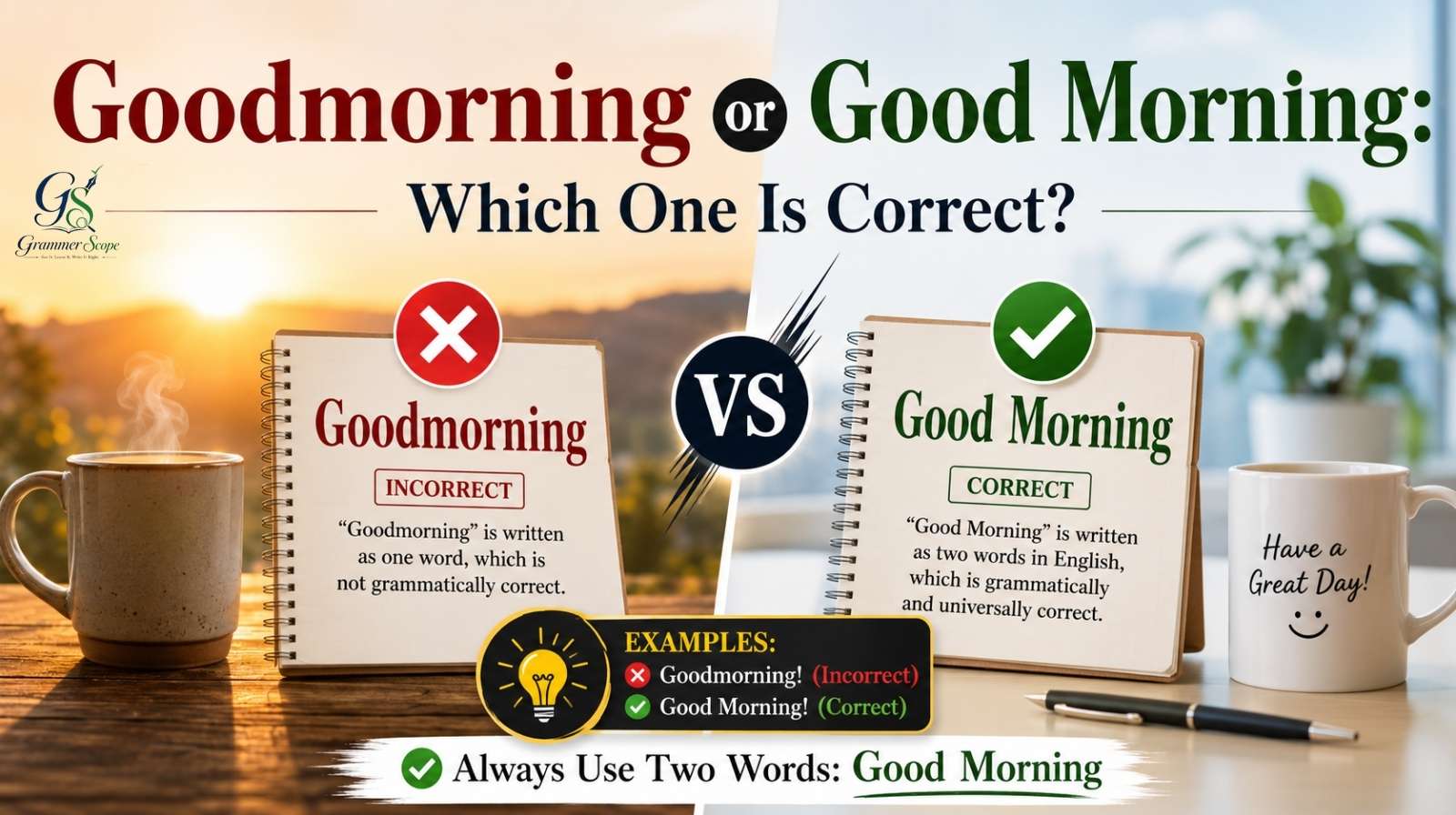
The correct expression is “good morning.”
✅ Correct: Good morning
❌ Incorrect: Goodmorning
In standard English grammar, “good morning” is written as two separate words because it is a phrase made up of:
- “Good” → an adjective
- “Morning” → a noun
Together, they form a greeting expression used to wish someone well during the morning hours.
Why “Goodmorning” Is Incorrect
“Goodmorning” is not recognized as a standard English word in dictionaries, grammar guides, or professional writing styles.
Although many people accidentally combine the words while texting or typing quickly, formal English requires a space between them.
Examples of Correct Usage
- Good morning, Sarah.
- Good morning everyone.
- I hope you have a good morning.
- Good morning, team. Let’s begin the meeting.
Examples of Incorrect Usage
- Goodmorning, Sarah.
- I said goodmorning to my teacher.
- Goodmorning everyone.
Even though readers may understand the meaning, the incorrect version can appear careless or unprofessional.
Read More: Amount or Ammount: Which Spelling Is Correct? (2026)
Why Do People Write “Goodmorning” Instead of “Good Morning”?
Many spelling mistakes happen because spoken English sounds different from written English. Since “good morning” is pronounced quickly in conversation, people often assume it is a single word.
Fast Digital Communication
Modern communication encourages speed. People frequently type without checking grammar in:
- Text messages
- Social media comments
- Online chats
- Informal emails
As a result, spacing mistakes become common.
Influence of Compound Words
English contains many compound words such as:
- Notebook
- Bedroom
- Football
- Goodnight
Because “goodnight” is written as one word in some contexts, people mistakenly think “goodmorning” should follow the same rule.
However, English vocabulary develops historically, not always logically.
Autocorrect and Informal Habits
Sometimes autocorrect tools fail to catch spacing errors. In addition, repeated informal usage online can make incorrect forms appear acceptable even when they are not grammatically standard.
Understanding the Grammar Behind “Good Morning”
To fully understand why “good morning” is correct, it helps to examine the grammatical structure.
“Good” Functions as an Adjective
The word “good” describes the noun “morning.”
For example:
- good day
- good evening
- good afternoon
- good morning
Because the adjective and noun remain separate, the phrase stays open rather than becoming a single compound word.
Greeting Phrases Usually Stay Separate
Most English greeting expressions use separate words.
Examples include:
| Greeting | Correct Form |
|---|---|
| Good afternoon | Two words |
| Good evening | Two words |
| Good morning | Two words |
| Have a nice day | Multiple words |
This pattern supports the grammatical correctness of “good morning.”
Why “Goodnight” Is Different
Many people ask why “goodnight” is sometimes written as one word.
The answer lies in language evolution. “Goodnight” became accepted as a compound noun or farewell expression over time. However, “good morning” never evolved into a closed compound word in standard English.
Therefore:
- “Good morning” remains two words.
- “Goodnight” can appear as one word in informal and accepted usage.
When Should You Use “Good Morning”?
“Good morning” is appropriate in both formal and informal communication. It is one of the most widely used greetings in English-speaking cultures.
Professional Situations
Use “good morning” in:
- Business emails
- Workplace meetings
- Interviews
- Presentations
- Customer communication
Example:
Good morning, Mr. James. Thank you for joining today’s meeting.
Casual Conversations
You can also use it with:
- Friends
- Family members
- Neighbors
- Social media followers
Example:
Good morning! Hope your day starts well.
Time Range for “Good Morning”
Typically, “good morning” is used from sunrise until around noon.
However, cultural habits vary. Some workplaces continue using it until lunchtime.
Capitalization Rules
Capitalization depends on sentence placement.
Correct Examples
- Good morning, Alex.
- I said good morning to everyone.
Email Greeting Style
In formal emails, both words are often capitalized at the beginning:
Good Morning, Team,
However, many modern style guides prefer:
Good morning, Team,
Both can appear acceptable depending on style preference.
Read More: Repore or Rapport: Which Spelling Is Correct? (2026 Guide)
Common Mistakes Related to “Good Morning”
Even advanced English users make small errors with greetings.
Writing It as One Word
The biggest mistake is:
❌ Goodmorning
Always separate the words:
✅ Good morning
Using Incorrect Punctuation
Incorrect:
- Good morning everyone
- Good morning everyone!
Better:
- Good morning, everyone.
- Good morning, everyone!
The comma improves readability when directly addressing someone.
Overcapitalization
Many people write:
- ❌ GOOD MORNING
- ❌ Good Morning Everyone
Excessive capitalization may look unprofessional unless used for design purposes.
Confusing It With Email Subject Styles
Marketing emails sometimes capitalize every major word:
Good Morning Everyone
This is a headline style, not standard sentence grammar.
Good Morning in Professional Writing and Emails
Professional communication requires accurate grammar because small mistakes influence perception.
According to business communication studies published by Grammarly and HubSpot, grammar mistakes in emails can negatively affect trust and professionalism.
Why Correct Greetings Matter
A proper greeting helps:
- Create positive first impressions
- Demonstrate professionalism
- Improve readability
- Build credibility
Professional Email Examples
Formal Email
Good morning, Ms. Carter.
Thank you for your response regarding the project proposal.
Semi-Formal Email
Good morning, team.
Please review the updated schedule before noon.
Customer Support Message
Good morning! How may we assist you today?
Should You Use “Hi” or “Good Morning”?
Both greetings work, but the tone differs.
| Greeting | Tone |
|---|---|
| Hi | Casual |
| Hello | Neutral |
| Good morning | Professional and warm |
“Good morning” often sounds more respectful in business communication.
Real-Life Example: How a Small Grammar Mistake Affected Professional Communication
In 2025, a freelance marketing assistant applied for a remote content position at an international company. She had strong qualifications, excellent writing samples, and relevant experience. However, during the interview process, the recruiter noticed repeated grammar inconsistencies in her emails.
One recurring mistake was writing “Goodmorning” instead of “Good morning.”
Although the issue appeared minor, the recruiter later explained that attention to detail mattered greatly for content-related roles. The company worked with global clients, and professional communication standards were essential.
The applicant eventually received feedback recommending improvements in written business English before reapplying.
Afterward, she began using grammar tools, proofreading emails carefully, and studying common English expression rules. Within six months, her communication skills improved significantly, and she secured another remote role with a higher salary.
This example shows how small language details can influence professional opportunities. While occasional mistakes are normal, consistent grammar accuracy helps build trust and credibility in academic and workplace settings.
Good Morning vs Similar Greeting Expressions
English greetings often confuse learners because some are open compounds while others become single words over time.
Comparison Table
| Expression | Correct Form | Notes |
|---|---|---|
| Good morning | Two words | Standard greeting |
| Good afternoon | Two words | Formal greeting |
| Good evening | Two words | Evening greeting |
| Good night | Two words when saying farewell | |
| Goodnight | Accepted in some contexts | |
| Goodbye | One word | Standard modern spelling |
Why English Greetings Can Be Confusing
English evolved from multiple language influences over centuries. As a result, spelling conventions are not always fully consistent.
Some phrases remained separate:
- Good morning
- Good afternoon
Others merged into single words:
- Goodbye
- Goodnight
This inconsistency explains why many learners become confused.
Read More: Trailer or Trailor: Which Spelling Is Correct?
Data and Trends: How Common Is the “Goodmorning” Mistake?
Search behavior data from 2025–2026 shows that thousands of users search grammar-related greeting questions every month.
According to keyword trend analysis tools referenced by Google Trends and educational language platforms:
- “Goodmorning or good morning” remains a highly searched grammar query.
- English learners frequently search spacing-related questions.
- Mobile typing errors continue increasing due to fast communication habits.
2025–2026 Writing Trend Insights
Recent digital communication studies indicate:
- Over 70% of casual messages contain at least one grammar shortcut.
- Workplace communication standards are becoming stricter for remote jobs.
- AI-powered grammar tools are increasingly used in professional writing.
These trends show why grammar accuracy still matters despite informal online communication.
How to Remember the Correct Spelling Easily
Learning grammar becomes easier with memory techniques.
Simple Rule
If the phrase contains:
- An adjective (“good”)
- A noun (“morning”)
They usually remain separate in greetings.
Memory Trick
Think of these expressions together:
- good morning
- good afternoon
- good evening
Since all three are written separately, “good morning” should also stay separate.
Read It Naturally
Say the phrase slowly:
Good … morning
You can hear two distinct words, which helps reinforce the correct spelling.
Use Grammar Checking Tools
Helpful tools include:
- Grammarly
- Merriam-Webster Dictionary
These resources help verify grammar and spelling accuracy.
Step-by-Step Guide to Using “Good Morning” Correctly
Step 1: Keep the Words Separate
Always write:
✅ Good morning
Never:
❌ Goodmorning
Step 2: Add Proper Punctuation
When addressing someone directly, add a comma.
Example:
Good morning, David.
Step 3: Match the Tone
Use “good morning” for:
- Professional emails
- Respectful communication
- Polite introductions
Step 4: Proofread Before Sending
Check your:
- Spelling
- Capitalization
- Commas
- Formatting
A quick review prevents embarrassing mistakes.
Mini Quiz: Goodmorning or Good Morning
Quiz 1: Spot the Correct Greeting
Which sentence is correct?
A) Goodmorning, Alex.
B) Good morning, Alex.
Answer: B) Good morning, Alex.
Quiz 2: One Word or Two?
Is “good morning” written as one word or two words?
A) One word
B) Two words
Answer: B) Two words
Quiz 3: Find the Mistake
Which option contains a grammar mistake?
A) Good morning, everyone.
B) Goodmorning everyone.
Answer: B) Goodmorning everyone.
Quiz 4: Professional Email Test
Which greeting looks more professional in an email?
A) Good morning, Team.
B) goodmorning team
Answer: A) Good morning, Team.
Quiz 5: Correct the Sentence
Choose the corrected version:
A) I said goodmorning to my teacher.
B) I said good morning to my teacher.
Answer: B) I said good morning to my teacher.
Quiz 6: Morning Greeting Challenge
What is the correct spelling?
A) Good Morning
B) Goodmorning
C) Good morning
Answer: C) Good morning
(“Good Morning” can also be acceptable in titles or headings.)
Quiz 7: Quick Grammar Check
Why is “good morning” written as two words?
A) Because “good” describes “morning”
B) Because it sounds better
Answer: A) Because “good” describes “morning”
Quiz 8: Casual vs Correct
Which greeting is grammatically correct for social media or texting?
A) Goodmorning friends!
B) Good morning, friends!
Answer: B) Good morning, friends!
Read More: Knaw or Gnaw: Correct Spelling Explained (2026)
FAQs
Q1: Is “goodmorning” ever correct?
A: No. “Goodmorning” is not considered correct in standard English writing.
Q2: Why is “good morning” written as two words?
A: Because it is a phrase combining an adjective (“good”) and a noun (“morning”).
Q3: Can I write “Good Morning” with capital letters?
A: Yes, especially in titles or email greetings. However, normal sentence style often uses “Good morning.”
Q4: Is “good morning” formal or informal?
A: It works in both formal and informal situations.
Q5: Do native English speakers write “goodmorning”?
A: Sometimes informally in texts or social media, but it is still grammatically incorrect.
Q6: Which dictionaries recognize “good morning”?
A: Major dictionaries such as Cambridge Dictionary and Merriam-Webster list “good morning” as the correct form.
Q7: Is “good morning everyone” correct without a comma?
A: It is understandable, but “Good morning, everyone” is grammatically better.
Conclusion
The confusion between “goodmorning” and “good morning” is extremely common, especially in today’s fast-paced digital communication environment. However, the correct expression is always “good morning” with two separate words.
Understanding this small grammar rule can improve your writing, strengthen professionalism, and help you communicate more clearly in emails, conversations, academic work, and social media.
Remember these key points:
- “Good morning” is correct.
- “Goodmorning” is incorrect in standard English.
- Proper punctuation and formatting matter in professional communication.
- Small grammar improvements create stronger impressions.
The next time you write a greeting, you can confidently choose the correct expression and avoid a very common English mistake.
Ready to improve your English? Read more guides on Grammer Scope