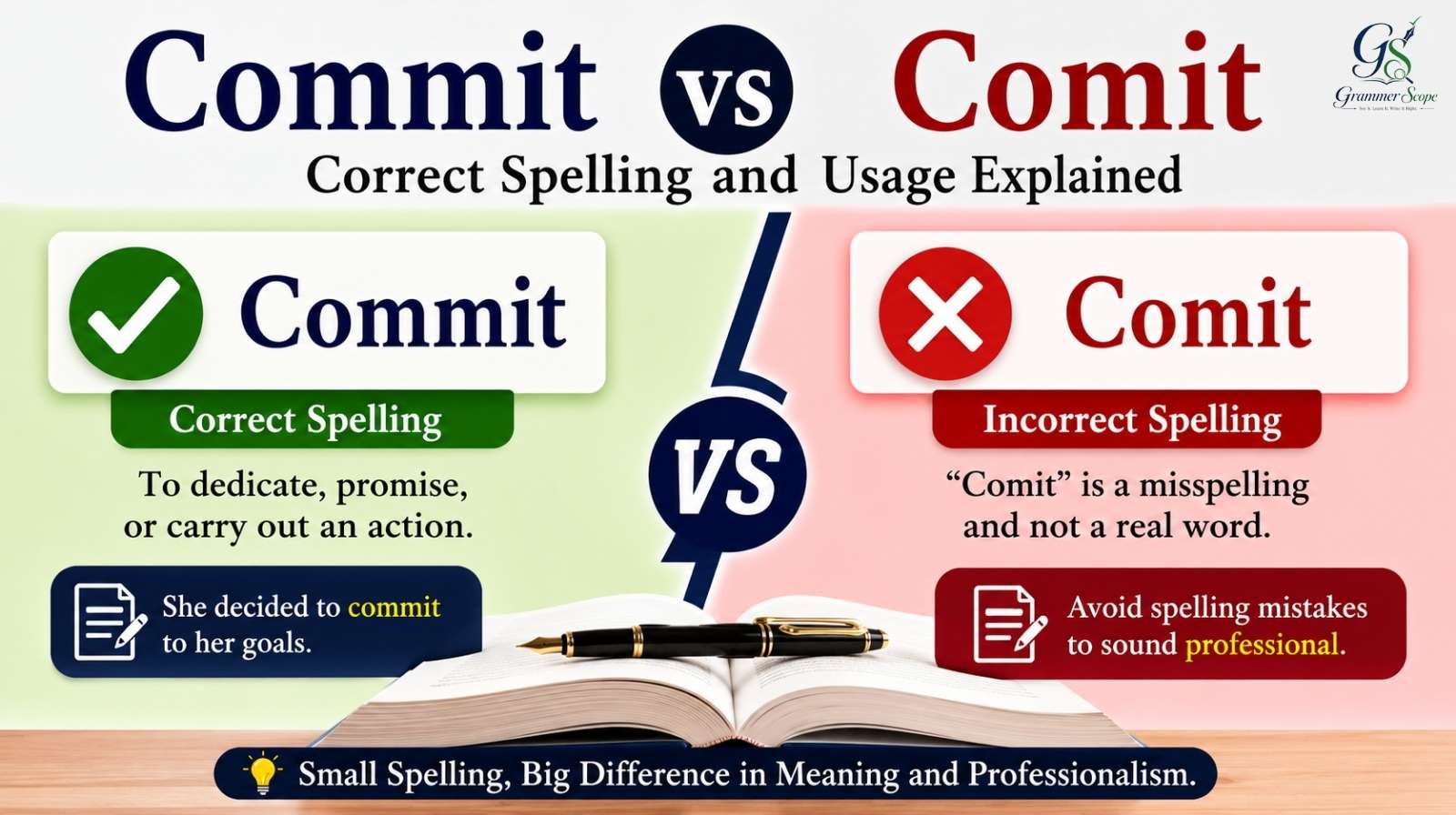
English spelling mistakes are common, especially when words contain double letters. One of the most frequently confused spellings is “Commit vs Comit.” Many writers accidentally remove one “m” and type comit instead of commit. While the mistake looks small, it can affect professional writing, academic work, SEO content, and even business communication.
If you have ever wondered whether comit is a real word or why commit uses double “m,” this guide explains everything in simple English. You will learn the correct spelling, pronunciation, grammar rules, real-world examples, and memory tricks that help you avoid this mistake forever.
By the end of this article, you will confidently know when and how to use commit correctly in writing and conversation.
Understanding the Difference Between Commit and Comit
The primary difference is simple:
| Word | Correct or Incorrect | Meaning |
|---|---|---|
| Commit | ✅ Correct | To dedicate, perform, or pledge something |
| Comit | ❌ Incorrect | Misspelling of “commit” |
The correct spelling is always commit with double “m.”
What Does “Commit” Mean?
The verb commit has several meanings depending on context:
- To dedicate yourself to something
- To carry out an action
- To promise or pledge
- To officially record or finalize something
Examples of “Commit” in Sentences
- She decided to commit to daily exercise.
- The company will commit more resources to customer support.
- He refused to commit to the long-term contract.
- Developers often commit code changes in software projects.
Why Do People Write “Comit”?
People commonly misspell the word because:
- They type too quickly
- They forget the double consonant rule
- English spelling patterns can feel inconsistent
- Autocorrect sometimes fails
However, comit is not recognized as a standard English word in dictionaries.
Also Read: Pre vs Post: Correct Usage & Meaning Guide 2026
Why “Commit” Has Double “M”
English grammar contains many words where consonants are doubled. The word commit follows this pattern because of its pronunciation and word structure.
The Double Consonant Rule
In English, consonants are often doubled when:
- The word has two syllables
- Stress falls on the second syllable
- A short vowel sound comes before the consonant
The pronunciation of commit stresses the second syllable:
com-MIT
Therefore, the “m” becomes doubled.
Similar Words With Double Consonants
Here are related examples:
| Correct Word | Incorrect Version |
|---|---|
| Submit | Subit |
| Permit | Perit |
| Commit | Comit |
| Occur | Ocur |
| Address | Adress |
Understanding this pattern helps improve spelling accuracy in English writing.
Common Uses of the Word “Commit”
The word commit appears in many professional, academic, legal, and technical situations.
Commit in Daily Conversation
People often use commit when discussing dedication or responsibility.
Examples
- I want to commit to healthier habits.
- They committed to helping the local community.
- You should commit fully to your goals.
Commit in Business Writing
In workplaces, the word often refers to promises or agreements.
Examples
- The organization committed to reducing costs.
- Management committed additional funding to the project.
- We cannot commit to the deadline yet.
Commit in Technology and Programming
In software development, developers “commit” code changes to repositories like Git.
Examples
- Please commit your code before deployment.
- The programmer committed several updates yesterday.
Commit in Legal Contexts
The word may also refer to carrying out actions, including crimes.
Examples
- The suspect was accused of committing fraud.
- It is illegal to commit cybercrime.

Commit vs Comit: Comparison Table
Here is a quick comparison table for easier understanding.
| Feature | Commit | Comit |
|---|---|---|
| Spelling Status | Correct | Incorrect |
| Dictionary Word | Yes | No |
| Part of Speech | Verb | None |
| Used in Professional Writing | Yes | No |
| Accepted in Academic Writing | Yes | No |
| Grammar Approved | Yes | No |
This comparison clearly shows that commit is the only correct spelling in modern English.
Real-Life Example of How Spelling Errors Affect Credibility
Spelling mistakes may seem harmless, but they can seriously impact credibility online and offline.
Case Study: Resume Rejection Due to Spelling Errors
In 2025, a recruitment consulting agency shared hiring insights showing that spelling mistakes remain one of the top reasons employers reject resumes during initial screening. A candidate applying for a project management role repeatedly wrote “comit” instead of “commit” throughout their CV and cover letter.
Although the applicant had strong qualifications, recruiters viewed the repeated spelling mistake as a sign of poor attention to detail. Because project managers are expected to communicate professionally, the error negatively affected the candidate’s credibility.
The hiring manager later explained that grammar and spelling reflect professionalism, especially in client-facing roles. The applicant was not selected for the interview stage despite having relevant experience.
This example demonstrates why learning correct spelling matters in real life. A single repeated mistake can influence hiring decisions, brand reputation, academic grades, and online authority.
Therefore, writers should always proofread carefully and use grammar-checking tools before publishing content or submitting documents.
Also Read: Hustle or Hussle: Which Spelling Is Correct?
Statistics About Spelling Errors in Digital Writing (2025–2026)
Recent studies show that spelling mistakes continue to impact communication quality online.
Key Data and Trends
- According to research from Grammarly, spelling and grammar errors reduce reader trust in professional communication.
- A 2025 content marketing survey found that users are more likely to leave webpages containing visible spelling mistakes.
- Business communication studies indicate that typo-free emails improve customer confidence and response rates.
- SEO experts also report that content quality signals, including readability and correctness, influence user engagement metrics.
Why This Matters for SEO
Search engines prioritize high-quality, trustworthy content. While Google may not directly penalize small spelling mistakes, poor readability can increase bounce rates and reduce user trust.
That means accurate spelling indirectly supports:
- Better engagement
- Higher readability
- Improved authority
- Stronger E-E-A-T signals
For bloggers, students, businesses, and content creators, proper spelling is essential for long-term credibility.
How to Remember the Correct Spelling of Commit
If you frequently confuse commit and comit, these simple memory tricks can help.
Remember the Double “M”
Think about commitment requiring “more effort.”
More effort = extra “m”
This association makes the spelling easier to recall.
Break the Word Into Sounds
Pronounce it slowly:
com + mit = commit
Hearing the stressed second syllable helps reinforce the double consonant.
Use Spell-Checking Tools
Helpful tools include:
These tools quickly identify spelling mistakes before publication.
Common Grammar Mistakes Related to Commit
Many writers also make errors with different forms of the word.
Commit vs Committed
| Word | Usage |
|---|---|
| Commit | Present tense |
| Committed | Past tense |
| Committing | Continuous tense |
| Commitment | Noun form |
Correct Examples
Present Tense
- I commit to finishing the work.
Past Tense
- She committed to the agreement yesterday.
Continuous Form
- They are committing more time to research.
Noun Form
- His commitment impressed the entire team.
Incorrect Examples
- ❌ She comited to the task.
- ❌ We are comiting resources.
- ❌ His comitment is impressive.
Notice how double consonants appear in related forms as well.

Step-by-Step Guide to Avoid Spelling Mistakes
Improving spelling accuracy is easier with consistent habits.
Step 1: Slow Down While Typing
Typing too fast increases spelling errors.
Step 2: Proofread Carefully
Always reread emails, articles, and assignments before submitting them.
Step 3: Use Grammar Tools
Applications like Grammarly and built-in spell checkers catch common mistakes instantly.
Step 4: Read More Frequently
Reading quality content improves spelling memory naturally.
Step 5: Practice Commonly Misspelled Words
Create a small list of words you often misspell and review them regularly.
Also Read: Challenge or Challange: Which Is Correct? (2026 Guide)
Mini Quiz: Commit vs Comit
1: Spot the Correct Spelling
Which word is spelled correctly?
A) Comit
B) Commit
C) Commet
D) Comitt
Answer: B) Commit
2: Fill in the Blank
She decided to ______ to her fitness goals.
A) Comit
B) Commit
Answer: B) Commit
3: True or False
“Comit” is a correct English word.
Answer: False
4: Quick Grammar Check
Which sentence is correct?
A) He comited to the project.
B) He committed to the project.
Answer: B) He committed to the project.
5: Choose the Right Meaning
What does “commit” usually mean?
A) To forget something
B) To dedicate or promise
C) To cancel work
D) To hide information
Answer: B) To dedicate or promise
6: Missing Letter Challenge
Complete the word correctly:
C O M _ I T
Answer: M
Correct Word: Commit
7: Real-Life Writing Test
Which version looks more professional in an email?
A) We comit to quality service.
B) We commit to quality service.
Answer: B) We commit to quality service.
8: Double Letter Challenge
How many “m” letters are in the word “commit”?
A) One
B) Two
C) Three
Answer: B) Two
9: Fast Typing Trap
Which spelling mistake do people commonly make?
A) Comit
B) Commit
Answer: A) Comit
10: Sentence Fixer
Find the mistake:
“I will comit to learning English daily.”
Answer: “Comit” is incorrect.
Correct Sentence: “I will commit to learning English daily.”
11: Past Tense Test
What is the correct past tense of “commit”?
A) Commited
B) Comitted
C) Committed
Answer: C) Committed
12: SEO Writer Challenge
Why is correct spelling important in articles?
A) It improves readability and trust
B) It confuses readers
C) It lowers quality
Answer: A) It improves readability and trust
13: One-Word Answer
Correct spelling?
“C _ M M I T”
Answer: O
Commit
14: Professional Writing Check
Which word should never be used in formal writing?
A) Commit
B) Comit
Answer: B) Comit
15: Final Brain Booster
Complete the sentence:
Successful people ______ to their goals.
Answer: Commit
FAQs
Q1: Is “comit” ever correct?
A: No. “Comit” is not a correct English spelling. The correct word is always commit.
Q2: Why does “commit” have two m’s?
A: The word follows an English spelling rule where stressed syllables often require doubled consonants.
Q3: Is “commit” a verb or noun?
A: “Commit” is mainly used as a verb. The noun form is “commitment.”
Q4: What is the meaning of commit?
A: It means to dedicate, pledge, carry out, or officially perform an action.
Q5: How do you remember the spelling of commit?
A: Remember that commitment takes extra effort, so the word uses an extra “m.”
Q6: Is “committed” also spelled with double letters?
A: Yes. “Committed” contains double “m” and double “t.”
Q7: Can spelling mistakes hurt SEO?
A: Yes indirectly. Poor spelling can reduce user trust, readability, and engagement metrics.
Conclusion
Understanding the difference between Commit vs Comit is simple once you know the spelling rule. The correct word is always commit, while comit is an incorrect spelling mistake.
Because the word appears frequently in business communication, academic writing, software development, and everyday English, learning the correct spelling is important for professionalism and credibility.
To avoid mistakes, remember the double “m,” proofread carefully, and use grammar tools whenever possible. Small improvements in spelling can make your writing clearer, more trustworthy, and more effective.
Whether you are a student, blogger, professional writer, or business owner, mastering commonly confused words like commit helps strengthen your communication skills and online authority.
Ready to improve your English? Read more guides on Grammer Scope