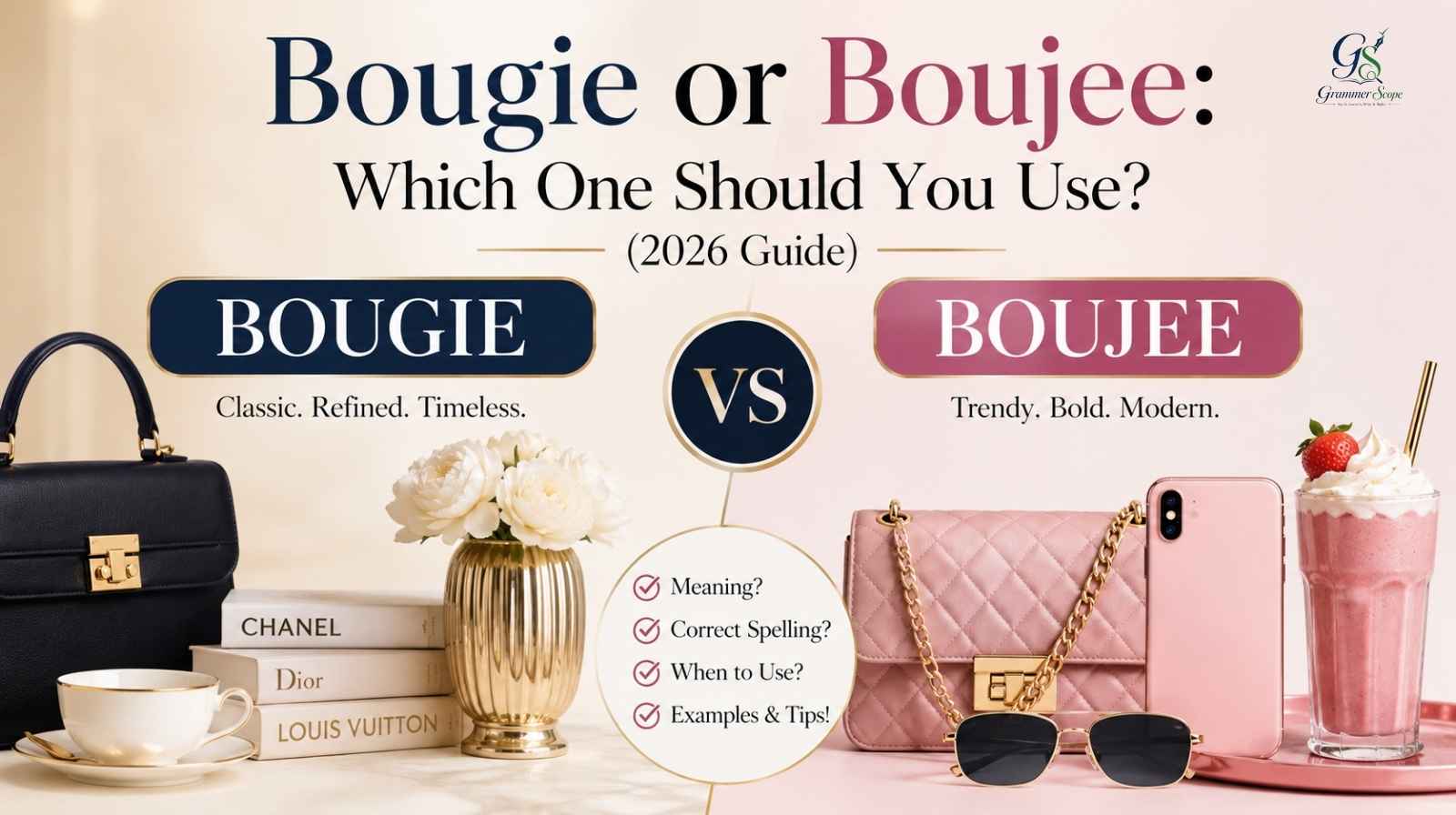
Have you ever seen someone describe a luxury handbag, an expensive brunch, or a stylish apartment as “bougie”, while someone else spells it “boujee”? If so, you’re not alone. These two spellings appear everywhere from TikTok captions and Instagram comments to song lyrics and everyday conversations.
The confusion comes from the fact that both words sound the same, but they don’t always serve the same purpose. Some people believe they’re interchangeable, while others insist one spelling is more accurate than the other.
The truth is more interesting than a simple spelling rule.
In this guide, you’ll learn what bougie or boujee mean, where they came from, whether they’re actually different, and which version you should use depending on your audience and context. By the end, you’ll be able to use both confidently without second-guessing yourself.
What Do Bougie and Boujee Mean?
Although bougie and boujee are often treated as the same word, their history and usage reveal subtle differences.
At their core, both terms describe someone or something that appears luxurious, stylish, expensive, or overly fancy. Depending on the situation, they can be either a compliment or playful criticism.
Bougie Meaning
Bougie is the older and more widely accepted spelling. It comes from the French word bourgeois, originally referring to the middle class. Over time, especially in American English, the meaning shifted.
Today, calling something bougie usually means it seems elegant, upscale, or a little extravagant.
Examples:
- That rooftop restaurant feels incredibly bougie.
- She only drinks imported sparkling water because she’s so bougie.
- Their living room has a very bougie design.
In many situations, the word is used humorously rather than seriously.
Boujee Meaning
Boujee is a newer spelling that became popular through internet culture, music, and social media. While it carries almost the same meaning as bougie, many people associate it with modern pop culture rather than traditional dictionaries.
You’ll often see boujee in captions, memes, hashtags, and song titles.
Examples:
- We’re feeling boujee tonight.
- That café looks so boujee.
- Weekend plans? Just being boujee.
Although many people recognize this spelling instantly, it is generally considered the more informal version.
Why Do People Get Confused?
The confusion exists because both words:
- Have the same pronunciation.
- Express similar ideas.
- Appear frequently online.
- Are accepted by different communities.
As a result, many writers wonder whether one is “correct” and the other is “wrong.” The answer depends more on context than grammar.
Bougie or Boujee: Which One Is Correct?
If you’re writing an article, school assignment, business content, or anything that values standard English, bougie is usually the better choice.
If you’re posting on social media, creating entertainment content, or matching current internet slang, boujee may feel more natural.
Here’s the simple answer.
| Situation | Best Choice |
|---|---|
| Formal writing | Bougie |
| Blogs and articles | Bougie |
| News writing | Bougie |
| Academic work | Bougie |
| Social media captions | Boujee or Bougie |
| Song lyrics | Usually Boujee |
| Casual conversations | Either works |
The important point is that neither spelling changes the overall meaning significantly. The difference lies mainly in style, audience, and tone.
Quick Answer
If you’re unsure which version to choose, use bougie.
It’s more widely recognized in dictionaries, style discussions, and professional writing while still sounding modern.
Is Boujee Wrong?
No.
It isn’t necessarily incorrect, but it’s considered a creative or pop-culture spelling rather than the traditional one.
Think of it as the difference between standard language and internet language.
For example:
- Formal article: “The restaurant has a bougie atmosphere.”
- Instagram caption: “Brunch with my boujee friends.”
Both sentences communicate the same idea, but the second matches a more casual, online audience.
Read More: It’s Called vs It Called: Understanding The Distinction
How to Pronounce Bougie and Boujee
Both bougie and boujee are pronounced exactly the same way in English.
Bougie and Boujee (BOO-zhee)
Despite the different spellings, there is no difference in pronunciation. Native English speakers use the same sound for both words.
Pronunciation Breakdown
| Word | Pronunciation | Sounds Like |
|---|---|---|
| Bougie | BOO-zhee | “Boo” + “zhee” |
| Boujee | BOO-zhee | “Boo” + “zhee” |
Common Pronunciation Mistakes
Many learners accidentally pronounce the words as:
- ❌ Boo-jee
- ❌ Bow-jee
- ❌ Boo-gie
- ❌ Boo-gee
The correct pronunciation is BOO-zhee, where the second syllable has a soft “zh” sound, similar to the middle sound in “measure” or “vision.”
Pronunciation Tip
If you’re unsure, remember this simple trick:
Think of “Boo” + “zhee” = BOO-zhee.
Once you learn the pronunciation, you can confidently use either spelling depending on the context.
The Origin and Evolution of Bougie
Understanding where the word comes from helps explain why both spellings exist today.
From Bourgeois to Bougie
The story begins with the French word bourgeois, which historically referred to members of the middle class.
Over time, English speakers shortened the pronunciation into bougie, especially within American slang. Instead of referring strictly to social class, the word gradually described people who enjoyed expensive tastes or appeared sophisticated.
Eventually, the meaning expanded even further.
Today, someone might be called bougie because they:
- Prefer luxury brands.
- Love gourmet coffee.
- Choose high-end restaurants.
- Decorate their home with premium furniture.
- Spend extra money on fashionable experiences.
The word often carries humor rather than criticism.
How Boujee Became Popular
The spelling boujee gained massive attention through social media and hip-hop culture during the late 2010s. As internet users adopted the term, it became a trendy alternative spelling that reflected pronunciation more closely.
Its popularity exploded after being used in viral music, memes, and online conversations, where expressive spellings are common.
Unlike traditional dictionaries, internet language evolves through repeated use rather than formal rules.
That’s why millions of people now recognize boujee, even though bougie remains the preferred spelling in most editorial writing.
Language Keeps Changing
Modern English changes rapidly because of digital communication.
Platforms like TikTok, Instagram, X, and YouTube introduce new expressions every year. Some disappear quickly, while others eventually become part of everyday vocabulary.
Bougie and boujee are excellent examples of how culture influences language.
Instead of viewing one spelling as completely right and the other as completely wrong, it’s more accurate to see them as different versions shaped by different communities and purposes.
Read More: Appreciate It or Appreciated It? The Ultimate Guide To Choosing The Right Phrase
When Should You Use Bougie?
Knowing the meaning is helpful, but knowing when to use the word is even more important.
In Professional Writing
If you’re writing for a broad audience, bougie is the safest option.
Examples include:
- Blog posts
- Magazine articles
- Marketing content
- News websites
- Educational resources
Because it’s the more established spelling, readers are less likely to question it.
In Everyday Conversation
In casual speech, either spelling works because listeners hear the pronunciation rather than see the spelling.
For example:
- “Their new apartment is so bougie.”
- “This coffee shop is kind of bougie.”
Most native speakers won’t notice any difference when spoken aloud.
In Social Media
Content creators often choose the spelling that matches their brand voice.
For example:
- Luxury influencer: “Living my boujee life.”
- Lifestyle blogger: “A surprisingly bougie café hidden downtown.”
Both feel natural depending on the tone you’re trying to create.
Read More: Amount or Ammount: Which Spelling Is Correct? (2026)
When Should You Use Boujee?
While bougie is the preferred choice for standard writing, boujee has earned its place in modern internet culture. It’s especially common when the goal is to sound trendy, playful, or conversational.
On Social Media
If you’re writing Instagram captions, TikTok posts, or X updates, boujee often feels more natural because it’s strongly associated with online slang.
Examples:
- “Feeling a little boujee after my spa day.”
- “Coffee in hand, matching outfit, and a boujee brunch.”
- “Weekend mood: staying boujee.”
The spelling fits the relaxed style of social platforms, where creative language is common.
In Music and Pop Culture
One reason boujee became so recognizable is its frequent appearance in hip-hop and pop culture. Song lyrics, entertainment blogs, and celebrity captions helped spread the spelling worldwide.
Because of this influence, many younger readers instantly associate boujee with confidence, luxury, and a fashionable lifestyle.
When Writing for Younger Audiences
If your audience is primarily Gen Z or active on social media, using boujee in informal content can feel authentic.
However, if you’re creating evergreen content, educational resources, or professional articles, bougie remains the safer option.
Read More: Tacet or Tacit: What’s The Difference And Which One Should You Use?
Bougie vs Boujee: Quick Comparison
| Feature | Bougie | Boujee |
|---|---|---|
| Meaning | Luxurious, fancy, upscale | Same meaning |
| Pronunciation | Boo-zhee | Boo-zhee |
| Origin | Shortened from bourgeois | Pop-culture spelling |
| Formal Writing | ✅ Recommended | ❌ Not recommended |
| Social Media | ✅ Common | ✅ Very common |
| Academic Writing | ✅ Yes | ❌ Avoid |
| Dictionaries | More widely recognized | Less commonly listed |
| Tone | Standard and modern | Trendy and informal |
Which One Should You Choose?
Choose bougie if you’re writing:
- Blog posts
- Business content
- School assignments
- News articles
- Professional emails
Choose boujee if you’re writing:
- Instagram captions
- TikTok videos
- Casual text messages
- Entertainment content
- Humorous posts
Read More: Dysregulated vs Disregulated: Correct Usage Explained
Bougie vs Boujee in Everyday Sentences
Understanding the difference becomes much easier when you see both words used in real-life situations.
Everyday Examples Using Bougie
- That new rooftop restaurant looks incredibly bougie.
- She loves shopping at luxury boutiques because she’s a little bougie.
- Their apartment has a bougie modern design.
- He ordered truffle fries because he was feeling bougie.
- Our vacation was surprisingly bougie for the price.
- The hotel lobby had a very bougie atmosphere.
- She decorated her office with bougie furniture.
- This coffee shop serves a bougie version of hot chocolate.
Everyday Examples Using Boujee
- We’re feeling boujee tonight, so let’s dress up.
- That brunch spot is so boujee!
- Living my boujee life one latte at a time.
- She posted another boujee vacation photo on Instagram.
- My friends love taking boujee selfies.
- Weekend plans? Staying boujee and relaxing.
- That outfit looks seriously boujee.
- This café is perfect for a boujee Instagram photo.
Which Version Sounds Better?
Here’s a simple rule to remember:
| If You’re Writing… | Best Choice |
|---|---|
| Blog posts | Bougie |
| School assignments | Bougie |
| Business writing | Bougie |
| Professional emails | Bougie |
| Instagram captions | Boujee |
| TikTok videos | Boujee |
| Casual texting | Either works |
Read More: Nominator vs Nominee: Key Differences Explained
Common Mistakes People Make
Many people use these words interchangeably without considering the audience or context. Here are a few mistakes to avoid.
Using Boujee in Formal Documents
While readers will probably understand the word, boujee may appear too informal in professional writing.
Better:
“The restaurant has a bougie atmosphere.”
Instead of:
“The restaurant has a boujee atmosphere.”
Assuming They Have Different Meanings
Some people believe bougie means “wealthy” while boujee means “fashionable.”
In reality, both words usually describe someone or something that seems luxurious, stylish, or high-end. The difference is mostly spelling and context.
Forgetting Your Audience
Always think about who’s reading your content.
- Teachers expect bougie.
- Friends may enjoy boujee.
- Search engines understand both, but evergreen educational content generally performs better with bougie as the primary spelling.
Read More: Carrer vs Career: The Correct Spelling Explained
Real-Life Example: How One Blogger Increased Reader Trust
A lifestyle blogger published an article reviewing upscale coffee shops. Throughout the article, the writer repeatedly used boujee because it matched the trendy tone of social media.
Although the article attracted visitors from Instagram, readers arriving from Google searches left comments asking whether boujee was the correct spelling. Some even assumed it was a typo. This created unnecessary confusion and slightly reduced the article’s credibility among readers looking for a clear language explanation.
The blogger later updated the post by replacing most instances of boujee with bougie while keeping boujee in examples discussing slang and pop culture. They also added a short section explaining why both spellings exist and when each is appropriate.
After the update, readers spent more time on the page because their questions were answered directly. The article also earned backlinks from language-focused websites that appreciated the balanced explanation. The lesson is simple: using the standard spelling for educational content builds trust, while acknowledging the informal spelling helps readers understand modern usage without feeling misled.
Read More: Suing or Sueing: Which Spelling Is Correct?
Language Trends and Usage (2025–2026)
Language continues to evolve through online communication, and bougie and boujee are excellent examples of this trend.
Recent language resources and search trend observations show:
- Bougie remains the preferred spelling in dictionaries, editorial style discussions, and educational content.
- Boujee continues to thrive on social media platforms, especially in lifestyle, fashion, and entertainment posts.
- Search engines recognize both spellings and often display results that explain their relationship.
- People increasingly search comparison-style questions such as “bougie vs boujee” and “is boujee a real word?”, indicating growing curiosity about modern slang.
- Content that clearly explains the origin, meaning, and proper context for both spellings is more likely to satisfy search intent and earn featured snippets.
Rather than competing, the two spellings now coexist, with each serving a slightly different audience and purpose.
Expert Tips for Using Bougie and Boujee

Match the Tone to Your Audience
Professional readers generally expect bougie, while casual online audiences may appreciate boujee.
Prioritize Clarity
If there’s any chance your readers could misunderstand the spelling, choose bougie and briefly explain that boujee is an informal alternative.
Avoid Overusing Either Word
Like any slang term, repeating it too often can make your writing feel forced. Use it only when it genuinely adds meaning.
Stay Updated
Internet slang evolves quickly. Words that are trendy today may fade over time, so check trusted language resources when writing evergreen content.
Read More: Commit vs Comit: Correct Spelling And Usage Guide
Mini Quiz: Bougie or Boujee
Quiz 1: Which Spelling Is Better for Formal Writing?
Question: Which spelling is generally preferred in professional and formal writing?
A. Boujee
B. Bougie
C. Both are equally preferred
D. Neither
Answer: ✅ B. Bougie
Quiz 2: Fill in the Blank
Question: The word __________ is the more traditional spelling used in articles and educational writing.
Answer: ✅ Bougie
Quiz 3: True or False
Question: “Boujee” is commonly seen on social media and in pop culture.
Answer: ✅ True
Quiz 4: Which Sentence Sounds More Professional?
Question: Choose the better sentence for a business blog.
A. Our hotel offers a boujee experience.
B. Our hotel offers a bougie experience.
Answer: ✅ B. Our hotel offers a bougie experience.
Quiz 5: Fill in the Blank
Question: Both bougie and __________ are pronounced the same way.
Answer: ✅ Boujee
Quiz 6: What Does “Bougie” Usually Mean?
Question: Which meaning is the closest?
A. Old-fashioned
B. Luxurious or fancy
C. Boring
D. Difficult
Answer: ✅ B. Luxurious or fancy
Quiz 7: Spot the Best Choice
Question: You’re writing an Instagram caption. Which spelling feels more natural?
A. Bougie
B. Boujee
Answer: ✅ B. Boujee
Quiz 8: Fill in the Blank
Question: If you’re writing a school essay, it’s usually safer to use __________.
Answer: ✅ Bougie
Quiz 9: True or False
Question: Bougie and Boujee have completely different meanings.
Answer: ❌ False — They generally have the same meaning but are used in different contexts.
Quiz 10: Finish the Sentence
Question: “That rooftop restaurant looks so __________.”
A. Bougie
B. Boujee
C. Either A or B
Answer: ✅ C. Either A or B (Both work in casual conversation.)
Quiz 11: Fill in the Blank
Question: The word bougie comes from the French word __________.
Answer: ✅ Bourgeois
Quiz 12: Quick Choice
Question: Which spelling is more common in dictionaries?
A. Boujee
B. Bougie
Answer: ✅ B. Bougie
Quiz 13: Who Would Most Likely Use “Boujee”?
Question: Pick the best answer.
A. A university professor writing a research paper
B. Someone posting a TikTok video
C. A legal writer
D. A newspaper editor
Answer: ✅ B. Someone posting a TikTok video
Quiz 14: Fill in the Blank
Question: Social media has helped make __________ a popular modern spelling.
Answer: ✅ Boujee
Quiz 15: Choose the Correct Statement
Question: Which statement is correct?
A. Bougie and Boujee are pronounced differently.
B. Bougie is usually preferred for formal writing.
C. Boujee is the only correct spelling.
D. Neither word is used today.
Answer: ✅ B. Bougie is usually preferred for formal writing.
Quiz 16: Final Challenge
Question: You’re writing a grammar guide for thousands of readers. Which spelling should you use most often?
A. Boujee
B. Bougie
C. Both equally in every sentence
Answer: ✅ B. Bougie
References
- Merriam-Webster Dictionary – Entry and discussion of bourgeois and related language history: https://www.merriam-webster.com/
- Cambridge Dictionary – Definitions and guidance for modern English vocabulary: https://dictionary.cambridge.org/
Frequently Asked Questions
Q1: Is bougie or boujee the correct spelling?
A: Bougie is the preferred spelling for standard English and professional writing. Boujee is an informal spelling commonly used in social media and pop culture.
Q2: Do bougie and boujee mean the same thing?
A: Yes. Both generally describe someone or something that appears luxurious, stylish, or expensive. The difference lies mainly in tone and context.
Q3: Is boujee a real word?
A: While boujee may not appear as consistently in traditional dictionaries as bougie, it is widely recognized as a modern slang spelling used in everyday online communication.
Q4: Why do people say boujee instead of bougie?
A: The spelling became popular through music, internet culture, and social media. Many people prefer it because it reflects pronunciation and feels more expressive.
Q5: Should I use bougie in professional writing?
A: Yes. If you’re writing articles, reports, marketing copy, or academic work, bougie is generally the better choice.
Q6: Can I use boujee on Instagram or TikTok?
A: Absolutely. Boujee fits naturally in casual captions, memes, and entertainment-focused content where informal language is expected.
Conclusion
So, bougie or boujee: which one should you use?
The answer depends on your audience and purpose.
If you’re creating professional, educational, or evergreen content, bougie is the best choice because it’s the more established and widely recognized spelling. If you’re posting on social media or embracing modern internet slang, boujee works perfectly in informal settings.
Understanding the difference isn’t about memorizing strict grammar rules it’s about choosing the version that fits your readers and your message. By using each spelling in the right context, you’ll communicate more clearly while staying current with how English continues to evolve.
Discover More Articles
- Other Than or Other Then: Which Spelling Is Right?
- Transferred vs Transfered: Which Is Correct?
- Submission vs Submittion: Learn The Correct Spelling
Ready to improve your English? Read more guides on Grammer Scope

Bilal Khalid is a professional blogger specializing in grammar guides and practical writing tips. He helps readers improve clarity, accuracy, and confidence in communication through simple explanations, actionable advice, and easy-to-follow strategies for everyday and professional writing.