Many English learners and even native speakers get confused between “suing” and “sueing.” Since the base word is “sue,” people naturally assume adding “-ing” should create “sueing.” However, English spelling rules do not always work that way.
If you have ever typed “I am sueing someone” and wondered whether it was correct, you are not alone. This spelling mistake appears frequently in emails, legal discussions, academic writing, and social media posts.
The good news is that the rule is simple once you understand it. In this guide, you will learn the correct spelling, why the mistake happens, grammar rules, examples, pronunciation tips, and how to avoid this common error in everyday writing.
What Is the Correct Spelling: Suing or Sueing?
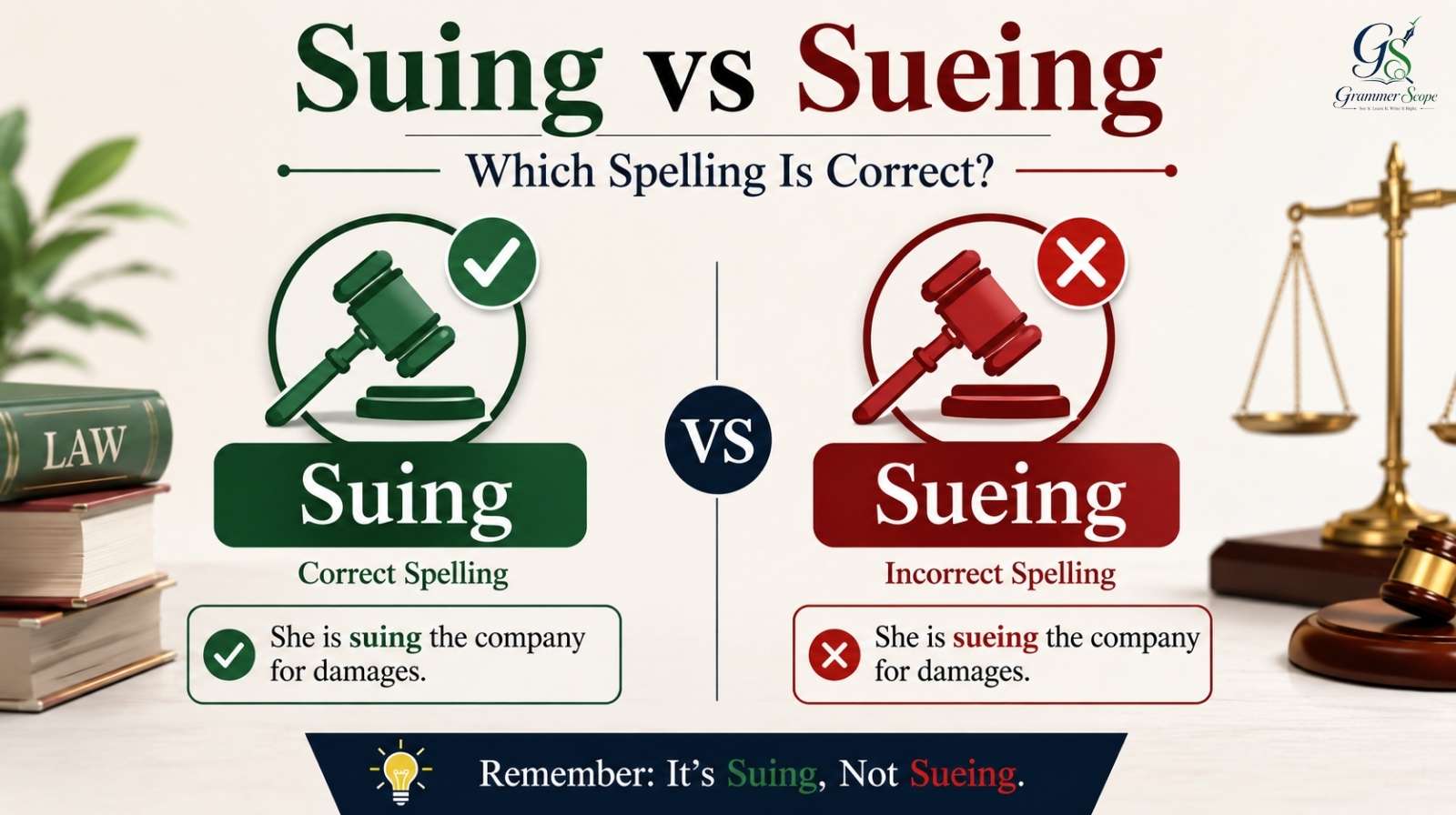
The correct spelling is suing.
❌ Sueing — Incorrect
✅ Suing — Correct
The word “suing” is the present participle and gerund form of the verb “sue.”
Meaning of “Sue”
To sue means to take legal action against a person or organization in court.
Examples of Correct Usage
- She is suing the company for damages.
- They are suing their landlord over unsafe conditions.
- He considered suing after the accident.
Incorrect Examples
- ❌ She is sueing the company.
- ❌ They talked about sueing the hospital.
Even though “sueing” may look logical, it is not accepted in standard English grammar.
Read More: Pre vs Post: Correct Usage & Meaning Guide 2026
Why “Sueing” Looks Correct but Isn’t
The confusion comes from normal English spelling patterns. In many verbs ending with “e,” we usually remove the “e” before adding “-ing.”
For example:
| Base Verb | Correct -ing Form |
|---|---|
| Make | Making |
| Write | Writing |
| Drive | Driving |
| Sue | Suing |
When forming “suing,” the silent “e” is dropped before adding “-ing.”
The Grammar Rule Behind It
Most English verbs ending in silent “e” follow this rule:
Remove the final “e” before adding “-ing.”
Therefore:
- Sue → Suing
- Dance → Dancing
- Smile → Smiling
However, English learners often keep the “e” because the pronunciation of “sue” feels different from other words.
Why People Commonly Type “Sueing”
Several reasons explain this spelling mistake:
Pronunciation Confusion:
The word “sue” has a long vowel sound. Because of this, writers sometimes think the “e” must remain.
Auto-Correction Errors:
Some devices fail to recognize context and may not immediately flag “sueing.”
Lack of Familiarity With Legal Terms:
People who rarely encounter legal vocabulary may guess the spelling instead of confirming it.
Suing Meaning in Legal English
The word “suing” is heavily connected with law and legal disputes. It commonly appears in courts, contracts, news reports, and business conflicts.
Common Legal Situations Involving Suing
People may sue because of:
- Personal injury
- Breach of contract
- Defamation
- Property disputes
- Workplace discrimination
- Medical malpractice
Example Sentences in Legal Context
- The employee is suing the company for unfair dismissal.
- Several customers are suing the manufacturer after the product recall.
- The actor denied rumors about suing the newspaper.
Difference Between “Sue” and “Suing”
| Word | Function | Example |
|---|---|---|
| Sue | Base verb | I may sue them. |
| Suing | Present participle/gerund | She is suing them. |
Understanding this distinction improves both spoken and written English accuracy.
Read More: Hustle or Hussle: Which Spelling Is Correct?
Real-Life Example: A Costly Spelling Mistake in Professional Writing
In 2025, a freelance content writer shared an experience on a professional writing forum about a legal article submitted to a client. The article repeatedly used the word “sueing” instead of “suing.” Although the rest of the content was accurate, the client rejected the work immediately because spelling errors in legal writing reduce credibility.
The writer explained that the mistake happened because spell-check software failed to highlight every occurrence. As a result, the article appeared unprofessional despite having valuable information.
This situation demonstrates an important lesson: even small grammar mistakes can affect trust, authority, and search rankings. Readers expect legal and educational content to be polished and accurate.
Professional editors often say spelling accuracy influences how readers judge expertise. Therefore, bloggers, students, lawyers, and business writers should always verify confusing English words before publishing content online.
Today, many SEO experts also emphasize that clear, error-free writing improves user experience signals, which may indirectly support better search visibility.
Suing vs Sueing: Quick Comparison Table
| Feature | Suing | Sueing |
|---|---|---|
| Correct spelling | ✅ Yes | ❌ No |
| Accepted in dictionaries | ✅ Yes | ❌ No |
| Used in legal English | ✅ Yes | ❌ No |
| Grammatically correct | ✅ Yes | ❌ No |
| Common mistake | ❌ No | ✅ Yes |
This is the simplest way to remember the difference:
“Suing” follows the standard English rule of dropping silent “e” before adding “-ing.”
Common Grammar Rules for Words Ending in “E”
Learning the broader grammar pattern helps prevent similar spelling mistakes in the future.
Rule 1: Drop Silent “E” Before “-ing”
| Verb | Correct Form |
|---|---|
| Bake | Baking |
| Move | Moving |
| Use | Using |
| Sue | Suing |
Rule 2: Keep “E” if Needed for Pronunciation
Some words keep the “e” to maintain pronunciation clarity.
Examples:
- Age → Ageing (British English variation)
- Dye → Dyeing
Important Exception: Dyeing vs Dying
This is one reason people become confused about “suing.”
- Dyeing = coloring fabric or hair
- Dying = approaching death
Because “dyeing” keeps the “e,” some writers incorrectly assume “sueing” should also keep it. However, “suing” does not follow that exception.
Read More: Challenge or Challange: Which Is Correct? (2026 Guide)
Statistics and Language Trends (2025–2026)
Search interest in grammar corrections continues to grow rapidly. According to recent language-learning and SEO trend reports from 2025:
- Grammar-related searches increased significantly due to AI-generated content editing.
- Common spelling comparison searches such as “suing vs sueing” gained higher monthly search volume.
- Educational publishers reported increased demand for simple grammar explanations and writing guides.
Additionally, writing platforms and proofreading tools continue to identify spelling mistakes as one of the top issues in online publishing.
According to data from reputable writing resources and educational platforms:
- Spelling mistakes reduce perceived content trustworthiness.
- Readers are more likely to leave pages containing visible grammar errors.
- Clear grammar improves readability and user engagement.
These trends show why accurate spelling matters not only for communication but also for SEO performance and online credibility.
Credible References
How to Remember the Correct Spelling Easily
If you frequently forget whether it is “suing” or “sueing,” these memory tricks can help.
Think of Similar Verbs
- Use → Using
- Move → Moving
- Sue → Suing
Notice how the silent “e” disappears.
Remember the Core Rule
Drop the silent “e” before adding “-ing.”
Read the Word Out Loud
“Sueing” often looks awkward when spoken naturally. “Suing” feels smoother and matches standard pronunciation.
Use Spell-Checking Tools Carefully
Grammar tools help, but they are not perfect. Always proofread legal or professional documents manually.
Common Mistakes Writers Make With “Suing”
Even experienced writers occasionally misuse this word.
Mistake #1: Keeping the “E”
❌ Sueing
✅ Suing
Mistake #2: Using Wrong Verb Tense
❌ He sue yesterday.
✅ He sued yesterday.
Mistake #3: Confusing “Sue” With “Sew”
Because of pronunciation similarities, some learners mix up:
- Sue = legal action
- Sew = stitching fabric
Context is important.
Read More: Vendor or Vender: Which Is Correct In 2026?
Mini Quiz: Suing or Sueing?
1. Which spelling is correct?
A) Sueing
B) Suing
Answer: B) Suing ✅
2. Fill in the blank:
She is ______ the company for damages.
Answer: suing ✅
3. True or False:
“Sueing” is correct English spelling.
Answer: False ❌
4. Which word means taking legal action?
A) Sewing
B) Suing
C) Singing
Answer: B) Suing ✅
5. Fill in the blank:
The lawyer suggested ______ the landlord.
Answer: suing ✅
6. What happens to the silent “e” in “sue” before adding “-ing”?
A) It stays
B) It disappears
C) It doubles
Answer: B) It disappears ✅
7. Spot the correct sentence:
A) He is sueing his employer.
B) He is suing his employer.
Answer: B) He is suing his employer. ✅
8. Fill in the blank:
Many customers are ______ the company after the recall.
Answer: suing ✅
9. Which is NOT correct?
A) Suing
B) Sueing
Answer: B) Sueing ❌
10. True or False:
“Suing” follows a common English spelling rule.
Answer: True ✅
11. Sue → ______
Answer: Suing ✅
12. The actor talked about ______ the newspaper.
Answer: suing ✅
13. Remove the silent “__” before adding “-ing.”
Answer: e ✅
14. “Suing” is commonly used in ______ language.
Answer: legal ✅
15. Correct spelling: S_u_i_n_g
Answer: Suing ✅
Frequently Asked Questions
Q1: Is “Sueing” Ever Correct?
A: No. “Sueing” is considered incorrect in both American and British English.
Q2: Why Is It “Suing” Instead of “Sueing”?
A: Because English grammar usually removes the silent “e” before adding “-ing.”
Q3: What Does “Suing” Mean?
A: “Suing” means taking legal action against someone in court.
Q4: How Do You Spell “Sue” in Present Tense?
- Base form: Sue
- Present participle: Suing
- Past tense: Sued
Q5: Is “Suing” a Legal Term?
A: Yes. It is commonly used in legal, business, and formal writing.
Q6: Why Do People Misspell “Suing”?
A: Most people assume the “e” should remain because the base word ends with “e.”
Q7: Is “Suing” Used in Everyday English?
A: Yes. It appears in conversations, news articles, legal reports, and social media discussions.
Conclusion
The correct spelling is always “suing,” not “sueing.” Although the incorrect version may appear logical at first glance, English grammar rules require dropping the silent “e” before adding “-ing.”
Understanding this simple rule can help you avoid spelling mistakes in professional writing, academic work, legal discussions, and online content. Moreover, accurate grammar improves credibility, readability, and SEO performance.
Whenever you feel unsure, remember this quick formula:
Sue → Suing
By mastering small grammar details like this, your writing becomes clearer, more trustworthy, and more professional.
Ready to improve your English? Read more guides on Grammer Scope