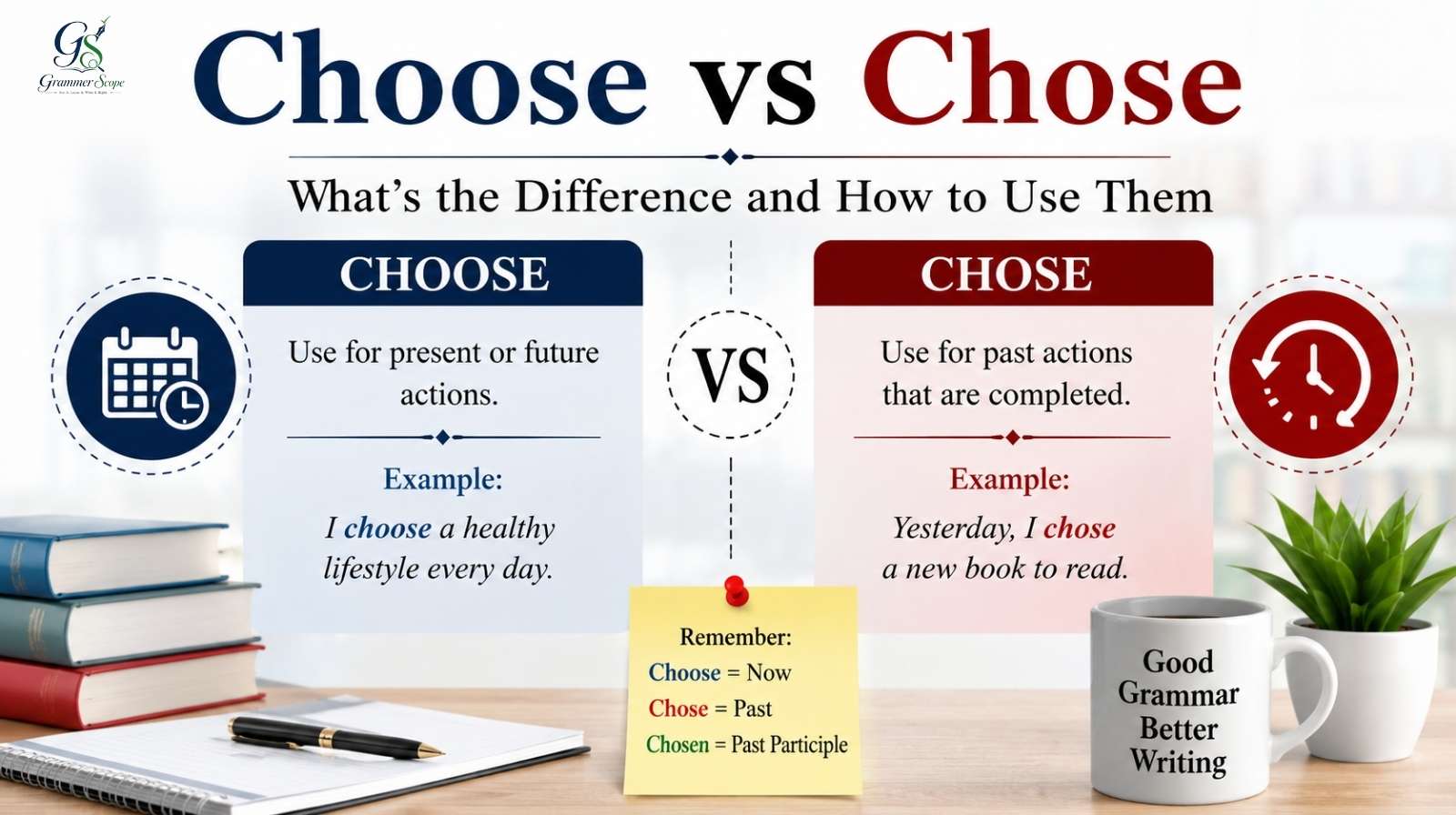
Have you ever paused while writing a sentence and wondered, “Should I use choose or chose?” You are not alone. Because these two words look almost identical and come from the same verb, they are easy to confuse. However, the difference is actually simple once you understand when the action happens.
The main rule is this: choose is generally used for the present or future, while chose is used for the past.
For example:
- I need to choose a new laptop today.
- Yesterday, I chose a new laptop.
One small letter changes the verb tense and, therefore, changes the meaning of the sentence. This guide explains the Choose vs Chose difference in simple English, with grammar rules, real examples, memory tricks, common mistakes, and practical guidance you can use in everyday writing.
Choose vs Chose: The Quick Answer
If you want the shortest possible answer, remember this:
Choose = present tense or the base form
Chose = simple past tense
The verb choose means to select, decide on, or pick from two or more options. Cambridge Dictionary lists its main verb forms as choose, chose, and chosen. In other words, chose is the past form, while chosen is normally the past participle.
Use Choose When the Action Is Present or Future
Use choose when someone is making a decision now, makes decisions regularly, or will make a decision later.
Examples:
- Please choose a seat.
- I always choose coffee in the morning.
- You can choose whichever option you prefer.
- Tomorrow, we will choose the winner.
- Which dress do you want to choose?
The decision has not been placed in a finished past time. Therefore, choose is the correct form.
Use Chose When the Action Happened in the Past
Use chose when the act of selecting or deciding happened and was completed in the past.
Examples:
- I chose the blue shirt yesterday.
- She chose to study abroad last year.
- We chose a different route.
- They chose the cheaper option.
- He chose not to attend the meeting.
Words such as yesterday, last week, earlier, in 2025, when I was younger, and other finished time references often signal that chose may be needed.
The One-Line Rule to Remember
Ask yourself:
Is the choosing happening now or later? Use choose. Did the choosing already happen? Use chose.
That simple question solves most choose vs chose mistakes.
Read More: Trailer or Trailor: Which Spelling Is Correct?
What Does “Choose” Mean and When Should You Use It?
Choose is a verb that means to select something, decide between options, or prefer one possibility over another.
For example, if you have five shirts and decide which one to wear, you choose one. If you have several career paths and decide which path to follow, you choose a career.
Cambridge defines choose as deciding which one of several things you want and taking action based on that decision.
Choose as the Present Tense
The most common use of choose is for a present action or a general habit.
Examples:
- I choose my words carefully.
- They choose healthy meals.
- We choose quality over speed.
- You choose what happens next.
These sentences describe something happening now or something that happens generally.
Compare:
- Every morning, I choose tea.
- Yesterday morning, I chose tea.
The first sentence describes a habit. The second describes one completed decision in the past.
Choose After “To”
Another important grammar pattern is to choose.
Examples:
- I want to choose carefully.
- She needs to choose a topic.
- We decided to choose the safer option.
- He hopes to choose a new apartment soon.
After to, use the base form choose, not chose.
Incorrect:
- I want to chose a new phone.
Correct:
- I want to choose a new phone.
This is one of the easiest places to make a grammar mistake because the sentence may refer to the future. However, the grammar rule is based on the structure to + base verb.
Choose After Modal Verbs
You also use choose after modal verbs such as:
- can
- could
- should
- would
- may
- might
- must
- will
Examples:
- You can choose any color.
- We should choose carefully.
- She might choose another option.
- They will choose the winner tomorrow.
- You must choose one answer.
Incorrect:
- You can chose any color.
Correct:
- You can choose any color.
The reason is simple: modal verbs are followed by the base form of the verb.
What Does “Chose” Mean and When Should You Use It?
Chose is the simple past tense of choose. It tells readers that a decision, selection, or preference happened at an earlier time and is complete.
Cambridge Dictionary identifies chose as the past simple form of choose, while Dictionary.com likewise explains that chose is the simple past tense of the verb.
Chose Describes a Finished Decision
Look at these examples:
- I chose this university three years ago.
- She chose the red dress yesterday.
- We chose to stay home last night.
- They chose a new manager.
- He chose the wrong answer.
In every example, the decision happened in the past.
You can often test the sentence by adding a finished time expression:
- Yesterday, I chose…
- Last year, she chose…
- Earlier, we chose…
- In the end, they chose…
If the action clearly belongs to a completed time in the past, chose is usually the right answer.
Chose Is Not Used After “Did”
A very common mistake is writing did chose.
Incorrect:
- I did chose the first option.
Correct:
- I did choose the first option.
Why? Because did already marks the sentence as past tense. The main verb returns to its base form.
The same rule applies to questions:
Incorrect:
- Did you chose the restaurant?
Correct:
- Did you choose the restaurant?
Think of it this way: did carries the past tense, so choose does not need to become chose.
Chose Is an Irregular Past-Tense Form
Many English verbs form the past tense by adding -ed:
- walk → walked
- play → played
- decide → decided
However, choose is an irregular verb. Its forms change differently:
choose → chose → chosen
This is why choosed is incorrect in standard English.
Dictionary.com notes that choose changes form rather than following the usual -ed pattern, just like other irregular verbs.
Examples:
- Today, I choose.
- Yesterday, I chose.
- I have chosen.
Understanding all three forms makes the Choose vs Chose difference much easier.
Read More: Suing or Sueing: Which Spelling Is Correct?
Choose, Chose, and Chosen: Understanding All Three Verb Forms
The confusion does not always stop with choose and chose. Many writers also wonder when to use chosen.
The easiest way to learn the verb is to see all three major forms together.
| Verb Form | Word | Main Use | Example |
|---|---|---|---|
| Base/Present | Choose | Present, future, infinitive | I choose carefully. |
| Simple Past | Chose | Completed past action | I chose carefully yesterday. |
| Past Participle | Chosen | Usually with have, has, had, or be | I have chosen carefully. |
Cambridge lists the forms as choose – chose – chosen, confirming the standard verb pattern used in modern English.
Choose: Present or Base Form
Use choose in structures such as:
- I choose…
- We choose…
- Please choose…
- To choose…
- Can you choose…?
- Will they choose…?
Examples:
- Please choose your answer.
- I want to choose wisely.
- Can we choose later?
- They will choose a winner tomorrow.
Chose: Simple Past Form
Use chose for a completed past decision.
Examples:
- I chose the first answer.
- She chose a different path.
- We chose this hotel last summer.
- They chose not to respond.
Notice that chose can stand as the main past-tense verb by itself.
Chosen: Past Participle
Use chosen most often with have, has, had, or forms of be.
Examples:
- I have chosen my topic.
- She has chosen a new career.
- We had chosen the venue before the event.
- He was chosen as captain.
- They were chosen for the project.
Incorrect:
- I have chose my answer.
Correct:
- I have chosen my answer.
This distinction matters because chose and chosen are not interchangeable.
A useful pattern is:
Yesterday, I chose.
I have chosen.
Read More: Commit vs Comit: Correct Spelling And Usage Guide
How to Decide Between Choose and Chose Every Time
When you are writing quickly, you may not have time to think about complex grammar rules. Fortunately, you can use a simple step-by-step method.
Step 1: Find the Action
First, identify the action of selecting or deciding.
For example:
- Sarah ___ the best option.
The missing word represents the act of making a decision.
Step 2: Ask When the Action Happened
Now ask:
Did Sarah make the decision in the past, or is she making it now?
If the sentence is:
- Sarah ___ the best option yesterday.
The word yesterday shows that the action happened in the past.
Therefore:
- Sarah chose the best option yesterday.
If the sentence is:
- Sarah wants to ___ the best option.
The phrase to requires the base verb.
Therefore:
- Sarah wants to choose the best option.
Step 3: Look for Grammar Signals
Certain words and structures can help.
Signals that often point to choose
- to choose
- can choose
- should choose
- will choose
- want to choose
- need to choose
- please choose
- usually choose
- always choose
Examples:
- You should choose carefully.
- I need to choose a password.
- We will choose tomorrow.
Signals that often point to chose
- yesterday
- last night
- last year
- earlier
- previously
- when I was…
- in the end
- at that time
Examples:
- Yesterday, I chose the blue one.
- We chose that option last year.
- In the end, she chose to leave.
These signals are helpful, although context should always determine the final answer.
Step 4: Check for “Did”
If the sentence uses did, use choose.
- Did you choose already?
- I did choose carefully.
Never write:
- Did you chose already?
Step 5: Check for Have, Has, or Had
If you see have, has, or had, you will usually need chosen, not choose or chose.
- I have chosen.
- She has chosen.
- We had chosen.
This quick process helps you select the correct form without guessing.
Read More: Submission vs Submittion: Learn The Correct Spelling
Choose vs Chose Examples in Real Sentences
Learning grammar through real examples is often easier than memorizing definitions. Here are common situations where the difference becomes clear.
At School
Present:
- Students can choose their research topics.
Past:
- Last semester, the students chose their research topics.
The first sentence discusses a current ability or general rule. The second describes a completed action.
At Work
Present:
- We need to choose a new marketing strategy.
Past:
- We chose a new marketing strategy during Monday’s meeting.
The phrase need to takes the base form choose, while the finished meeting places the second action in the past.
While Shopping
Present:
- Please choose the size you want.
Past:
- She chose a larger size yesterday.
Again, the difference is based on time.
Making Future Plans
Present/Future:
- They will choose a destination next month.
Past:
- They chose a destination last month.
The word will is followed by choose. The finished time expression last month requires chose.
In Everyday Conversation
- You can choose whatever you like.
- Why did you choose that one?
- I chose it because it was cheaper.
- We have chosen a different option.
Seeing all four forms together can be particularly helpful:
choose → chose → chosen
Read More: Transferred vs Transfered: Which Is Correct?
Common Choose vs Chose Mistakes and How to Fix Them
Although the rule is straightforward, certain sentence patterns repeatedly cause confusion.
Mistake 1: Using “Chose” for the Present
Incorrect:
- I chose what to wear every morning.
Correct:
- I choose what to wear every morning.
Why? The sentence describes a regular habit, so use the present tense.
Mistake 2: Using “Choose” for a Completed Past Action
Incorrect:
- Yesterday, I choose the black shoes.
Correct:
- Yesterday, I chose the black shoes.
The word yesterday clearly places the action in the past.
Mistake 3: Writing “To Chose”
Incorrect:
- I want to chose a better option.
Correct:
- I want to choose a better option.
After to, use the base form.
Mistake 4: Writing “Did Chose”
Incorrect:
- Did she chose the winner?
Correct:
- Did she choose the winner?
The auxiliary verb did already marks the sentence as past.
Mistake 5: Writing “Have Chose”
Incorrect:
- We have chose our destination.
Correct:
- We have chosen our destination.
After have, use the past participle chosen.
Mistake 6: Using “Choosed”
Incorrect:
- I choosed the red one.
Correct:
- I chose the red one.
Choose is an irregular verb, so its simple past form is chose, not choosed.
A Real-Life Writing Example: How One Small Verb Changed the Meaning
Imagine a university student named Daniel writing an email to his professor about a research project.
He wants to explain two things: first, that he has already made a decision about his topic; second, that his classmates still need to make their own decisions.
His first draft says:
“I choose my topic last week, but the other students still have time to chose theirs.”
Although the meaning is understandable, both verb forms are incorrect.
The first part refers to last week, which is a completed time in the past. Daniel should write chose:
“I chose my topic last week…”
The second part follows to, so it requires the base form choose:
“…but the other students still have time to choose theirs.”
The corrected sentence is:
“I chose my topic last week, but the other students still have time to choose theirs.”
Now consider one more sentence:
“I have chose a topic that focuses on climate policy.”
This also needs correction. The phrase have requires the past participle, so the correct form is:
“I have chosen a topic that focuses on climate policy.”
This real-world example shows why learning only “choose is present and chose is past” is useful but not always enough. You also need to recognize common grammar structures. To choose, did choose, and have chosen each follow different patterns. Once you understand the full verb sequence choose, chose, chosen writing emails, essays, reports, and professional messages becomes much easier.
Read More: Other Than or Other Then: Which Spelling Is Right?
Why Choose vs Chose Still Matters in Modern English
You may wonder whether a one-letter grammar difference really matters in 2026. In casual conversation, listeners often understand the intended meaning from context. However, in written English, correct verb tense helps readers understand exactly when an action occurred.
For example, compare:
- We choose our suppliers carefully.
- We chose our suppliers carefully.
The first can describe an ongoing business practice. The second describes a completed decision in the past. The change is small, but the time meaning is different.
Recent English-language grammar resources continue to identify this pair as a common source of confusion. A 2025 guide from LanguageTool, revised in 2026, specifically explains that choose refers to present-time usage while chose refers to a past action, showing that this remains an active grammar question for modern writers and learners.
A Useful 2025–2026 Data Perspective
There is no universal official count showing exactly how many people confuse choose and chose every year. Therefore, it would be misleading to invent a percentage.
However, current language resources published or updated in 2025 and 2026 continue to create dedicated explanations for this exact grammar problem. LanguageTool published its guide in 2025 and revised it in March 2026, while other grammar resources also published updated explanations during 2026. This continued publication suggests that verb-tense confusion around this word pair remains relevant to English learners and writers.
The practical lesson is clear: even a familiar word can cause problems when writers focus on spelling similarity instead of verb tense.
Why Correct Verb Tense Builds Clarity
Correct grammar is not simply about following rules for their own sake. Verb tense gives readers important information.
Compare:
- I choose based on quality.
- I chose based on quality.
The first sentence may describe your current approach or general habit.
The second says the decision is already finished.
Therefore, choosing the correct verb form improves clarity, accuracy, and professionalism.
Read More: Striping vs Stripping: Meaning, Grammar And Usage Guide
Easy Memory Tricks for Choose and Chose
Sometimes grammar rules are easy to understand but difficult to remember while writing. These memory tricks can help.
Remember the “OO” in Choose
Choose has two O’s:
chOOse
Think of the double OO as a reminder that the choice is still open.
You can use this idea:
The options are still open → choose.
For example:
- You can still choose.
- I need to choose.
- We will choose later.
This is not an official grammar rule, of course, but memory associations can make the correct form easier to recall.
Remember: Chose Has Already Closed the Decision
You can think of chose as representing a decision that is already finished.
The choice is no longer happening. It happened before.
- Yesterday, I chose.
- Earlier, she chose.
- Last year, they chose.
So remember:
Action still happening or possible → choose
Action completed in the past → chose
Use the Verb Pattern
Memorize this three-word sequence:
Choose – Chose – Chosen
Say it aloud several times:
- Today I choose.
- Yesterday I chose.
- I have chosen.
This pattern works much better than trying to memorize each word separately.
Use a Time Test
Before choosing between the two words, ask:
Can I naturally add “yesterday”?
If yes:
- Yesterday, I chose.
If the action is happening now:
- Now, I choose.
This quick test is especially useful when proofreading.
Read More: Goodmorning or Good Morning: Which One Is Correct?
Choose vs Chose Pronunciation
The spelling difference also matches a pronunciation difference.
How to Pronounce “Choose”
Choose is pronounced approximately like:
/tʃuːz/
It rhymes with:
- lose
- shoes
- news
Example:
I choose the blue shoes.
How to Pronounce “Chose”
Chose is pronounced approximately like:
/tʃoʊz/ in American English.
It rhymes with:
- rose
- nose
- goes
Example:
Yesterday, I chose the blue shoes.
The pronunciation changes because the tense changes.
This can be useful when speaking because saying the words correctly reinforces their different grammatical roles.
Choose vs Chose: Quick Comparison Table
Here is the easiest reference guide to save for future use.
| Feature | Choose | Chose |
|---|---|---|
| Verb form | Base/present form | Simple past tense |
| Main time | Present, general, or future | Completed past |
| Example | I choose carefully. | I chose carefully yesterday. |
| After “to” | Yes: to choose | No |
| After modal verbs | Yes: can choose | No |
| After “did” | Yes: did choose | No |
| With yesterday/last week | Usually no | Usually yes |
| Past participle | No | No—use chosen |
| Related form | choose | choose → chose → chosen |
The most important point is that both words are correct. The question is not which word is better. The question is which verb tense your sentence requires.
Read More: Lable or Label: Which Spelling Is Correct?
When Should You Use “Choose” or “Chose” in Formal Writing?
The grammar rules are exactly the same in formal and informal English. Whether you are writing a school essay, job application, business email, blog post, or academic paper, use the form that matches the time of the action.
In Professional Emails
Present or future:
- Please choose a suitable meeting time.
- We will choose the final candidate next week.
Past:
- The team chose a suitable meeting time yesterday.
- We chose the final candidate last Friday.
In Academic Writing
Present/general:
- Researchers choose methods based on the study design.
Past:
- The researchers chose a qualitative approach for the study.
In Business Writing
Present:
- Customers can choose from several plans.
Past:
- The company chose a new software provider in June.
Clear tense helps formal writing sound more precise and trustworthy.
Read More: As Well or Aswell – Which One Is Correct?
Mini Quiz: Choose vs Chose
Quiz 1. Fill in the Blank: Pick the Correct Word
Yesterday, I ______ the blue dress.
A) choose
B) chose
Answer: B) chose — The action happened yesterday, so use the past tense chose.
Quiz 2. Which Sentence Is Correct?
A) I need to chose a topic.
B) I need to choose a topic.
Answer: B) I need to choose a topic. — After to, always use the base form choose.
Quiz 3. Fill in the Blank: Can You Get It Right?
You can ______ any movie you like.
A) choose
B) chose
Answer: A) choose — After can, use the base verb choose.
Quiz 4. Past or Present?
Last week, Sarah ______ a new laptop.
A) choose
B) chose
Answer: B) chose — Last week shows that the action happened in the past.
Quiz 5. Spot the Correct Sentence
A) Did you chose the restaurant?
B) Did you choose the restaurant?
Answer: B) Did you choose the restaurant? — After did, use the base form choose.
Quiz 6. Fill in the Blank: One More Grammar Check
I have ______ my favorite option.
A) choose
B) chose
C) chosen
Answer: C) chosen — After have, use the past participle chosen.
Quiz 7. Choose the Right Verb
Every morning, I ______ my clothes before breakfast.
A) choose
B) chose
Answer: A) choose — Every morning describes a regular habit, so use choose.
Quiz 8. Fill in the Blank: Yesterday Clue
We ______ to stay home last night.
A) choose
B) chose
C) chosen
Answer: B) chose — Last night tells us the decision was made in the past.
Quiz 9. Can You Complete the Verb Pattern?
Choose → ______ → Chosen
A) Choosed
B) Chose
C) Choosing
Answer: B) Chose — The correct irregular verb pattern is choose → chose → chosen.
Quiz 10. Final Quick Challenge
Tomorrow, the judges will ______ the winner.
A) choose
B) chose
C) chosen
Answer: A) choose — After will, always use the base form of the verb: choose.
Quick Memory Tip: Choose = now or later | Chose = past | Chosen = used with have, has, or had.
References
For further reading and authoritative definitions, consult these trusted sources:
Frequently Asked Questions
Q1: Is it “I choose” or “I chose”?
A: Both can be correct.
Use I choose for a present action or general habit:
- I choose quality over quantity.
Use I chose for a completed past action:
- I chose quality over quantity yesterday.
The correct word depends on when the decision happened.
Q2: Is “chose” the past tense of “choose”?
A: Yes. Chose is the simple past tense of choose.
The main verb pattern is:
choose → chose → chosen
For example:
- I choose now.
- I chose yesterday.
- I have chosen already.
Q3: Is it “did you choose” or “did you chose”?
A: The correct phrase is did you choose.
Example:
- Did you choose a restaurant?
After did, use the base form of the main verb.
Incorrect:
- Did you chose a restaurant?
Q4: Is it “have chose” or “have chosen”?
A: The correct phrase is have chosen.
Examples:
- I have chosen my answer.
- She has chosen a new career.
- We had chosen the location before the event.
Chosen is the past participle.
Q5: Can “choose” be used for the future?
A: Yes. Use choose with future structures.
Examples:
- I will choose tomorrow.
- They are going to choose later.
- We need to choose before Friday.
Although the decision may happen later, the grammar still uses the base form choose.
Q6: Is “choosed” a real word?
A: No, choosed is not the standard simple past form of choose.
The correct forms are:
choose → chose → chosen
Because choose is an irregular verb, it does not form its past tense by adding -ed.
Q7: What is the easiest way to remember choose vs chose?
A: Remember the timing:
Choose = now, generally, or later
Chose = already happened
Then remember the full pattern:
choose → chose → chosen
If you see to, a modal verb, or did, use choose. If the decision happened at a finished time in the past, use chose.
Final Thoughts
The Choose vs Chose difference comes down to one essential idea: time.
Use choose when the action is happening now, happens regularly, or follows structures such as to choose, can choose, and will choose. Use chose when the decision happened and was completed in the past.
Keep this simple rule in mind:
Choose now. Chose before. Chosen with have, has, had, or passive structures.
For example:
- I need to choose a topic.
- Yesterday, I chose a topic.
- I have chosen a topic.
Once you start checking when the action happened, the correct answer becomes much easier to spot. So the next time you stop and wonder whether to write choose or chose, look at the tense first and choose the form that matches your sentence.
Discover More Articles
- You Too or You To: What’s the Correct Grammar in 2026?
- Long Term or Longterm: Which Spelling Is Correct in 2026?
- Take Effect or Take Affect? The Correct Phrase Explained
Ready to improve your English? Read more guides on Grammer Scope

Bilal Khalid is a professional blogger specializing in grammar guides and practical writing tips. He helps readers improve clarity, accuracy, and confidence in communication through simple explanations, actionable advice, and easy-to-follow strategies for everyday and professional writing.