Many English writers struggle with in-person vs in person because the two expressions look almost identical. However, using the wrong form can make your writing appear less polished and may even confuse readers.
Whether you’re writing an email, business report, blog post, academic paper, or social media update, understanding the difference between in-person and in person is essential for clear communication.
In this guide, you’ll learn exactly when to use each form, see real-world examples, discover common mistakes to avoid, and gain confidence in choosing the correct expression every time.
What Is the Difference Between In-Person and In Person?
The difference is simple:
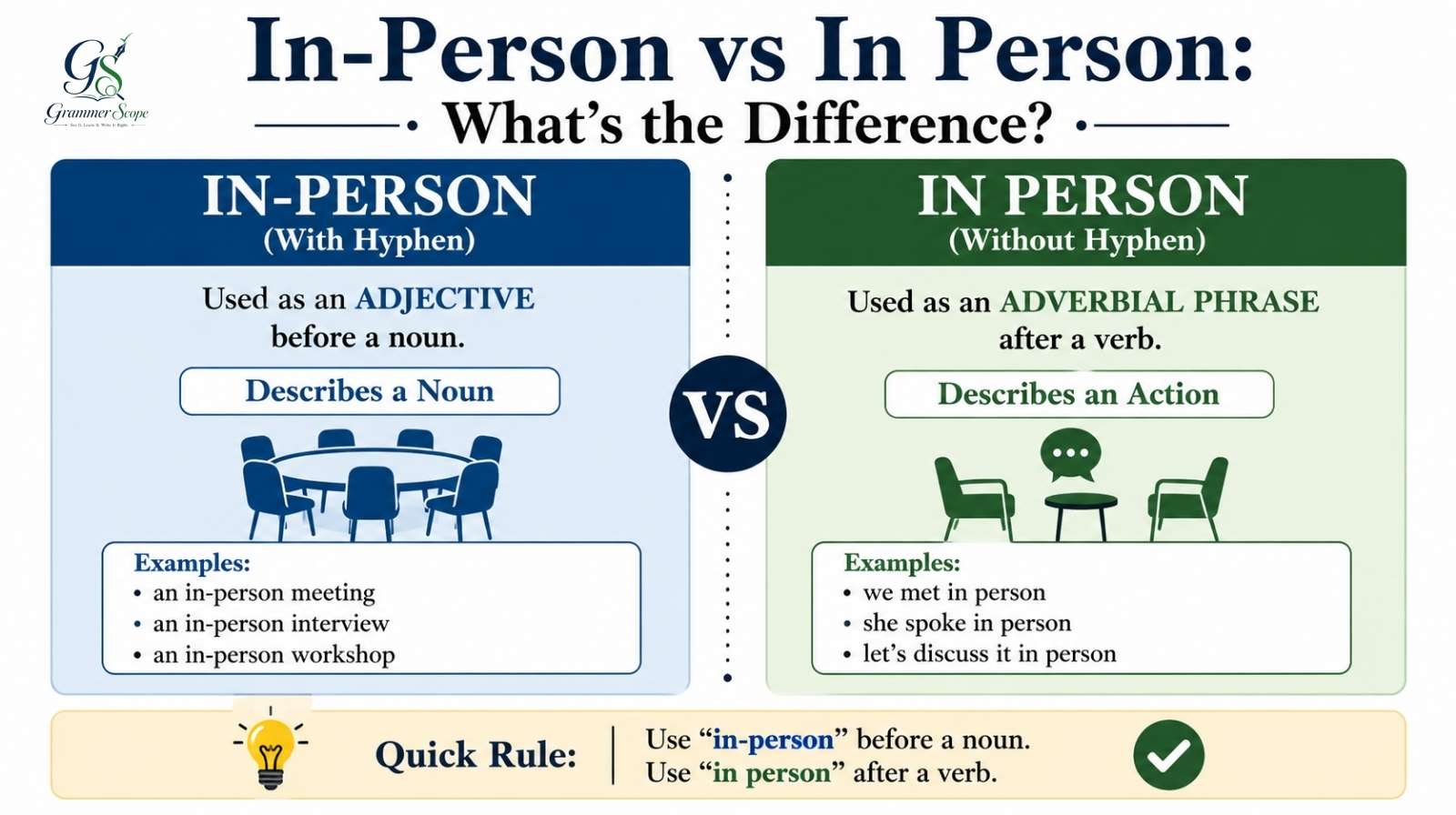
- In-person (with a hyphen) is an adjective.
- In person (without a hyphen) is an adverbial phrase.
Quick Answer
| Term | Part of Speech | Example |
|---|---|---|
| In-person | Adjective | We had an in-person meeting. |
| In person | Adverbial phrase | We met in person. |
Why the Difference Matters
English often uses hyphenated words before nouns to create compound adjectives. When the phrase directly describes a noun, use in-person.
When the phrase describes how something happened, use in person.
Featured Snippet Answer
Use “in-person” when it describes a noun and “in person” when it describes an action. For example, “an in-person interview” is correct because it describes the interview, while “we interviewed the candidate in person” is correct because it describes how the interview occurred.
Read More: Trailer or Trailor: Which Spelling Is Correct?
Understanding “In-Person” as an Adjective
The hyphenated version functions as a compound adjective.
It modifies a noun and provides more information about that noun.
When to Use In-Person
Use in-person before a noun.
Examples:
- An in-person interview
- An in-person workshop
- An in-person consultation
- An in-person conference
- An in-person appointment
Example Sentences
- The company scheduled an in-person meeting for next Tuesday.
- Students attended an in-person class after months of online learning.
- The clinic offers in-person appointments and virtual consultations.
- We conducted an in-person evaluation of the property.
Common Pattern
In-person + noun
Examples:
- In-person event
- In-person discussion
- In-person training
- In-person assessment
- In-person presentation
Because the phrase directly describes the noun, the hyphen is necessary.
Understanding “In Person” as an Adverbial Phrase
Without a hyphen, in person functions as a phrase that explains how something happened.
It modifies a verb rather than a noun.
When to Use In Person
Use in person after a verb or action.
Examples:
- Meet in person
- Speak in person
- Interview in person
- Appear in person
- Discuss in person
Example Sentences
- We finally met in person after months of video calls.
- The CEO appeared in person at the event.
- Customers can apply in person at the office.
- She preferred to discuss the matter in person.
Common Pattern
Verb + in person
Examples:
- Meet in person
- Talk in person
- Interview in person
- Present in person
- Attend in person
Since the phrase describes the action, no hyphen is needed.
In-Person vs In Person: Side-by-Side Comparison
The easiest way to remember the difference is to look at both forms together.
| Feature | In-Person | In Person |
|---|---|---|
| Hyphenated? | Yes | No |
| Part of Speech | Adjective | Adverbial Phrase |
| Describes | Noun | Verb/Action |
| Placement | Before a noun | After a verb |
| Example | In-person interview | Interview in person |
| Example | In-person meeting | Meet in person |
| Example | In-person class | Attend in person |
Memory Trick
Ask yourself:
“Is it describing a thing or an action?”
If it describes a thing (noun), use in-person.
If it describes an action (verb), use in person.
Read More: Of Course or Ofcourse: Which One Should You Use?
Real-Life Example: How Businesses Use These Terms
After the global shift toward remote work, companies increasingly needed to distinguish between virtual and physical interactions.
Consider a recruiting department hiring new employees.
A job posting may say:
“Candidates who advance to the final stage will participate in an in-person interview.”
Here, in-person describes the type of interview.
Later, the recruiter might email the candidate:
“We look forward to meeting you in person next week.”
In this sentence, in person describes how the meeting will occur.
Many organizations now maintain hybrid work models. Human resource departments often use both forms in the same communication:
“The first training session is an in-person workshop. Afterward, participants will meet in person with their mentors.”
This distinction helps ensure clarity and professionalism. Large corporations, universities, healthcare providers, and government agencies commonly follow this grammar rule in official communications.
Understanding the difference prevents ambiguity and strengthens credibility, especially in professional writing where precision matters.
Usage Trends and Language Data (2025–2026)
The rise of remote work, virtual learning, and hybrid events has significantly increased the use of both expressions.
According to workplace trend reports from Google Workspace, Microsoft Work Trend Index, and Gallup, hybrid work continues to be a dominant model in 2025 and 2026. As a result, terms distinguishing physical attendance from virtual participation appear more frequently in business communications.
Common phrases include:
- In-person meeting
- In-person conference
- In-person training
- Meet in person
- Attend in person
- Interview in person
Search behavior also indicates growing interest in grammar questions related to workplace communication, especially among professionals, students, recruiters, and content creators.
Why This Matters
As hybrid communication becomes standard, using the correct term helps readers quickly understand whether participation occurs physically or virtually.
Common Mistakes Writers Make
Even experienced writers occasionally confuse these forms.
Mistake 1: Using In Person Before a Noun
❌ We scheduled an in person meeting.
✅ We scheduled an in-person meeting.
Mistake 2: Using In-Person After a Verb
❌ We met in-person yesterday.
✅ We met in person yesterday.
Mistake 3: Hyphenating Everything
Some writers assume compound words always require hyphens.
However, context matters.
❌ The manager spoke in-person.
✅ The manager spoke in person.
Mistake 4: Mixing Formal and Informal Usage
Professional documents should consistently follow standard grammar conventions.
Correct usage improves readability and professionalism.

How to Remember the Rule Every Time
A simple checklist can help.
Use “In-Person” If:
✔ It comes before a noun
✔ It describes a person, meeting, class, event, or interview
✔ It functions as an adjective
Examples:
- In-person conference
- In-person consultation
- In-person training
Use “In Person” If:
✔ It follows a verb
✔ It describes how something happened
✔ It functions as an adverbial phrase
Examples:
- Meet in person
- Talk in person
- Apply in person
One-Sentence Formula
Noun = In-Person
Action = In Person
Read More: Writing or Writting? Correct Spelling Explained
Mini Quiz: In-Person vs In Person
Quiz 1: Which One Describes a Noun?
Question: Which form is used before a noun?
A) In person
B) In-person
Answer: ✅ B) In-person
Quiz 2: Fill in the Blank
Question: We attended an ______ conference last week.
Answer: ✅ in-person
Quiz 3: Quick Choice
Question: Which sentence is correct?
A) We met in-person yesterday.
B) We met in person yesterday.
Answer: ✅ B) We met in person yesterday.
Quiz 4: Fill in the Blank
Question: The company scheduled an ______ interview.
Answer: ✅ in-person
Quiz 5: True or False
Question: “In person” is usually used after a verb.
Answer: ✅ True
Quiz 6: Fill in the Blank
Question: I would rather discuss this ______.
Answer: ✅ in person
Quiz 7: Spot the Correct Sentence
Question: Which sentence is correct?
A) She attended an in-person workshop.
B) She attended an in person workshop.
Answer: ✅ A) She attended an in-person workshop.
Quiz 8: Fill in the Blank
Question: We finally met ______ after months of emails.
Answer: ✅ in person
Quiz 9: Grammar Check
Question: Is “in-person meeting” correct?
Answer: ✅ Yes
Quiz 10: Fill in the Blank
Question: The clinic offers ______ appointments for patients.
Answer: ✅ in-person
Quiz 11: What Does It Describe?
Question: In the phrase “in-person class,” what does “in-person” describe?
A) An action
B) A noun
Answer: ✅ B) A noun
Quiz 12: Fill in the Blank
Question: Customers can apply ______ at the office.
Answer: ✅ in person
Quiz 13: Choose the Right Form
Question: Which sentence is correct?
A) The CEO appeared in person.
B) The CEO appeared in-person.
Answer: ✅ A) The CEO appeared in person.
Quiz 14: Quick Rule Test
Question: If the phrase comes before a noun, should it be hyphenated?
Answer: ✅ Yes, use in-person.
Quiz 15: Final Challenge
Question: Complete the sentence:
“We had an ______ meeting, and afterward we spoke ______.”
Answer: ✅ in-person, in person
References
Frequently Asked Questions
Q1: Is it in-person or in person meeting?
A: The correct phrase is in-person meeting because the expression describes the noun “meeting.”
Q2: Is meet in-person correct?
A: No. The correct phrase is meet in person because it describes the action of meeting.
Q3: Why does in-person need a hyphen?
A: The hyphen combines two words into a compound adjective that modifies a noun.
Q4: Is in-person AP Style correct?
A: Yes. AP Style generally hyphenates compound modifiers before nouns, making in-person meeting correct.
Q5: Is in person one word?
A: No. Standard English treats in person as two separate words when used as an adverbial phrase.
Q6: Can I use in-person after a verb?
A: Typically no. Standard grammar prefers in person after verbs.
Q7: What is the opposite of in person?
A: Common opposites include:
- Online
- Virtual
- Remote
- Digitally
Conclusion
Understanding in-person vs in person is easier once you know their grammatical roles.
Remember:
- In-person is an adjective that describes a noun.
- In person is an adverbial phrase that describes an action.
For example:
- We attended an in-person conference.
- We met the speakers in person.
Using the correct form improves clarity, professionalism, and credibility in your writing. The next time you encounter in-person vs in person, simply ask whether you’re describing a noun or an action. That quick check will help you choose the right version every time.
Explore More Helpful Articles
- Pre vs Post: Correct Usage & Meaning Guide 2026
- Hustle or Hussle: Which Spelling Is Correct?
- Challenge or Challange: Which Is Correct? (2026 Guide)
Ready to improve your English? Read more guides on Grammer Scope

Bilal Khalid is a professional blogger specializing in grammar guides and practical writing tips. He helps readers improve clarity, accuracy, and confidence in communication through simple explanations, actionable advice, and easy-to-follow strategies for everyday and professional writing.