Have you ever typed “aswell” in a message, email, or article and wondered if it was actually correct? You are not alone. Thousands of English learners and even native speakers often confuse “as well” or “aswell.”
The confusion usually happens because many English compound words are written together, such as “already,” “however,” or “someone.” Therefore, people naturally assume that “aswell” may also be a proper word. However, grammar rules tell a different story.
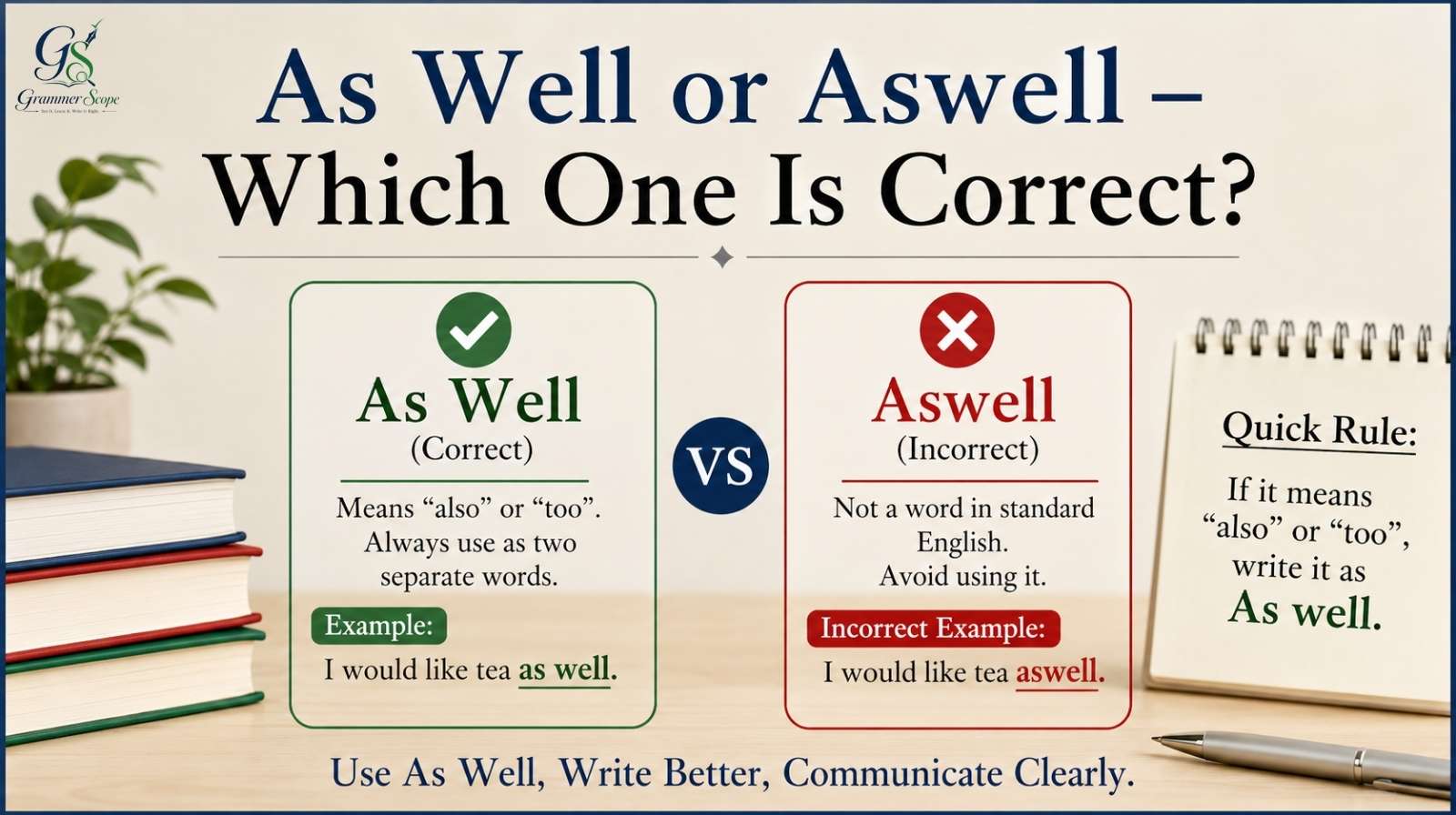
In simple terms, “as well” is correct, while “aswell” is considered incorrect in standard English. Understanding this small difference can instantly improve your writing clarity, professionalism, and grammar accuracy.
In this complete guide, you will learn:
- The correct form between “aswell” and “as well”
- Grammar rules and meanings
- Real-world examples
- Common mistakes to avoid
- Professional writing tips
- FAQs people commonly search on Google
By the end of this article, you will confidently know when and how to use “as well” correctly in both formal and casual writing.
What Does “As Well” Mean?
The phrase “as well” means:
- Also
- Too
- In addition
- Along with something else
It is commonly used to add extra information to a sentence.
Examples of “As Well”
- She speaks Spanish as well.
- I would like coffee as well.
- They attended the meeting as well.
- He plays football and cricket as well.
In all these examples, “as well” functions similarly to words like “too” or “also.”
Is “Aswell” a Real Word?
No, “aswell” is not a standard English word.
Major dictionaries, grammar guides, and language authorities do not recognize “aswell” as a correct spelling in formal English.
Why People Write “Aswell”
People often combine the words because:
- They type quickly
- Autocorrect misses the error
- They confuse it with other compound words
- Informal internet writing encourages shortcuts
However, professional writing standards still require the two-word form: as well.
Quick Answer
| Word | Correct or Incorrect? |
|---|---|
| As well | ✅ Correct |
| Aswell | ❌ Incorrect |
Read More: Amount or Ammount: Which Spelling Is Correct? (2026)
As Well vs Aswell: The Main Difference
The difference is extremely simple but important.
| Term | Meaning | Grammar Status |
|---|---|---|
| As well | Means “also” or “too” | Correct |
| Aswell | Misspelled version | Incorrect |
Why “As Well” Stays Separate
In English grammar, some expressions remain as separate words because they function as phrases rather than merged compound words.
“As well” belongs to this category.
For example:
- As soon as
- As far as
- As long as
- As well
These phrases maintain their spacing because each word has its own grammatical role.
Common Sentence Comparison
Incorrect:
- I want pizza aswell.
Correct:
- I want pizza as well.
Incorrect:
- She can dance aswell.
Correct:
- She can dance as well.
Even though the pronunciation sounds connected in speech, the written form must remain separate.
How to Use “As Well” Correctly in Sentences
Using “as well” correctly is easier than many people think. Usually, it appears at the end of a sentence.
Use “As Well” at the End
This is the most common placement.
Examples:
- I am coming to the party as well.
- Sarah bought a notebook as well.
- We enjoyed the movie as well.
This structure sounds natural and professional.
Use “As Well” in Formal Writing
“As well” is acceptable in both formal and informal writing.
Professional Examples:
- The report includes financial data as well.
- The company expanded into Europe as well.
- We recommend updating the software as well.
Because it sounds polished and neutral, many professionals prefer “as well” instead of “too.”
Avoid Overusing It
Although “as well” is useful, repeating it too often can make writing sound repetitive.
Repetitive:
- She likes tea as well. She likes coffee as well. She likes juice as well.
Better:
- She likes tea, coffee, and juice.
Good writing balances sentence variety naturally.
Common Grammar Mistakes Related to “As Well”
Many writers misuse “as well” in small but noticeable ways.
Writing It as One Word
This is the most common mistake.
Wrong:
- I will join aswell.
Correct:
- I will join as well.
Wrong Placement in Sentences
Some people place it awkwardly inside sentences.
Awkward:
- She as well likes music.
Better:
- She likes music as well.
Confusing It With “Also” and “Too”
Although similar, these words are used differently.
| Word | Typical Position |
|---|---|
| Also | Middle of sentence |
| Too | End of sentence |
| As well | Usually end of sentence |
Examples:
- She also sings.
- She sings too.
- She sings as well.
All are grammatically correct, but sentence style changes slightly.
“As Well” in British vs American English
Both British and American English use “as well” correctly.
However, usage style can vary slightly.
British English
British speakers commonly use “as well” in everyday conversation.
Example:
- I’ll have tea as well.
American English
Americans often prefer “too” or “also,” although “as well” is still correct.
Example:
- I’ll have tea too.
Even so, “as well” remains widely accepted worldwide.
Read More: Tacet or Tacit: What’s The Difference And Which One Should You Use?
Real-Life Example: How One Small Grammar Mistake Affected Professional Writing
In 2025, a freelance content writer shared an interesting experience on a professional writing forum. The writer submitted a client article containing the word “aswell” multiple times throughout the content.
At first glance, the mistake seemed minor. However, the client immediately noticed the spelling issue because the article was intended for a business website. The client considered the repeated error unprofessional and requested a complete revision before publication.
The writer later explained that the mistake happened due to years of informal texting habits where words were shortened or combined without careful proofreading. Because “aswell” visually looked natural, the error repeatedly slipped through editing software.
After correcting the phrase to “as well,” the article was approved successfully.
This example highlights an important reality of professional communication:
Small grammar mistakes can influence credibility.
Whether you are writing:
- Blog posts
- Academic papers
- Emails
- Social media captions
- Website content
Correct grammar improves trust and readability.
In competitive industries such as SEO writing, marketing, and publishing, even tiny spelling mistakes can affect user perception. Therefore, learning proper forms like “as well” helps writers appear more polished and authoritative.
Why Correct Grammar Still Matters in 2026
Some people argue that internet slang and casual communication make grammar less important today. However, recent data suggests the opposite.
According to language research published by Grammarly and workplace communication studies from HubSpot, clear grammar continues to influence:
- Professional credibility
- Reader trust
- Content engagement
- Hiring decisions
- SEO readability signals
A 2025 digital communication study found that readers were significantly more likely to trust online content that contained fewer grammar mistakes.
This matters especially for:
- Bloggers
- Students
- Copywriters
- Business owners
- Job applicants
Google’s helpful content systems also reward clear, user-focused writing. Therefore, improving small grammar details like “as well” can indirectly support better readability and user experience.
Why Search Engines Care About Readability
Search engines aim to show users reliable and understandable content.
When articles contain repeated spelling errors:
- Readers leave faster
- Trust decreases
- Engagement drops
As a result, polished grammar supports better long-term SEO performance.
Easy Trick to Remember the Correct Form
Here is a simple memory trick:
If “well” means “also,” keep it separate.
Think about these examples:
- I want dessert as well.
- She came as well.
You would never combine similar phrases like:
- astoo
- asalso
Therefore, “as well” should also remain separated.
Quick Memory Formula
✅ “As well” = correct phrase
❌ “Aswell” = spelling mistake
This simple rule helps you avoid the error instantly.
As Well vs Also vs Too
Many learners ask whether these words are interchangeable.
The answer is mostly yes, but sentence tone differs slightly.
| Phrase | Tone | Example |
|---|---|---|
| As well | Neutral/Formal | I would like dessert as well. |
| Also | Formal/Common | I also enjoy reading. |
| Too | Casual | I like pizza too. |
Which One Should You Use?
Choose based on writing style:
- Use also for formal sentence flow
- Use too for casual conversation
- Use as well for balanced professional tone
Read More: Dysregulated vs Disregulated: Correct Usage Explained
Best Writing Tips to Avoid Grammar Mistakes
Improving grammar does not require perfect English. Small habits create major improvement over time.
Proofread Slowly
Fast typing often creates combined-word mistakes. Always reread important content carefully.
Use Grammar Tools
Helpful tools include:
These tools can catch errors before publishing.
Read Professional Content
Reading high-quality articles improves grammar naturally over time.
Focus on:
- News websites
- Educational blogs
- Professional magazines
- Business publications
Exposure to correct English patterns strengthens writing habits.
Mini Quiz: As Well or Aswell
Quiz 1: Which One Is Correct?
Which sentence uses the correct spelling?
A) I want ice cream aswell.
B) I want ice cream as well.
Answer: B) I want ice cream as well.
Quiz 2: Spot the Mistake
Find the incorrect word:
“She can sing aswell.”
Answer: The incorrect word is “aswell.”
Correct sentence: “She can sing as well.”
Quiz 3: What Does “As Well” Mean?
What is the closest meaning of “as well”?
A) Never
B) Also
C) Quickly
Answer: B) Also
Quiz 4: Formal or Informal?
Can you use “as well” in professional writing?
A) Yes
B) No
Answer: A) Yes
Quiz 5: Fill in the Blank
“I would like dessert _____.”
A) aswell
B) as well
Answer: B) as well
Quiz 6: Grammar Check
Which one looks more professional?
A) We offer free delivery aswell.
B) We offer free delivery as well.
Answer: B) We offer free delivery as well.
Quiz 7: Quick Choice
Which word is NOT correct in standard English?
A) As well
B) Aswell
Answer: B) Aswell
Quiz 8: Similar Meaning
Which word can replace “as well”?
A) Also
B) Suddenly
C) Quietly
Answer: A) Also
Quiz 9: Sentence Position
Where is “as well” usually placed?
A) Beginning
B) End
C) Middle only
Answer: B) End
Quiz 10: True or False
“Aswell” is accepted by major English dictionaries.
Answer: False
Quiz 11: Final Challenge
Choose the best sentence:
A) Sarah bought coffee as well.
B) Sarah bought coffee aswell.
Answer: A) Sarah bought coffee as well.
Frequently Asked Questions
Q1: Is “aswell” ever correct?
A: No. “Aswell” is considered incorrect in standard English grammar and spelling.
Q2: Should “as well” always be two words?
A: Yes. The correct form is always written as two separate words: “as well.”
Q3: Can I use “as well” in formal writing?
A: Absolutely. “As well” works perfectly in academic, business, and professional writing.
Q4: What is another word for “as well”?
A: Common alternatives include:
- Also
- Too
- In addition
- Besides
Q5: Why do people write “aswell”?
A: Most people write “aswell” because of typing habits, autocorrect issues, or confusion with compound words.
Q6: Is “as well” more formal than “too”?
A: Generally, yes. “As well” often sounds slightly more professional and polished than “too.”
Q7: Does Google care about grammar mistakes?
A: Indirectly, yes. Clear grammar improves readability, user trust, and engagement, which can support better SEO performance.
Conclusion
When comparing “aswell” vs “as well,” the correct choice is simple:
✅ As well
❌ Aswell
Although the mistake looks small, using the proper spelling improves clarity, professionalism, and writing quality. Whether you are writing emails, articles, assignments, or social media captions, correct grammar helps readers trust your content more easily.
Remember this easy rule:
If you mean “also” or “too,” always write “as well” as two separate words.
Over time, mastering small grammar details like this can significantly improve your communication skills and overall writing confidence.
So next time you type the phrase, make sure you choose “as well” correctly.
Ready to improve your English? Read more guides on Grammer Scope