Have you ever typed “masonary” while writing about brick walls, stone construction, or building work and wondered whether the spelling was correct? You are not alone. Because the word comes from mason, adding an extra a can seem perfectly logical.
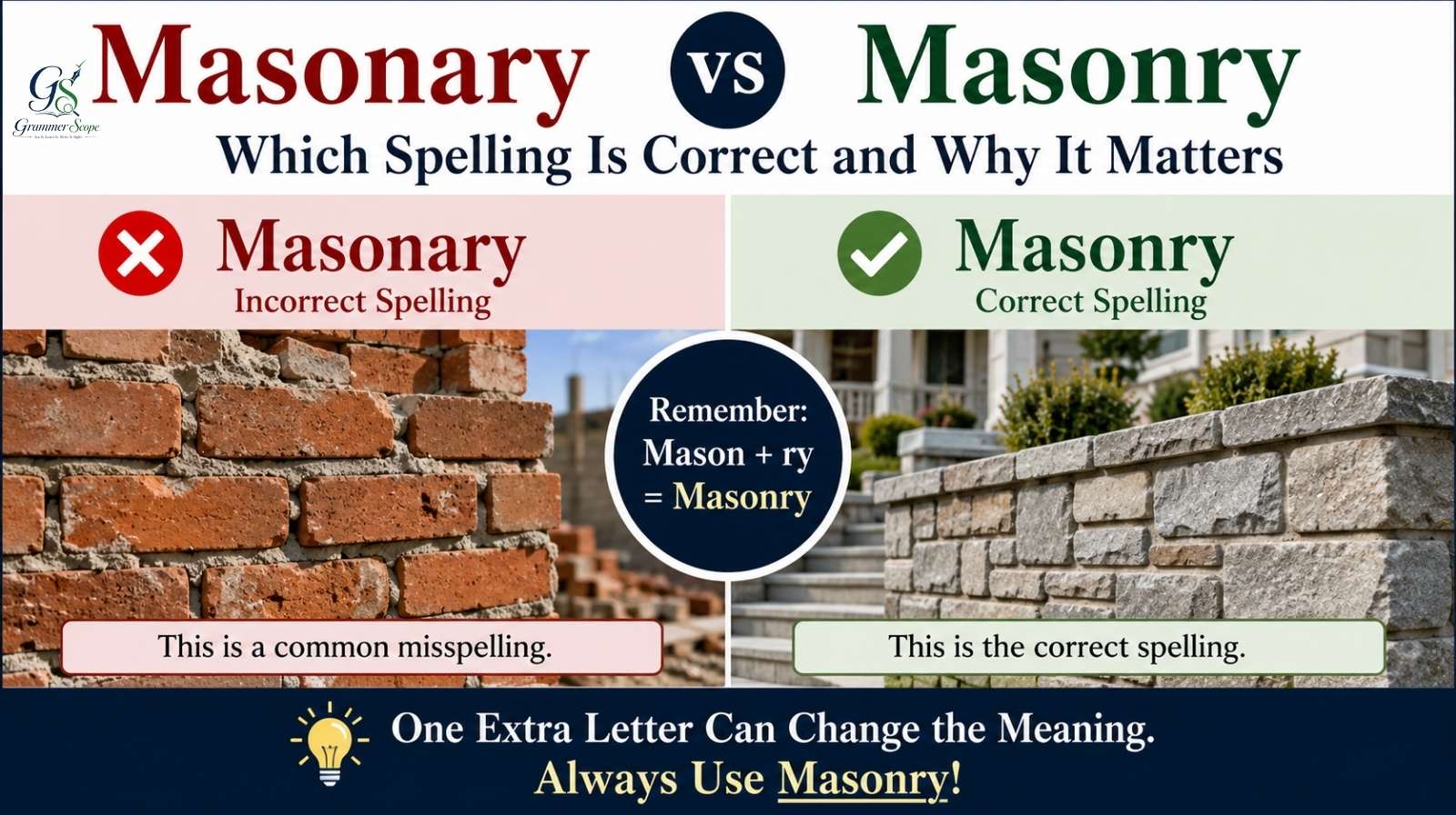
However, when it comes to Masonary vs Masonry, only one spelling is correct in standard English: masonry.
That missing extra letter may look like a small detail, but spelling accuracy matters, especially in construction documents, academic writing, business websites, contracts, job descriptions, and professional communication.
In this guide, you’ll learn the correct spelling, what masonry means, why masonary is a common mistake, how to remember the difference, and how to use the word confidently in real sentences.
Quick Answer
The correct spelling is masonry.
Masonary is a misspelling and is not the standard English word for brickwork, stonework, or the trade of a mason.
| Word | Correct? | Meaning |
|---|---|---|
| Masonry | ✅ Yes | Building work or structures made with brick, stone, or similar materials |
| Masonary | ❌ No | Incorrect spelling of masonry |
The Simple Rule
If you are referring to:
- brickwork
- stonework
- construction by a mason
- the trade of building with stone or brick
Use masonry.
Correct: The historic building features beautiful stone masonry.
Incorrect: The historic building features beautiful stone masonary.
Featured Snippet Answer
Masonry is the correct spelling. “Masonary” is a common misspelling. Masonry refers to the craft, work, or structures made by building with materials such as brick, stone, or concrete blocks.
Major dictionaries recognize masonry as the standard spelling and define it as the craft, work, or structures associated with a mason.
What Does Masonry Mean?
Masonry is primarily a noun. It refers to construction work involving individual materials such as brick, stone, or concrete units, as well as the finished structures created from those materials.
Merriam-Webster defines masonry broadly as construction or work associated with materials used by masons, while Cambridge Dictionary describes it as building materials and the skill of building with brick and stone.
Masonry as a Construction Method
In construction, masonry often describes structures built from separate units joined together, commonly with mortar.
For example:
- The contractor specializes in brick masonry.
- The old bridge contains original stone masonry.
- Engineers inspected the masonry walls for cracks.
- The house has a strong masonry exterior.
In these examples, masonry relates directly to the physical construction work or materials.
Masonry as a Skilled Trade
The word can also describe the skill or profession itself.
For example:
- She studied masonry at a technical college.
- Masonry requires patience, precision, and practical knowledge.
- He began his career in stone masonry.
Here, masonry means the craft or occupation rather than a specific wall or structure.
Masonry as Finished Work
Sometimes, masonry refers to the completed brickwork or stonework of a building.
For example:
- Water damage affected the exterior masonry.
- The damaged masonry needs immediate repair.
- The architect preserved the original masonry.
This usage is particularly common in architecture, engineering, restoration, and construction reports.
Read More: Seel or Seal – Correct Word Explained With Examples (2026)
Why Is Masonry Correct but Masonary Wrong?
The confusion between masonary vs masonry usually happens because writers recognize the word mason and assume that the longer form should naturally become masonary.
That assumption is understandable, but English spelling does not always follow the patterns we expect.
The Word Does Not Need an Extra “A”
Look carefully at the correct spelling:
Mason + ry = Masonry
Not:
Mason + ary = Masonary
The correct word is masonry, with no extra a between mason and ry.
A simple visual comparison makes the difference easier to remember:
❌ masonary
✅ masonry
The extra a is the entire mistake.
Pronunciation Can Cause Confusion
Masonry is generally pronounced approximately as:
MAY-suhn-ree
When spoken quickly, the middle and final sounds can make some people think there is an additional vowel in the spelling. As a result, they may write masonary even though the standard written form is masonry.
This is a common issue in English: pronunciation and spelling do not always match perfectly.
Word History Helps Explain the Spelling
The word masonry has a long history. Dictionary sources trace it through Middle English and French forms associated with the work and craft of a mason. The established modern English spelling became masonry, which is why adding an extra a is incorrect.
Therefore, the safest approach is not to create the spelling based only on how the word sounds. Instead, remember the established form:
mason → masonry

Masonary vs Masonry: A Detailed Comparison
Although these two spellings look similar, they do not have equal status in standard English.
| Feature | Masonry | Masonary |
|---|---|---|
| Standard English word | Yes | No |
| Correct spelling | Yes | No |
| Dictionary recognition | Yes | Not standard |
| Used in construction | Yes | No |
| Suitable for formal writing | Yes | No |
| Meaning | Brickwork, stonework, or a mason’s craft | Misspelling |
| Professional usage | Correct | Incorrect |
When Should You Use “Masonry”?
Use masonry whenever you are discussing:
- brick construction
- stone construction
- concrete block structures
- a mason’s craft
- building restoration
- masonry repairs
- construction materials
- architectural structures
Examples:
- The company offers masonry repair services.
- The castle is famous for its medieval masonry.
- Cracks appeared in the building’s exterior masonry.
- He learned the basics of stone masonry.
Should “Masonary” Ever Be Used?
In standard English writing, no.
If you mean the construction trade or work involving brick and stone, masonary should be corrected to masonry.
This applies to:
- blog posts
- business websites
- school assignments
- construction proposals
- contracts
- invoices
- architecture reports
- job descriptions
- social media posts
One incorrect spelling may not completely prevent someone from understanding your meaning. However, accuracy creates a more professional and trustworthy impression.
Read More: Girlie or Girly: Correct Usage, Meaning And Examples (2026)
Masonry Meaning and Common Uses
Understanding the meaning of masonry makes it much easier to remember its spelling.
Masonry Means Brickwork or Stonework
One common meaning of masonry is the physical material or structure built from brick or stone.
Examples:
- The chimney’s masonry was damaged during the storm.
- The building has decorative stone masonry.
- Workers repaired the cracked masonry around the entrance.
In these sentences, masonry refers to the constructed parts of the building.
Masonry Can Mean the Work of a Mason
A mason is a skilled worker who builds using materials such as stone or brick. Masonry is the work or craft associated with that profession.
For example:
- The mason repaired the wall.
- Masonry requires specialized construction skills.
This distinction is important:
A mason is the person. Masonry is the craft, work, or structure.
Merriam-Webster similarly distinguishes a mason as a skilled worker from masonry as the associated work, craft, or construction.
Masonry Can Describe a Type of Construction
You will often see masonry used before another noun.
Common combinations include:
- masonry wall
- masonry construction
- masonry repair
- masonry contractor
- masonry building
- masonry work
- masonry materials
- masonry structure
For example:
The engineer inspected the masonry structure before renovation began.
In all these phrases, the spelling remains exactly the same: masonry.
Mason vs Masonry: What Is the Difference?
Another reason people become confused is that mason and masonry are closely related words.
However, they have different grammatical roles and meanings.
| Word | Part of Speech | Meaning | Example |
|---|---|---|---|
| Mason | Noun | A skilled person who works with stone, brick, or similar materials | The mason rebuilt the wall. |
| Masonry | Noun | The craft, work, or structures associated with a mason | The masonry needs repair. |
A Mason Is a Person
A mason is the individual performing the work.
Example:
The mason carefully placed each stone.
Masonry Is the Work or Result
Masonry refers to the craft or the finished construction.
Example:
The masonry on the historic building has survived for centuries.
A simple way to remember this is:
Mason = Who
Masonry = What they do or create
Read More: Puddy or Putty: Which Spelling Is Correct? (2026 Guide)
Why the Correct Spelling Matters in Professional Writing
You might wonder whether one extra letter really matters. In casual conversation, people may still understand what you mean.
However, written communication is different.
Spelling Affects Professional Credibility
Imagine seeing these two lines on a construction company’s website:
We provide professional masonary services.
We provide professional masonry services.
The first sentence contains a noticeable spelling mistake. The second looks polished and professional.
For businesses, technical accuracy matters because customers often judge credibility through details.
Technical Documents Require Precision
Construction and engineering documents frequently use specialized terminology.
Words such as:
- masonry
- structural
- foundation
- reinforcement
- insulation
need to be spelled correctly.
A typo may not change the physical structure being discussed, but repeated errors can make a document appear less carefully prepared.
Search Visibility Can Also Be Affected
People search online using both correct and incorrect spellings. Therefore, understanding the difference between masonary and masonry can be useful for website owners and content creators.
However, the main content should still use the standard spelling naturally and accurately.
Google’s people-first content guidance emphasizes creating helpful, reliable content for users rather than manipulating search rankings.
For a grammar or educational article, that means answering the user’s actual question clearly:
What is correct? Why is it correct? How can readers remember it?
Real-Life Example: Why One Letter Can Matter
Imagine a small construction company preparing a proposal for a major historic building restoration project.
The project involves repairing old brick walls, restoring stone arches, and strengthening damaged exterior sections. The company has years of experience, skilled workers, and an impressive portfolio.
However, throughout its proposal, the company repeatedly writes:
“Our masonary restoration services include brick repair and stone replacement.”
The technical team reviewing the proposal immediately understands the intended meaning. Still, the spelling error appears several times across a professional document.
Now imagine another company submitting a similar proposal using precise language:
“Our masonry restoration services include brick repair, stone replacement, repointing, and structural assessment.”
The difference is only one letter, but the second version appears more polished.
This does not mean that one spelling mistake automatically makes a company unqualified. However, professional writing contributes to first impressions. In industries involving architecture, construction, engineering, preservation, and contracts, terminology should be consistent.
The lesson extends beyond this single word. Accurate spelling supports clarity, professionalism, and trust.
That is why learning the difference between Masonary vs Masonry matters. The correct form is easy to remember once you know the rule, and using it consistently helps your writing look more reliable.
Read More: Labeller or Labeler: Which Spelling Is Correct?
How to Remember the Correct Spelling of Masonry
Fortunately, you do not need to memorize a complicated grammar rule.
Use these simple memory tricks.
Remember: Mason + RY
Think of the word this way:
Mason → Masonry
Do not insert another a.
Visual pattern:
MAS O N R Y
The correct word moves directly from mason to ry.
Look for the Extra “A”
Whenever you write the word, check whether you accidentally added an a after mason.
❌ masonary
✅ masonry
If you see that extra letter, remove it.
Connect the Word to Related Terms
Remember this simple relationship:
- mason = worker
- masonry = work or construction
Because the correct word is a recognized form of mason, it is best to learn the complete spelling as one unit rather than trying to build it phonetically.
Use the Sentence Test
Try this sentence:
The old church is famous for its stone ______.
The correct answer is:
masonry
This method helps you connect the spelling with its meaning.
Read More: Any Time vs Anytime: Meaning, Usage And Grammar Rules
Common Examples of Masonry in Sentences
Seeing a word in context is one of the best ways to remember it.
Construction Examples
- The contractor specializes in residential masonry.
- Heavy rain damaged the exterior masonry.
- The project requires experienced masonry workers.
- Brick masonry remains popular in many traditional buildings.
Architecture Examples
- The cathedral is known for its impressive stone masonry.
- Engineers inspected the masonry walls for structural damage.
- The original masonry was preserved during renovation.
Everyday Examples
- The house has beautiful decorative masonry around the entrance.
- He started a career in masonry after completing his training.
- The chimney needs masonry repair before winter.
Incorrect and Correct Usage
❌ The building requires extensive masonary repair.
✅ The building requires extensive masonry repair.
❌ She works in stone masonary.
✅ She works in stone masonry.
❌ The old masonary is beginning to crack.
✅ The old masonry is beginning to crack.
Masonry in 2025–2026: Why Accurate Terminology Still Matters
In 2025 and 2026, masonry remains an active term across construction, architecture, historic preservation, engineering, and technical publishing. Current dictionary entries continue to define the word as the craft, occupation, work, or structures associated with building in brick and stone, and recent example usage includes contemporary references to masonry buildings and construction.
What Current Dictionary Evidence Shows
Major reference dictionaries consistently recognize:
- masonry as the standard English word
- mason as the skilled worker
- masonry as relating to brickwork, stonework, construction, or the craft itself
Cambridge Dictionary lists masonry as both building material/work and the skill of building with brick and stone. (Cambridge Dictionary)
Merriam-Webster also records the word’s history going back to the 13th century, demonstrating that masonry is a long-established English word rather than a modern spelling variation. (Merriam-Webster)
A Useful Data Point
The strongest evidence in a spelling question is often not a search-volume estimate but standard dictionary recognition. Multiple major dictionaries consistently document masonry as the accepted spelling and meaning, while masonary is treated as a spelling error rather than a standard alternative.
That consistency matters for writers because it provides a clear answer:
There is no standard spelling debate here. Masonry is correct.
Read More: Bougie or Boujee: Which One Should You Use? (2026 Guide)
Common Mistakes People Make With Masonry
The masonary mistake is simple, but it often appears alongside other usage problems.
Adding an Extra “A”
This is the most common error.
❌ masonary
✅ masonry
Why does it happen?
Because writers mentally divide the word into:
mason + ary
However, the standard spelling does not work that way.
Confusing Mason and Masonry
Remember:
A mason performs the work.
Masonry is the work or construction.
Incorrect:The masonry repaired the wall.
Correct:
The mason repaired the wall.
Correct:
The masonry wall needed repair.
Capitalizing the Word Unnecessarily
When referring to construction, the word is normally lowercase:
The house requires masonry repair.
However, Masonry can appear with a capital letter in contexts referring to Freemasonry or related organizations and concepts.
Therefore, context matters.
Using the Wrong Word in Professional Content
If you are writing for a construction company, architecture firm, or home improvement website, double-check common phrases such as:
- masonry contractor
- masonry repair
- brick masonry
- stone masonry
- masonry construction
Consistent terminology improves readability and professionalism.

A Simple Checklist Before Using the Word
Before publishing or sending your writing, use this quick checklist:
- Am I writing about brickwork, stonework, or construction?
- Do I mean the craft or work of a mason?
- Did I spell the word masonry?
- Did I accidentally add an extra a?
- Is the word being used correctly in the sentence?
If the answer is yes, you’re using the correct form.
The One-Second Spelling Check
Before moving on, remember:
MASONRY has no extra A.
That single reminder solves the entire confusion.
Read More: Drier or Dryer: Which Word Is Correct?
Mini Quiz: Masonary vs Masonry
Quiz 1: Choose the Correct Spelling
Which spelling is correct?
A) Masonary
B) Masonry
C) Masonery
Answer: B) Masonry ✅
Quiz 2: Fill in the Blank
The old building has beautiful stone □□□□□□□.
Answer: Masonry ✅
Quiz 3: True or False
“Masonary” is the correct standard spelling in English.
Answer: False ❌
The correct spelling is masonry.
Quiz 4: Spot the Mistake
Which sentence contains a spelling mistake?
A) The masonry wall needs repair.
B) He works in stone masonry.
C) The masonary on the building looks old.
Answer: C ✅
Masonary should be masonry.
Quiz 5: Who Is a Mason?
What does the word mason usually refer to?
A) A building material
B) A skilled worker
C) A type of wall
D) A construction machine
Answer: B) A skilled worker ✅
Quiz 6: Mason or Masonry?
Choose the correct word:
“The ______ carefully repaired the damaged brick wall.”
Answer: Mason ✅
Quiz 7: Fill in the Blank
“The historic castle is famous for its impressive stone □□□□□□□.”
Answer: Masonry ✅
Quiz 8: Quick Choice
Which word refers to the craft or work of building with brick and stone?
A) Mason
B) Masonry
C) Masonary
D) Masoner
Answer: B) Masonry ✅
Quiz 9: Find the Extra Letter
What is the main spelling problem in “masonary”?
A) It has an extra A
B) It has an extra M
C) It is missing an R
D) It needs another Y
Answer: A) It has an extra A ✅
Quiz 10: True or False
Masonry can refer to brickwork, stonework, or the craft of a mason.
Answer: True ✅
Quiz 11: Choose the Correct Sentence
A) The masonary needs repair.
B) The masonry needs repair.
C) The masonery needs repair.
Answer: B) The masonry needs repair. ✅
Quiz 12: Fill in the Blank
Remember the simple spelling rule:
Mason + RY = □□□□□□□
Answer: Masonry ✅
Quiz 13: What Does Masonry Describe?
Which of these can be described as masonry?
A) Brick walls
B) Stone structures
C) Construction work
D) All of the above
Answer: D) All of the above ✅
Quiz 14: One Word Challenge
Which word has no extra “A”?
A) Masonary
B) Masonry
C) Masonery
D) Masonarry
Answer: B) Masonry ✅
Quiz 15: Fill in the Blank
“The contractor specializes in brick □□□□□□□.”
Answer: Masonry ✅
Quiz 16: Mason vs Masonry
Which statement is correct?
A) A masonry is a person who builds walls.
B) A mason is the craft of building.
C) A mason is a person, while masonry is the work or craft.
D) Mason and masonry mean exactly the same thing.
Answer: C) A mason is a person, while masonry is the work or craft. ✅
Quiz 17: True or False
Adding an extra “A” makes masonary the correct spelling.
Answer: False ❌
The extra A is exactly what makes the spelling incorrect.
Quiz 18: Final Spelling Test
Complete the sentence:
“Cracks appeared in the building’s exterior ______.”
A) Masonary
B) Masonry
C) Masonery
D) Masonerry
Answer: B) Masonry ✅
Quiz 19: The Ultimate Memory Test
What is the easiest way to remember the correct spelling?
A) Mason + ary
B) Mason + ery
C) Mason + ry
D) Mason + arry
Answer: C) Mason + ry ✅
Correct Word: MASONRY 🎯
Frequently Asked Questions
Q1: Is it masonary or masonry?
A: The correct spelling is masonry. Masonary is a misspelling and should not be used in standard English.
Q2: What does masonry mean?
A: Masonry refers to the craft, work, or structures created using materials such as brick, stone, or concrete blocks. It can also refer to the trade practiced by a mason.
Q3: Why do people spell masonry as masonary?
A: People often add an extra a because the word is related to mason and may sound like it contains another vowel when spoken quickly. However, the standard spelling is simply masonry.
Q4: How do you spell masonry correctly?
A: The correct spelling is:
M-A-S-O-N-R-Y
There is no extra a before the final letters.
Q5: What is the difference between a mason and masonry?
A: A mason is a person who works with materials such as stone or brick. Masonry is the craft, work, or construction associated with that person.
Q6: Is masonry a noun?
A: Yes. Masonry is primarily a noun. It can refer to the craft of building, the work performed by a mason, or the brick and stone structures themselves.
Q7: Can masonry refer to Freemasonry?
A: Yes. When capitalized as Masonry, the word can refer to Freemasonry in certain contexts. However, lowercase masonry normally refers to the construction craft or structures made from materials such as brick and stone.
Final Thoughts: Masonary vs Masonry
The confusion between Masonary vs Masonry has a simple answer: masonry is the only correct standard spelling.
If you’re talking about brickwork, stonework, construction, or the skilled trade of a mason, always write masonry.
The easiest way to remember it is this:
Mason + ry = Masonry
No extra a is needed.
Although the difference is only one letter, correct spelling matters in professional documents, academic writing, construction websites, business communication, and everyday English. Learning this small distinction helps your writing appear clearer, more accurate, and more trustworthy.
So, the next time you find yourself typing masonary, pause and remove the extra a.
The correct spelling is always: Masonry.
Discover More Article
- Shown vs Showed: The Complete Guide To Using These Two Forms Correctly (2026)
- Hola or Ola? The Complete Guide To Meaning, Usage And Confusion
- Breath or Breathe: Clear Difference, Rules, And Examples
Ready to improve your English? Read more guides on Grammer Scope