Have you ever wondered whether you should write girlie or girly? At first glance, both words seem correct because they appear frequently in conversations, social media posts, and even online articles. However, many writers aren’t sure if they mean the same thing or whether one is more appropriate than the other.
The confusion comes from the fact that both words are related to femininity, yet they’re used in different ways depending on the context. Choosing the wrong one can make your writing sound awkward or less natural, especially in formal English.
In this guide, you’ll learn the difference between girlie or girly, discover when each word should be used, see plenty of real-world examples, and avoid the common mistakes that many English learners make. By the end, you’ll know exactly which word fits your sentence with confidence.
Is It Girlie or Girly?
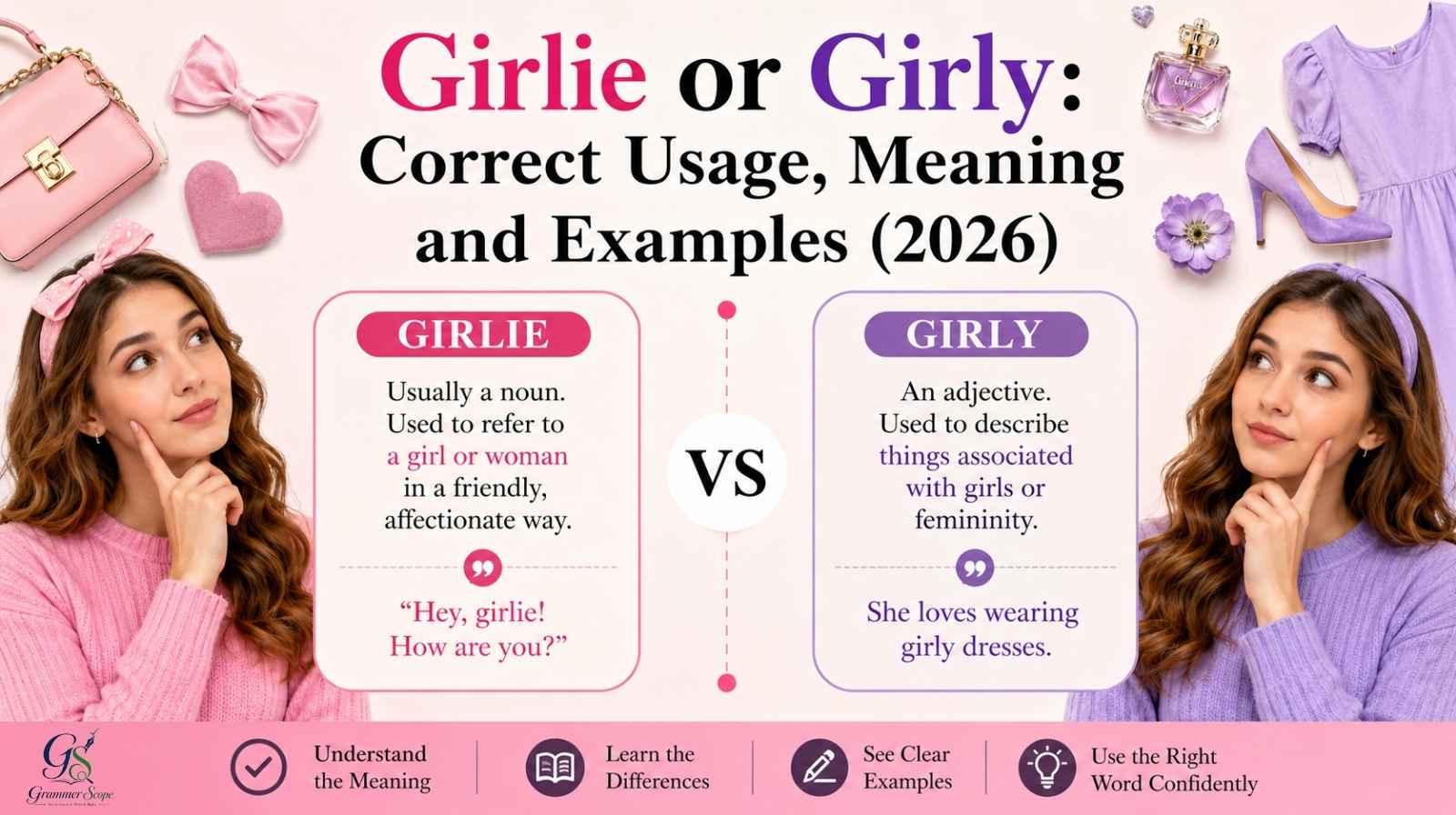
The short answer is that both “girlie” and “girly” are correct English words, but they are not always interchangeable.
- Girly is an adjective that describes something traditionally associated with girls or femininity.
- Girlie is usually a noun or an informal adjective used affectionately to refer to a girl, woman, or something with a playful feminine style.
Although both words share the same root, their meanings and usage differ slightly. Understanding those differences will help you write more naturally.
Girly Meaning
The word girly is primarily an adjective.
It describes things that have qualities traditionally associated with girls or women, such as colors, clothing, decorations, hobbies, or behaviors.
Examples:
- She loves wearing girly dresses with floral patterns.
- The bedroom has a girly pink theme.
- Her handwriting has a girly style.
- Some people enjoy girly fashion, while others prefer a minimalist look.
Notice that girly describes a noun rather than naming a person.
Girlie Meaning
Girlie is often used as a noun in casual English.
It can refer to a girl or woman in a friendly, affectionate, or playful way. In some contexts, it also functions as an adjective, although this usage is less common than girly.
Examples:
- Hi, girlie! How have you been?
- Thanks for the advice, girlie.
- The boutique sells trendy girlie accessories.
- She posted a fun selfie with the caption, “Weekend vibes, girlie!”
Because girlie is informal, it’s best suited for conversations, text messages, social media, or friendly writing rather than academic or professional documents.
Read More: Flier vs Flyer: Which Spelling Is Correct in 2026?
What’s the Difference Between Girlie and Girly?
Although the words are closely related, their grammar and tone are different.
| Feature | Girly | Girlie |
|---|---|---|
| Part of Speech | Adjective | Usually a noun; sometimes an adjective |
| Tone | Neutral to descriptive | Informal, playful, affectionate |
| Common Use | Describes feminine style or qualities | Refers to a girl or woman casually |
| Formal Writing | More acceptable | Rarely used |
| Everyday Conversation | Common | Very common in casual speech |
Think of It This Way
If you’re describing something, choose girly.
If you’re addressing or referring to a person informally, girlie is often the better choice.
For example:
✔ That’s a girly handbag.
✔ Thanks, girlie!
Using this simple rule can prevent most mistakes.
Why People Confuse These Words
There are several reasons these words are mixed up.
- They differ by only one letter.
- Both relate to femininity.
- Social media influencers often use girlie as a nickname.
- Many online posts use them interchangeably.
- Informal English sometimes blurs the distinction.
Fortunately, once you understand each word’s grammatical role, choosing the correct one becomes much easier.
How Dictionaries Define Girlie and Girly
Understanding dictionary definitions makes the difference much clearer.
Girly Definition
Most major dictionaries define girly as an adjective meaning:
- Characteristic of girls.
- Traditionally feminine.
- Having a style associated with women or girls.
This definition focuses on describing appearance, personality, or objects rather than referring to a person directly.
Girlie Definition
Girlie is generally defined as:
- A girl or young woman (informal).
- An affectionate way of addressing someone.
- Occasionally describing something with a playful feminine style.
Because the word carries a casual tone, it is much more common in everyday conversation than in formal writing.
Which One Appears More Often?
In published books, newspapers, and professional writing, girly appears far more frequently than girlie because it serves as a standard descriptive adjective.
Meanwhile, girlie has become increasingly popular in social media captions, online communities, text messages, and casual conversations, where a friendly and relaxed tone is preferred.
Read More: It’s Called vs It Called: Understanding The Distinction
When Should You Use Girly?
Now that you understand the basic difference, let’s look at when girly is the best choice.
Use girly whenever you’re describing a person, object, style, behavior, or appearance that has traditionally feminine characteristics.
It functions as an adjective, meaning it modifies a noun.
Describing Fashion
Fashion is one of the most common contexts where girly appears.
Examples:
- She prefers girly outfits with floral prints.
- That boutique sells girly handbags and accessories.
- The designer launched a girly summer collection.
- Her wardrobe combines girly dresses with modern sneakers.
Describing Colors and Decorations
The word also works well when talking about design, interiors, or colors.
Examples:
- The room has a girly pink and white theme.
- They decorated the party with girly balloons.
- She chose a girly phone case covered in flowers.
- The wedding invitations have a soft, girly aesthetic.
Describing Personality or Interests
Sometimes girly describes someone’s preferences rather than appearance.
Examples:
- She’s very girly and enjoys shopping.
- My sister likes girly romantic movies.
- Their daughter has a girly sense of style.
- Being girly doesn’t define someone’s abilities or ambitions.
Grammar Tip:
Because girly is an adjective, it usually comes before a noun or after a linking verb.
Correct:
- A girly dress
- The room looks girly.
Incorrect:
- She is a girly. ❌
Read More: Appreciate It or Appreciated It? The Ultimate Guide To Choosing The Right Phrase
When Should You Use Girlie?
Unlike girly, the word girlie is most commonly used as a noun or a friendly form of address.
You’ll often hear it in conversations, text messages, TikTok videos, Instagram captions, and casual chats.
As a Friendly Nickname
Examples:
- Hey, girlie, how are you?
- Thanks for helping me, girlie.
- Good morning, girlie!
- You’ve got this, girlie!
This usage sounds warm, playful, and supportive.
On Social Media
In recent years, girlie has become extremely popular online.
Examples include:
- Coffee girlie
- Book girlie
- Pilates girlie
- Matcha girlie
- Travel girlie
- Clean-girl girlie
- Skincare girlie
These expressions describe someone who strongly enjoys a particular hobby or lifestyle.
Example:
“I’m definitely a coffee girlie.”
The speaker isn’t talking about gender alone they’re expressing their identity in a fun, casual way.
Informal Writing
Examples:
- The group chat is full of supportive girlies.
- Every skincare girlie should wear sunscreen.
- The fashion girlies loved the new collection.
- The book girlies can’t stop recommending this novel.
Notice how girlie feels much more conversational than girly.
Girlie vs Girly: Key Differences at a Glance
| Feature | Girly | Girlie |
|---|---|---|
| Primary Part of Speech | Adjective | Noun (sometimes adjective) |
| Main Purpose | Describes feminine style or qualities | Refers to a girl or woman informally |
| Tone | Neutral, descriptive | Casual, playful, affectionate |
| Common in Formal Writing | Yes | Rarely |
| Popular on Social Media | Yes | Very common |
| Example | A girly outfit | Hey, girlie! |
This comparison highlights the simplest rule to remember:
- Girly = describes something.
- Girlie = casually refers to someone.
Read More: Accomodation vs Accommodation: What’s The Correct Spelling?
Common Mistakes to Avoid
Even fluent English speakers sometimes confuse these two words.
Here are the mistakes you’ll want to avoid.
Mistake 1: Using Girlie as a Formal Adjective
❌ The company launched a girlie marketing campaign.
✔ The company launched a girly marketing campaign.
Professional writing generally prefers girly as the adjective.
Mistake 2: Using Girly as a Noun
❌ Thanks, girly!
Although people occasionally say this in casual speech, girlie is far more natural as a nickname.
✔ Thanks, girlie!
Mistake 3: Assuming One Word Is Wrong
Some writers believe only one spelling is correct.
That’s not true.
Both words are accepted English words.
The important point is choosing the one that matches your sentence and tone.
Mistake 4: Using Either Word in Highly Formal Writing
In academic papers, legal documents, research reports, or business communications, both words may sound overly informal depending on the context.
Instead, use clearer alternatives such as:
- feminine
- traditionally feminine
- womanly (when appropriate)
- feminine style
- feminine aesthetic
Read More: Recurring vs Reoccurring: The Complete Guide To Correct Usage
Real-Life Example: How One Content Writer Improved Readability
A lifestyle blogger published an article reviewing popular fashion accessories for young women. Throughout the draft, the writer repeatedly used girlie to describe products, writing phrases like “girlie handbags,” “girlie dresses,” and “girlie bedroom ideas.” While the content sounded friendly, several readers commented that the wording felt inconsistent and overly casual for a blog that aimed to provide expert shopping advice.
During editing, the writer replaced most of these descriptions with girly, since the word functions naturally as an adjective. However, girlie was intentionally kept in places where it addressed readers directly, such as “Hey, girlies!” in the introduction and “Beauty girlies will love these products” in a social media promotion.
After the update, the article read more smoothly and matched readers’ expectations. The descriptive language became clearer, while the conversational tone remained engaging where appropriate. This simple adjustment made the writing feel more polished without losing its friendly personality.
The lesson is straightforward: use “girly” to describe things and “girlie” when casually referring to people or building a friendly connection with your audience. Keeping this distinction in mind helps your writing sound both natural and professional.
2025–2026 Language Trends and Usage Data
Language evolves continuously, especially through social media and digital communication. During 2025–2026, informal expressions such as “book girlie,” “coffee girlie,” “fashion girlie,” and “clean girlie” became increasingly common across platforms like TikTok, Instagram, and Pinterest. These phrases reflect online communities built around shared interests and aesthetics.
At the same time, established dictionaries and style references continue to recognize girly as the standard adjective for describing feminine characteristics, styles, or objects. This distinction explains why you’ll often see girly fashion, girly bedroom, or girly accessories in articles, shopping guides, and professional content, while girlie is more common in captions, comments, and casual conversations.
For writers, bloggers, and businesses, understanding this difference is important. Matching your word choice to the context helps improve readability, maintains a consistent tone, and creates content that feels natural to modern readers while remaining grammatically accurate.
Read More: Cocoon or Cacoon? Which Spelling Is Correct? (Complete Grammar Guide)
Mini Quiz: Girlie or Girly
Quiz 1: Which Word Fits Best?
Choose the correct word.
She bought a _______ pink backpack.
A. girlie
B. girly
✅ Answer: B. girly
Quiz 2: Fill in the Blank
“Hey, _______! Long time no see.”
✅ Answer: girlie
Quiz 3: True or False
“Girly” is mainly used as an adjective.
✅ Answer: True
Quiz 4: Which Sentence Is Correct?
A. She wore a girlie dress to the party.
B. She wore a girly dress to the party.
✅ Answer: B. She wore a girly dress to the party.
Quiz 5: Fill in the Blank
The bedroom has a _______ style with pastel colors and flowers.
✅ Answer: girly
Quiz 6: What’s the Best Choice?
Your best friend texts you, “Good luck, _______!”
A. girly
B. girlie
✅ Answer: B. girlie
Quiz 7: True or False
Both girlie and girly are real English words.
✅ Answer: True
Quiz 8: Fill in the Blank
She loves reading romance novels and calls herself a book _______.
✅ Answer: girlie
Quiz 9: Which Word Describes Something?
Which word is mainly used to describe a noun?
A. girlie
B. girly
✅ Answer: B. girly
Quiz 10: Fill in the Blank
The boutique is famous for its _______ fashion collection.
✅ Answer: girly
Quiz 11: Spot the Correct Sentence
A. Thanks, girly!
B. Thanks, girlie!
✅ Answer: B. Thanks, girlie!
Quiz 12: Final Challenge
Complete the sentence:
When you’re describing something feminine, use _______. When you’re casually referring to a person, use _______.
✅ Answer: girly, girlie
References
For further reading and authoritative definitions, consult these trusted sources:
Frequently Asked Questions
Q1: Is girlie or girly grammatically correct?
A: Yes. Both “girlie” and “girly” are correct English words, but they serve different purposes.
- Girly is mainly an adjective that describes something traditionally feminine.
- Girlie is usually an informal noun or friendly nickname for a girl or woman.
The correct choice depends on the context of your sentence.
Q2: Which word is more common in formal writing?
A: Girly is far more common in formal and professional writing because it functions as a standard adjective.
Examples:
- girly fashion
- girly bedroom
- girly accessories
- girly aesthetic
Girlie is generally reserved for casual conversations, social media, and friendly communication.
Q3: Can I call someone “girlie”?
A: Yes but only in the right situation.
Calling someone girlie is usually affectionate, playful, or friendly. You’ll often hear it between close friends or see it used by influencers and online communities.
Examples:
- Thanks, girlie!
- Good luck, girlie!
- You’re amazing, girlie!
However, avoid using it in professional emails, workplace conversations, or when speaking to someone you don’t know well, as it may sound too informal or overly familiar.
Q4: Is “girly” considered offensive?
A: Not necessarily.
The word girly simply describes something associated with traditional femininity. Whether it’s perceived positively or negatively depends on the context and the individual’s preferences.
For example:
- “She loves girly fashion.” ✔
- “The room has a girly design.” ✔
Using girly respectfully as a descriptive adjective is perfectly acceptable in modern English.
Q5: Why has “girlie” become so popular online?
A: Social media has played a significant role in popularizing girlie. Communities on platforms like TikTok and Instagram often use the word to express shared interests or identities in a fun, inclusive way.
Examples include:
- Book girlie
- Coffee girlie
- Travel girlie
- Fitness girlie
- Matcha girlie
- Skincare girlie
These phrases create a sense of belonging and are part of modern internet culture.
Q6: Can “girlie” replace “girly” in every sentence?
A: No.
Although the words are related, they are not interchangeable.
Correct:
- She bought a girly handbag.
- Thanks, girlie!
Incorrect:
- She bought a girlie handbag. ✘
- Thanks, girly! (less natural)
Choosing the correct word makes your writing sound more fluent and natural.
Conclusion
When comparing girlie or girly, the key is understanding how each word functions in a sentence rather than assuming one spelling is right and the other is wrong.
Remember this simple rule:
- Girly is an adjective that describes something with traditionally feminine qualities.
- Girlie is an informal noun or affectionate nickname used when referring to or addressing someone in a friendly way.
As online language continues to evolve in 2025–2026, you’ll see girlie appear frequently in social media culture, while girly remains the preferred choice in articles, blogs, and professional writing. Knowing the distinction helps you write more naturally, communicate more clearly, and avoid one of the most common vocabulary mix-ups.
Whenever you’re unsure, ask yourself a simple question:
- Am I describing something? → Use girly.
- Am I referring to or addressing someone casually? → Use girlie.
Following this guideline will make your English sound polished, accurate, and confident in both everyday conversations and professional content.
Discover More Articles
- In-Person vs In Person: What’s The Difference?
- Gage or Gauge: What’s The Difference? Explained Simply
- Defence or Defense: Which Spelling Is Correct?
Ready to improve your English? Read more guides on Grammer Scope

Bilal Khalid is a professional blogger specializing in grammar guides and practical writing tips. He helps readers improve clarity, accuracy, and confidence in communication through simple explanations, actionable advice, and easy-to-follow strategies for everyday and professional writing.