Have you ever paused while writing and wondered whether it should be gluing vs glueing? You are not alone. At first glance, glueing seems logical because the base word is glue. However, English spelling rules do not always work exactly as we expect.
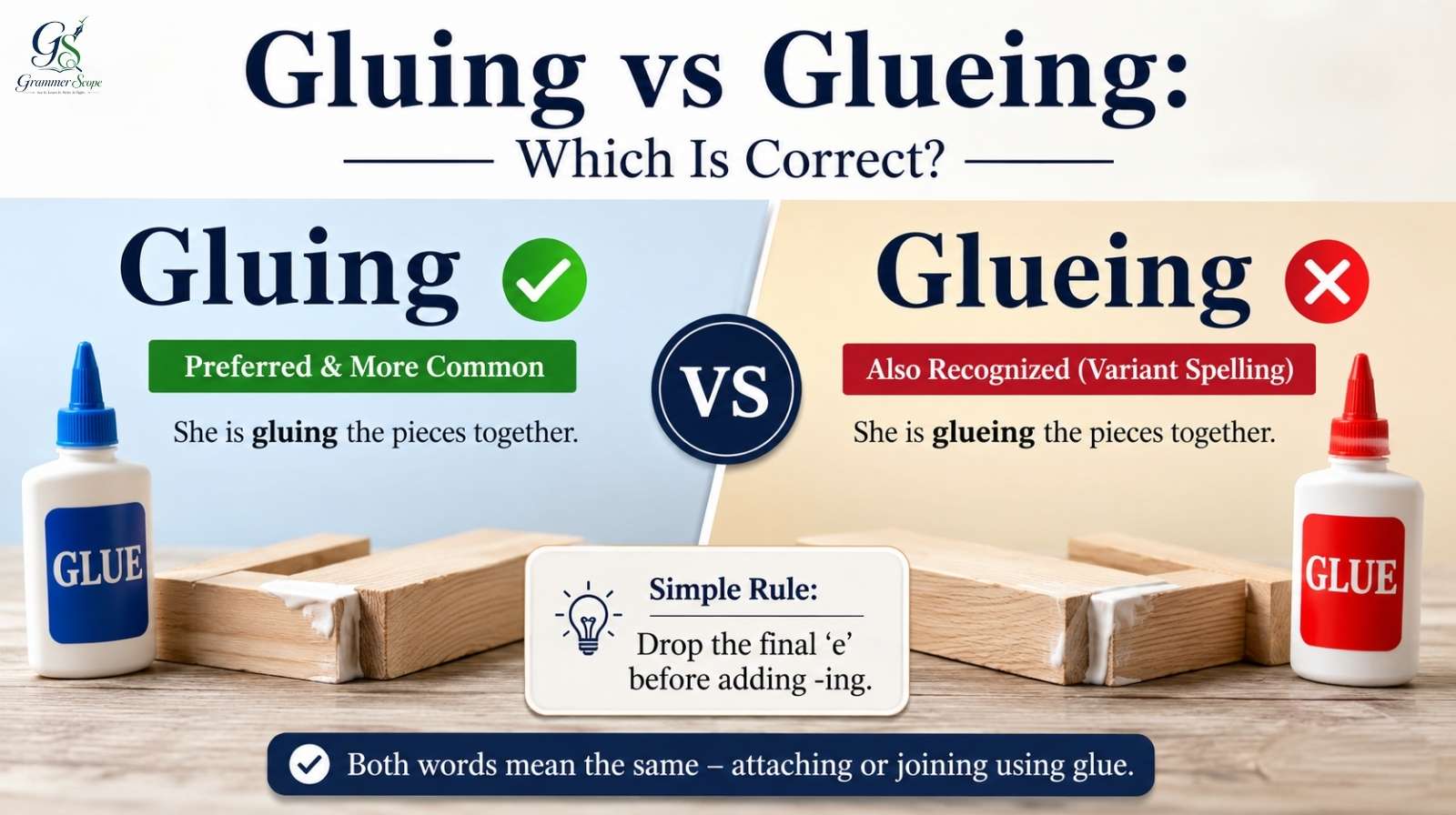
The short answer is that both gluing and glueing are recognized spellings by some major dictionaries, but gluing is generally the more common and preferred form, especially in modern American English. The confusion comes from the way English handles verbs ending in the letter e before adding -ing.
In this guide, you will learn the difference between gluing vs glueing, understand the grammar behind both spellings, see real examples, discover which version is best for formal writing, and learn an easy trick to remember the preferred spelling.
What Is the Difference Between Gluing vs Glueing?

The main difference between gluing vs glueing is spelling preference rather than meaning.
Both words come from the verb glue, meaning to attach or join things together using an adhesive substance.
- Gluing is the more widely used and preferred spelling.
- Glueing is also recognized as a variant spelling by dictionaries such as Cambridge and Merriam-Webster.
- Both forms have the same meaning.
- In most modern writing, gluing is the safest choice.
Gluing vs Glueing: Quick Comparison
| Feature | Gluing | Glueing |
|---|---|---|
| Meaning | Joining with glue | Joining with glue |
| Grammar role | Present participle/gerund | Present participle/gerund |
| Modern usage | More common | Less common |
| American English | Strongly preferred | Rare |
| British English | Common | Recognized variant |
| Best choice for general writing | Yes | Usually avoid unless style requires it |
For example:
- She is gluing the pieces together.
- The children spent the afternoon gluing paper shapes onto cards.
Although glueing can appear in dictionaries as a variant, gluing is the spelling most readers will immediately recognize.
Cambridge Dictionary lists both gluing and glueing as present participle forms of glue, while Merriam-Webster also recognizes both forms.
The Simple Answer
If you are writing:
- an essay
- blog post
- professional email
- school assignment
- business document
- website content
use gluing unless a specific style guide tells you otherwise.
It is the cleaner and more widely preferred option.
What Does “Gluing” Mean?
Gluing is the present participle and gerund form of the verb glue.
The verb glue means to join, attach, or stick something to another surface using an adhesive.
Gluing as a Present Participle
A present participle is often used with forms of be to create continuous verb tenses.
Examples:
- She is gluing the broken vase.
- They are gluing the decorations onto the wall.
- He was gluing the model airplane together.
- We will be gluing the final pieces tomorrow.
In these sentences, gluing describes an action that is happening or was happening.
Gluing as a Gerund
A gerund is an -ing form of a verb that functions as a noun.
Examples:
- Gluing requires patience.
- Gluing the pieces together was harder than expected.
- Gluing is an important part of this craft project.
The spelling stays the same whether gluing functions as a present participle or a gerund.
Gluing in Figurative Expressions
The word is not always used literally.
For example:
- The exciting story kept me glued to the book.
- The audience was glued to the screen.
Here, glued means intensely focused or unable to look away.
Cambridge defines gluing as the present participle of glue, while the verb itself means joining things together using glue.
Read More: Seel or Seal – Correct Word Explained With Examples (2026)
Why Is “Gluing” Spelled Without the E?
The spelling of gluing follows a common English spelling pattern.
When many verbs ending in a silent e take the suffix -ing, the final e is dropped.
For example:
- make → making
- bake → baking
- write → writing
- dance → dancing
- close → closing
- use → using
- glue → gluing
This pattern explains why many people naturally learn gluing as the standard spelling.
The Basic Silent E Rule
A useful spelling rule is:
When a verb ends in a silent e, the final e is usually dropped before adding -ing.
For example:
Glue + ing → Gluing
Not:
Glue + ing → Glueing according to the usual spelling pattern.
However, English is a language with historical variation, and some dictionaries still recognize glueing as an alternative form.
Why the Confusion Happens
The confusion is understandable because the word glue already ends with two vowels.
When people see:
- glue
- glue + ing
they may instinctively keep the complete original word and write glueing.
That makes visual sense, but modern usage generally favors gluing.
Think of it this way:
Drop the final e, then add -ing.
Glue → gluing
This is the easiest spelling to remember.
Is Glueing Incorrect?
This is where the answer requires a little nuance.
Calling glueing completely incorrect would be too absolute because major dictionaries recognize it as a variant spelling. Cambridge, for example, explicitly lists both glueing and gluing, and Merriam-Webster also records gluing also glueing.
However, recognition does not necessarily mean both spellings are equally common in every context.
Why “Gluing” Is Still the Better Choice
For most writers, gluing is preferable because it:
- follows the familiar silent-e spelling pattern
- looks natural to modern readers
- is widely used in American English
- appears as the primary form in many dictionaries
- avoids distracting readers who may assume glueing is a mistake
Therefore, if you want one spelling that works well almost everywhere, choose gluing.
When Might You See “Glueing”?
You may encounter glueing in:
- older publications
- British or international writing
- dictionary variant listings
- technical documents
- historical texts
- content following a particular house style
The important point is that the two spellings do not have different meanings.
Gluing and glueing both refer to the action of attaching something with glue.
The difference is primarily one of spelling preference.
Read More: Girlie or Girly: Correct Usage, Meaning And Examples (2026)

Gluing vs Glueing in American and British English
Many spelling questions become easier when we consider regional English differences. However, gluing vs glueing is not as simple as saying one spelling belongs exclusively to American English and the other exclusively to British English.
American English
In American English, gluing is overwhelmingly the safest and most familiar spelling.
Examples:
- I am gluing the poster to the board.
- The carpenter is gluing the wooden pieces together.
- She spent the afternoon gluing photos into an album.
If you write for an American audience, choose gluing.
British English
British dictionaries may be more willing to record glueing as an alternative spelling.
However, gluing is also widely understood and commonly used.
Therefore, writers should not assume that glueing is mandatory in British English.
International English
For websites, academic writing, business communication, and content intended for a global audience, gluing is usually the best option.
Why?
Because it is concise, familiar, and widely accepted.
Quick Regional Guide
| Writing Context | Recommended Spelling |
|---|---|
| American English | Gluing |
| General British English | Gluing |
| International English | Gluing |
| Academic writing | Gluing |
| Business writing | Gluing |
| SEO content | Gluing |
| Historical or house-style writing | Follow the required style guide |
The safest universal rule is simple:
Use “gluing” unless you have a specific reason or style requirement to use “glueing.”
How to Use Gluing Correctly in a Sentence
Understanding a spelling becomes easier when you see it used naturally.
Here are several examples of gluing in different contexts.
Everyday Examples
- Maria is gluing the broken picture frame.
- The children are gluing colored paper onto cardboard.
- I spent an hour gluing the model together.
- He is gluing the label onto the package.
- They were gluing the decorations before the event.
Professional Examples
- The technician is gluing the damaged components together.
- Workers are gluing the flooring material to the surface.
- The manufacturer uses automated equipment for gluing the panels.
- Proper gluing ensures a stronger bond between the materials.
Figurative Examples
The idea of glue can also describe things that bring people or ideas together.
For example:
- Trust is the glue holding the team together.
- Shared values act as the social glue of a community.
In figurative expressions, the concept remains similar: something creates a strong connection.
Read More: Puddy or Putty: Which Spelling Is Correct? (2026 Guide)
A Real-Life Writing Example: Why One Extra Letter Can Create Unnecessary Doubt
Imagine a freelance writer preparing an instructional article for a home improvement website. The article explains how to repair a broken wooden chair. While writing the step-by-step instructions, the writer repeatedly uses the phrase:
“Begin by glueing the damaged sections together.”
The sentence is understandable, and many readers would know exactly what it means. However, the editor reviewing the article pauses at the spelling. The editor has seen gluing much more often and wonders whether glueing is a typo.
Now imagine this happening throughout a long article. Even when a variant spelling is technically recognized, an unfamiliar version can interrupt the reading experience. The editor may spend unnecessary time checking dictionaries, and readers may search for confirmation.
The final version changes the wording to:
“Begin by gluing the damaged sections together.”
Nothing about the meaning changes. The instruction is exactly the same. However, the sentence now matches the spelling most modern readers expect.
This example shows an important writing lesson: correctness is not the only consideration. Clarity and reader familiarity also matter.
When multiple forms are recognized, choosing the more familiar form can improve readability. That is why gluing is generally the better choice for everyday writing, educational content, professional communication, and digital publishing.
Gluing vs Glueing: Which One Should You Use in Formal Writing?
For formal writing, the best choice is gluing.
This includes:
- academic essays
- research papers
- professional reports
- business documents
- resumes
- instructional materials
- blog posts
- website copy
Why Consistency Matters
Suppose you are writing a 2,000-word article and use:
- gluing in one paragraph
- glueing in another paragraph
Readers may wonder whether the words have different meanings.
They do not.
Using one consistent spelling prevents confusion.
A Simple Checklist
Before publishing, ask yourself:
- Am I writing for a general audience?
- Is this American or international English?
- Do I want the most familiar spelling?
- Does my style guide specify a variant?
- Have I used the same spelling consistently?
If the answer is yes to general readability and modern usage, choose:
Gluing
What About SEO Writing?
For SEO content, clarity should always come before forcing unusual keyword variations.
If people search for both gluing vs glueing, it makes sense to explain both spellings naturally. However, the main body should not repeatedly switch between them without purpose.
A strong approach is:
- Use gluing as the preferred spelling.
- Mention glueing when explaining the variant.
- Answer the user’s exact search question clearly.
- Use natural language instead of repeating keywords excessively.
Google’s guidance emphasizes helpful, reliable, people-first content rather than content created primarily to manipulate rankings. It also encourages clear sourcing and demonstrates the importance of trust and expertise.
Read More: Labeller or Labeler: Which Spelling Is Correct?

Common Mistakes People Make With Gluing and Glueing
The gluing vs glueing confusion often leads to a few predictable mistakes.
Mistake 1: Assuming Glueing Has a Different Meaning
Some people think:
- gluing = attaching things with glue
- glueing = something else
This is incorrect.
Both spellings refer to the same action.
Mistake 2: Thinking One Extra Letter Changes the Grammar
Both words can function as the -ing form of glue.
For example:
- She is gluing the pieces together.
- Glueing is listed as a variant form.
The grammatical function remains the same.
Mistake 3: Using Both Forms Randomly
Switching between gluing and glueing can make writing look inconsistent.
Choose one spelling and stick with it.
For most situations, choose gluing.
Mistake 4: Applying Every Silent-E Rule Without Checking
English spelling contains patterns, but it also contains exceptions and historical variants.
For example:
- make → making
- write → writing
- use → using
- glue → gluing
The rule helps, but dictionaries remain useful when a word seems unusual.
Mistake 5: Assuming the Less Common Form Is Always Wrong
Language is more complicated than a simple right-or-wrong list.
Some spellings are:
- standard
- preferred
- accepted variants
- regional forms
- archaic forms
In this case, glueing is a recognized variant, but gluing is the more practical choice for most modern writing.
Read More: Any Time vs Anytime: Meaning, Usage And Grammar Rules

The Grammar Rule Behind Gluing
Understanding the grammar rule makes this spelling easier to remember.
Primary Rule: Drop the Silent E Before -ING
Many English verbs ending in silent e drop that letter before adding -ing.
Examples:
| Base Verb | -ING Form |
|---|---|
| make | making |
| bake | baking |
| write | writing |
| dance | dancing |
| close | closing |
| move | moving |
| use | using |
| glue | gluing |
This pattern is why gluing looks natural within standard English spelling conventions.
Important Exceptions to the Rule
Of course, English has exceptions.
Sometimes the final e remains before -ing.
For example:
- see → seeing
- agree → agreeing
- flee → fleeing
These examples show why English learners sometimes hesitate with words like glue.
The safest approach is to remember that spelling patterns are helpful guides, but dictionaries determine accepted usage.
The Best Memory Trick
Remember this phrase:
Glue loses the e before -ing.
So:
GLUE → GLUING
This simple mental shortcut works well for everyday writing.
Read More: Bougie or Boujee: Which One Should You Use? (2026 Guide)
Language Data and Why Spelling Clarity Still Matters in 2025–2026
English remains one of the dominant languages of online publishing, which means small spelling questions can affect a large number of readers. W3Techs data reported in late 2025 estimated that English was used as the content language on roughly 49% of websites among the sites it measured.
That does not mean every spelling variation harms communication. Readers usually understand both gluing and glueing.
However, digital writing depends heavily on immediate clarity.
A reader scanning:
- instructions
- product guides
- educational content
- search results
- professional documents
should not have to stop and question a familiar word.
This is where preferred spelling matters.
What the Data Means for Writers
The practical lesson is not that every sentence must follow one global version of English.
Instead:
- Choose a recognized spelling.
- Match your target audience.
- Follow a consistent style.
- Prefer familiar wording when possible.
- Check authoritative dictionaries when uncertain.
For gluing vs glueing, the most straightforward recommendation remains:
Use gluing for most modern content.

Gluing vs Glueing: Step-by-Step Decision Guide
Still unsure which spelling to use? Follow this simple process.
Step 1: Identify the Meaning
Are you referring to the action of attaching something using glue?
Example:
She is ___ the paper to the wall.
The answer involves the verb glue.
Step 2: Add the -ING Form
The standard preferred form is:
glue → gluing
Step 3: Consider Your Audience
If your readers are:
- American
- international
- students
- general online audiences
- professional readers
choose gluing.
Step 4: Check Your Style Guide
If you work for a publication with a specific house style, follow that guide.
Consistency is more important than randomly mixing variants.
Step 5: Use the Simple Default
When uncertain, write:
Gluing
It is the most practical choice for modern English writing.
Read More: Drier or Dryer: Which Word Is Correct?
Gluing vs Glueing in Search Queries and Everyday Writing
One reason this spelling question continues to appear is that search behavior and writing behavior are not always the same.
People may type:
- How do you spell glueing?
- Is glueing correct?
- Gluing or glueing?
- Why is gluing spelled without e?
The fact that someone searches for glueing does not mean that spelling should automatically become the preferred form in the answer.
A good educational article should acknowledge the confusion and then provide context.
Search Query vs Recommended Usage
A reader might search:
Is glueing correct?
The answer should explain:
- Yes, glueing is recognized as a variant by some dictionaries.
- Gluing is generally more common and preferred.
- Both forms refer to the same action.
- For most modern writing, use gluing.
This approach is more helpful than simply saying one form is right and the other is always wrong.
Quick Examples: Correct Usage of Gluing
Here are more examples to help make the spelling automatic.
In a School Project
- The students are gluing pictures into their notebooks.
- We spent the afternoon gluing cardboard pieces together.
In DIY Instructions
- Start by gluing the wooden edges together.
- Allow the adhesive to dry after gluing the pieces.
In Crafting
- She enjoys gluing beads onto handmade cards.
- Gluing requires a steady hand when working with small objects.
In Professional Writing
- The process involves cutting, shaping, and gluing the materials.
- Workers are gluing the panels before the final inspection.
The more often you see gluing used naturally, the easier the spelling becomes to remember.
Read More: Breath or Breathe: Clear Difference, Rules, And Examples
Mini Quiz: Gluing vs Glueing
Quiz 1: Pick the Preferred Spelling
Which spelling is generally preferred in modern English?
A. Glueing
B. Gluing
Answer: B. Gluing
Quiz 2: Fill in the Blank
She is ______ the broken pieces of the vase together.
Answer: Gluing
Quiz 3: Quick Choice
What is the base verb of gluing?
A. Glue
B. Glued
C. Glues
Answer: A. Glue
Quiz 4: Spot the Correct Sentence
Which sentence uses the preferred modern spelling?
A. The children are glueing pictures into their books.
B. The children are gluing pictures into their books.
Answer: B. The children are gluing pictures into their books.
Quiz 5: Fill in the Blank
Complete the spelling pattern:
Glue → ______
Answer: Gluing
Quiz 6: True or False
Gluing and glueing have completely different meanings.
Answer: False
Both words refer to the action of attaching something using glue.
Quiz 7: Grammar Challenge
In the sentence below, what is gluing?
“She is gluing the paper to the wall.”
A. Noun
B. Present participle
C. Adjective
Answer: B. Present participle
Quiz 8: Fill in the Blank
The common spelling rule is:
Drop the final e and add ______.
Answer: -ing
Quiz 9: Which One Sounds Right?
Choose the best sentence for modern professional writing:
A. The workers are glueing the wooden panels.
B. The workers are gluing the wooden panels.
Answer: B. The workers are gluing the wooden panels.
Quiz 10: Fast Spelling Test
Which word follows a similar spelling pattern?
A. Make → Making
B. Make → Makeing
C. Make → Makeng
Answer: A. Make → Making
Quiz 11: Fill in the Blank
For most everyday, academic, and professional writing, ______ is the safest choice.
Answer: Gluing
Quiz 12: True or False
Glueing is always considered completely incorrect by every dictionary.
Answer: False
Some major dictionaries recognize glueing as a variant spelling, although gluing is generally preferred.
Quiz 13: Meaning Check
What does gluing mean?
A. Cutting something apart
B. Joining things using an adhesive
C. Painting a surface
Answer: B. Joining things using an adhesive
Quiz 14: Final Challenge
Complete this simple memory trick:
Glue loses the ______ before adding -ing.
Answer: e
Remember: Glue → Gluing.
References
For further reading and authoritative definitions, consult these trusted sources:
Frequently Asked Questions
Q1: Is gluing or glueing correct?
A: Both gluing and glueing are recognized as variants by some major dictionaries. However, gluing is the more common and generally preferred spelling in modern writing.
Q2: Why is gluing spelled without an E?
A: Gluing follows the common rule of dropping a final silent e before adding -ing. Similar examples include make → making and bake → baking.
Q3: Is glueing wrong in British English?
A: Not necessarily. Glueing is recognized as a variant spelling by dictionaries, including Cambridge. However, gluing is also widely used and is generally the safer choice for most readers.
Q4: Is gluing a verb or a noun?
A: It can function as both. As a present participle, it is part of a verb phrase: “She is gluing the paper.” As a gerund, it acts as a noun: “Gluing requires patience.”
Q5: Which spelling should I use in an essay?
A: Use gluing unless your teacher, institution, or required style guide specifies otherwise. It is the more familiar and widely preferred form.
Q6: Does gluing have a different meaning from glueing?
A: No. Both spellings refer to the same action: attaching or joining something using glue.
Q7: How can I remember the correct spelling?
A: Use this memory trick:
Drop the e, add -ing: glue → gluing.
Final Verdict: Gluing vs Glueing
So, gluing vs glueing: which is correct?
The most accurate answer is that both spellings are recognized by some authoritative dictionaries, but gluing is the more common and preferred spelling for modern English writing. Cambridge and Merriam-Webster both acknowledge variant forms, while gluing remains the safest choice for everyday, academic, professional, and online content.
The easiest rule to remember is:
Glue → Gluing
Drop the final e and add -ing.
If you want your writing to look clear, natural, and familiar to the widest audience, choose gluing. And whenever an English spelling looks confusing, do not rely only on instinct check the grammar pattern, consider your audience, and verify unusual cases with a trusted dictionary.
Discover More Articles
- Coach vs Couch: What’s The Difference In 2026?
- Shown vs Showed: The Complete Guide To Using These Two Forms Correctly (2026)
- Hola or Ola? The Complete Guide To Meaning, Usage And Confusion
Ready to improve your English? Read more guides on Grammer Scope