Have you ever paused while writing an email and wondered whether to write any time or anytime? You’re not alone. These two expressions look almost identical, yet they don’t always serve the same purpose. Using the wrong one can make your writing appear less polished, especially in academic, professional, or online content.
The confusion exists because English contains many compound words that evolved over time. While anytime has become a common single-word adverb, any time still remains the correct choice in several grammatical situations. Knowing which one fits your sentence can instantly improve your writing.
In this guide, you’ll learn the exact difference between Any Time vs Anytime, discover simple grammar rules, see plenty of real-world examples, and learn an easy trick that helps you choose the correct form every time.
What Is the Difference Between Any Time and Anytime?
Although these expressions have similar meanings, they are not always interchangeable.
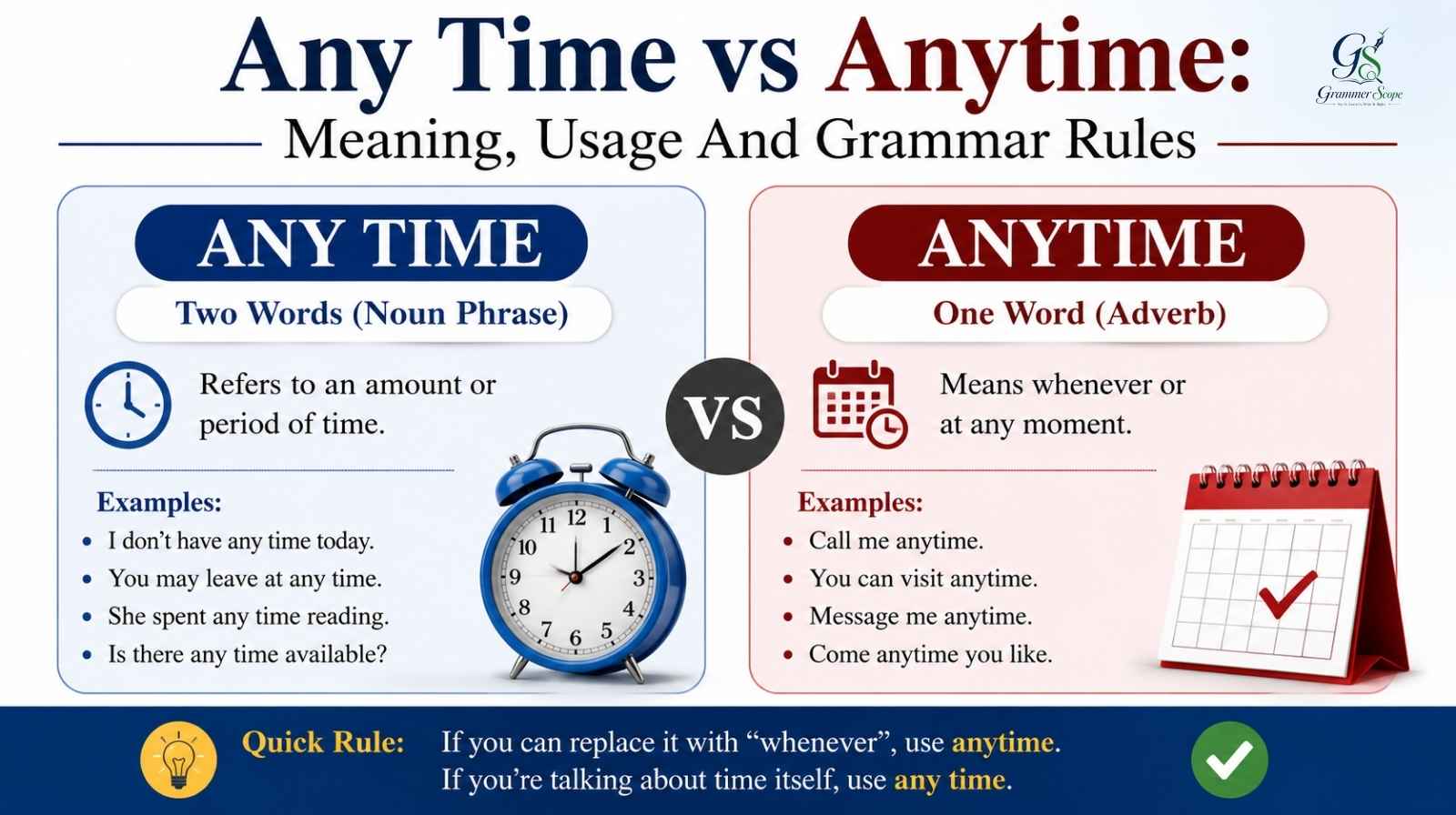
- Any time is a two-word noun phrase.
- Anytime is a one-word adverb.
The easiest way to remember this is to identify what the sentence needs. If you’re referring to an amount of time, use any time. If you’re describing when something can happen, anytime is usually the better choice.
Understanding “Any Time”
Any time refers to an unspecified amount or period of time. Since it functions as a noun phrase, it often follows a preposition such as at, for, or during.
Examples:
- I don’t have any time to watch television today.
- She didn’t spend any time worrying about the results.
- We can discuss it at any time that suits you.
- Is there any time available tomorrow?
Notice that each sentence refers to an actual amount or period of time.
Understanding “Anytime”
Anytime functions as an adverb meaning whenever or at any moment.
Examples:
- You can call me anytime.
- Feel free to visit anytime.
- The support team is available anytime.
- Come back anytime you need help.
In these examples, anytime describes when an action may happen.
Quick Rule to Remember
Ask yourself this question:
Can I replace the word with “whenever”?
If the answer is yes, anytime is usually correct.
If the answer is no, you probably need any time.
For example:
✔ Call me anytime.
→ Call me whenever.
✔ I don’t have any time today.
→ I don’t have whenever today. ❌
Read More: Other Than or Other Then: Which Spelling Is Right?
Meaning of “Any Time”
The phrase any time means an unspecified amount of time or any particular moment. It has existed much longer than the single-word form and remains common in formal English.
You’ll often see it after prepositions and verbs referring to available time.
When to Use “Any Time”
Use any time when discussing:
- Available time
- Amount of time
- A specific period
- Scheduling
- Time that belongs to someone
Examples:
- Do you have any time this afternoon?
- I couldn’t find any time to finish the report.
- She rarely has any time for herself.
- We appreciate any time you can volunteer.
These examples show that the phrase refers to actual time rather than simply describing when something happens.
Common Sentence Patterns
You’ll frequently see:
- have any time
- spend any time
- find any time
- at any time
- during any time
Examples:
- We didn’t spend any time arguing.
- You may leave at any time.
- She cannot find any time to relax.
- The offer may end at any time.
Although at any time contains two words, it remains grammatically correct because the preposition at requires the noun phrase any time.
Read More: Striping vs Stripping: Meaning, Grammar And Usage Guide
Meaning of “Anytime”
Anytime is a modern compound word that acts as an adverb. It means whenever, at any moment, or whenever convenient.
It’s commonly used in conversation, emails, websites, advertisements, and everyday writing.
When to Use “Anytime”
Choose anytime when it modifies a verb by telling when an action can happen.
Examples:
- Stop by anytime.
- You can message me anytime.
- Visitors are welcome anytime.
- Feel free to ask questions anytime.
In each sentence, the word answers the question When?
Anytime vs Whenever
One of the easiest grammar tricks is replacing anytime with whenever.
Examples:
✔ Visit us anytime.
→ Visit us whenever.
✔ Email me anytime.
→ Email me whenever.
If the sentence still sounds natural, anytime is the correct choice.
Any Time vs Anytime: Side-by-Side Comparison
| Feature | Any Time | Anytime |
|---|---|---|
| Word Type | Two-word noun phrase | One-word adverb |
| Meaning | An amount or period of time | Whenever or at any moment |
| Formal Writing | Preferred where a noun phrase is required | Accepted in modern English as an adverb |
| Can Replace with “Whenever”? | No | Yes |
| Used After Prepositions? | Yes | Usually No |
| Example | I don’t have any time today. | Call me anytime. |
| Grammar Function | Refers to time itself | Describes when something happens |
Read More: Goodmorning or Good Morning: Which One Is Correct?
Common Grammar Rules You Should Never Forget
Understanding the grammar behind Any Time vs Anytime becomes much easier when you learn a few simple rules. Instead of memorizing dozens of examples, remember these guidelines whenever you write.
Rule 1: Use “Any Time” After Prepositions
When the phrase follows a preposition such as at, for, during, in, or without, the correct form is almost always any time because it functions as a noun phrase.
Examples
- You may leave at any time.
- We didn’t have any time for lunch.
- She worked without any time to rest.
- You can cancel your subscription at any time.
- I haven’t had any time this week.
This is one of the most reliable grammar rules to remember.
Rule 2: Use “Anytime” as an Adverb
If the word tells when something can happen, use anytime.
Examples
- Call me anytime.
- You’re welcome anytime.
- Come back anytime you need assistance.
- Feel free to contact us anytime.
In each sentence, anytime modifies the verb and answers the question “When?”
Rule 3: Replace It with “Whenever”
A quick editing trick is to replace the word with whenever.
If the sentence still makes sense, anytime is correct.
✔ Visit us anytime.
→ Visit us whenever.
✔ Email me anytime.
→ Email me whenever.
However:
✘ I don’t have whenever today.
Therefore, the correct sentence is:
✔ I don’t have any time today.
Rule 4: Formal Writing Requires Extra Attention
Modern dictionaries accept anytime as an adverb. However, many editors still prefer any time in very formal or academic writing, especially after prepositions.
If you’re writing:
- a university paper
- a legal document
- a business proposal
- a government report
always double-check your usage.
Read More: Lable or Label: Which Spelling Is Correct?
Common Mistakes Writers Make
Even experienced writers occasionally confuse these two expressions because they sound identical.
Here are the mistakes you should avoid.
Mistake 1: Writing “Anytime” After a Preposition
❌ You may leave at anytime.
✔ You may leave at any time.
Mistake 2: Using “Any Time” as an Adverb
❌ Call me any time.
✔ Call me anytime.
Although some style guides accept both in informal writing, anytime is generally the preferred adverb.
Mistake 3: Assuming They Are Always Interchangeable
Many learners think the two forms always mean the same thing.
They don’t.
Choosing the correct form depends on grammar, not just meaning.
Mistake 4: Ignoring Sentence Structure
Instead of memorizing one rule, identify the sentence’s function.
Ask yourself:
- Is this referring to time itself?
- Or is it describing when something happens?
That single question usually gives you the correct answer.
Read More: As Well or Aswell – Which One Is Correct?
Real-Life Example: How One Small Grammar Choice Improved a Business Website
A freelance copywriter was hired to rewrite the customer support pages for an online software company. While reviewing the website, she noticed that almost every page used the phrase “Contact us at anytime.”
At first glance, the sentence looked perfectly acceptable. However, because the phrase followed the preposition at, it was grammatically incorrect. She updated every occurrence to “Contact us at any time.”
During the same editing project, she left sentences such as “You can chat with us anytime.” unchanged because anytime was functioning correctly as an adverb.
After publishing the revised content, the company also standardized similar expressions throughout its knowledge base and help center. This consistency made the website feel more professional and easier to read. Customer emails became more polished because support agents copied the corrected wording directly from the website.
The lesson is simple: grammar isn’t only about passing English exams. Small choices like any time versus anytime influence readability, professionalism, and credibility. Whether you’re writing blog posts, marketing content, emails, or academic papers, understanding the correct form helps your writing appear more trustworthy and polished.
Read More: Take Effect or Take Affect? The Correct Phrase Explained
Why This Difference Matters in SEO and Online Writing
If you publish articles, product descriptions, or business websites, using the correct form improves both readability and user trust.
Search engines increasingly reward content that demonstrates clarity, expertise, and a positive user experience. While Google does not rank a page simply because it uses any time or anytime correctly, accurate grammar contributes to higher-quality content that readers are more likely to trust and engage with.
Here are a few reasons why correct usage matters:
Better User Experience
Readers can understand your message without stopping to question your wording.
Improved Professionalism
Correct grammar builds confidence in your expertise, whether you’re running a blog or a business website.
Higher Content Quality
Well-edited content is easier to read, more likely to earn backlinks, and often performs better over time because users stay engaged.
Stronger Brand Credibility
Consistent grammar helps your website appear reliable and authoritative, which is especially important for educational and professional content.
Language Trends and Usage (2025–2026)
Recent writing guidance from major language authorities continues to recognize a clear distinction between any time and anytime.
- Modern dictionaries, including Merriam-Webster and Cambridge Dictionary, list anytime as a standard adverb meaning whenever.
- Most grammar style resources still recommend any time whenever the phrase functions as a noun or follows a preposition.
- Digital writing assistants and grammar checkers increasingly flag incorrect combinations such as “at anytime”, encouraging writers to use “at any time” instead.
- With AI-assisted writing becoming more common in 2025–2026, careful human proofreading remains essential because automated tools can still miss context-dependent grammar choices.
These trends show that understanding the grammatical role of the expression not just memorizing the spelling is the key to using it correctly.
Read More: Long Term or Longterm: Which Spelling Is Correct in 2026?
Mini Quiz: Any Time vs Anytime
Quiz 1: Choose the Correct Word
Which sentence is correct?
A. Call me any time.
B. Call me anytime.
✅ Answer: B. Call me anytime.
Quiz 2: Fill in the Blank
You can visit us ________ you like.
✅ Answer: anytime
Quiz 3: True or False
“Anytime” is always written as two words.
✅ Answer: False
Quiz 4: Pick the Correct Sentence
A. I don’t have anytime today.
B. I don’t have any time today.
✅ Answer: B. I don’t have any time today.
Quiz 5: Fill in the Blank
I didn’t have ________ to finish my homework.
✅ Answer: any time
Quiz 6: Which One Means “Whenever”?
A. Any time
B. Anytime
✅ Answer: B. Anytime
Quiz 7: Fill in the Blank
Feel free to message me ________.
✅ Answer: anytime
Quiz 8: Choose the Correct Option
Which phrase is correct?
A. At anytime
B. At any time
✅ Answer: B. At any time
Quiz 9: True or False
Any time refers to an amount or period of time.
✅ Answer: True
Quiz 10: Fill in the Blank
You may leave at ________.
✅ Answer: any time
Quiz 11: Spot the Correct Sentence
A. Come back anytime you need help.
B. Come back any time you need help.
✅ Answer: A. Come back anytime you need help.
Quiz 12: Fill in the Blank
Do you have ________ available tomorrow afternoon?
✅ Answer: any time
Quiz 13: Quick Grammar Check
Which word is an adverb?
A. Any time
B. Anytime
✅ Answer: B. Anytime
Quiz 14: Fill in the Blank
Our support team is available ________.
✅ Answer: anytime
Quiz 15: Final Challenge
Complete the sentence:
You can cancel your subscription at ________.
✅ Answer: any time
References
- Merriam-Webster Dictionary – Entry for Anytime and Any Time
https://www.merriam-webster.com/ - Cambridge Dictionary – Definitions and usage examples for Anytime and Any Time
https://dictionary.cambridge.org/
Frequently Asked Questions
Q1: Is anytime one word or two words?
A: It depends on how it’s used.
- Anytime (one word) is an adverb meaning whenever or at any moment.
- Any time (two words) is a noun phrase that refers to an amount or period of time.
Examples
- You can visit anytime.
- I don’t have any time today.
Q2: Which is more correct: any time or anytime?
A: Neither is more correct than the other. The correct choice depends on the sentence.
Use any time when referring to time itself.
Use anytime when describing when something can happen.
Q3: Can I use anytime in formal writing?
A: Yes, anytime is widely accepted in modern English as an adverb.
However, in highly formal or academic writing, many editors recommend using any time whenever the sentence requires a noun phrase, especially after prepositions like at or for.
Q4: Why is “at anytime” usually incorrect?
A: The preposition at requires the noun phrase any time, not the adverb anytime.
✔ Correct:
- You may leave at any time.
✘ Incorrect:
- You may leave at anytime.
Q5: What’s the easiest way to remember the difference?
A: Use this simple trick:
If you can replace it with whenever, use anytime.
If you’re talking about an amount or period of time, use any time.
Q6: Is anytime accepted by dictionaries?
A: Yes. Major dictionaries such as Merriam-Webster, Cambridge Dictionary, and Dictionary.com recognize anytime as a standard English adverb.
Key Takeaways
Before you finish, remember these essential rules:
- Any time is a two-word noun phrase that refers to an amount or period of time.
- Anytime is a one-word adverb meaning whenever.
- Use any time after prepositions like at, for, and during.
- Replace the word with whenever to check if anytime is correct.
- Understanding the sentence’s grammar is more important than memorizing examples.
- Correct usage improves clarity, professionalism, and the overall quality of your writing.
Conclusion
Understanding the difference between Any Time vs Anytime is much easier once you know their grammatical roles. Although they look similar, they are not always interchangeable.
Use any time when you’re referring to an amount or period of time, and choose anytime when you mean whenever or at any moment. A quick “whenever” test can help you decide which form belongs in your sentence.
Whether you’re writing emails, blog posts, academic papers, or professional documents, applying these simple rules will make your writing clearer, more accurate, and more credible. Over time, these small grammar improvements can make a noticeable difference in how readers perceive your content.
Discover More Articles
- It’s Called vs It Called: Understanding The Distinction
- Flier vs Flyer: Which Spelling Is Correct in 2026?
- You Too or You To: What’s the Correct Grammar in 2026?
Ready to improve your English? Read more guides on Grammer Scope

Bilal Khalid is a professional blogger specializing in grammar guides and practical writing tips. He helps readers improve clarity, accuracy, and confidence in communication through simple explanations, actionable advice, and easy-to-follow strategies for everyday and professional writing.