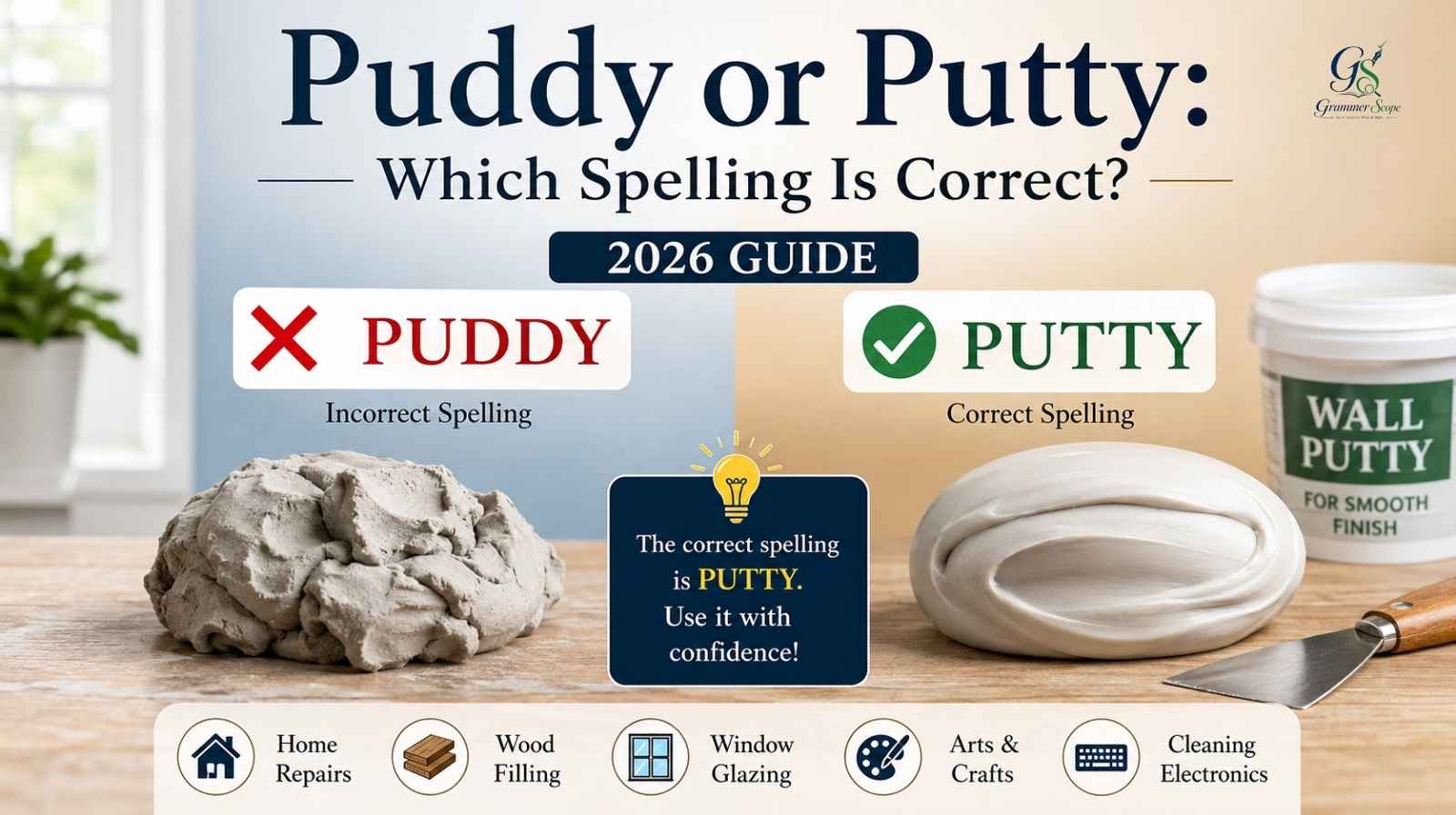
Have you ever typed “puddy” while writing an email, homework assignment, or social media post and wondered if it was actually correct? You’re definitely not alone. English contains thousands of words with similar sounds, making spelling mistakes surprisingly common.
One of the most frequently confused spellings is Puddy or Putty. At first glance, both appear believable, but only one is considered correct in standard English. Using the wrong spelling can make your writing look less professional and may even confuse readers.
In this complete grammar guide, you’ll discover the correct spelling, its meaning, pronunciation, grammar rules, real-life examples, common mistakes, and practical tips to help you remember it forever. By the end of this article, you’ll know exactly when and why you should use putty instead of puddy.
Puddy or Putty: Which One Is Correct?
The correct spelling is putty.
Puddy is generally considered a misspelling of putty in modern English dictionaries and standard writing. Unless you’re referring to a person’s surname, a fictional character, or a brand name, puddy should not be used when talking about the soft material used for filling holes or sealing glass.
Quick Answer
| Word | Correct? | Meaning |
|---|---|---|
| Putty | ✅ Yes | A soft material used for sealing, filling, repairing, or modeling. |
| Puddy | ❌ No | Usually a spelling mistake unless used as a proper noun or name. |
If you’re writing essays, blog posts, business emails, or academic documents, always choose putty.
Why Do People Write “Puddy”?
There are several reasons why this spelling mistake happens.
- The words sound similar in many English accents.
- English pronunciation doesn’t always match spelling.
- Fast typing often replaces tt with dd.
- Autocorrect may fail to catch uncommon typing errors.
- Some people simply remember the pronunciation instead of the spelling.
Fortunately, once you understand the origin and meaning of putty, the correct spelling becomes much easier to remember.
Read More: Transferred vs Transfered: Which Is Correct?
What Does Putty Mean?
Putty is a soft, moldable substance used in construction, repairs, arts and crafts, and various industrial applications. Traditionally, it is made from a mixture of powdered chalk and linseed oil, although modern versions use synthetic materials designed for specific purposes.
Depending on the context, putty may refer to several different products.
Building Putty
Builders use putty to fill cracks, seal window frames, and smooth small imperfections before painting.
Example:
The carpenter applied fresh putty around the window before installing the glass.
Wall Putty
Wall putty creates a smooth surface before painting interior or exterior walls.
Example:
Always let the wall putty dry completely before applying the first coat of paint.
Modeling Putty
Children, artists, and hobbyists use modeling putty because it is soft, reusable, and easy to shape.
Example:
The children spent hours creating colorful animals with modeling putty.
Cleaning Putty
Special cleaning putty removes dust from keyboards, cameras, and electronic devices.
Example:
Cleaning putty easily reached the dust trapped between the keyboard keys.
Why “Puddy” Is Usually Incorrect
Many English learners assume puddy is simply another accepted spelling. However, reputable English dictionaries recognize putty as the standard spelling for the material.
Standard English Uses “Putty”
Whether you’re writing for school, work, or online publishing, professional English requires the spelling putty.
For example:
✅ I bought wall putty before repainting the room.
❌ I bought wall puddy before repainting the room.
Only the first sentence follows standard English conventions.
Are There Any Exceptions?
Yes but they are uncommon.
The word Puddy may appear as:
- A family surname.
- The name of a fictional character.
- A business or brand name.
- A nickname.
These uses are proper nouns and do not change the correct spelling of the common English noun putty.
Spelling Tip
Remember this simple trick:
Putty has two Ts because it is used to fix Things.
This easy memory aid helps reinforce the correct spelling whenever you’re unsure.
Read More: Other Than or Other Then: Which Spelling Is Right?
The Origin and History of the Word “Putty”
Understanding where a word comes from often makes it easier to spell correctly.
The word putty entered English several centuries ago through French, ultimately tracing back to Latin roots related to materials used for sealing and plastering. Over time, builders, craftsmen, and glaziers adopted the term to describe a soft compound used to secure glass panes and repair small surface imperfections.
How the Meaning Expanded
Originally associated with glazing windows, putty gradually took on broader meanings as new materials and technologies emerged. Today, the term can describe products used in:
- Home improvement
- Automotive repairs
- Woodworking
- Arts and crafts
- Electronics cleaning
- Industrial manufacturing
Despite these evolving applications, the spelling has remained consistently putty in standard English.
Why the Spelling Stayed the Same
Unlike many English words that developed multiple accepted spellings over time, putty retained its original form. This consistency is one reason dictionaries, style guides, and educational resources continue to recognize putty as the only standard spelling for the material.
Read More: Striping vs Stripping: Meaning, Grammar And Usage Guide
Common Examples of Putty in Everyday English
One of the easiest ways to remember the correct spelling is to see putty used in real-life situations. Below are examples from different contexts.
Home Improvement
People often use wall putty before painting to create a smooth, even finish.
Examples
- The painter applied putty to the wall before adding the final coat of paint.
- We need more putty to repair the cracks around the window.
- The contractor recommended waterproof wall putty for the bathroom.
Woodworking and Furniture Repair
Woodworkers use putty to fill nail holes, dents, and scratches.
Examples
- She used wood putty to hide the small holes in the table.
- Allow the putty to dry before sanding the surface.
- The repaired cabinet looked brand new after applying wood putty.
Glass Installation
Traditional glazing putty holds glass securely inside wooden window frames.
Examples
- The old window needed fresh glazing putty.
- He carefully removed the damaged putty before replacing the glass.
- Fresh putty helps create a weather-resistant seal.
Arts and Crafts
Modeling putty is popular among children, artists, and hobbyists.
Examples
- The students made miniature animals using colorful putty.
- Modeling putty is easy to shape and reuse.
- She enjoys creating tiny sculptures from soft putty.
Technology Cleaning
Cleaning putty removes dust from electronics.
Examples
- Cleaning putty reached the dirt between the keyboard keys.
- A small amount of putty removed dust from the camera lens cover.
- Use cleaning putty gently to avoid damaging delicate devices.
Read More: Submission vs Submittion: Learn The Correct Spelling

Puddy vs Putty: A Simple Comparison
If you’re still unsure which spelling to choose, this quick comparison makes the difference clear.
| Feature | Puddy | Putty |
|---|---|---|
| Standard English word | ❌ No | ✅ Yes |
| Found in major dictionaries | ❌ Generally no | ✅ Yes |
| Correct for construction material | ❌ No | ✅ Yes |
| Suitable for academic writing | ❌ No | ✅ Yes |
| Professional usage | ❌ No | ✅ Yes |
| May be used as a name | ✅ Sometimes | ❌ Usually not |
Key Takeaway
Whenever you’re referring to the soft material used for sealing, filling, repairing, or modeling, putty is always the correct spelling.
Read More: Goodmorning or Good Morning: Which One Is Correct?
Common Mistakes Writers Make
Spelling errors often happen because English pronunciation can be misleading. Here are some of the most common mistakes involving putty.
Mistake 1: Writing the Word as “Puddy”
❌ The wall needs more puddy.
✅ The wall needs more putty.
Mistake 2: Assuming Both Spellings Are Correct
Many people think puddy is simply an American or British variation.
That isn’t true.
Unlike words such as color/colour or center/centre, putty has only one standard spelling.
Mistake 3: Depending Only on Pronunciation
Some accents make putty sound almost like puddy, leading people to spell it incorrectly.
A good rule is to remember that English spelling doesn’t always match pronunciation.
Mistake 4: Ignoring Spell Check
Although modern writing tools catch many mistakes, they don’t always recognize context.
Proofreading your work remains one of the best ways to eliminate spelling errors.
How to Remember the Correct Spelling
Fortunately, remembering putty is easier than you might think.
Trick 1: Think About Repairs
Putty fixes Things.
Both words contain TT, making this an easy memory trick.
Trick 2: Connect It to Construction
Whenever you hear the word putty, imagine someone repairing a cracked wall or sealing a window.
Visual memory helps reinforce correct spelling.
Trick 3: Read More
Reading books, articles, and reputable websites exposes you to correct spelling repeatedly.
Over time, your brain naturally recognizes putty as the correct form.
Trick 4: Practice Writing
Write a few sentences using the word.
For example:
- I bought wall putty yesterday.
- The carpenter replaced the old putty.
- Wood putty repaired the damaged furniture.
Simple repetition strengthens long-term memory.
Read More: Lable or Label: Which Spelling Is Correct?
Step-by-Step Guide: How to Avoid Confusing Puddy and Putty
If you frequently mix up these words, follow this simple process before publishing or submitting your writing.
Step 1: Ask Yourself What the Word Means
Are you talking about a soft material used for repairing, sealing, or filling?
If yes, the answer is putty.
Step 2: Double-Check the Spelling
Look carefully for TT in the middle.
Correct:
P U T T Y
Step 3: Use a Dictionary
If you’re uncertain, verify the spelling using trusted dictionaries such as:
- Merriam-Webster
- Cambridge Dictionary
- Oxford Learner’s Dictionary
Reliable references eliminate guesswork.
Step 4: Read the Sentence Aloud
Sometimes hearing the sentence helps you notice unusual spellings.
Although puddy may sound acceptable in casual speech, it doesn’t belong in standard written English.
Step 5: Proofread Before Publishing
Whether you’re writing a blog post, email, school assignment, or business report, always perform one final spelling check.
A few extra seconds can prevent embarrassing mistakes.
Read More: As Well or Aswell – Which One Is Correct?
Real-Life Case Study: How One Small Spelling Mistake Affected a Home Improvement Blog
A home improvement blogger published a detailed guide about repairing damaged walls before painting. The article contained useful advice, high-quality images, and practical step-by-step instructions. However, throughout the article, the writer repeatedly used the word “puddy” instead of “putty.”
At first, the mistake seemed harmless. Readers still understood the general topic. But over the following weeks, several visitors left comments pointing out the incorrect spelling. A few readers questioned the credibility of the guide because such a basic mistake appeared multiple times. Others wondered whether “puddy” referred to a different product.
After reviewing the feedback, the blogger corrected every occurrence of “puddy” to “putty,” updated the headings, image captions, and meta description, and republished the article. The revised version appeared more professional, gained reader trust, and reduced confusion for new visitors.
This example highlights an important lesson: even a single repeated spelling mistake can affect how readers perceive your expertise. Accurate spelling not only improves readability but also strengthens credibility, especially in educational and informational content. Whether you’re publishing a blog, writing an assignment, or preparing business documents, using the correct spelling—putty—helps create a polished and trustworthy impression.
Why Correct Spelling Matters for SEO and User Experience (2025–2026)
Search engines have become increasingly effective at understanding search intent, spelling variations, and content quality. Modern algorithms can often recognize common misspellings, but they still reward content that demonstrates expertise, accuracy, and trustworthiness.
According to Google’s Search Quality Evaluator Guidelines, high-quality content should be factually accurate, well-written, and created to help users. Consistent spelling supports these quality signals by improving readability and user confidence.
At the same time, writing platforms and grammar tools continue to emphasize the importance of error-free content. Industry reports from 2025–2026 indicate that users are more likely to trust articles that are professionally written and free from obvious spelling mistakes, particularly when researching educational or technical topics.
For writers, bloggers, students, and businesses, using putty instead of puddy isn’t just about following dictionary rules it’s about presenting clear, credible, and authoritative content that readers can rely on.
Read More: Take Effect or Take Affect? The Correct Phrase Explained
Mini Quiz: Puddy or Putty
Quiz 1: Which Spelling Is Correct?
Which word is the correct English spelling?
A. Puddy
B. Putty
✅ Answer: B. Putty
Quiz 2: Fill in the Blank
The painter applied ______ before painting the wall.
✅ Answer: Putty
Quiz 3: True or False
“Puddy” is the standard English spelling for the material used to fill cracks.
✅ Answer: False
Quiz 4: What Is Putty Used For?
Which of these is a common use of putty?
A. Filling wall cracks
B. Charging a phone
C. Cooking food
D. Washing clothes
✅ Answer: A. Filling wall cracks
Quiz 5: Fill in the Blank
Wood ______ can hide small nail holes in furniture.
✅ Answer: Putty
Quiz 6: Spot the Correct Sentence
Which sentence is correct?
A. I bought wall puddy yesterday.
B. I bought wall putty yesterday.
✅ Answer: B. I bought wall putty yesterday.
Quiz 7: Where Is Putty Commonly Used?
Choose the correct answer.
A. Construction and repairs
B. Space travel only
C. Swimming competitions
D. Music concerts
✅ Answer: A. Construction and repairs
Quiz 8: Fill in the Blank
The correct spelling has two ______ in the middle.
✅ Answer: Ts
Quiz 9: True or False
Putty can be used for arts and crafts as well as home repairs.
✅ Answer: True
Quiz 10: Which Word Belongs in the Sentence?
Please pass me the ______ so I can repair the window frame.
A. Puddy
B. Putty
✅ Answer: B. Putty
Quiz 11: Fill in the Blank
Remember the trick: Putty fixes ______.
✅ Answer: Things
Quiz 12: Quick Choice
Which spelling should you use in professional writing?
A. Puddy
B. Putty
✅ Answer: B. Putty
Quiz 13: Final Challenge (Fill in the Blank)
Complete the sentence:
Before painting the wall, the contractor filled the cracks with ______.
✅ Answer: Putty
References
For additional guidance on English spelling and word usage, consult these trusted sources:
- Merriam-Webster Dictionary – https://www.merriam-webster.com/
- Cambridge Dictionary – https://dictionary.cambridge.org/
These resources provide authoritative definitions, usage guidance, and writing best practices.
Frequently Asked Questions
Q1: Is puddy a real English word?
A: In standard English, puddy is not recognized as the correct spelling for the soft material used in construction, repairs, or crafts. It is generally considered a misspelling of putty.
However, Puddy may appear as a surname, nickname, fictional character, or brand name. In those cases, it functions as a proper noun rather than a common English word.
Q2: Which spelling should I use: puddy or putty?
A: Always use putty when referring to the soft material used for:
- Filling cracks
- Sealing windows
- Repairing wood
- Preparing walls before painting
- Modeling and crafts
- Cleaning electronics
Example:
✅ I used putty to repair the damaged wall.
❌ I used puddy to repair the damaged wall.
Q3: What does putty mean?
A: Putty is a soft, moldable material used for filling, sealing, smoothing, or repairing surfaces. Different types include:
- Wall putty
- Wood putty
- Glazing putty
- Epoxy putty
- Modeling putty
- Cleaning putty
Each type is designed for a specific purpose, but they all share the characteristic of being easy to shape before they harden or are removed.
Q4: Why do people spell putty as puddy?
A: This mistake usually happens because:
- The pronunciation sounds similar in some accents.
- English spelling can be inconsistent.
- People type quickly and accidentally replace TT with DD.
- They remember the sound instead of the spelling.
Learning the correct spelling and practicing it regularly helps eliminate this common error.
Q5: Is putty used only in construction?
A: No.
Although putty is widely associated with construction and home repairs, it also appears in several other fields.
For example:
- Artists use modeling putty.
- Mechanics use epoxy putty.
- Office workers use cleaning putty for keyboards.
- Hobbyists use specialty putties for miniature models.
The exact meaning depends on the context.
Q6: How can I remember the correct spelling?
A: A simple memory trick is:
Putty has two Ts because it fixes Things.
Another effective method is to picture someone filling a crack in a wall with putty. Visual associations make the correct spelling easier to remember.
Key Takeaways
Before you finish, here are the most important points to remember:
- ✅ Putty is the only correct standard English spelling.
- ❌ Puddy is usually a spelling mistake unless it is part of a proper noun.
- Putty refers to a soft material used for filling, sealing, repairing, or modeling.
- The word appears in construction, woodworking, painting, arts and crafts, and electronics cleaning.
- Remember the phrase: “Putty fixes Things” to recall the double T.
- Correct spelling improves clarity, professionalism, and reader trust.
Conclusion
If you’ve ever wondered whether puddy or putty is the correct spelling, the answer is straightforward: putty is the standard and accepted English word.
Whether you’re repairing a wall, sealing a window, filling holes in wood, or describing a modeling material, putty is the spelling you should always use. While puddy may occasionally appear as a surname or fictional name, it is not the correct choice for everyday English writing.
Taking the time to use accurate spelling helps your writing appear more professional, improves readability, and builds trust with your audience. Small details like choosing putty instead of puddy can make a significant difference in academic work, business communication, and online publishing.
The next time you hesitate between Puddy or Putty, remember one simple rule:
Putty is the correct spelling. Puddy is almost always a misspelling.
Keep practicing correct spelling, proofread your work, and you’ll avoid this common mistake with confidence.
Discover More Articles
- You Too or You To: What’s the Correct Grammar in 2026?
- Long Term or Longterm: Which Spelling Is Correct in 2026?
- Take Effect or Take Affect? The Correct Phrase Explained
Ready to improve your English? Read more guides on Grammer Scope

Bilal Khalid is a professional blogger specializing in grammar guides and practical writing tips. He helps readers improve clarity, accuracy, and confidence in communication through simple explanations, actionable advice, and easy-to-follow strategies for everyday and professional writing.