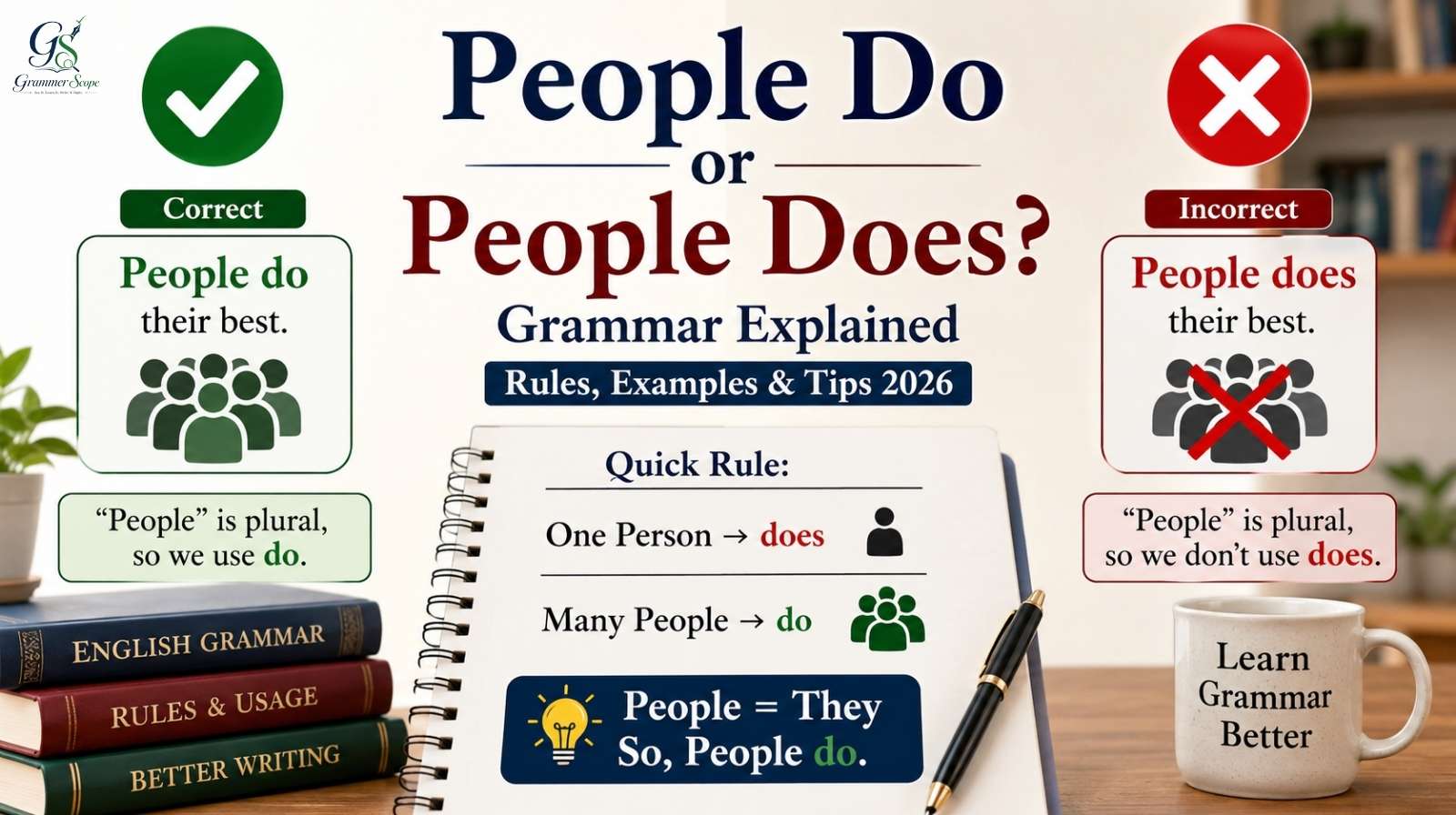
If you have ever paused while writing a sentence and wondered, “People do or people does: which one is correct?”, the answer is simple: people do is correct in standard English.
However, knowing the correct answer is not always enough. You also need to understand why “people do” is correct, why “people does” is wrong, and how the same grammar rule works in questions, negative sentences, and everyday writing.
The confusion usually comes from subject-verb agreement. English verbs change depending on the subject, and words such as person, people, everyone, somebody, do, and does can make the rule feel more complicated than it really is.
The good news? Once you understand one basic principle, this mistake becomes much easier to avoid.
In this guide, you will learn the exact rule behind people do or people does, see real examples, understand common mistakes, and discover a quick memory trick you can use every time.
People Do or People Does: The Quick Answer

The correct phrase is:
People do
The incorrect phrase is:
People does
Why Is “People Do” Correct?
The word people is normally a plural noun. Plural subjects use do, while does is used with third-person singular subjects.
For example:
- People do make mistakes.
- People do care about what others think.
- People do not always agree.
- Do people understand this rule?
- Why do people make this mistake?
By contrast:
- ✘ People does make mistakes.
- ✘ People does not agree.
- ✘ Does people understand the rule?
A simple grammar rule explains all of these examples:
People is plural, so use do not does.
Cambridge Dictionary identifies people as a plural noun and gives examples using plural verb forms. Its grammar guidance also explains that people takes a plural verb.
The Fastest Memory Trick
Replace people with they.
If they do is correct, then people do is correct too.
- They do their work. ✔
- People do their work. ✔
Now try the incorrect version:
- They does their work. ✘
- People does their work. ✘
This is one of the easiest ways to remember the rule.
Read More: Accomodation vs Accommodation: What’s The Correct Spelling?
Why “People Do” Is Grammatically Correct
To fully understand people do or people does, start with the subject of the sentence.
The subject is people.
In ordinary English, people means more than one person:
- One person
- Two people
- Ten people
- Many people
Because it refers to more than one person, it normally functions as a plural noun.
Therefore, it takes a plural verb form.
Person Does, but People Do
Look at this simple comparison:
| Subject | Number | Correct Form |
|---|---|---|
| A person | Singular | A person does |
| One student | Singular | One student does |
| He | Singular | He does |
| She | Singular | She does |
| It | Singular | It does |
| People | Plural | People do |
| Students | Plural | Students do |
| They | Plural | They do |
| We | Plural | We do |
The pattern is straightforward:
Singular third-person subject → does
Plural subject → do
For example:
One person does the work.
But:
Five people do the work.
The subject changes from singular to plural, so the verb changes too.
The Rule Behind People Do or People Does
This grammar rule is called subject-verb agreement.
Subject-verb agreement means the verb must match the subject grammatically.
Consider these examples:
- She works every day.
- They work every day.
- A person does the work.
- People do the work.
- He wants help.
- They want help.
- The child has a book.
- The children have books.
The exact form of the verb depends on the subject.
This is why people does creates a grammatical mismatch. People is plural, but does is the singular third-person form.
Why the Rule Can Feel Backward
English sometimes confuses learners because the singular form of many present-tense verbs ends in -s:
- He works.
- She reads.
- The student writes.
However, plural subjects usually use the base form:
- They work.
- Students read.
- People write.
The same pattern appears with do and does:
- He does
- She does
- A person does
But:
- They do
- Students do
- People do
Cambridge’s present simple grammar explains this broader pattern: the third-person singular form differs from the base form, while plural subjects such as we and they use the appropriate non-singular form.
Understanding Subject-Verb Agreement
Subject-verb agreement is the foundation of the people do or people does rule.
In simple terms, first identify the subject. Then decide whether that subject is singular or plural. Finally, choose the verb form that matches.
Singular Subjects Usually Take Singular Forms
Singular subjects include:
- he
- she
- it
- a person
- the teacher
- my friend
- the child
Examples:
- He does his homework.
- She does her best.
- The teacher does the planning.
- A person does not always know the answer.
In questions:
- Does he understand?
- Does she agree?
- Does the teacher know?
- Does a person need permission?
Plural Subjects Take “Do”
Plural subjects include:
- we
- they
- students
- teachers
- friends
- people
Examples:
- We do our best.
- They do understand.
- Students do make mistakes.
- People do change their minds.
In questions:
- Do they agree?
- Do students understand?
- Do people know the answer?
The “They” Test for People Do
Whenever you are unsure, use this formula:
People = they
Then test the verb.
For example:
Do people like this product?
Replace people with they:
Do they like this product?
It works.
Now try:
Does people like this product?
Replace people with they:
Does they like this product?
That immediately sounds incorrect.
Therefore:
Do people like this product? ✔
Does people like this product? ✘
This substitution test is especially useful when proofreading emails, blog posts, academic writing, or social media captions.
Read More: Recurring vs Reoccurring: The Complete Guide To Correct Usage
How to Use “People Do” in Different Types of Sentences
The rule does not change simply because the sentence changes form.
Whether you are writing a statement, negative sentence, question, or emphatic sentence, people still normally takes do.
People Do in Positive Statements
Examples:
- People do learn from experience.
- People do care about clear communication.
- People do make grammar mistakes.
- People do change over time.
- People do notice spelling errors.
- People do appreciate honesty.
In these examples, do can function as the main verb or add emphasis.
Compare:
People make mistakes.
With:
People do make mistakes.
The second sentence adds emphasis. It strongly confirms the statement.
People Do Not in Negative Sentences
Use do not or don’t with people.
Correct:
- People do not always agree.
- People don’t know everything.
- People do not usually speak exactly the same way.
- Some people don’t understand the rule immediately.
Incorrect:
- ✘ People does not always agree.
- ✘ People doesn’t always agree.
The correct negative pattern is:
People + do not + base verb
For example:
People do not understand the problem.
Not:
People does not understand the problem.
Do People in Questions
When forming a simple present question, put do before the plural subject.
Correct:
- Do people like surprises?
- Do people understand this rule?
- Why do people make this mistake?
- What do people usually mean by this?
- How do people learn grammar?
Incorrect:
- ✘ Does people like surprises?
- ✘ Why does people make this mistake?
The question pattern is:
Do + people + base verb?
For example:
Do people use this expression often?
Why Do People…?
One of the most common structures is:
Why do people + base verb?
Examples:
- Why do people make spelling mistakes?
- Why do people confuse do and does?
- Why do people learn languages differently?
- Why do people change their opinions?
Remember that after do, the next verb stays in its base form.
Correct:
Why do people make mistakes?
Incorrect:
✘ Why do people makes mistakes?
The word do already carries the tense and agreement function in this structure, so the main verb remains in its base form.
Read More: Dwarfs or Dwarves: Which Plural Should You Use?
Why “People Does” Is Incorrect
The phrase people does is incorrect in standard English when people means more than one person.
The reason is not based on style or preference. It is a subject-verb agreement issue.
“Does” Is a Singular Third-Person Form
Use does with:
- he
- she
- it
- a person
- the man
- the woman
- my friend
- the company, when treated as singular
Examples:
- He does his job.
- She does her homework.
- The person does the work.
- My friend does not agree.
However, do not use does with ordinary plural subjects.
That includes:
- people
- they
- students
- children
- workers
- friends
Correct:
- People do their jobs.
- Students do their homework.
- Children do make mistakes.
Incorrect:
- ✘ People does their jobs.
- ✘ Students does their homework.
- ✘ Children does make mistakes.
A Common Source of Confusion
Some learners see people as a group and assume that every group noun takes a singular verb.
That is not correct.
The grammatical form of the noun matters.
For example:
- Everyone does
- Everybody does
- Someone does
- Each person does
But:
- People do
- Students do
- Friends do
Words such as everyone and everybody may refer to many individuals, but they are grammatically singular in standard English.
By contrast, people is normally plural.
This distinction explains many common errors.
People vs Everyone
Compare:
Everyone does their best.
This is correct because everyone is grammatically singular.
Now compare:
People do their best.
This is also correct because people is plural.
The meaning may involve multiple individuals in both sentences, but grammar depends on the grammatical subject, not simply on how many individuals you imagine.
That is why you cannot apply the rule for everyone to people.

People Do or People Does: Common Mistakes to Avoid
Understanding the correct answer is useful, but recognizing the mistakes is equally important.
Here are several errors people commonly make.
Mistake 1: Treating People Like a Singular Collective Noun
Incorrect:
People does not understand.
Correct:
People do not understand.
Why?
Because people normally takes a plural verb.
Mistake 2: Using “Does” in Questions
Incorrect:
Does people know about this?
Correct:
Do people know about this?
The subject is plural, so use do.
Mistake 3: Using “Doesn’t” With People
Incorrect:
People doesn’t like being ignored.
Correct:
People don’t like being ignored.
Doesn’t means does not, so it belongs with singular third-person subjects.
Mistake 4: Confusing Person and People
Correct:
A person does have a choice.
Correct:
People do have choices.
The subject changes:
person → singular → does
people → plural → do
Mistake 5: Changing the Main Verb After “Do”
Incorrect:
Do people likes grammar?
Correct:
Do people like grammar?
After do, use the base verb.
The same rule applies here:
- Do people know?
- Do people want?
- Do people like?
- Do people understand?
Not:
- ✘ Do people knows?
- ✘ Do people wants?
- ✘ Do people likes?
Read More: Attornies or Attorneys? Correct Spelling Explained (2026)

A Simple Step-by-Step Guide to Choose Do or Does
Use this quick process whenever you are unsure.
Step 1: Find the Subject
Ask:
Who or what is performing the action?
For example:
___ people understand the rule?
The subject is people.
Step 2: Decide Whether the Subject Is Singular or Plural
Ask:
Does the subject refer grammatically to one or more than one?
People is plural in ordinary usage.
Step 3: Choose the Correct Form
Use:
- Does for he, she, it, or another singular third-person subject.
- Do for I, you, we, they, and plural nouns.
Therefore:
People → plural → do
Step 4: Check With “They”
Replace people with they.
If the sentence works with they do, use people do.
Step 5: Check the Main Verb
If you are asking a question or using an auxiliary:
Do people understand?
The main verb should be in the base form.
Quick Checklist
- Is the subject people?
- Does people mean more than one person?
- Can you replace it with they?
- Does they do sound correct?
- Is the main verb in the base form after do?
If the answers point to a normal plural use of people, choose do.
People Do vs Person Does: Real-Life Examples
The best way to master grammar is to see the rule in realistic sentences.
At Work
Correct:
People do their best when expectations are clear.
Correct:
Do people in your team understand the new policy?
Incorrect:
✘ People does their best when expectations are clear.
In Academic Writing
Correct:
People do not always respond to information in the same way.
Correct:
Why do people develop different opinions?
Incorrect:
✘ Why does people develop different opinions?
In Everyday Conversation
Correct:
Do people really say that?
Correct:
People do strange things sometimes.
Correct:
People don’t always mean what they say.
In Emails
Correct:
Do people need access before the meeting?
Correct:
People do need clear instructions before starting.
These examples show why subject-verb agreement matters beyond grammar exercises. A small verb mistake can make professional writing look less polished.
Read More: Weiner or Wiener: Meaning And Correct Usage Explained (2026)
Real-Life Case Study: How One Small Grammar Error Changes a Message
Imagine a small business owner preparing a customer survey email. The subject line asks:
“Why does people choose our service?”
The owner reads the sentence several times and thinks it sounds acceptable because the sentence begins with why does, a pattern often used in English questions.
However, the problem becomes clear when the subject is identified.
The subject is people, not why.
Because people is plural, the correct question is:
“Why do people choose our service?”
Now consider what happens during proofreading. The writer uses the “they” test:
Why do they choose our service?
That sounds natural.
Then:
Why does they choose our service?
The error becomes obvious immediately.
The same issue appears in the survey questions:
✘ Does people trust online reviews?
Corrected:
✔ Do people trust online reviews?
Another sentence says:
✘ People doesn’t always read the full description.
Corrected:
✔ People don’t always read the full description.
Finally, the owner changes:
✘ People does make quick decisions.
To:
✔ People do make quick decisions.
The corrected version is clearer and grammatically consistent.
This example shows an important lesson: grammar errors involving do and does often happen because writers focus on the words immediately beside the verb instead of identifying the actual subject first. In a long sentence, that can become even more difficult. Therefore, taking a few seconds to locate the subject can prevent repeated mistakes.
For everyday proofreading, the most reliable method is simple: identify the subject, decide whether it is singular or plural, and then test people by replacing it with they.
Grammar and Usage Data: What the 2025–2026 Search Landscape Shows
A useful way to understand this topic in 2026 is to look at the kind of questions currently being published and searched around it.
Recent grammar pages published in 2025 and 2026 continue to focus specifically on the confusion between “people do” and “people does.” The recurring explanation is consistent: people normally functions as a plural noun and therefore takes do. Recent guides on the exact query continue to frame subject-verb agreement, singular versus plural subjects, questions, and negative forms as the main learning points.
There is an important accuracy point here: no authoritative 2025–2026 dataset appears to publish a reliable percentage showing exactly how many English learners make the specific people does error. Rather than inventing a statistic, the safer conclusion is that the topic remains an active grammar question in current educational content and search results.
The underlying grammatical evidence is much stronger and more useful than a made-up percentage. Cambridge’s current dictionary and grammar resources consistently classify ordinary people as plural and explain that it takes a plural verb.
For learners, the practical takeaway is clear: this is a small but persistent subject-verb agreement problem, and the solution is to understand the rule rather than memorize isolated sentences.
Read More: Seel or Seal – Correct Word Explained With Examples (2026)
The Difference Between People, Person, Persons, and Peoples
The people do or people does question becomes even easier when you understand these related words.
Person
Person refers to one individual.
It is singular.
Examples:
- One person does the work.
- A person does not always agree.
- Does the person understand?
People
People normally refers to more than one person.
It is plural.
Examples:
- People do the work.
- People do not always agree.
- Do people understand?
Cambridge Grammar notes that person is used for an individual, while people is the usual everyday term for groups of human beings.
Persons
Persons is also a plural form, but it is much more formal and often appears in legal, official, or technical contexts.
For example:
Authorized persons only.
In ordinary conversation, you would usually say people rather than persons.
Peoples
Peoples has a different meaning and is used when discussing multiple distinct groups, nations, or communities.
For example:
Indigenous peoples around the world have diverse languages and traditions.
This is not usually relevant to the everyday people do or people does question, but understanding the distinction can prevent confusion.
Important Exceptions and Special Uses of “People”
In normal everyday English:
People do
That is the rule you will use most of the time.
However, English does contain special meanings of a people.
“A People” Can Refer to One Nation or Group
In historical, cultural, or anthropological contexts, a people can refer to a particular nation or ethnic group.
For example:
The islanders are a people with a long cultural tradition.
This use is different from the ordinary plural meaning of people as “more than one person.”
However, it does not mean you should start using people does for ordinary sentences.
For everyday grammar:
- People do ✔
- People don’t ✔
- Do people…? ✔
That remains the standard pattern.
“The People” Still Usually Takes a Plural Verb
Consider:
The people are waiting.
Here, the people refers to a group of individuals, so the plural verb are is natural.
Cambridge’s grammar guidance explicitly describes people as a plural noun and states that it takes a plural verb in its ordinary meaning.
Therefore, do not let unusual or specialized uses distract you from the main rule.
For most writing situations, remember:
People = plural = do
Read More: Girlie or Girly: Correct Usage, Meaning And Examples (2026)
How to Avoid Do and Does Mistakes in the Future
Learning one rule is useful. Building a habit is even better.
Read the Whole Subject
Do not choose a verb based only on the nearest word.
Instead, ask:
What is the actual subject?
For example:
Do people in large cities prefer public transportation?
The full subject begins with people, which is plural.
Therefore, use do.
Use the Pronoun Substitution Method
Replace the noun with a pronoun.
- People → they
- A person → he/she/they in singular usage depending on context
- Students → they
- The teacher → he/she/they depending on intended singular reference
For the specific rule:
People = they
So:
People do = They do
Learn Do and Does as a Pattern
Instead of memorizing individual sentences, remember this pattern:
DO:
- I
- you
- we
- they
- people
- plural nouns
DOES:
- he
- she
- it
- singular third-person nouns
This makes the choice faster.
Proofread Questions Carefully
Questions often create more confusion because the auxiliary comes before the subject.
For example:
Do people know?
It may feel less obvious because do comes first. Therefore, mentally rearrange the sentence:
People do know.
The correct agreement becomes easier to see.
Read More: Puddy or Putty: Which Spelling Is Correct? (2026 Guide)
Expert Tips for Remembering “People Do”
Here are five simple tips that can help you avoid the mistake permanently.
Tip 1: Remember That People Means More Than One
Think:
one person
but
many people
More than one person means plural agreement.
Tip 2: Put People in the Same Group as They
Remember:
They do.
Therefore:
People do.
Tip 3: Never Judge by Whether a Word Ends in “S”
Not every plural noun ends in -s.
For example:
- people
- children
- men
- women
- mice
These are plural even though their forms do not follow the usual noun + s pattern.
Tip 4: Identify the Subject Before Choosing the Verb
Ask:
Who is doing the action?
Once you identify people as the subject, the answer becomes much easier.
Tip 5: Read the Sentence Aloud
Incorrect forms often sound unnatural:
People does understand.
Compare:
They does understand.
The error becomes easier to hear.
Reading your writing aloud can help catch this and other agreement mistakes.
Read More: Labeller or Labeler: Which Spelling Is Correct?
Mini Quiz: People Do or People Does
Quiz 1. People Do or People Does?
Choose the correct sentence:
A) People does their best.
B) People do their best.
Answer: B) People do their best.
Because people is plural, it takes do.
Quiz 2. Fill in the Blank: People □□□ Their Homework
Choose the correct word:
A) does
B) do
Answer: B) do
Correct sentence: People do their homework.
Quiz 3. Do or Does? Let’s Make It Easy
Which question is correct?
A) Does people understand the rule?
B) Do people understand the rule?
Answer: B) Do people understand the rule?
Use do because people is plural.
Quiz 4. Spot the Grammar Mistake
Which sentence is wrong?
A) People do make mistakes.
B) People does make mistakes.
Answer: B) People does make mistakes.
The correct form is People do make mistakes.
Quiz 5. Fill in the Blank: Why □□□ People Make Mistakes?
Choose the correct word:
A) do
B) does
Answer: A) do
Correct: Why do people make mistakes?
Quiz 6. Person vs People Challenge
Complete the sentence:
One person ______ the work, but many people ______ the work.
A) do / does
B) does / do
Answer: B) does / do
Person is singular, so use does. People is plural, so use do.
Quiz 7. Quick “They” Test
Which word can you replace people with to check the grammar?
A) He
B) She
C) They
D) It
Answer: C) They
Since we say They do, we also say People do.
Quiz 8. Fill in the Blank: People □□□ Not Always Agree
A) do
B) does
Answer: A) do
Correct: People do not always agree.
You can also say: People don’t always agree.
Quiz 9. Choose the Correct Negative Sentence
A) People doesn’t like confusion.
B) People don’t like confusion.
Answer: B) People don’t like confusion.
People is plural, so use don’t, not doesn’t.
Quiz 10. Which Sentence Sounds Right?
A) Do people like clear answers?
B) Does people like clear answers?
Answer: A) Do people like clear answers?
The correct pattern is Do + people + base verb.
Quiz 11. Fill in the Blank: People □□□ Care About Good Communication
A) do
B) does
Answer: A) do
Correct: People do care about good communication.
Quiz 12. Find the Correct Rule
Which grammar rule is correct?
A) People is plural, so use do.
B) People is singular, so use does.
Answer: A) People is plural, so use do.
Simple rule: Person does, people do.
Quiz 13. What Comes After “Do People”?
Choose the correct sentence:
A) Do people likes grammar?
B) Do people like grammar?
Answer: B) Do people like grammar?
After do, use the base form of the verb: like, not likes.
Quiz 14. Final Mini Challenge: Fill in the Blanks
Choose the correct answer:
People ______ mistakes, but one person ______ not always admit them.
A) does / do
B) do / does
Answer: B) do / does
Correct sentence: People do make mistakes, but one person does not always admit them.
References
For further reading and authoritative definitions, consult these trusted sources:
Frequently Asked Questions
Q1: Is “people do” or “people does” correct?
A: People do is correct in standard English because people is normally a plural noun. Plural subjects take do, while does is used with singular third-person subjects.
Example:
People do make mistakes. ✔
Not:
People does make mistakes. ✘
Q2: Why do we say “people do” and not “people does”?
A: We say people do because the verb must agree with its subject. Since people is plural, it takes do.
Compare:
One person does.
Many people do.
Q3: Is “people doesn’t” correct?
A: No, people doesn’t is incorrect in standard English.
Use:
People don’t understand.
or:
People do not understand.
Doesn’t is used with singular third-person subjects such as he, she, it, or a person.
Q4: Do people or does people?
A: Use do people.
Correct:
Do people know the answer?
Incorrect:
Does people know the answer?
Because people is plural, it takes do.
Q5: Why do people say “people does”?
A: This error often happens because of confusion about subject-verb agreement. Some learners mistakenly treat people as singular because it refers to a group. Others confuse it with grammatically singular words such as everyone or everybody.
However, people normally takes plural verb forms.
Q6: Does a person or do a person?
A: Use does a person because a person is singular.
Correct:
Does a person need experience?
But with the plural form:
Do people need experience?
Q7: Can I use “people do” in formal writing?
A: Yes. People do is grammatically correct in formal, academic, professional, and everyday English when people is used in its normal plural sense.
Examples:
People do respond differently to change.
People do not always interpret information in the same way.
Final Answer: People Do or People Does?
When deciding between people do or people does, the correct choice is people do.
The rule is based on simple subject-verb agreement:
People is normally plural. Plural subjects use do.
So write:
- People do their best.
- People do not always agree.
- Do people understand?
- Why do people make mistakes?
Avoid:
- ✘ People does their best.
- ✘ People doesn’t agree.
- ✘ Does people understand?
The easiest way to remember the rule is to replace people with they.
Since you would say they do, you should also say people do.
Once you start identifying the subject before choosing the verb, this grammar question becomes much easier. Keep the simple formula in mind person does, people do and you will be able to use the correct form confidently in writing and conversation.
Discover More Articles
- Drier or Dryer: Which Word Is Correct?
- Bougie or Boujee: Which One Should You Use? (2026 Guide)
- Any Time vs Anytime: Meaning, Usage And Grammar Rules
Ready to improve your English? Read more guides on Grammer Scope