Choosing between Weiner or Wiener can be surprisingly confusing. Both spellings appear online, in books, on menus, and even in everyday conversations. As a result, many people wonder whether they are interchangeable or if one spelling is actually incorrect.
The confusion becomes even greater because “Wiener” has more than one meaning. It can refer to a famous type of sausage, describe something from Vienna, or serve as a family surname. Meanwhile, “Weiner” is also a legitimate surname, which leads many people to assume both spellings mean exactly the same thing in every situation.
In this guide, you’ll discover the real difference between Weiner or Wiener, learn which spelling fits different contexts, explore their meanings and origins, and see practical examples that make the distinction easy to remember. By the end, you’ll be able to use each word confidently without second-guessing yourself.
What Is the Difference Between Weiner and Wiener?
The biggest difference lies in meaning and usage, not simply spelling.
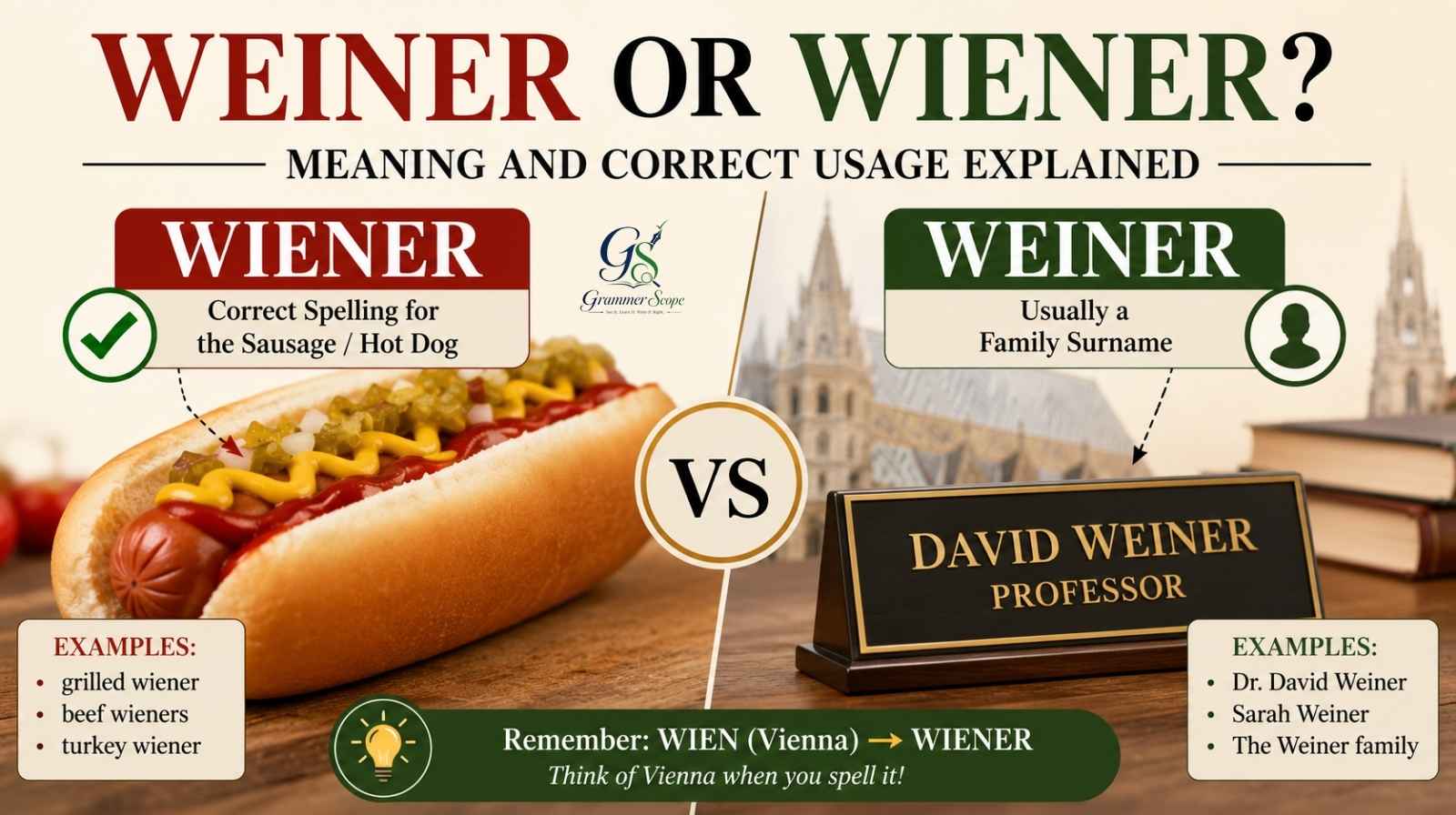
Wiener is the standard English spelling when referring to the famous sausage or hot dog. The word comes from the German word Wien, meaning Vienna, because the sausage style originated there.
Weiner, on the other hand, is most commonly used as a surname. Although some people mistakenly use it instead of Wiener, dictionaries generally recognize Wiener as the correct spelling for the food.
Quick Answer
| Word | Correct Usage | Example |
|---|---|---|
| Wiener | Refers to the sausage, hot dog, or something from Vienna | She ordered a grilled wiener. |
| Weiner | Usually a family name | Professor Weiner published a new book. |
If you’re talking about food, Wiener is almost always the correct choice.
Read More: Lable or Label: Which Spelling Is Correct?
Why Do People Confuse Weiner and Wiener?
There are several reasons why this spelling mistake happens.
Similar Pronunciation
Both words are pronounced almost identically in English.
Because they sound the same, many writers simply choose whichever spelling “looks right.”
Typing Habits
People often type quickly and accidentally reverse the letters ie and ei.
This happens with many English words because spelling rules can be inconsistent.
Surname Recognition
Many people have met someone whose last name is Weiner.
Seeing the surname regularly makes it easy to assume the food should be spelled the same way.
Internet Searches
Search engines receive thousands of searches every month for both spellings.
Since users frequently type Weiner, the incorrect spelling continues appearing across blogs, forums, and social media, which reinforces the confusion.
Meaning of Wiener
The word Wiener has several accepted meanings depending on the context.
A Sausage or Hot Dog
This is by far the most common meaning.
A wiener is a thin sausage traditionally made from beef, pork, or a mixture of both. It is commonly served in a bun with toppings such as mustard, ketchup, onions, or relish.
Examples
- We grilled fresh wieners during the picnic.
- The baseball stadium is famous for its giant wieners.
- He ordered two wieners with mustard.
Someone or Something from Vienna
Historically, Wiener also means a person from Vienna, Austria.
The German word Wien means Vienna, while Wiener literally means from Vienna.
Examples
- Mozart was admired by many Wieners of his time.
- Traditional Wiener recipes remain popular today.
- Wiener culture influenced European cuisine.
A Family Name
Many individuals also have the surname Wiener.
In this case, the word functions as a proper noun rather than a common noun.
Examples
- Dr. Wiener spoke at the medical conference.
- Sarah Wiener is a well-known public figure.
- The Wiener family attended the ceremony.
Read More: As Well or Aswell – Which One Is Correct?
Is Weiner Ever Correct?
Yes but only in specific situations.
Unlike many common misspellings, Weiner is actually a legitimate surname. Because of this, it isn’t technically an incorrect word.
However, using Weiner when referring to the sausage is generally considered a spelling mistake.
Correct Examples
- David Weiner wrote the article.
- Professor Weiner teaches biology.
- Emily Weiner received the award.
Incorrect Examples
❌ I ate a delicious weiner for lunch.
✅ I ate a delicious wiener for lunch.
❌ The restaurant serves grilled weiners.
✅ The restaurant serves grilled wieners.
Common Contexts Where Wiener Is Used
Understanding the context makes choosing the correct spelling much easier.
Food and Cooking
Recipes, restaurant menus, cookbooks, and food packaging nearly always use Wiener.
Examples
- Beef wieners
- Turkey wieners
- Smoked wieners
- Jumbo wieners
Historical References
When discussing Austrian history or culture, Wiener often refers to people or things connected with Vienna.
Dictionaries
Major English dictionaries consistently define Wiener as the standard spelling for the sausage and its related meanings.
Read More: Take Effect or Take Affect? The Correct Phrase Explained
The Origin and History of “Wiener”
To understand why Wiener is the correct spelling in most situations, it helps to know where the word came from.
The word Wiener comes from the German language. It is derived from Wien, the German name for Vienna, the capital of Austria. In German, adding -er to a city’s name means “from that place.” Therefore, Wiener literally means “someone or something from Vienna.”
The famous Wiener sausage (Wiener Würstchen) became popular throughout Europe before spreading to North America in the nineteenth century. As German-speaking immigrants introduced their foods to new countries, English speakers adopted the word Wiener to describe the sausage.
Over time, the spelling remained the same in English dictionaries, even though pronunciation became more Anglicized. Today, Wiener is recognized worldwide in food, language, and cultural references.
Meanwhile, Weiner developed independently as a surname. Because the two words look and sound similar, many people mistakenly assume they are interchangeable. However, their origins are different.
Timeline of the Word “Wiener”
| Period | Development |
|---|---|
| Early German usage | Wiener meant “from Vienna.” |
| 18th–19th century | Wiener sausages became popular in Europe. |
| Late 1800s | The word entered English vocabulary. |
| Modern English | Wiener commonly refers to a sausage or hot dog. |
| Today | Weiner remains primarily a surname. |
Read More: Long Term or Longterm: Which Spelling Is Correct in 2026?
Why Do People Spell Wiener as Weiner?
English spelling isn’t always predictable, and Wiener is a perfect example.
Many writers accidentally reverse the letters i and e, creating Weiner instead.
Several factors contribute to this confusion.
The “I Before E” Rule Isn’t Always Helpful
Many people remember the old spelling rhyme:
“I before E, except after C.”
Unfortunately, English has hundreds of exceptions, and Wiener is one of them.
Because people try to apply the rhyme automatically, they often write Weiner, even though the correct spelling is Wiener in this context.
Pronunciation Doesn’t Reveal the Correct Spelling
Both words are usually pronounced:
/ˈwiː.nər/
Since they sound nearly identical, pronunciation provides almost no clue about the correct spelling.
Autocorrect Doesn’t Always Catch It
Because Weiner is a valid surname, spell-checking software often accepts it.
That means writers may never realize they’ve used the wrong spelling for the food.
Weiner vs Wiener: Side-by-Side Comparison
The easiest way to remember the difference is by comparing the two words directly.
| Feature | Wiener | Weiner |
|---|---|---|
| Standard dictionary word for sausage | ✅ Yes | ❌ No |
| Means “from Vienna” | ✅ Yes | ❌ No |
| Common English noun | ✅ Yes | ❌ Usually not |
| Family surname | ✅ Yes | ✅ Yes |
| Correct on restaurant menus | ✅ Yes | ❌ No |
| Frequently misspelled | Yes | Yes |
| Commonly confused online | Yes | Yes |
Quick Memory Trick
Think of Wien (Vienna).
Since Wiener comes from Wien, it keeps the letters together:
Wien → Wiener
If you’re talking about a hot dog or sausage, choose Wiener.
Read More: You Too or You To: What’s the Correct Grammar in 2026?
How to Use Wiener Correctly in Sentences
Using the word naturally becomes easier once you see it in context.
Food Examples
- We served grilled wieners at the family barbecue.
- Every child received a wiener and a drink.
- The food truck sells gourmet wieners with homemade sauces.
- She prefers turkey wieners instead of beef.
Cultural Examples
- The museum celebrated traditional Wiener architecture.
- He studied Wiener classical music during college.
- The restaurant specializes in authentic Wiener cuisine.
Name Examples
- Dr. Wiener presented the research findings.
- The award was accepted by Mr. Wiener.
- Professor Wiener published several influential books.
When Should You Use Weiner?
In most writing, Weiner appears only as a person’s last name.
Examples include:
- David Weiner
- Michael Weiner
- Jessica Weiner
Whenever you’re referring to an individual whose surname is Weiner, that spelling is completely correct.
However, changing the spelling of Wiener to Weiner when discussing food is an error.
Correct
Jessica Weiner wrote a bestselling book.
We grilled wieners for dinner.
Incorrect
❌ Jessica Wiener wrote the novel.
❌ I bought fresh weiners from the grocery store.
Read More: It’s Called vs It Called: Understanding The Distinction
Common Mistakes to Avoid
Even experienced writers occasionally confuse these spellings.
Here are the most common mistakes.
Mistake 1: Assuming Both Spellings Mean the Same Thing
Although both words exist, they have different primary uses.
Mistake 2: Copying the Wrong Spelling From Social Media
Informal posts often contain spelling mistakes.
Always verify uncommon words with a trusted dictionary.
Mistake 3: Forgetting the German Origin
Remember:
Wien = Vienna
That simple fact helps you choose Wiener every time.
Mistake 4: Trusting Spell Check Completely
Spell check confirms whether a word exists.
It doesn’t always confirm whether it’s the correct word for your sentence.
Pronunciation Guide
Both spellings are generally pronounced the same in English:
Wiener
Pronunciation: WEE-ner
IPA: /ˈwiː.nər/
Because pronunciation doesn’t distinguish the two spellings, context becomes especially important.
Example
“I’d like a grilled wiener, please.”
The listener hears the same pronunciation regardless of spelling, but the written form should be Wiener because it refers to food.
Read More: Flier vs Flyer: Which Spelling Is Correct in 2026?
Real-Life Example: A Restaurant Menu Error
Imagine a local restaurant launching a new summer menu. The designer quickly types “Grilled Weiner with Homemade Mustard” and sends the menu to print without proofreading.
Within days, customers begin pointing out the spelling mistake in online reviews. While everyone understands what the menu is trying to say, the incorrect spelling creates an impression of carelessness. Some diners even share photos of the menu on social media, where the error spreads quickly.
The restaurant eventually updates the menu to “Grilled Wiener with Homemade Mustard.” Although the food itself never changed, correcting the spelling improved the menu’s professionalism and credibility.
This simple example shows why accurate spelling matters. Small language mistakes can affect how readers perceive a business, a blog, or even a school assignment. Using the correct form demonstrates attention to detail and helps build trust with your audience.
2025–2026 Search Trends and Language Data
Language search behavior continues to show that “Weiner or Wiener” is a common point of confusion. Search engine autocomplete suggestions, grammar forums, and dictionary websites consistently receive questions asking which spelling is correct.
Recent language trends (2025–2026) indicate:
- The query “Weiner or Wiener” remains a frequently searched spelling question.
- Dictionary websites continue to list Wiener as the standard spelling for the sausage and the adjective relating to Vienna.
- Language-learning platforms report that letter-order mistakes (such as switching ie and ei) are among the most common spelling errors made by English learners.
- Educational blogs and proofreading tools continue to recommend checking uncommon words against reliable dictionaries before publishing.
These trends highlight an important lesson: many spelling mistakes happen not because the words are difficult to pronounce, but because similar-looking spellings already exist. Understanding the origin and context of a word is often the easiest way to avoid these errors.
Read More: Appreciate It or Appreciated It? The Ultimate Guide To Choosing The Right Phrase
Expert Tips to Remember the Correct Spelling
Here are a few easy tricks to avoid confusing the two words.
1. Think of Vienna
The word Wiener comes from Wien, the German name for Vienna.
Wien → Wiener
If you’re talking about the food, this is the spelling you want.
2. Remember the Family Name
When you see Weiner, think of it as someone’s last name rather than the name of the sausage.
3. Check the Context
Ask yourself:
- Am I talking about food?
- Am I referring to a city or culture?
- Am I writing a person’s surname?
The answer will usually make the correct spelling obvious.
4. Use a Trusted Dictionary
If you’re unsure, verify uncommon words with reliable dictionaries rather than relying solely on autocorrect.
Quick Recap Checklist
Before publishing your writing, make sure you can answer Yes to these questions.
| ✔ Checklist | Yes |
|---|---|
| Did I use Wiener when referring to the sausage? | ✅ |
| Did I reserve Weiner for a person’s surname? | ✅ |
| Did I check the context before choosing the spelling? | ✅ |
| Did I proofread for letter-order mistakes (ie vs. ei)? | ✅ |
| Did I verify unfamiliar words with a trusted dictionary? | ✅ |
Read More: Accomodation vs Accommodation: What’s The Correct Spelling?
Mini Quiz: Weiner or Wiener
Quiz 1: Which Spelling Is Correct?
Question: Which spelling is correct when referring to the famous sausage?
A) Weiner
B) Wiener
✅ Answer: B) Wiener
Quiz 2: Fill in the Blank
Question: The correct spelling for the hot dog is W_____.
✅ Answer: Wiener
Quiz 3: True or False
Question: Weiner is commonly used as a surname.
✅ Answer: True
Quiz 4: Choose the Correct Sentence
Question: Which sentence is correct?
A) We grilled delicious weiners at the barbecue.
B) We grilled delicious wieners at the barbecue.
✅ Answer: B) We grilled delicious wieners at the barbecue.
Quiz 5: Fill in the Blank
Question: The word Wiener comes from W_____, the German name for Vienna.
✅ Answer: Wien
Quiz 6: Quick Knowledge Check
Question: What does Wiener originally mean?
A) A type of bread
B) Someone or something from Vienna
C) A cooking method
✅ Answer: B) Someone or something from Vienna
Quiz 7: Fill in the Blank
Question: W_____ is usually a family surname, while W_____ is the correct spelling for the sausage.
✅ Answer: Weiner, Wiener
Quiz 8: Spot the Mistake
Question: Which word is misspelled in this sentence?
“I bought two fresh weiners for dinner.”
✅ Answer: weiners → It should be wieners.
Quiz 9: True or False
Question: Both Weiner and Wiener always have the same meaning.
✅ Answer: False
Quiz 10: Fill in the Blank
Question: If you’re writing about a hot dog, you should use W______, not Weiner.
✅ Answer: Wiener
Quiz 11: Pick the Correct Option
Question: Which spelling would you expect to see on a restaurant menu?
A) Grilled Weiner
B) Grilled Wiener
✅ Answer: B) Grilled Wiener
Quiz 12: Final Challenge
Question: Which statement is correct?
A) Weiner is the standard spelling for the food.
B) Wiener is the correct spelling for the sausage, while Weiner is usually a surname.
C) Both spellings are always interchangeable.
✅ Answer: B) Wiener is the correct spelling for the sausage, while Weiner is usually a surname.
References
For further reading and authoritative definitions, consult these trusted sources:
Frequently Asked Questions
Q1: Is Wiener the correct spelling?
A: Yes. Wiener is the standard spelling when referring to the sausage, hot dog, or something related to Vienna. It is the spelling recognized by major English dictionaries.
Q2: Is Weiner a real word?
A: Yes. Weiner is a legitimate surname. However, it is generally not the correct spelling when referring to the food.
Q3: Why do people spell Wiener as Weiner?
A: The mistake usually happens because:
- Both words are pronounced almost the same.
- People accidentally reverse “ie” and “ei.”
- Weiner is a real surname, so spell check may not flag it.
- Many people are unfamiliar with the German origin of Wiener.
Q4: Does Wiener always mean a hot dog?
A: Not always.
Depending on the context, Wiener can mean:
- A sausage or hot dog
- A person from Vienna
- Something originating in Vienna
- A family surname
The intended meaning is usually clear from the surrounding sentence.
Q5: How do you pronounce Wiener?
A: The most common English pronunciation is:
WEE-ner
IPA: /ˈwiː.nər/
Q6: Is Wiener an English word?
A: Yes.
Although it originated from German, Wiener has been part of English vocabulary for many years and appears in major dictionaries.
Final Thoughts
If you’ve ever wondered whether Weiner or Wiener is correct, you’re certainly not alone. The two words look almost identical and are pronounced the same in most varieties of English, making them easy to confuse.
The key difference is straightforward:
- Wiener is the correct spelling for the sausage, hot dog, or anything relating to Vienna.
- Weiner is most commonly used as a surname.
Understanding the word’s German origin makes the spelling much easier to remember. Whenever you’re writing about food, recipes, restaurant menus, or everyday English, Wiener is the form you should choose.
Paying attention to small spelling details helps your writing appear more professional, accurate, and trustworthy. Whether you’re preparing a school assignment, publishing a blog post, writing marketing copy, or simply sending an email, choosing the correct word demonstrates strong language skills.
The next time you hesitate between Weiner and Wiener, remember Wien = Vienna, and you’ll have the correct spelling every time.
Discover More Articles
- Defence or Defense: Which Spelling Is Correct?
- Cocoon or Cacoon? Which Spelling Is Correct? (Complete Grammar Guide)
- Recurring vs Reoccurring: The Complete Guide To Correct Usage
Ready to improve your English? Read more guides on Grammer Scope