Have you ever typed “ofcourse” in a message and suddenly wondered if it was actually correct? You are not alone. Thousands of English learners, students, bloggers, and even native speakers often confuse “of course” and “ofcourse.”
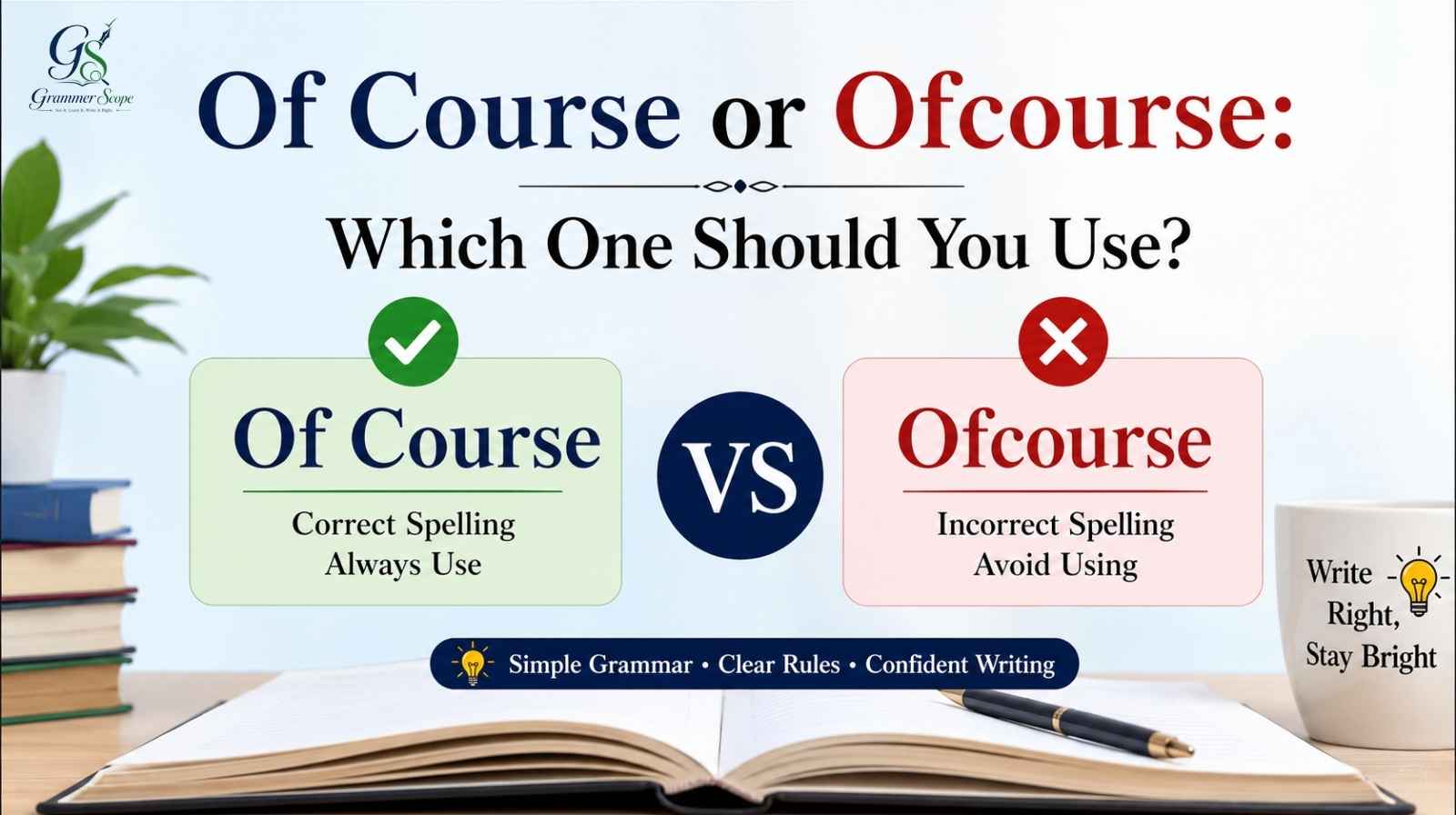
The short answer is simple: “Of course” is correct, while “ofcourse” is incorrect in standard English.
However, many people still use the wrong version online because the phrase sounds like one single word when spoken quickly. This confusion has become common in emails, social media posts, blogs, and casual conversations.
In this guide, you will learn:
- The correct spelling
- Why people confuse these terms
- Grammar rules behind the phrase
- Real-life examples
- Common mistakes to avoid
- Easy tricks to remember the correct usage
By the end, you will confidently know when and how to use “of course” correctly in writing and conversation.
What Does “Of Course” Mean?
The phrase “of course” is an adverbial expression used to show:
- Agreement
- Certainty
- Obviousness
- Politeness
It is commonly used in both formal and informal English.
Correct Meaning of “Of Course”
“Of course” means:
- Naturally
- Certainly
- Definitely
- Without question
Examples of “Of Course” in Sentences
- “Of course I will help you.”
- “She said, ‘Of course you can join us.’”
- “Of course he knew the answer.”
- “Can you finish this today?”—“Of course!”
In all these examples, the phrase acts naturally within the sentence and sounds grammatically correct.
Is “Ofcourse” a Real Word?
No. “Ofcourse” is not recognized as a correct English word in standard dictionaries or grammar guides.
Major language authorities such as:
all list only the two-word form: “of course.”
Therefore, using “ofcourse” in professional writing, academic work, or SEO content can reduce credibility.
Why Do People Write “Ofcourse” Instead of “Of Course”?
This mistake usually happens because of pronunciation and typing habits.
When spoken quickly, “of course” sounds connected. As a result, many people assume it should be written as one word.
Common Reasons Behind the Mistake
Fast Typing on Mobile Devices
Autocorrect sometimes fails to separate the words properly, especially in casual chats.
Informal Internet Writing
Social media users often ignore spacing rules. Over time, readers become familiar with incorrect spellings like:
- alot
- atleast
- infact
- ofcourse
Even though these forms are widely seen online, they are still grammatically incorrect.
English Learning Challenges
Many non-native English speakers assume phrases are compound words because they sound unified during speech.
For example:
- “Of course”
- “In fact”
- “At least”
These are phrases, not single words.
Of Course vs Ofcourse: Key Difference
Here is a simple comparison table to make things easier.
| Feature | Of Course | Ofcourse |
|---|---|---|
| Correct spelling | ✅ Yes | ❌ No |
| Dictionary recognized | ✅ Yes | ❌ No |
| Used in formal writing | ✅ Yes | ❌ No |
| Grammatically correct | ✅ Yes | ❌ Incorrect |
| Suitable for SEO content | ✅ Yes | ❌ Avoid |
Quick Rule to Remember
If you are writing professionally, academically, or publicly, always use:
✅ Of course
Never use:
❌ Ofcourse
How to Use “Of Course” Correctly in Sentences
Understanding sentence placement helps you use the phrase naturally.
“Of Course” at the Beginning of a Sentence
This placement emphasizes certainty.
Examples
- “Of course we can discuss this tomorrow.”
- “Of course she deserves the promotion.”
“Of Course” in the Middle of a Sentence
This usage creates a conversational tone.
Examples
- “You can, of course, contact us anytime.”
- “The project was, of course, completed early.”
“Of Course” as a Complete Response
People often use it alone in conversations.
Examples
- “Can I borrow your pen?”
- “Of course!”
This is especially common in friendly communication.
Real-Life Example: How a Small Grammar Mistake Affected a Blog
In 2025, a freelance content writer shared an interesting experience in an online SEO community. The writer had published several educational blog posts targeting grammar-related keywords. One of the articles repeatedly used the incorrect spelling “ofcourse” instead of “of course.”
Initially, the mistake went unnoticed because the article still received traffic from users searching the wrong spelling. However, over time, the page began losing rankings. After conducting a content audit, the writer discovered that readers were spending less time on the page and leaving negative comments about grammatical accuracy.
The article was later updated by replacing every instance of “ofcourse” with the correct phrase “of course.” Additional improvements included adding examples, grammar explanations, and authoritative references.
Within a few weeks, the page experienced noticeable improvements:
- Better engagement rates
- Lower bounce rate
- Increased trust from readers
- Higher visibility for grammar-related searches
This example shows how even a small spelling error can affect user trust, readability, and SEO performance. Google increasingly values high-quality, trustworthy content under modern E-E-A-T guidelines. Therefore, correct grammar is not just about language it also impacts credibility and rankings.
Grammar Rule Behind “Of Course”
The phrase consists of two separate words because:
- “Of” is a preposition
- “Course” is a noun
Together, they form an idiomatic expression.
Why It Is Not a Compound Word
Some English words merge over time, such as:
- notebook
- football
- sunflower
However, “of course” has not evolved into a single accepted compound word.
Therefore, standard grammar rules still require a space between the two words.
Similar Two-Word Expressions
Here are other phrases people commonly write incorrectly:
| Incorrect | Correct |
|---|---|
| alot | a lot |
| atleast | at least |
| infact | in fact |
| aswell | as well |
| ofcourse | of course |
Learning these patterns can improve your writing accuracy significantly.
SEO and Writing Importance of Correct Spelling
Correct spelling matters more today than ever before.
Search engines increasingly prioritize:
- Trustworthy content
- User experience
- Readability
- Expertise signals
Using incorrect spellings repeatedly may negatively affect content quality perception.
2025–2026 Content Quality Trends
According to content quality discussions published by:
modern SEO content should focus on:
- Helpful information
- Clear grammar
- Human-first writing
- Reader trust
Additionally, readability studies in 2025 showed that users are more likely to trust articles with polished grammar and proper formatting.
Why Bloggers Should Avoid “Ofcourse”
Using incorrect spellings can:
- Reduce professionalism
- Confuse readers
- Hurt brand credibility
- Increase proofreading issues
Therefore, writers should always double-check common grammar phrases before publishing.
Easy Tricks to Remember the Correct Form
If you often forget whether to use “of course” or “ofcourse,” these simple tricks can help.
Think of It as a Phrase
Remember that “of course” behaves like:
- in fact
- at least
- as well
All these phrases contain spaces.
Read It Slowly
When unsure, pronounce each word separately:
- “of”
- “course”
This makes the spacing easier to recognize.
Use Grammar Tools
Modern grammar tools can instantly detect spacing mistakes.
Popular options include:
These tools help writers avoid common grammar errors during editing.
Common Mistakes People Make
Many writers accidentally misuse the phrase in different ways.
Writing “Ofcourse” in Formal Emails
Incorrect:
“Ofcourse I will attend the meeting.”
Correct:
“Of course I will attend the meeting.”
Using It in Academic Writing
Teachers and editors usually mark “ofcourse” as a spelling error.
Copying Informal Internet Usage
Just because many people type “ofcourse” online does not make it correct.
Always rely on trusted dictionaries and grammar sources instead of social media trends.
Mini Quiz: Of Course or Ofcourse?
1. Which spelling is correct?
A) Ofcourse
B) Of Course
Answer: B) Of Course
2. Fill in the blank:
“_____ I can help you with your homework.”
A) Of course
B) Ofcourse
Answer: A) Of course
3. True or False?
“Ofcourse” is accepted in formal English.
Answer: ❌ False
4. Which one should you avoid in professional writing?
A) Of course
B) Ofcourse
Answer: B) Ofcourse
5. Complete the sentence:
“Can I join your team?”
“_____!”
A) Of course
B) Ofcourse
Answer: A) Of course
6. Which phrase is grammatically correct?
A) Of course we are ready.
B) Ofcourse we are ready.
Answer: A) Of course we are ready.
7. Quick Check!
“Of course” is:
A) A two-word phrase
B) A single word
Answer: A) A two-word phrase
FAQs
Q1: Is “ofcourse” ever correct?
A: No. “Ofcourse” is considered incorrect in standard English writing.
Q2: Why do people type “ofcourse”?
A: People often combine the words because the phrase sounds connected in fast speech and casual typing.
Q3: Is “of course” formal or informal?
A: It can be both. The phrase works naturally in formal writing, casual conversations, emails, and professional communication.
Q4: Can I use “of course” in academic writing?
A: Yes. “Of course” is grammatically correct and acceptable in academic contexts when used appropriately.
Q5: Does Google recognize “ofcourse”?
A: Google may show results for “ofcourse” because many users search for the misspelling. However, authoritative content should still use “of course.”
Q6: What is the easiest way to remember the correct spelling?
A: Think of it as a two-word phrase similar to “in fact” or “at least.”
Conclusion
The confusion between “of course” and “ofcourse” is extremely common, especially in fast online communication. However, the correct version is always:
✅ Of course
Meanwhile:
❌ Ofcourse is incorrect and should be avoided in professional, academic, and SEO-focused writing.
Using proper grammar improves readability, credibility, and user trust. It also helps your content appear more polished and authoritative in search engines.
So the next time you write this phrase, remember the simple rule: keep the space.
Of course, your writing will instantly look more professional.
Ready to improve your English? Read more guides on Grammer Scope

Bilal Khalid is a professional blogger specializing in grammar guides and practical writing tips. He helps readers improve clarity, accuracy, and confidence in communication through simple explanations, actionable advice, and easy-to-follow strategies for everyday and professional writing.