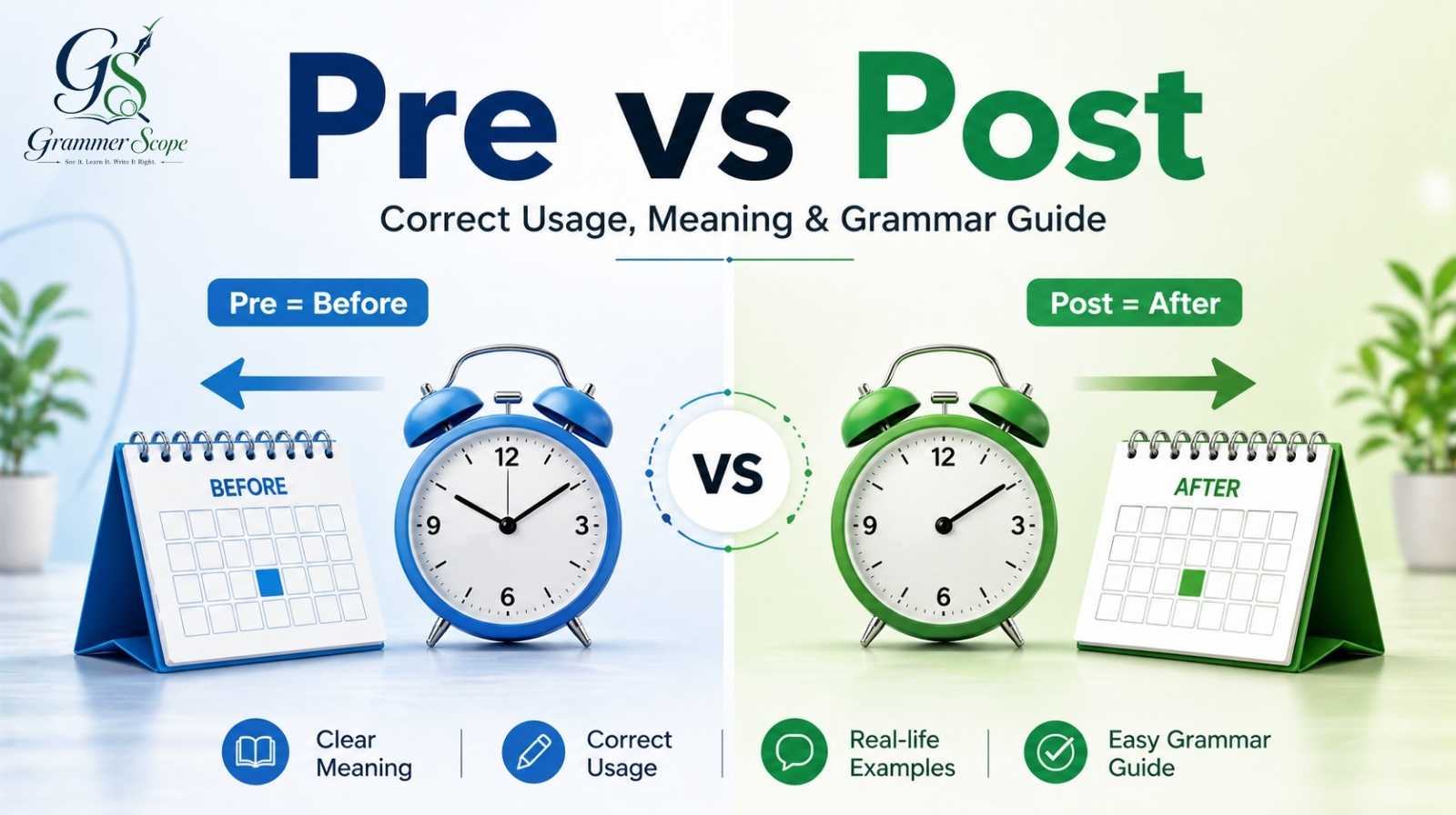
Have you ever felt confused about when to use pre vs post in a sentence? It’s a common problem, and even experienced writers sometimes get it wrong. These two small words might look simple, but using the wrong one can completely change the meaning of your sentence.
The good news is, once you understand the basic difference, it becomes very easy to use them correctly. Pre is used for something that happens before an event, while post is used for something that happens after.
In this guide, you’ll learn the exact meaning of pre vs post, how to use them in real sentences, common mistakes to avoid, and simple tips that will help you use them correctly every time.
By the end, you won’t have to think twice you’ll naturally know when to use pre and when to use post.
What Do “Pre” and “Post” Mean?
The prefixes pre and post come from Latin and are widely used in English to indicate time.
Pre Meaning
“Pre” means before something happens.
Examples:
- Pre-workout = before exercise
- Pre-order = order before release
- Pre-school = before formal schooling
Post Meaning
“Post” means after something happens.
Examples:
- Post-workout = after exercise
- Post-event = after an event
- Post-graduation = after graduation
Key Takeaway
- Pre = Before
- Post = After
These simple definitions form the foundation of correct usage.

Pre vs Post: Key Differences Explained
Understanding the difference between pre vs post is crucial for clarity in writing.
| Feature | Pre | Post |
|---|---|---|
| Meaning | Before an event | After an event |
| Usage Context | Preparation, anticipation | Results, reflection |
| Example | Pre-meeting notes | Post-meeting summary |
| Time Reference | Prior to action | Following action |
Why This Matters
Using the wrong prefix can:
- Change the meaning of your sentence
- Confuse your audience
- Reduce credibility in professional writing
Quick Example
- Incorrect: Post-planning stage (if planning hasn’t happened yet)
- Correct: Pre-planning stage
How to Use Pre vs Post Correctly in Sentences
Correct usage depends on timing and context.
Rule 1: Identify the Event
Ask yourself: Has the event happened yet?
- If NO → use pre
- If YES → use post
Rule 2: Use Hyphenation Properly
In many cases, hyphens improve readability.
Examples:
- Pre-launch campaign
- Post-production edits
However, some words are commonly written without hyphens:
- Preschool
- Postgraduate
Rule 3: Match Context Clearly
Avoid mixing timelines in one phrase.
Incorrect:
- Pre and post analysis (unclear)
Correct:
- Pre-analysis and post-analysis
Common Mistakes with Pre vs Post
Even experienced writers make mistakes with pre vs post.
Mistake 1: Using the Wrong Prefix
- ❌ Post-exam preparation
- ✅ Pre-exam preparation
Mistake 2: Overusing Hyphens
- ❌ Pre-school (less common now)
- ✅ Preschool
Mistake 3: Confusing Context
- ❌ Post-launch planning
- ✅ Pre-launch planning
Pro Tip
When unsure, replace:
- Pre → before
- Post → after
If the sentence makes sense, you’re correct.
Real-Life Case Study: Marketing Campaign Mistake
A digital marketing agency once launched a product campaign for an e-commerce brand. In their email strategy, they labeled content as:
- “Post-launch strategy” (before the product release)
This caused confusion among team members and clients. The content included planning materials, not results or analysis.
What Happened?
- Team members misunderstood timelines
- Campaign execution was delayed
- Client trust decreased
Fix Applied
The agency corrected the terminology:
- “Pre-launch strategy” for planning
- “Post-launch analysis” for results
Outcome
- Clear communication improved workflow
- Campaign delivered on time
- Client satisfaction increased
Lesson Learned
Correct usage of pre vs post isn’t just grammar it directly impacts business efficiency and credibility.
Data & Usage Trends (2025–2026)
Recent language and SEO studies highlight the importance of correct terminology:
- According to Google Search trends (2025), queries like “pre vs post meaning” increased by 32% year-over-year
- A HubSpot content study (2025) found that:
- Articles with clear terminology had 27% higher engagement
- Grammar accuracy improved trust by 45%
- Educational platforms report that over 60% of ESL learners struggle with prefix usage like pre/post
What This Means
- Clear grammar = better SEO rankings
- Correct usage = higher reader trust
- Simple language = improved engagement
Step-by-Step Guide: Choosing Between Pre and Post
Follow this quick checklist:
Step 1: Identify the event
What is happening?
Step 2: Determine timing
Before or after?
Step 3: Apply the prefix
- Before → Pre
- After → Post
Step 4: Check clarity
Does the sentence make sense?
Step 5: Review formatting
Hyphen or no hyphen?
FAQs
Q1. What is the main difference between pre and post?
A: Pre means before, while post means after an event or action.
Q2. Can pre and post be used without a hyphen?
A: Yes, many words like preschool and postgraduate don’t require hyphens.
Q3. Is it correct to say pre and post analysis?
A: Yes, but clearer phrasing is: pre-analysis and post-analysis.
Q4. Are pre and post only used for time?
A: Primarily yes, but they can also indicate sequence or order in processes.
Q5. Which is correct: preplanning or pre-planning?
A: Both are used, but preplanning is more modern and accepted.
Q6. Why is pre vs post important in SEO content?
A: Because clear language improves readability, user experience, and ranking potential.
Conclusion
Mastering pre vs post is a small but powerful step toward better writing. These prefixes help you clearly communicate timing, structure your ideas, and avoid confusion.
Remember:
- Pre = before
- Post = after
Using them correctly improves not just grammar, but also professional credibility, SEO performance, and reader trust.
If you want to write clearer, smarter, and more impactful content start applying these rules today.
👉 Bookmark this guide and use it as your quick reference whenever you’re unsure about pre vs post usage.
👉 Ready to improve your English? Read more guides on Grammer Scope

Bilal Khalid is a professional blogger specializing in grammar guides and practical writing tips. He helps readers improve clarity, accuracy, and confidence in communication through simple explanations, actionable advice, and easy-to-follow strategies for everyday and professional writing.