Have you ever paused while writing and wondered whether you should use “due to” or “do to”? You’re not alone. Thousands of English learners, students, and even experienced writers make this mistake because the two phrases sound almost identical when spoken.
Although they are pronounced similarly, due to and do to have completely different meanings and grammatical functions. Using the wrong one can confuse readers and make your writing appear less polished. Whether you’re writing an academic paper, a business email, a blog post, or simply replying to a message, knowing the difference is essential.
The good news is that this grammar rule is much easier than it seems. Once you understand how each phrase works, you’ll rarely mix them up again.
In this complete guide, you’ll learn what due to and do to mean, when to use each one, common mistakes to avoid, memory tricks, and plenty of real-world examples to help you write with confidence.
What Is the Difference Between “Due To” and “Do To”?

The easiest way to understand these phrases is to remember that they perform entirely different jobs in a sentence.
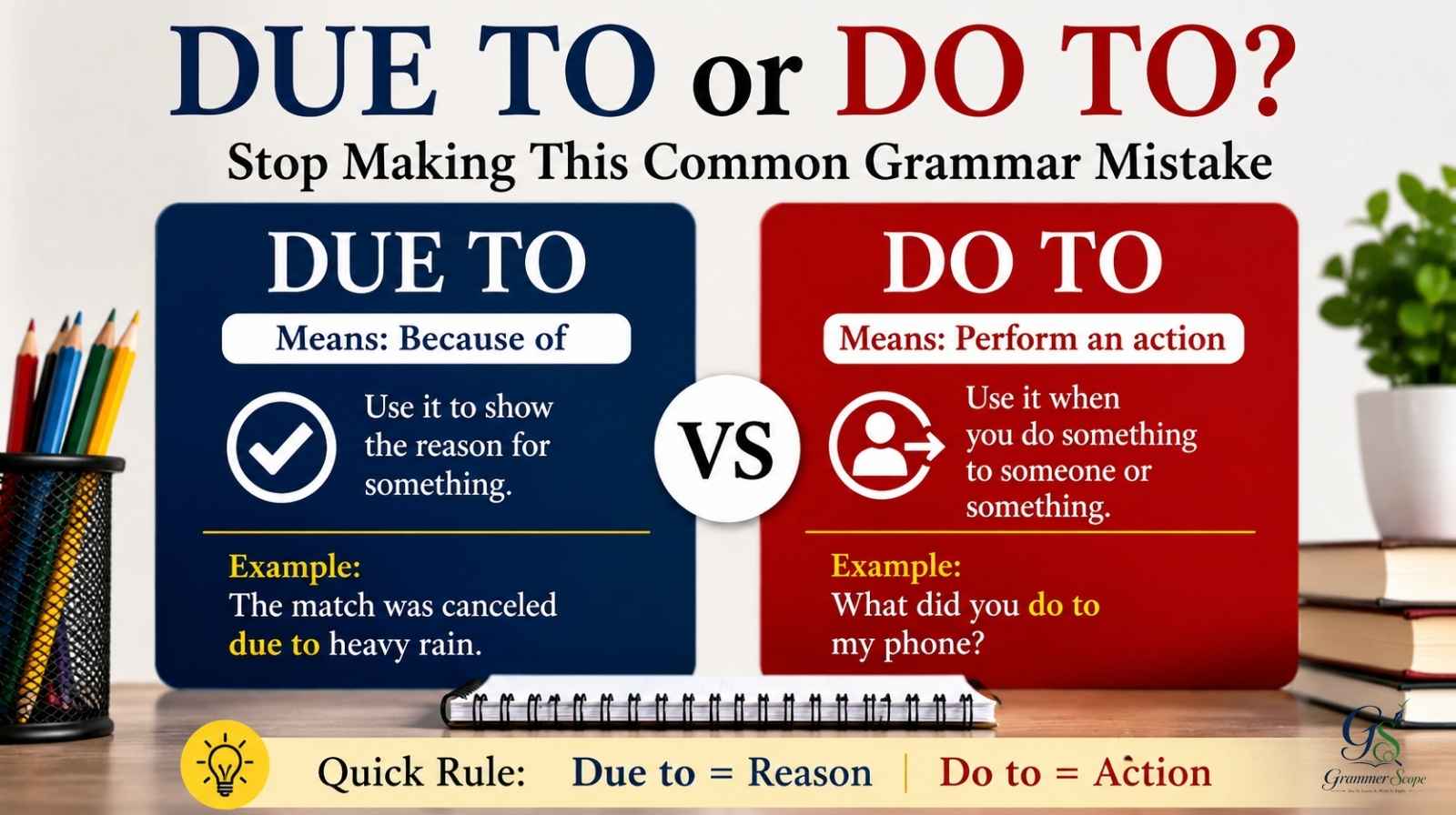
- Due to means because of or caused by.
- Do to means perform an action to someone or something.
Even though they sound alike, one explains a reason, while the other describes an action.
Quick Answer
| Phrase | Meaning | Correct Example |
|---|---|---|
| Due to | Because of | The game was canceled due to heavy rain. |
| Do to | Perform an action to | Never do to others what you wouldn’t want done to you. |
If you’re expressing the reason something happened, due to is almost always the correct choice.
If you’re talking about performing an action toward someone or something, use do to.
Read More: Other Than or Other Then: Which Spelling Is Right?
Understanding “Due To”
The phrase due to is one of the most common expressions in English. It introduces the cause or reason behind something.
Think of it as another way of saying:
- because of
- caused by
- resulting from
- owing to
Examples
- The meeting was postponed due to bad weather.
- Flights were delayed due to heavy fog.
- The store closed early due to a power outage.
- Production stopped due to equipment failure.
- Attendance increased due to better marketing.
Notice that every sentence answers the question:
Why did it happen?
That’s exactly what due to is designed to do.
When Should You Use “Due To”?
Use due to whenever you’re explaining the cause of something.
Examples include:
- school closures
- weather delays
- project failures
- medical conditions
- traffic problems
- business decisions
For instance:
❌ The picnic ended do to rain.
✅ The picnic ended due to rain.
Only the second sentence correctly explains the reason the picnic ended.
Grammar Rule: Why “Due To” Works
Traditionally, grammar experts explain that due to functions as an adjective phrase, often describing a noun.
Example:
The cancellation was due to snow.
Here, due to snow explains the cancellation.
In modern English, however, due to is widely accepted in everyday writing whenever it clearly introduces the reason for something. You’ll frequently see it in newspapers, professional documents, websites, and business communication.
As a result, writers no longer need to worry excessively about older grammar debates. The key is simply using due to to express a cause not an action.
Read More: Striping vs Stripping: Meaning, Grammar And Usage Guide
Understanding “Do To”
Unlike due to, the phrase do to is much less common.
It combines:
- do (a verb meaning perform or carry out)
- to (a preposition)
Together, they mean perform an action toward someone or something.
Examples
- Don’t do that to your little brother.
- What did they do to the old building?
- I would never do that to a friend.
- Please don’t do this to yourself.
- What has stress done to your sleep schedule?
In each example, someone performs an action that affects another person or object.
The phrase is not explaining a reason. Instead, it describes an action being directed at someone or something.
How to Tell Which One You Need
A simple trick is to ask yourself one question:
Am I explaining a reason or describing an action?
If you’re giving the reason something happened, choose due to.
If you’re talking about what someone did to another person or object, choose do to.
For example:
- The event was canceled due to lightning. ✔️ (reason)
- What did the storm do to the roof? ✔️ (action)
This quick test works in almost every situation and can help you avoid one of the most common grammar mistakes in English.
Read More: Goodmorning or Good Morning: Which One Is Correct?

Common Mistakes Writers Make with “Due To” and “Do To”
Because due to and do to sound almost identical, they’re often confused in writing. In fact, many spelling errors happen because people write the words exactly as they hear them.
Fortunately, once you recognize the pattern, these mistakes become easy to avoid.
Mistake 1: Using “Do To” Instead of “Due To”
This is by far the most common error.
❌ The flight was delayed do to heavy snow.
✅ The flight was delayed due to heavy snow.
Why?
The sentence explains why the flight was delayed. Since you’re giving a reason, due to is correct.
Mistake 2: Using “Due To” for an Action
Sometimes writers accidentally use due to when they mean an action performed on someone or something.
❌ What did you due to my laptop?
✅ What did you do to my laptop?
Here, the speaker is asking about an action, not a reason.
Mistake 3: Trusting Spell Check Too Much
Spell-check tools often miss this error because both due and do are correctly spelled English words.
For example:
❌ The meeting was canceled do to illness.
Most grammar checkers will flag this today, but some basic spell checkers may not. That’s why understanding the grammar rule yourself is important.
Read More: Lable or Label: Which Spelling Is Correct?

Due To vs Do To: Side-by-Side Comparison
The table below summarizes the key differences.
| Feature | Due To | Do To |
|---|---|---|
| Meaning | Because of; caused by | Perform an action toward someone or something |
| Part of Speech | Phrase introducing a cause | Verb + preposition |
| Purpose | Explains a reason | Describes an action |
| Common Usage | Very common | Much less common |
| Example | The match ended due to rain. | What did you do to my phone? |
Quick Checklist
Before you write, ask yourself:
- ✅ Am I explaining why something happened?
- ✅ Can I replace it with because of?
- ✅ If yes, use due to.
Or ask:
- ✅ Am I describing an action toward a person or object?
- ✅ Can I replace it with did to or performed to?
- ✅ If yes, use do to.
This simple checklist can prevent nearly every mistake.
Read More: As Well or Aswell – Which One Is Correct?
Real-Life Example: How One Small Grammar Mistake Changed a Professional Email
Imagine Sarah, a project manager, sending an email to an important client.
She writes:
“The project deadline has been extended do to unexpected technical issues.”
She reads the email quickly, everything looks fine, and she clicks Send.
A few minutes later, the client replies professionally but notices the error. While the message is still understandable, the typo leaves a less polished impression. In business communication, small grammar mistakes can subtly affect credibility, especially when communicating with clients, employers, or stakeholders.
The corrected version should read:
“The project deadline has been extended due to unexpected technical issues.”
This single-word correction immediately makes the sentence grammatically accurate and more professional.
The same situation happens every day with students submitting essays, bloggers publishing articles, job seekers writing cover letters, and businesses creating marketing materials. Since “do to” is a real phrase, many writers don’t realize they’ve made a mistake until someone points it out.
The lesson is simple: whenever you’re explaining the reason something happened, pause for a moment and ask yourself, “Could I replace this with ‘because of’?” If the answer is yes, then due to is almost certainly the correct choice.
Developing this habit takes only a few seconds, but it can significantly improve the clarity and professionalism of your writing.
Memory Tricks to Remember the Difference
Grammar becomes much easier when you have a simple memory trick.
Trick 1: Think “Because Of”
Whenever you write due to, mentally replace it with because of.
Example:
The concert was canceled due to rain.
↓
The concert was canceled because of rain.
If the sentence still makes sense, you’ve chosen the correct phrase.
Trick 2: Think “Did To”
For do to, imagine replacing it with did to.
Example:
What did you do to the computer?
↓
What did you did to the computer?
Although that replacement isn’t grammatically correct, it reminds you that the phrase involves an action, not a reason.
Trick 3: Remember the Keywords
- Due → Reason
- Do → Action
That’s the easiest rule to remember.
If you’re explaining why, use due to.
If someone performs an action, use do to.
Read More: Take Effect or Take Affect? The Correct Phrase Explained
2025–2026 Grammar Trends: Why This Mistake Still Matters
Even with advanced grammar-checking tools available today, confusing “due to” and “do to” remains a common writing error.
According to recent language reports and grammar platform insights (2025–2026), millions of documents are checked every day, and word-choice errors continue to rank among the most frequently corrected mistakes. Homophones words or phrases that sound alike but have different meanings are especially challenging because basic spell checkers often fail to detect them.
Modern AI-powered grammar assistants have improved significantly, but they still rely on context. If a sentence is ambiguous, even advanced tools may not always suggest the correct phrase. This is why understanding the grammar rule yourself remains valuable for students, professionals, bloggers, and anyone who writes regularly.
Strong grammar offers several benefits:
- It makes your writing easier to understand.
- It improves professionalism in emails and reports.
- It builds trust with readers.
- It reduces editing time.
- It helps create polished academic and business documents.
Whether you’re publishing a blog post, submitting an assignment, or sending an important email, using due to and do to correctly demonstrates attention to detail and strengthens your communication.
Tips to Never Confuse “Due To” and “Do To” Again
Learning the rule is only the first step. The following habits will help you remember it naturally.
1. Replace It with “Because Of”
Whenever you’re unsure, substitute because of.
Example:
The picnic was canceled due to rain.
↓
The picnic was canceled because of rain.
If the sentence still works, due to is the correct choice.
2. Look for an Action
Ask yourself:
Is someone doing something to another person or object?
If yes, choose do to.
Example:
What did the puppy do to the couch?
Someone (the puppy) performed an action.
3. Proofread Slowly
Many writers skim over familiar phrases and miss small errors.
During proofreading, pay extra attention to commonly confused word pairs like:
- due to / do to
- your / you’re
- its / it’s
- affect / effect
- than / then
Slowing down for just a few seconds can catch mistakes that automatic tools may overlook.
4. Read the Sentence Aloud
Reading aloud often makes awkward wording easier to notice.
For example:
❌ The event was postponed do to bad weather.
When spoken carefully, the mistake becomes easier to identify because the sentence is explaining a reason, not an action.
Read More: Long Term or Longterm: Which Spelling Is Correct in 2026?
Mini Quiz: Due To or Do To
Quiz 1: Which phrase means “because of”?
Answer: Due to
Quiz 2: Which phrase describes an action?
Answer: Do to
Quiz 3: Which sentence is correct?
A. The game was canceled do to rain.
B. The game was canceled due to rain.
Answer: B. The game was canceled due to rain.
Quiz 4: Fill in the blank.
The meeting was postponed _____ heavy traffic.
Answer: due to
Quiz 5: Which phrase can often be replaced with “because of”?
Answer: Due to
Quiz 6: Which sentence is correct?
A. What did you do to my phone?
B. What did you due to my phone?
Answer: A. What did you do to my phone?
Quiz 7: True or False
“Do to” is always incorrect.
Answer: False. It is correct when referring to an action performed on someone or something.
Quiz 8: Fill in the blank.
Please don’t _____ your little brother.
Answer: do that to
Quiz 9: Which phrase explains the reason something happened?
Answer: Due to
Quiz 10: Choose the correct sentence.
A. School closed due to snow.
B. School closed do to snow.
Answer: A. School closed due to snow.
Quiz 11: What should you ask yourself before choosing the phrase?
Answer: Am I explaining a reason or describing an action?
Quiz 12: Fill in the blank.
What did the storm _____ the roof?
Answer: do to
Quiz 13: Which phrase is more common in everyday English?
Answer: Due to
Quiz 14: True or False
If you can replace the phrase with “because of,” you should use due to.
Answer: True.
Quiz 15: Quick Challenge
Which sentence is correct?
A. The flight was delayed do to fog.
B. The flight was delayed due to fog.
Answer: B. The flight was delayed due to fog.
References
For additional reading and authoritative guidance, consult these trusted resources:
- Merriam-Webster Dictionary – Definition and usage of due to and related grammar guidance: https://www.merriam-webster.com/
- Cambridge Dictionary – Definitions, examples, and usage notes for common English phrases: https://dictionary.cambridge.org/
Frequently Asked Questions
Q1: Is “do to” ever grammatically correct?
A: Yes. Although it’s much less common than due to, do to is correct when it means perform an action toward someone or something.
Example:
Please don’t do that to your sister.
Q2: Is “due to” the same as “because of”?
A: In many everyday situations, yes.
Both phrases express a reason.
Example:
- The flight was delayed due to fog.
- The flight was delayed because of fog.
Both sentences are correct and have nearly identical meanings.
Q3: Why do people confuse “due to” and “do to”?
A: The phrases are pronounced almost the same in spoken English. As a result, many writers accidentally type do to when they actually mean due to.
Q4: Is “do to” a spelling mistake?
A: Not always.
It becomes a mistake only when you’re trying to express a reason.
For example:
❌ School closed do to snow.
✅ School closed due to snow.
However:
✅ What did the snow do to the roads?
This sentence is correct because it describes an action.
Q5: Can grammar checkers catch this mistake?
A: Many modern grammar tools can identify the error, but they aren’t perfect. Because both do and due are valid English words, some mistakes may slip through if the context is unclear.
Understanding the rule yourself is the most reliable solution.
Q6: What’s the easiest way to remember the difference?
A: Use this simple formula:
- Due to = Because of = Reason
- Do to = Action
If you’re explaining why something happened, choose due to.
If someone is performing an action, choose do to.
Conclusion
Although due to and do to sound almost identical, they serve completely different purposes in English grammar.
Use due to whenever you’re explaining the reason something happened. If you can replace it with because of, you’ve almost certainly chosen the correct phrase.
Use do to only when you’re describing an action directed toward a person or object.
Remember this simple rule:
- Due to = Reason
- Do to = Action
By applying this distinction consistently, you’ll avoid one of the most common grammar mistakes in English. Whether you’re writing essays, emails, blog posts, or professional documents, choosing the correct phrase will make your writing clearer, more accurate, and more credible.
The next time you hesitate between due to and do to, pause for a moment and ask yourself one question:
Am I explaining a reason or describing an action?
That single question can help you make the right choice every time.
Discover More Articles
- It’s Called vs It Called: Understanding The Distinction
- Flier vs Flyer: Which Spelling Is Correct in 2026?
- You Too or You To: What’s the Correct Grammar in 2026?
Ready to improve your English? Read more guides on Grammer Scope