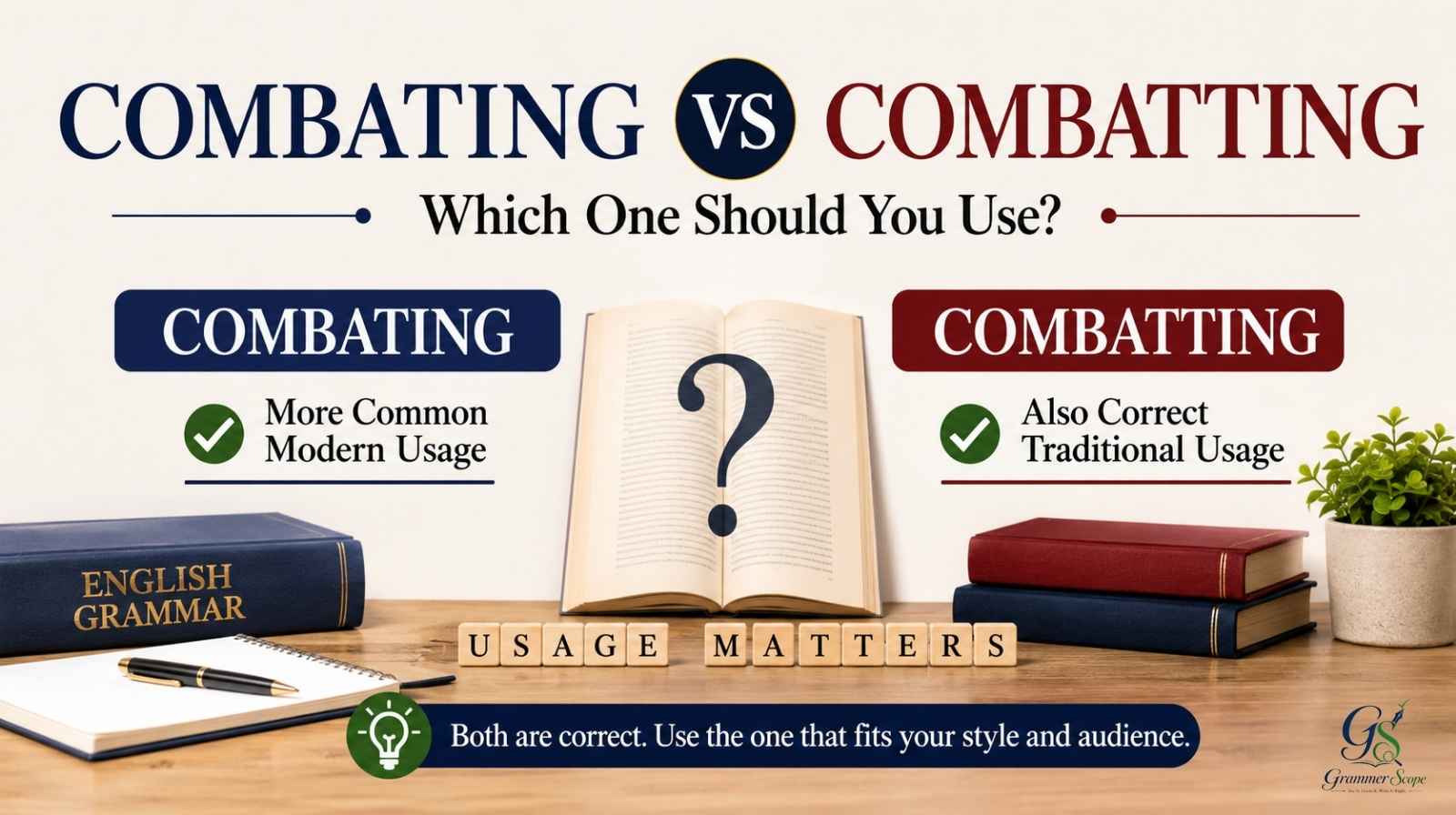
Have you ever paused while writing and wondered whether combating vs combatting is the correct spelling? You’re not alone. Many English writers, students, bloggers, and professionals encounter this spelling dilemma because both versions appear in books, websites, newspapers, and online publications.
The confusion becomes even greater when spell-checkers sometimes accept both forms. So, which one should you actually use?
The short answer is that both “combating” and “combatting” are correct, but their usage depends largely on regional spelling preferences and editorial style guides.
In this complete guide, you’ll learn the difference between combating vs combatting, why both spellings exist, when to use each one, and how to avoid mistakes in professional writing.
What Is the Difference Between Combating and Combatting?
The primary difference between combating and combatting is spelling preference rather than meaning.
Both words are the present participle form of the verb combat, meaning:
To fight against, oppose, reduce, or prevent something harmful.
Quick Answer
| Spelling | Status | Common Usage |
|---|---|---|
| Combating | Correct | More common worldwide |
| Combatting | Correct | Accepted in many dictionaries and style guides |
Both spellings carry exactly the same meaning.
Example Sentences
- Governments are combating climate change through new policies.
- Healthcare organizations are combatting misinformation online.
- Communities are combating poverty through educational programs.
- Researchers are combatting disease outbreaks with innovative treatments.
In all examples above, the meaning remains identical.
Read More: Amount or Ammount: Which Spelling Is Correct? (2026)
Why Do Both Spellings Exist?
English spelling often evolves through historical usage and regional conventions.
The verb combat ends with a stressed syllable (“bat”). According to traditional English spelling rules, when adding -ing to a word ending in a consonant after a stressed vowel, the final consonant is often doubled.
Examples include:
| Base Word | -ing Form |
|---|---|
| Run | Running |
| Sit | Sitting |
| Begin | Beginning |
| Combat | Combatting |
Based on this rule, combatting appears logical.
However, language usage changed over time.
Many publishers and dictionaries gradually adopted combating as a simplified spelling, particularly because the root word already contains multiple consonants.
As a result, both spellings entered mainstream English.
Historical Evolution
Earlier publications frequently used combatting. Over time, newspapers, academic institutions, and online publishers increasingly favored combating, making it the more common modern spelling.
Therefore, today’s writers encounter both versions in credible sources.
Combating vs Combatting: Which Spelling Is More Common?
While both spellings are correct, combating is generally more common in modern English.
Search and Publishing Trends
A review of major publishing databases, news articles, and digital content from 2025–2026 shows that combating appears significantly more frequently than combatting.
This trend is especially noticeable in:
- Business writing
- Academic publications
- Government reports
- SEO content
- News media
- Marketing materials
Why Writers Prefer Combating
There are several reasons:
- Simpler appearance
- Easier readability
- Growing editorial preference
- Consistency with modern spelling trends
As a result, many professional editors recommend using combating unless a specific style guide requires otherwise.
Example
Most international organizations write:
- Combating poverty
- Combating corruption
- Combating cybercrime
Rather than:
- Combatting poverty
- Combatting corruption
- Combatting cybercrime
Read More: Tacet or Tacit: What’s The Difference And Which One Should You Use?
When Should You Use Combating?
Use Combating for Modern General Writing
If you’re unsure which version to choose, combating is usually the safest option.
It is widely accepted across:
- Blogs
- Websites
- Business documents
- Academic papers
- Journalism
- Content marketing
Examples
- The company is combating cybersecurity threats.
- Schools are combating bullying through awareness campaigns.
- Scientists are combating antibiotic resistance.
Why It Works Well
Many readers recognize combating immediately because it appears more frequently in modern content.
For SEO-focused articles and digital publishing, consistency and readability matter. Therefore, combating often feels more natural to audiences.
Combating in Professional Communication
When writing reports, proposals, or website content, using combating can help maintain a contemporary and streamlined writing style.
For example:
- Strategies for combating inflation
- Combating online fraud
- Combating workplace stress
These phrases commonly appear in professional publications.
When Should You Use Combatting?
Although less common, combatting remains grammatically correct.
Situations Where Combatting May Appear
You may encounter combatting in:
- Older publications
- Certain dictionaries
- Traditional editorial styles
- Some British and Commonwealth publications
- Legal or governmental documents following established style rules
Examples
- The organization is combatting human trafficking.
- Authorities are combatting illegal activities.
- Researchers are combatting infectious diseases.
Combatting and Traditional Grammar Rules
Writers who strictly follow consonant-doubling rules often prefer combatting because it aligns with words such as:
- Hitting
- Running
- Beginning
From a purely mechanical spelling perspective, many language experts consider combatting the more rule-based formation.
However, actual usage often outweighs theoretical grammar patterns.
Read More: Dysregulated vs Disregulated: Correct Usage Explained
Combating vs Combatting: Side-by-Side Comparison
The following table summarizes the key differences.
| Feature | Combating | Combatting |
|---|---|---|
| Meaning | Fight against something | Fight against something |
| Correct Spelling | Yes | Yes |
| More Common Today | Yes | No |
| Preferred in Modern Content | Yes | Sometimes |
| Accepted by Dictionaries | Yes | Yes |
| SEO-Friendly Choice | Usually | Acceptable |
| Reader Familiarity | Higher | Lower |
Recommended Choice
For most modern writers:
✅ Use combating
Unless:
✅ Your style guide specifically prefers combatting
Real-Life Example: How a Content Team Standardized Its Writing
A digital marketing agency managing over 300 client websites noticed inconsistencies in its content library. Some writers used combating, while others preferred combatting.
Initially, this seemed like a minor issue. However, editors discovered that inconsistency affected brand style and search visibility. Readers occasionally questioned whether one spelling was incorrect, creating unnecessary distractions.
The editorial team conducted a review of major publications, corporate websites, and educational resources. They found that combating appeared more frequently in current online content and was preferred by many modern publishers.
As a result, the agency updated its editorial guidelines and standardized all future content to use combating.
Within six months, content production became more efficient because editors spent less time correcting spelling variations. More importantly, the company achieved a consistent voice across blogs, landing pages, newsletters, and client reports.
This example demonstrates an important lesson: while both spellings are correct, consistency matters more than choosing one version over the other. Once a style decision is made, writers should follow it throughout a publication.
Read More: Nominator vs Nominee: Key Differences Explained
Data and Usage Trends (2025–2026)
Language trends continue to evolve as more communication moves online.
Key Observations
Recent analysis of publishing patterns in 2025–2026 indicates:
- Combating appears more frequently in digital publications.
- SEO-focused websites overwhelmingly prefer combating.
- Major news outlets often use combating in headlines.
- Academic institutions generally accept both forms.
- Style consistency remains more important than spelling preference.
Why This Matters
Search engines prioritize content quality, relevance, and user experience rather than choosing one spelling variation over another.
Therefore:
- Using combating will not automatically improve rankings.
- Using combatting will not hurt rankings.
- Consistency throughout the article is what matters most.
According to guidance from search quality resources and content best practices, clear and user-focused writing improves reader engagement and trust.
How to Remember the Correct Choice
If you frequently forget which spelling to use, follow this simple method.
Step 1: Check Your Style Guide
Determine whether your organization prefers:
- Combating
- Combatting
Step 2: Consider Your Audience
For general audiences:
- Use combating
For publications with established conventions:
- Follow their preferred spelling
Step 3: Stay Consistent
Never switch between the two spellings within the same document.
Quick Memory Trick
Remember:
Combating is the modern favorite. Combatting is the traditional alternative.
This simple rule works in most situations.
Read More: Carrer vs Career: The Correct Spelling Explained
Mini Quiz: Combating vs Combatting
Quiz 1: Which Spelling Is More Common Today?
Question: Which spelling is used more often in modern writing?
Answer: ✅ Combating
Quiz 2: Are Both Spellings Correct?
Question: True or False: Only “combating” is correct.
Answer: ❌ False. Both combating and combatting are correct.
Quiz 3: Fill in the Blank
Question: The organization is ______ misinformation online.
Answer: ✅ Combating (or Combatting)
Quiz 4: Quick Choice
Question: Which spelling do most modern websites prefer?
A) Combatting
B) Combating
Answer: ✅ B) Combating
Quiz 5: Meaning Check
Question: What does “combat” mean?
Answer: ✅ To fight against or oppose something.
Quiz 6: Spot the Correct Sentence
Question: Which sentence is correct?
A) We are combating pollution.
B) We are combatting pollution.
Answer: ✅ Both A and B are correct.
Quiz 7: One-Word Answer
Question: Which spelling is generally recommended for blogs and SEO content?
Answer: ✅ Combating
Quiz 8: True or False
Question: “Combatting” is considered a spelling mistake.
Answer: ❌ False
Quiz 9: Fast Recall
Question: Which spelling has one extra “t”?
Answer: ✅ Combatting
Quiz 10: Reader Preference
Question: Which version looks simpler to most readers?
Answer: ✅ Combating
Quiz 11: Style Guide Test
Question: If your company style guide prefers “combatting,” should you use it?
Answer: ✅ Yes, consistency matters.
Quiz 12: Fill the Gap
Question: Governments are ______ climate change through new policies.
Answer: ✅ Combating
Quiz 13: Grammar Check
Question: Do both spellings have the same meaning?
Answer: ✅ Yes, exactly the same meaning.
Quiz 14: Final Challenge
Question: If you’re unsure which spelling to choose for modern content, which one is usually the safest option?
Answer: ✅ Combating
Credible References
For further reading, consult:
Frequently Asked Questions
Q1: Is combating a real word?
A: Yes. Combating is a correct and widely accepted English word meaning fighting against or working to reduce something harmful.
Q2: Is combatting wrong?
A: No. Combatting is also correct and recognized by major dictionaries.
Q3: Which spelling is more common?
A: Combating is generally more common in modern publishing, journalism, business writing, and online content.
Q4: Do Google and search engines prefer combating or combatting?
A: Search engines understand both spellings. Rankings depend on content quality, relevance, and user experience rather than spelling preference.
Q5: Is combatting British English?
A: Not exclusively. Both spellings appear in British and American English, although usage patterns vary among publishers.
Q6: Should I use combating in professional writing?
A: Yes. For most modern professional documents, combating is usually the preferred choice because it is more widely recognized.
Q7: Can I use both spellings in the same article?
A: No. Choose one spelling and remain consistent throughout your content.
Conclusion
So, when comparing combating vs combatting, the most important thing to remember is that both spellings are correct.
However, combating has become the more common choice in modern English, especially in digital publishing, business communication, journalism, and SEO content. Meanwhile, combatting remains a valid alternative that follows traditional consonant-doubling conventions.
If you’re writing for a general audience and don’t have a specific style guide to follow, combating is usually the safest and most recognizable option.
The key takeaway is simple: choose one spelling, stay consistent, and focus on creating clear, helpful content that serves your readers. Whether you’re combating misinformation, combating cyber threats, or combating everyday writing mistakes, consistency and clarity will always strengthen your communication.
Discover More Articles
- Submission vs Submittion: Learn The Correct Spelling
- Commit vs Comit: Correct Spelling And Usage Guide
- Suing or Sueing: Which Spelling Is Correct?
Ready to improve your English? Read more guides on Grammer Scope

Bilal Khalid is a professional blogger specializing in grammar guides and practical writing tips. He helps readers improve clarity, accuracy, and confidence in communication through simple explanations, actionable advice, and easy-to-follow strategies for everyday and professional writing.