Have you ever typed “other then” in a sentence and wondered if it looked wrong? You are not alone. Thousands of English learners and even native speakers confuse “other than” and “other then” because the words than and then sound similar when spoken quickly.
However, only one version is grammatically correct in most situations.
Understanding the difference between these two phrases can instantly improve your writing, help you avoid embarrassing grammar mistakes, and make your content look more professional. In this guide, you will learn the correct spelling, simple grammar rules, real-life examples, common mistakes, and easy memory tricks to remember the difference forever.
What Is the Correct Phrase: Other Than or Other Then?
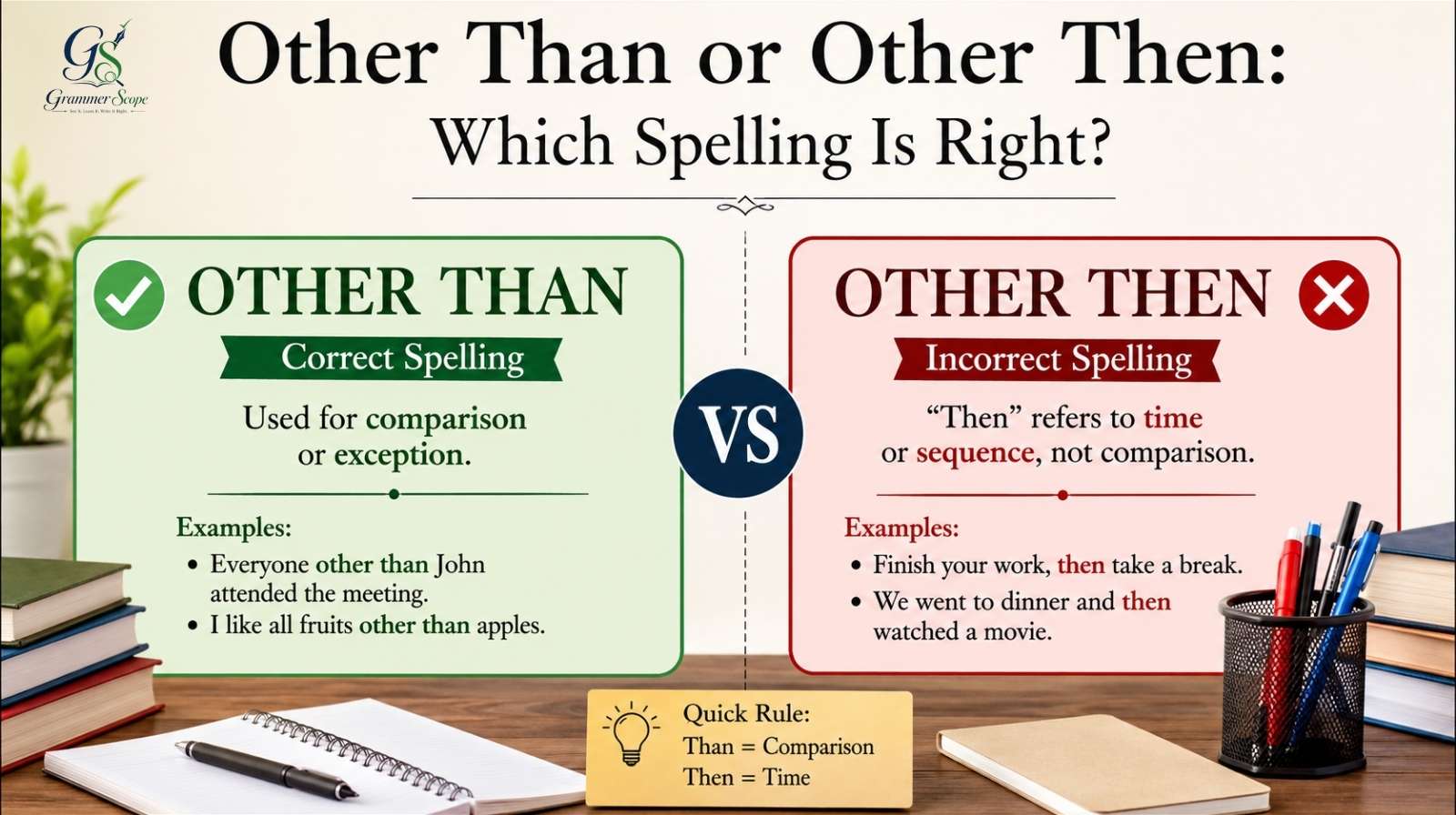
The correct phrase is “other than.”
❌ Other then
✅ Other than
The phrase “other than” is used when comparing, excluding, or mentioning an exception.
Examples of Correct Usage
- I do not eat anything other than vegetables.
- Everyone other than Sarah attended the meeting.
- He has no hobbies other than reading.
In contrast, “other then” is usually grammatically incorrect because the word then refers to time, sequence, or what happens next.
Why People Get Confused
The confusion happens because:
- Than and then sound similar
- Both are common English words
- Fast typing often causes spelling mistakes
- Autocorrect may not always catch the error
Therefore, learning the specific role of each word is important.
Understanding the Difference Between “Than” and “Then”
To fully understand why “other than” is correct, you need to know the difference between than and then.
What Does “Than” Mean?
The word than is mainly used for:
- Comparisons
- Exceptions
- Contrasts
Examples:
- She is taller than her brother.
- I prefer tea rather than coffee.
- No one other than John knew the answer.
What Does “Then” Mean?
The word then relates to:
- Time
- Sequence
- Next actions
Examples:
- Finish your homework, and then watch TV.
- Back then, life was simpler.
- We went to dinner and then saw a movie.
Quick Rule to Remember
- Than = Comparison
- Then = Time
This simple trick helps many writers avoid grammar mistakes instantly.
Why “Other Then” Is Usually Incorrect
The phrase “other then” almost never works in standard English grammar.
When people write it, they usually mean “other than.”
Incorrect Examples
❌ I do not like any fruit other then apples.
❌ Everyone other then Alex arrived early.
❌ She does nothing other then study.
Correct Versions
✅ I do not like any fruit other than apples.
✅ Everyone other than Alex arrived early.
✅ She does nothing other than study.
Can “Other Then” Ever Be Correct?
Technically, there are rare sentence structures where other and then may appear together separately, but not as a fixed phrase.
Example:
- We bought other items, then left the store.
Here, then refers to time, not comparison.
Therefore, whenever you want to express exclusion or comparison, always use other than.
Other Than Meaning and Usage Explained
The phrase “other than” has several meanings depending on the sentence context.
1. To Mean “Except”
This is the most common use.
Examples
- Everyone other than Mike passed the exam.
- I do not watch anything other than documentaries.
2. To Mean “Besides”
Sometimes it introduces an additional point.
Examples
- Other than grammar, she also studies literature.
- Other than English, he speaks Spanish.
3. To Show Difference
It may also compare one thing with another.
Examples
- Her lifestyle is completely different other than mine.
- The new design looks better other than the old version.
Although the third usage is less common, it still appears in casual writing.
Common Grammar Mistakes With Other Than
Many writers make predictable mistakes with this phrase. Understanding them can improve your grammar immediately.
Mistake #1: Using “Then” Instead of “Than”
This is the most common spelling error.
❌ Other then
✅ Other than
Mistake #2: Mixing Up Comparison and Time Words
People often confuse the two because both words sound alike.
Wrong Example
❌ She is smarter then me.
Correct Example
✅ She is smarter than me.
Mistake #3: Relying Only on Spellcheck
Most grammar tools may not catch the mistake because both then and than are valid words.
Therefore, proofreading carefully is essential.
Comparison Table: Other Than vs Other Then
| Phrase | Correct? | Meaning | Example |
|---|---|---|---|
| Other than | ✅ Yes | Except or besides | Everyone other than Tom came |
| Other then | ❌ No | Usually incorrect | Incorrect grammar usage |
| Than | ✅ Yes | Comparison | Better than before |
| Then | ✅ Yes | Time or sequence | Finish work, then relax |
This comparison table makes the distinction easier to remember quickly.
Real-Life Example: How One Small Grammar Mistake Hurt a Blog’s Credibility
In 2025, a freelance blogger shared a case study on a digital writing forum after noticing a drop in reader engagement. The writer had published several educational articles, but readers frequently commented about grammar mistakes. One recurring issue was the repeated use of “other then” instead of “other than.”
At first, the blogger assumed the difference was minor. However, analytics showed that visitors spent less time on pages containing visible grammar mistakes. The bounce rate increased, and social shares decreased compared to older articles with cleaner writing.
After editing the content and correcting the phrase throughout the website, the writer noticed measurable improvements within two months. Average reading time increased, comments became more positive, and several articles ranked higher in search results.
This example highlights an important truth about online writing: even small grammar mistakes can affect credibility, user trust, and SEO performance. Readers naturally trust content that looks polished and professional.
Therefore, learning commonly confused phrases like “other than” can make a real difference in both academic and professional writing.
2025–2026 Grammar and Writing Statistics
Recent writing and SEO studies show how important grammar accuracy has become online.
Key Statistics
- According to a 2025 content quality report by Grammarly, readers are significantly more likely to trust content with proper grammar and spelling.
- A 2026 digital marketing survey from HubSpot found that professionally written articles often achieve higher engagement and lower bounce rates.
- Research from Google Search Central emphasizes creating people-first content with clarity and readability.
These findings show why grammar matters not only in school but also in SEO, blogging, marketing, and business communication.
Easy Tricks to Remember the Difference
Simple memory tricks can help you avoid confusion forever.
Trick #1: “A” for Comparison
The word than contains the letter A.
Think:
Than = compArison
Trick #2: “E” for Time
The word then contains the letter E.
Think:
Then = timE
Trick #3: Replace the Word
If the sentence discusses:
- Comparison → use than
- Time/order → use then
Example
- Better ___ before → than
- Finish homework, ___ sleep → then
These quick tricks work surprisingly well for students and writers alike.
How to Avoid This Mistake in Professional Writing
If you create blog posts, emails, essays, or social media content, grammar accuracy matters.
Proofread Slowly
Read sentences carefully before publishing.
Use Grammar Tools
Helpful tools include:
- Grammarly
- ProWritingAid
Learn Commonly Confused Words
Examples include:
- Than vs Then
- Your vs You’re
- Their vs There
- Affect vs Effect
Improving these small areas can dramatically improve writing quality.
Mini Quiz: Other Than or Other Then
Quiz 1: Spot the Correct Phrase
Which sentence is correct?
A) Everyone other then Jake arrived early.
B) Everyone other than Jake arrived early.
Answer: B) Everyone other than Jake arrived early.
Quiz 2: Than or Then?
Choose the correct word:
“She is smarter ___ her brother.”
A) then
B) than
Answer: B) than
Quiz 3: Time or Comparison?
Which sentence talks about time?
A) Finish your work, then go outside.
B) I like pizza more than burgers.
Answer: A) Finish your work, then go outside.
Quiz 4: Fix the Grammar Mistake
Find the incorrect word:
“I do not eat anything other then vegetables.”
Answer: The incorrect word is then.
Correct sentence: “I do not eat anything other than vegetables.”
Quiz 5: Choose the Right Meaning
What does “other than” usually mean?
A) Next
B) Except
C) Later
Answer: B) Except
Quiz 6: Quick Grammar Challenge
Which sentence is grammatically correct?
A) We went shopping and than came home.
B) We went shopping and then came home.
Answer: B) We went shopping and then came home.
Quiz 7: Fill in the Blank
“No one other ___ Sarah knew the secret.”
A) then
B) than
Answer: B) than
Quiz 8: Common Mistake Check
Which phrase is correct for comparison?
A) Better then
B) Better than
Answer: B) Better than
FAQs
Q1: Is “other then” ever correct?
A: Usually, no. In nearly all cases, the correct phrase is “other than.”
Q2: Why do people confuse than and then?
A: The words sound similar in pronunciation, especially in casual speech.
Q3: What does “other than” mean?
A: It usually means except, besides, or apart from.
Q5: Is “other than” formal English?
A: Yes. It is widely used in academic, professional, and casual writing.
Q6: Can grammar tools detect this mistake?
A: Sometimes, but not always. Since both words are real English words, proofreading is still necessary.
Q7: Which is correct: “better then” or “better than”?
A: The correct phrase is better than because it expresses comparison.
Conclusion
The confusion between “other than” and “other then” is extremely common, but the correct choice is usually very simple.
Use other than when showing comparison, exclusion, or exception. Use then only when discussing time or sequence.
Remember this quick rule:
- Than = comparison
- Then = time
By mastering this small grammar distinction, you can improve your writing clarity, avoid common mistakes, and create more professional content. Whether you are writing blog posts, essays, emails, or social media captions, using the correct phrase helps build trust with readers.
Next time you type the phrase, you will know exactly which spelling is right: other than.
Ready to improve your English? Read more guides on Grammer Scope