Have you ever paused while writing an email or article and wondered whether you should write courtesy vs curtesy? You’re not alone. These two words look almost identical, yet they have very different meanings and uses.
One is a common English word that appears in everyday conversations, professional writing, and customer service, while the other is a rare legal term that many people mistakenly use as a spelling variation.
Because they differ by only one letter, it’s easy to assume they’re interchangeable. However, using the wrong one can confuse your readers and make your writing appear less polished.
In this complete guide, you’ll learn the difference between Courtesy vs Curtesy, understand when each word is appropriate, explore real-world examples, discover their origins, and learn simple tips to remember the correct spelling. By the end, you’ll know exactly which word to use in every situation.
Courtesy vs Curtesy: What’s the Main Difference?

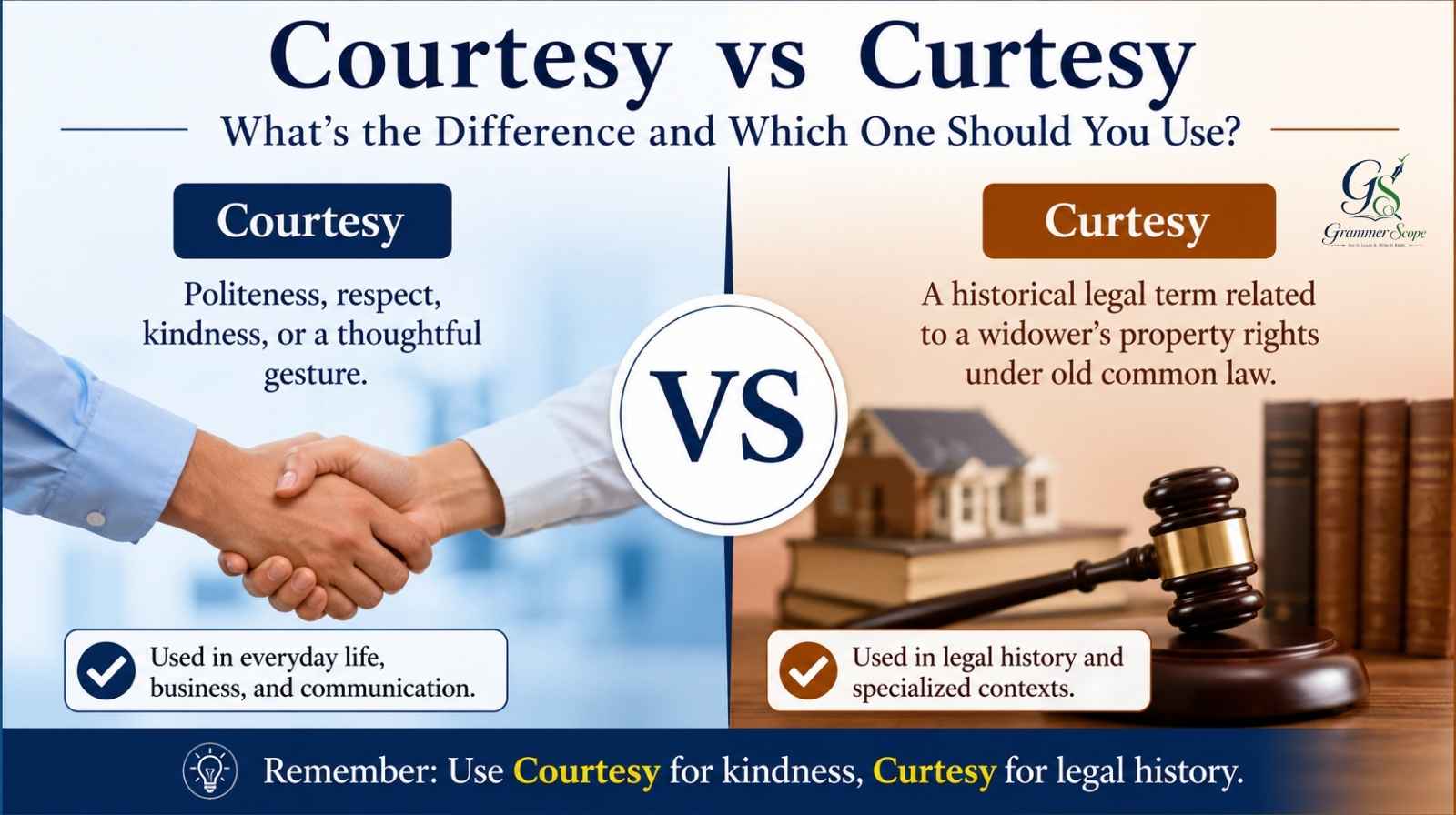
The simplest way to understand the difference is this:
| Word | Meaning | Common Usage |
|---|---|---|
| Courtesy | Polite behavior, respect, kindness, or a thoughtful gesture | Everyday English |
| Curtesy | An old legal term describing a husband’s historical property rights after his wife’s death | Rare legal context |
For most people, courtesy is the correct word nearly every time. It appears in schools, workplaces, businesses, customer service, books, and daily conversations.
On the other hand, curtesy is a specialized legal term that most English speakers will never need to use.
Quick Answer
If you’re talking about:
- being polite
- showing respect
- good manners
- customer service
- kindness
- professional communication
✅ Use courtesy.
Only use curtesy when referring to its historical legal meaning.
Read More: Tacet or Tacit: What’s The Difference And Which One Should You Use?
What Does “Courtesy” Mean?
Courtesy is a noun that refers to polite behavior, respect, consideration, or kindness shown toward other people. It can also describe something given freely as a gesture of goodwill.
It is one of the most frequently used words related to etiquette and professional communication.
Definition
Courtesy (noun): Polite behavior that shows respect, consideration, and kindness toward others.
Common Examples
- Thank you for your courtesy during the meeting.
- She treated every customer with courtesy and respect.
- Basic courtesy goes a long way in the workplace.
- Out of courtesy, he informed everyone before leaving.
- The hotel offered complimentary breakfast as a courtesy.
In each sentence, courtesy reflects kindness, respect, or professional behavior.
Courtesy in Professional Communication
Businesses often use the word courtesy because positive communication creates trust and strengthens relationships.
Examples include:
- Courtesy call
- Courtesy email
- Courtesy reminder
- Courtesy notice
- Courtesy copy (CC)
- Courtesy shuttle
- Courtesy discount
These expressions are common in customer service, corporate communication, healthcare, education, and government organizations.
Courtesy as a Free Service
Another common meaning of courtesy refers to something offered without charge.
Examples:
- The museum provided complimentary tickets as a courtesy.
- The dealership washed the car as a courtesy after servicing it.
- Guests received free drinks courtesy of the event sponsor.
- The airline upgraded the passenger as a courtesy after a long delay.
In these situations, courtesy represents a thoughtful gesture rather than politeness.
Why “Courtesy” Is Often Misspelled
Many people accidentally write curtesy because the pronunciation of courtesy can make the middle vowel sound less obvious in fast speech.
Other factors include:
- typing too quickly
- autocorrect inconsistencies
- confusion with similar-looking words
- unfamiliarity with the correct spelling
Fortunately, once you understand the distinction, the mistake becomes much easier to avoid.
What Does “Curtesy” Mean?
Unlike courtesy, curtesy is not another spelling for politeness.
Instead, it is an old legal term with a very specific historical meaning.
Definition of Curtesy
Curtesy (noun): A historical common-law right allowing a widower to inherit or use certain property owned by his deceased wife, provided specific legal conditions were met.
Today, this term appears mainly in:
- historical legal documents
- property law textbooks
- legal history research
- court archives
- academic discussions of common law
Outside these specialized contexts, most writers never use it.
Example Sentences
- The lawyer explained the historical doctrine of curtesy during the lecture.
- The inheritance dispute referenced the ancient legal principle of curtesy.
- Modern property laws have largely replaced the traditional concept of curtesy.
These examples show that curtesy belongs almost exclusively to legal history rather than everyday English.
Why Most People Never Need to Use “Curtesy”
In modern writing, courtesy is overwhelmingly more common than curtesy. Unless you’re studying legal history or discussing historical inheritance laws, curtesy is unlikely to appear in your work.
For this reason, if you’re writing an email, article, blog post, school assignment, or business document, the correct word is almost always courtesy.
Read More: Dysregulated vs Disregulated: Correct Usage Explained
What Is the Origin of “Courtesy” and “Curtesy”?
Although courtesy and curtesy look similar, they have completely different histories. Understanding where each word comes from makes it much easier to remember when to use them.
The Origin of “Courtesy”
The word courtesy comes from the Old French word courtoisie, meaning “politeness” or “refined behavior.” It later entered Middle English and became associated with the manners expected in a royal court.
Over time, its meaning expanded beyond the court to include kindness, respect, and considerate behavior in everyday life. Today, courtesy is widely used in personal conversations, workplaces, schools, customer service, and formal writing.
The Origin of “Curtesy”
The word curtesy has a legal origin rooted in English common law. It referred to a husband’s right to use or inherit his deceased wife’s property under certain conditions, especially if they had children together.
This legal doctrine developed centuries ago and was recognized in many common-law jurisdictions. However, modern inheritance laws have replaced or abolished this concept in most countries, making the term largely historical.
Why Their Origins Matter
Knowing the origin of each word helps you remember their purposes:
- Courtesy is connected with kindness, manners, and respectful behavior.
- Curtesy belongs to historical legal language and property law.
Because of this distinction, most writers will only use courtesy in everyday English.
Read More: Nominator vs Nominee: Key Differences Explained

Courtesy vs Curtesy: Side-by-Side Comparison
If you’re still unsure which word fits your sentence, this comparison table provides a quick reference.
| Feature | Courtesy | Curtesy |
|---|---|---|
| Meaning | Politeness, respect, kindness | Historical legal property right |
| Part of Speech | Noun | Noun |
| Used in Everyday English | ✅ Yes | ❌ Rarely |
| Used in Business Writing | ✅ Frequently | ❌ No |
| Appears in Legal History | ❌ No | ✅ Yes |
| Common Spelling Mistake | Often misspelled as curtesy | Often mistaken for courtesy |
| Modern Usage | Very common | Mostly historical |
Quick Rule to Remember
If your sentence involves good manners, respect, professional communication, or kindness, choose courtesy.
If you’re discussing historical inheritance laws, curtesy is the correct term.
Common Mistakes People Make
Many writers accidentally confuse these two words because they differ by only one letter. However, understanding the most common mistakes can help you avoid them.
Mistake 1: Assuming “Curtesy” Is an Alternative Spelling
One of the biggest misconceptions is believing that curtesy is simply another way to spell courtesy.
Incorrect:
Thank you for your curtesy.
Correct:
Thank you for your courtesy.
Mistake 2: Letting Spell Check Go Unnoticed
Some writing tools may not immediately flag curtesy because it is technically a real English word. As a result, writers often publish content with the wrong word without realizing it.
Always reread your work, especially when writing professional emails, blog posts, or academic assignments.
Mistake 3: Confusing Pronunciation with Spelling
Because the middle syllable in courtesy is often pronounced quickly, many people instinctively type curtesy instead.
A helpful trick is to remember that courtesy contains the word court, reflecting its historical connection to courtly manners.
Read More: Carrer vs Career: The Correct Spelling Explained
Real-Life Example: How One Small Spelling Mistake Changed a Professional Impression
Imagine Sarah, a marketing coordinator preparing a client presentation for a major business partner. She carefully designed every slide, proofread the statistics, and ensured the proposal looked polished. Before sending the presentation, she added a final thank-you note:
“Thank you for your curtesy and continued support.”
Neither her spell checker nor her presentation software highlighted the word because curtesy is a legitimate, though uncommon, legal term. Confident in her work, she sent the presentation to the client and her company’s senior management.
Later that day, one of the senior managers noticed the spelling mistake. Although the client understood the intended meaning, the error stood out because professional business communication typically uses courtesy. The manager reminded Sarah that even small spelling mistakes can affect credibility, especially in formal documents where attention to detail matters.
Sarah corrected the presentation and created a personal proofreading checklist for future projects. One item on the list was to double-check commonly confused words such as courtesy vs curtesy, affect vs effect, and its vs it’s.
The experience taught her an important lesson: accuracy isn’t only about grammar it also reflects professionalism and respect for the audience. Since then, she has reviewed important emails and presentations more carefully, reducing avoidable mistakes and improving the overall quality of her communication.
This example shows that while readers may understand what you mean, choosing the correct word helps your writing appear more polished, trustworthy, and professional.
Read More: Suing or Sueing: Which Spelling Is Correct?
Courtesy in Everyday Communication
The word courtesy appears in many situations that most English speakers encounter every day.
At Work
Professional communication often relies on courteous language to build positive relationships.
Examples include:
- Courtesy reminder
- Courtesy copy (CC)
- Courtesy call
- Courtesy notice
- Professional courtesy
Using respectful language creates a more positive workplace and helps prevent misunderstandings.
In Customer Service
Businesses frequently use courtesy to describe complimentary services or thoughtful gestures.
Examples include:
- Courtesy shuttle
- Courtesy vehicle
- Courtesy replacement
- Courtesy refund
- Courtesy upgrade
These expressions signal goodwill and demonstrate a commitment to customer satisfaction.
In Daily Life
Simple acts of courtesy make everyday interactions smoother and more pleasant.
Examples include:
- Holding the door open for someone.
- Saying “please” and “thank you.”
- Letting another driver merge into traffic.
- Speaking respectfully during disagreements.
- Offering your seat to someone who needs it.
These small gestures reflect the true meaning of courtesy and help build stronger personal and professional relationships.
2025–2026 Data: Why Courtesy Still Matters
Although technology has changed the way people communicate, courtesy remains one of the most valued soft skills in both personal and professional settings.
Recent workplace and communication research (2025–2026) continues to show several consistent trends:
- Employers consistently rank communication skills, professionalism, and respectful behavior among the most desirable workplace qualities.
- Customer experience studies indicate that people are more likely to trust and remain loyal to businesses that communicate politely and respectfully.
- Remote and hybrid work environments have increased the importance of courteous written communication, as emails, instant messages, and virtual meetings often replace face-to-face conversations.
- Hiring managers frequently identify professionalism and respectful communication as factors that influence first impressions during recruitment and interviews.
These findings reinforce an important point: while curtesy has become a historical legal term, courtesy remains highly relevant in modern communication. Whether you’re writing an email, serving customers, collaborating with colleagues, or publishing online content, demonstrating courtesy can improve relationships, strengthen credibility, and create a more positive experience for everyone involved.
Read More: Commit vs Comit: Correct Spelling And Usage Guide
Mini Quiz: Courtesy vs Curtesy
1. Which word means politeness and respect?
A. Courtesy
B. Curtesy
✅ Answer: A. Courtesy
2. Fill in the Blank
She thanked everyone for their ________ during the meeting.
✅ Answer: Courtesy
3. Which word is mainly used in historical legal contexts?
A. Courtesy
B. Curtesy
✅ Answer: B. Curtesy
4. True or False
“Curtesy” is simply another spelling of “courtesy.”
✅ Answer: False
5. Fill in the Blank
Basic ________ can make a big difference in customer service.
✅ Answer: Courtesy
6. Which sentence is correct?
A. Thank you for your curtesy.
B. Thank you for your courtesy.
✅ Answer: B. Thank you for your courtesy.
7. Quick Choice
If you’re writing a professional email, which word should you usually use?
A. Courtesy
B. Curtesy
✅ Answer: A. Courtesy
8. Fill in the Blank
The hotel offered a free breakfast as a ________.
✅ Answer: Courtesy
9. What does curtesy refer to?
A. Good manners
B. A historical legal property right
✅ Answer: B. A historical legal property right
10. True or False
Courtesy is commonly used in everyday English.
✅ Answer: True
11. Fill in the Blank
A polite “please” and “thank you” are simple acts of ________.
✅ Answer: Courtesy
12. Which phrase is commonly used in business?
A. Courtesy Reminder
B. Curtesy Reminder
✅ Answer: A. Courtesy Reminder
13. Spot the Correct Spelling
Which word is spelled correctly for showing kindness?
A. Curtesy
B. Courtesy
✅ Answer: B. Courtesy
14. Fill in the Blank
The lawyer discussed the historical concept of ________ during the lecture.
✅ Answer: Curtesy
15. Which word appears more often in modern English?
A. Courtesy
B. Curtesy
✅ Answer: A. Courtesy
16. True or False
You should use curtesy in everyday conversations.
✅ Answer: False
17. Fill in the Blank
The manager sent a ________ reminder about tomorrow’s meeting.
✅ Answer: Courtesy
18. Which word would you use to describe respectful behavior?
A. Courtesy
B. Curtesy
✅ Answer: A. Courtesy
19. Quick Challenge
Choose the correct sentence.
A. She showed great courtesy to every customer.
B. She showed great curtesy to every customer.
✅ Answer: A. She showed great courtesy to every customer.
20. Final Fill in the Blank
When talking about kindness, respect, or good manners, always choose ________.
✅ Answer: Courtesy
References
For additional reading and authoritative information, consult these trusted resources:
- Merriam-Webster Dictionary – Courtesy and Curtesy definitions: https://www.merriam-webster.com
- Cambridge Dictionary – Courtesy meaning and usage: https://dictionary.cambridge.org
Frequently Asked Questions
Q1: Is it courtesy or curtesy?
A: For almost every modern situation, courtesy is the correct word. It refers to politeness, respect, kindness, or a thoughtful gesture.
Curtesy is a real word, but it is an old legal term used in historical property law. Unless you’re discussing legal history, you should use courtesy.
Q2: Is “curtesy” a real English word?
A: Yes. Although many people assume it’s simply a misspelling, curtesy is an authentic English word with a specific legal meaning.
Historically, it described a widower’s right under common law to inherit or enjoy certain property owned by his deceased wife, provided legal requirements were met.
Today, the term is rarely used outside legal history and academic discussions.
Q3: Why do people misspell “courtesy” as “curtesy”?
A: There are several reasons:
- The words look almost identical.
- Their pronunciation sounds similar in everyday speech.
- People often type quickly without double-checking.
- Some spell checkers don’t flag curtesy because it’s technically a valid English word.
The easiest way to avoid the mistake is to remember that courtesy is the word associated with polite behavior.
Q4: How can I remember the correct spelling?
A simple memory trick is:
Courtesy = Court + Kindness
The word courtesy originated from the manners expected in a royal court. If your sentence is about respect or politeness, choose courtesy.
If your sentence is about historical inheritance law, curtesy is the correct term.
Q5: Can I use “curtesy” in business writing?
A: No.
Business emails, reports, websites, and professional documents almost always require courtesy.
Using curtesy in place of courtesy is generally considered a spelling error in modern business communication.
Q6: Is “courtesy” always a noun?
A: Most commonly, yes. However, it also appears in fixed expressions where it functions as part of a phrase.
Examples include:
- Courtesy call
- Courtesy reminder
- Courtesy copy (CC)
- Courtesy shuttle
- Courtesy upgrade
In each case, the word still relates to politeness, consideration, or a complimentary service.
Final Thoughts
Understanding the difference between Courtesy vs Curtesy is easier than it first appears. While the two words differ by only one letter, they belong to completely different contexts.
Courtesy is the word you’ll use in everyday English. It represents politeness, respect, kindness, and professional communication. Whether you’re writing an email, speaking with customers, creating content, or interacting with others, courtesy is almost always the correct choice.
Curtesy, on the other hand, is a historical legal term tied to old English common law. Unless you’re studying legal history or reading historical legal documents, you’re unlikely to encounter or need to use it.
When in doubt, ask yourself a simple question:
- Am I talking about kindness, respect, or good manners? → Use courtesy.
- Am I discussing historical property rights under common law? → Use curtesy.
Choosing the correct word not only improves your grammar but also makes your writing more accurate, professional, and trustworthy. Paying attention to these small details helps you communicate with confidence and leaves a stronger impression on your readers.
If you found this guide helpful, consider bookmarking it and sharing it with anyone who wants to improve their English vocabulary and avoid common spelling mistakes.
Key Takeaways
- ✅ Courtesy means politeness, respect, kindness, or a complimentary gesture.
- ✅ Curtesy is a historical legal term related to a widower’s property rights under old common law.
- ✅ In modern English, courtesy is almost always the correct choice.
- ✅ Curtesy is not an alternative spelling of courtesy.
- ✅ Remember: Kindness = Courtesy | Legal history = Curtesy.
Discover More Articles
- Other Than or Other Then: Which Spelling Is Right?
- Transferred vs Transfered: Which Is Correct?
- Submission vs Submittion: Learn The Correct Spelling
Ready to improve your English? Read more guides on Grammer Scope