Have you ever typed “cancelation” and wondered why your spell-checker suggested “cancellation” instead? Or perhaps you have seen both spellings on websites, tickets, contracts, and official documents and assumed one must be wrong.
The truth is a little more interesting.
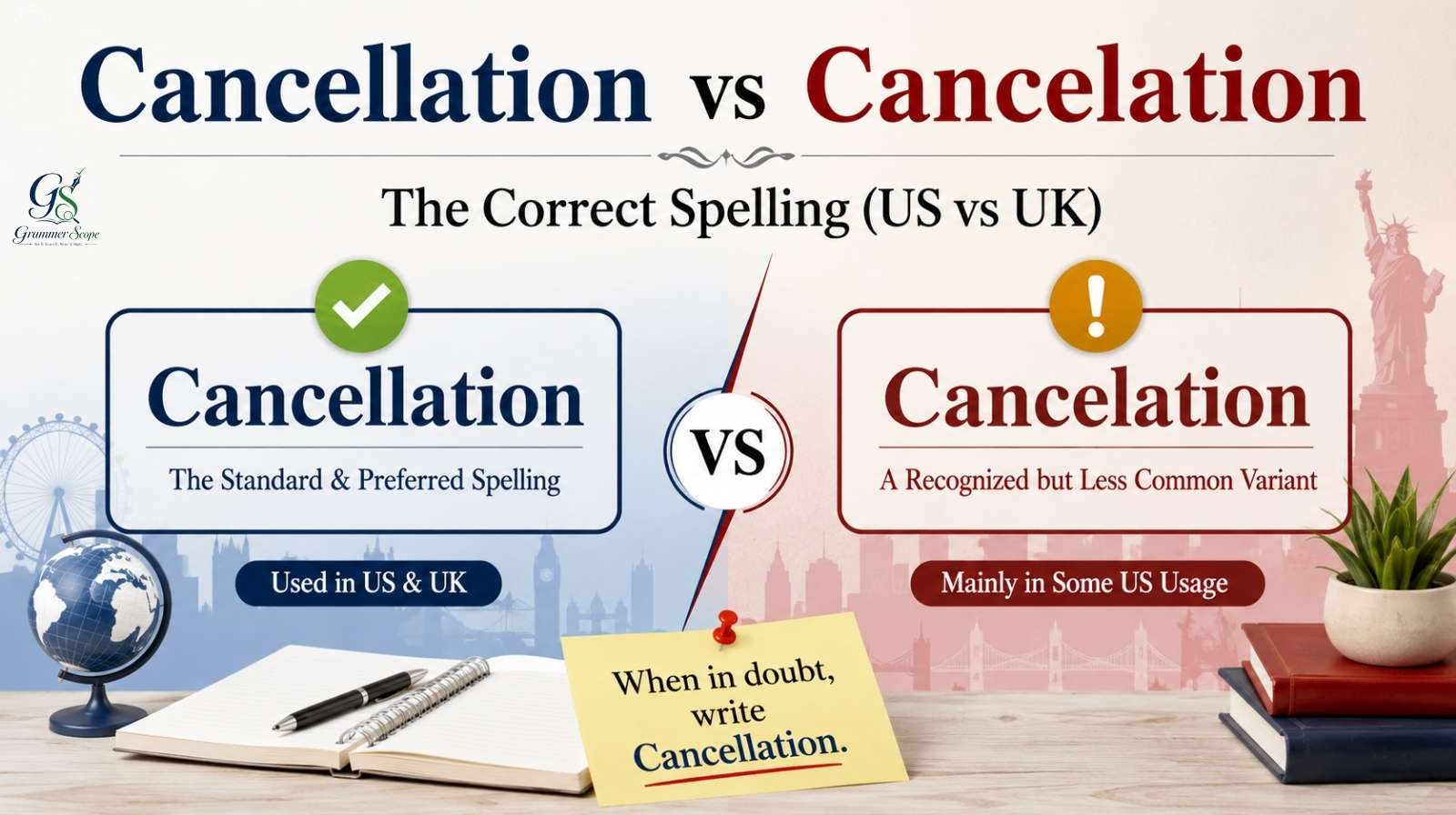
Cancellation vs Cancelation is mainly a spelling and regional usage question. Both forms refer to the act of cancelling something, but cancellation, with two l letters, is the standard and overwhelmingly preferred spelling in modern English. Cancelation, with one l, is also recognized in some dictionaries and appears mainly in American English, although it is much less common.
This guide explains exactly which spelling to use, why the confusion exists, how US and UK spelling conventions differ, and how to avoid making the mistake in professional writing.
What Is the Difference Between Cancellation and Cancelation?

The main difference between cancellation vs cancelation is the spelling, not the meaning.
Both words are nouns related to the verb cancel. They describe the act of stopping, ending, withdrawing, or calling something off.
However, their usage is different:
| Spelling | Meaning | Common Usage |
|---|---|---|
| Cancellation | The act of cancelling something | Standard and preferred worldwide |
| Cancelation | The act of cancelling something | Recognized but much less common, mainly US English |
The Quick Answer
If you are unsure which word to use, choose cancellation.
It is the safest and most widely accepted spelling in:
- American English
- British English
- Canadian English
- Australian English
- Academic writing
- Business communication
- Formal documents
For example:
- The airline announced the cancellation of the flight.
- You can request a cancellation before the renewal date.
- The event’s cancellation disappointed thousands of fans.
Although cancelation is a valid spelling in some dictionaries, it is far less common. Therefore, cancellation is usually the better choice when you want consistent, professional English.
The Simple Memory Trick
Remember this:
Cancel → Cancellation
Even though cancel has one l, the standard noun form is usually written with two:
cancell + ation = cancellation
Therefore, when writing an important email, article, contract, or customer policy, cancellation is the spelling most readers expect to see.
Why Is Cancellation Spelled With Two Ls?
The confusion comes from how English changes words when suffixes are added.
The base verb is:
cancel
When the noun suffix -ation is added, the standard spelling becomes:
cancellation
This spelling pattern can seem confusing because English does not always follow one simple rule across every word.
Cancellation Comes From the Verb Cancel
The word cancel means to decide that something planned, arranged, or expected will not happen. It can also mean to officially end something.
For example:
- They had to cancel the meeting.
- I want to cancel my subscription.
- The company decided to cancel the contract.
When discussing the action itself as a noun, we use cancellation:
- The cancellation of the meeting surprised everyone.
- Your subscription cancellation has been confirmed.
- We received notice of the contract’s cancellation.
The meaning does not change. The word simply changes from a verb to a noun.
Why English Learners Find It Confusing
Many people naturally expect the spelling to be:
cancel + ation = cancelation
That looks logical, especially because other English words often add a suffix without doubling the final consonant.
For example:
- educate → education
- celebrate → celebration
- operate → operation
However, cancellation developed as the established standard spelling, and modern usage strongly favors it.
This is an important reminder that English spelling is influenced not only by simple rules but also by word history, established conventions, and regional standards.
Read More: Courtesy vs Curtesy: What’s The Difference? (Complete Guide)

Cancellation vs Cancelation: US vs UK Usage
One of the biggest questions is whether cancelation is American English and cancellation is British English.
The answer is not exactly.
Is Cancellation the British Spelling?
Yes, cancellation is the standard spelling in British English.
British English generally uses the double-l form:
- cancellation
- cancelled
- cancelling
For example:
The concert’s cancellation was announced yesterday.
The booking was cancelled due to severe weather.
If you are writing for a UK audience, use cancellation consistently.
Is Cancelation the American Spelling?
Cancelation can be found in American English and is recognized as a variant spelling. However, that does not mean it is the standard American spelling.
In modern US English, cancellation remains widely used and preferred in professional, academic, and general writing.
This is where many writers become confused. American English is known for forms such as:
- color instead of colour
- organize instead of organise
- traveling instead of travelling in many US style conventions
So, some people assume American English must also prefer cancelation.
However, that assumption does not work here.
The safest form in both American and British English is:
cancellation
What About Cancelled and Canceled?
This is a separate but related spelling difference.
For the past tense and present participle, American and British English often differ:
| American English | British English |
|---|---|
| canceled | cancelled |
| canceling | cancelling |
| cancellation | cancellation |
This creates an interesting pattern.
American English commonly prefers one l in:
canceled and canceling
However, the noun cancellation generally keeps the double l.
For example, in American English:
The company canceled the service, but the cancellation process took several days.
That sentence may look inconsistent at first, but it follows established usage.
When Should You Use Cancellation?
Use cancellation whenever you want the standard, professional, and widely accepted spelling.
It is particularly appropriate for formal communication.
Use Cancellation in Business Writing
Businesses regularly use the word in policies and customer communication.
For example:
- Cancellation Policy
- Cancellation Request
- Free Cancellation
- Cancellation Fee
- Order Cancellation
- Subscription Cancellation
Imagine visiting a hotel website and seeing:
Cancelation Policy
Although some readers may accept it, Cancellation Policy looks more standard and familiar.
Consistency matters in business writing because customers expect policies, contracts, invoices, and legal-style documents to use conventional spelling.
Use Cancellation in Academic and Professional Writing
For essays, research papers, reports, and professional documents, cancellation is the stronger choice.
Examples:
- The cancellation of the experiment affected the research schedule.
- The unexpected cancellation caused financial losses.
- Participants received notice of the event’s cancellation.
Major dictionaries and established language references recognize cancellation as the standard form, making it the safer choice for formal writing.
Merriam-Webster dictionary
Use Cancellation for International Audiences
If your readers come from different countries, avoid unnecessary spelling variation.
Cancellation is understood internationally and is the most recognizable option across major English-speaking regions.
Therefore, it is especially useful for:
- Websites
- Global brands
- Travel platforms
- Educational content
- International businesses
- Software interfaces
- Customer support pages
Read More: Winner or Winer: Meaning, Difference And Correct Usage
Is Cancelation Actually Wrong?
No, cancelation is not simply a made-up spelling.
Some dictionaries recognize it as a variant form, particularly in American English. However, it is considerably less common than cancellation.
That distinction is important.
A spelling can be recognized without being the best choice for every situation.
Valid Does Not Always Mean Preferred
English contains many words with accepted spelling variants. However, one version is often much more common.
Think about the difference between:
- a recognized variant
- the standard form most readers expect
In the case of cancellation vs cancelation, cancellation is the dominant standard.
Therefore, if your goal is clarity and credibility, use the version your audience is most likely to recognize immediately.
Why Cancelation Appears Online
You may encounter cancelation in:
- Older publications
- Some US-based documents
- Brand-specific content
- Informal writing
- Automatically generated text
- User-created content
Its presence does not automatically mean the writer made an error. However, frequency and acceptance are not the same thing.
For a polished article or professional document, cancellation remains the better default.
Can You Use Cancelation in SEO Content?
You can mention cancelation when your content specifically addresses the spelling variation, as this article does.
However, if you are writing a standard page about a cancellation policy, it is better to use the preferred spelling naturally and consistently.
For example, a useful page title would be:
Cancellation Policy: How to Cancel Your Booking
Rather than:
Cancelation Policy: How to Cancel Your Booking
Search visibility also depends on matching the language people commonly use while maintaining natural, helpful writing. Google emphasizes creating helpful, reliable, people-first content rather than writing primarily to manipulate rankings.
Real-Life Case Study: Why One Letter Matters in Professional Writing
Consider a fictional but realistic situation involving an online travel company called Northstar Travel.
The company had customers from the United States, the United Kingdom, Canada, Australia, and several other countries. Its website was carefully designed, but one small inconsistency kept appearing across its booking pages.
The homepage used “Free Cancellation.”
However, an older help page said “Cancelation Fees.” The confirmation email used “Cancelation Request,” while the company’s terms and conditions returned to “Cancellation Policy.”
No customer was unable to understand the meaning. However, customer support began receiving questions about whether “cancelation” and “cancellation” referred to different procedures. A few users even assumed that one spelling applied to voluntary cancellations while the other referred to cancellations made by the company.
The issue was not grammar alone. It was consistency and user trust.
The content team reviewed the website and decided to standardize all customer-facing language around cancellation. They updated headings, emails, policy pages, FAQs, and interface labels.
Afterward, the terminology became clearer:
- Cancellation Policy
- Cancellation Request
- Cancellation Fee
- Booking Cancellation
- Free Cancellation
The lesson is simple: readers may understand both spellings, but inconsistent language can create unnecessary friction. When a business chooses the standard and widely recognized spelling, customers spend less time wondering whether different terms mean different things.
For this reason, one extra l can matter more than it first appears.
Read More: Dwarfs or Dwarves: Which Plural Should You Use?
Cancellation vs Cancelation in 2025–2026 Writing and Search
Language usage is constantly shaped by publishing habits, digital writing, search behavior, and editorial standards. For a spelling question like this, the most useful evidence is not a temporary trend but the continued treatment of the words in major dictionaries, style references, and search-focused writing guidance.
What Current Usage Tells Us
As of 2025–2026, major English dictionaries continue to list cancellation as the standard spelling, while cancelation remains a recognized but less common variant in relevant usage references. Dictionary evidence is especially valuable for spelling questions because it reflects established lexical standards rather than short-term popularity.
For publishers and website owners, consistency is equally important. Google’s current guidance continues to emphasize useful, reliable content created primarily for people. That means writers should choose familiar language, answer the user’s question clearly, and avoid awkward keyword repetition.
A Practical Data Point for Writers
The most meaningful current “data” for this topic is the strong difference in standardness and frequency of use:
- Cancellation remains the dominant standard form.
- Cancelation remains an accepted variant in some American usage.
- Major learner and general dictionaries prominently use cancellation as the main form.
- Professional phrases overwhelmingly follow the standard pattern, such as cancellation policy, flight cancellation, and subscription cancellation.
Therefore, if you are updating content in 2026, the practical recommendation remains unchanged:
Use cancellation as your default spelling unless you have a specific editorial or historical reason to preserve cancelation.
Why Consistency Is More Important Than Chasing Variants
Suppose your website uses:
- cancellation on one page
- cancelation on another page
- cancelled in one article
- canceled in another article
This may be acceptable if you deliberately follow different regional style guides for different audiences. However, random switching can make your content look poorly edited.
A better approach is to choose an editorial standard.
For example:
US-focused website: Use a consistent American style where appropriate, while still using cancellation as the standard noun.
UK-focused website: Prefer cancelled, cancelling, and cancellation.
Global website: Use one consistent house style and clearly maintain it across your content.
Read More: Attornies or Attorneys? Correct Spelling Explained (2026)

How to Remember the Correct Spelling
The easiest way to avoid confusion is to learn the standard form as a complete word.
The One-Letter Rule to Remember
For the noun, remember:
Cancellation = two l’s
Look at the middle of the word:
c a n c e l l a t i o n
The double l is the feature most people forget.
Use the Phrase “Cancellation Policy”
A useful memory technique is to connect the spelling with a phrase you see often:
Cancellation Policy
Because this phrase appears frequently on airline, hotel, subscription, and service websites, it can help reinforce the standard spelling.
For example:
I checked the hotel’s cancellation policy.
Please read the cancellation policy before making a booking.
The cancellation policy explains whether you will receive a refund.
Check Your Regional Style Guide
If you are writing professionally, follow one style consistently.
For example:
- Follow your company’s editorial guidelines.
- Match the spelling conventions of your publication.
- Consider your target audience.
- Keep related forms consistent where appropriate.
However, when you specifically need the noun, cancellation is generally the safest choice regardless of whether you write primarily for American or British readers.
Read More: Weiner or Wiener: Meaning And Correct Usage Explained (2026)

Common Mistakes With Cancellation and Cancelation
Understanding the most common errors can help you write with more confidence.
Mistake 1: Assuming Cancelation Is Always the US Standard
This is one of the biggest misconceptions.
American English often uses:
- canceled
- canceling
However, that does not mean cancelation automatically replaces cancellation.
The standard noun form remains:
cancellation
Mistake 2: Thinking Both Words Have Different Meanings
They do not have separate meanings.
Both refer to the act of cancelling something.
For example:
The cancellation of the event was unexpected.
The meaning would remain essentially the same if a recognized variant spelling were used. The issue is preference and standard usage, not a difference in definition.
Mistake 3: Using Both Spellings Randomly
Avoid writing:
Our cancellation policy allows a cancelation within 24 hours.
That sentence looks inconsistent.
Instead, write:
Our cancellation policy allows a cancellation within 24 hours.
Or, even more naturally:
Our cancellation policy allows you to cancel within 24 hours.
Mistake 4: Confusing Cancellation With Canceled or Cancelled
Remember that these forms do not all follow exactly the same regional pattern.
Noun:
- cancellation
US verb forms commonly include:
- canceled
- canceling
UK verb forms commonly include:
- cancelled
- cancelling
Therefore:
The airline canceled the flight because of its cancellation policy.
(US style)
The airline cancelled the flight because of its cancellation policy.
(UK style)
Read More: Seel or Seal – Correct Word Explained With Examples (2026)
Cancellation vs Cancelation: Examples in Everyday Sentences
Here are practical examples using the standard spelling.
Travel and Events
- The flight cancellation was caused by bad weather.
- We received an email about the concert’s cancellation.
- Early cancellation may qualify for a refund.
Subscriptions and Services
- Your subscription cancellation has been processed.
- Please submit a cancellation request before your billing date.
- The service offers immediate cancellation online.
Business and Legal Writing
- The contract allows cancellation under specific conditions.
- Both parties agreed to the cancellation of the agreement.
- Written notice is required for cancellation.
Everyday Communication
- Sorry for the late cancellation.
- The meeting’s cancellation was necessary.
- We apologize for the cancellation of today’s class.
These examples show why cancellation works naturally across different contexts.
A Quick Checklist Before You Publish
Use this checklist whenever you are unsure about cancellation vs cancelation:
- Am I using the noun form of cancel?
- If yes, have I used cancellation as my standard spelling?
- Is my spelling consistent throughout the document?
- Am I following the correct regional style for canceled/cancelled and canceling/cancelling?
- Will an international audience easily understand my wording?
- Have I checked formal headings such as Cancellation Policy?
- Have I avoided switching between cancellation and cancelation without a clear reason?
If you can answer yes to these questions, your usage is likely clear and consistent.
Read More: Girlie or Girly: Correct Usage, Meaning And Examples (2026)
Mini Quiz: Cancellation vs Cancelation
Quiz 1: Pick the Correct Spelling
Which spelling is the safest and most widely accepted choice in modern English?
A) Cancelation
B) Cancellation
C) Cancelllation
Answer: B) Cancellation
Quiz 2: Fill in the Blank
The airline announced the __________ of the flight due to bad weather.
Answer: Cancellation
Quiz 3: US or UK?
True or false: Cancellation is only used in British English.
Answer: False. Cancellation is widely used in both US and UK English.
Quiz 4: The Double-L Challenge
How many L’s are in the standard spelling of cancellation?
A) One
B) Two
C) Three
Answer: B) Two
Quiz 5: Fill in the Blank
Please read our __________ policy before booking your hotel.
Answer: Cancellation
Quiz 6: Spot the Best Choice
Which heading looks most standard and professional?
A) Cancelation Policy
B) Cancellation Policy
C) Cancel Policyation
Answer: B) Cancellation Policy
Quiz 7: Quick Meaning Check
What does cancellation mean?
A) The act of starting something
B) The act of stopping or calling something off
C) The act of improving something
Answer: B) The act of stopping or calling something off
Quiz 8: Fill in the Blank
Your subscription __________ has been successfully processed.
Answer: Cancellation
Quiz 9: One Word or Another?
Which spelling is a recognized but much less common variant, mainly found in some American usage?
A) Cancelation
B) Cancellation
C) Cancellashion
Answer: A) Cancelation
Quiz 10: Choose the Correct Sentence
Which sentence uses the standard spelling?
A) We received a cancelation email.
B) We received a cancellation email.
C) We received a cancelllation email.
Answer: B) We received a cancellation email.
Quiz 11: Fill in the Blank
The unexpected __________ of the concert disappointed thousands of fans.
Answer: Cancellation
Quiz 12: Don’t Get Tricked!
Which word is usually the best choice for formal writing, business documents, and academic content?
A) Cancelation
B) Cancellation
C) Cancelattion
Answer: B) Cancellation
Quiz 13: Related US Spelling
In common American English, which past-tense form is usually preferred?
A) Canceled
B) Cancelled
C) Cancellationed
Answer: A) Canceled
Quiz 14: Related UK Spelling
In British English, which form is usually preferred?
A) Canceling
B) Cancelling
C) Cancellationing
Answer: B) Cancelling
Quiz 15: Fill in the Blank
You may request a full refund if the __________ is made within 24 hours.
Answer: Cancellation
Quiz 16: Can You Keep It Consistent?
Which sentence is written most consistently?
A) Our cancellation policy explains every cancelation fee.
B) Our cancellation policy explains every cancellation fee.
C) Our cancelation policy explains every cancellation fee.
Answer: B) Our cancellation policy explains every cancellation fee.
Quiz 17: The Safest Rule
When you’re unsure whether to write cancelation or cancellation, what should you choose?
A) Always guess
B) Use Cancelation
C) Use Cancellation
Answer: C) Use Cancellation
Quiz 18: Final Fill in the Blank
The simple rule is: When in doubt, write __________.
Answer: Cancellation
Frequently Asked Questions
Q1: Is cancellation or cancelation correct?
A: Both spellings can be recognized, but cancellation is the standard and strongly preferred form in modern English. It is the safest choice for formal, professional, academic, and international writing.
Q2: Is cancelation an American spelling?
A: Cancelation is an accepted variant found mainly in American English. However, cancellation is also the standard and much more widely preferred spelling in the United States.
Q3: Why does cancellation have two Ls?
A: Cancellation developed as the established standard noun form of cancel. Although the base verb contains one l, the noun is conventionally spelled with a double l before -ation.
Q4: What is the UK spelling of cancellation?
A: The standard UK spelling is cancellation. British English also typically uses cancelled and cancelling for related verb forms.
Q5: Does American English use cancellation?
A: Yes. Cancellation is widely used in American English and is the standard choice for the noun. American English commonly differs more noticeably in related forms such as canceled and canceling.
Q6: Which spelling should I use in a cancellation policy?
A: Use cancellation. For example:
Cancellation Policy
This is the standard, professional, and internationally recognizable spelling.
Q7: Can I use cancelation in formal writing?
A: It may be recognized as a variant, but cancellation is the better choice for formal writing. It is more widely accepted and reduces the risk of appearing inconsistent or nonstandard to readers.
Final Verdict: Cancellation vs Cancelation
So, which spelling should you choose?
For almost every situation, the answer is cancellation.
The Cancellation vs Cancelation debate is not really about two different meanings. Both words refer to the act of cancelling something. The important difference is usage: cancellation, with two l letters, is the standard and overwhelmingly preferred spelling, while cancelation is a much less common variant mainly associated with some American usage.
The simplest rule is this:
When in doubt, write “cancellation.”
Use it in emails, articles, policies, academic papers, websites, business documents, and everyday writing. It is clear, professional, and widely understood across both US and UK English.
Discover More Articles
- Puddy or Putty: Which Spelling Is Correct? (2026 Guide)
- Any Time vs Anytime: Meaning, Usage And Grammar Rules
- Labeller or Labeler: Which Spelling Is Correct?
Ready to improve your English? Read more guides on Grammer Scope