Have you ever stopped while writing height and wondered whether it should actually be spelled hight? You are not alone. This is an easy mistake because the words look similar, and English spelling does not always follow the patterns we expect.
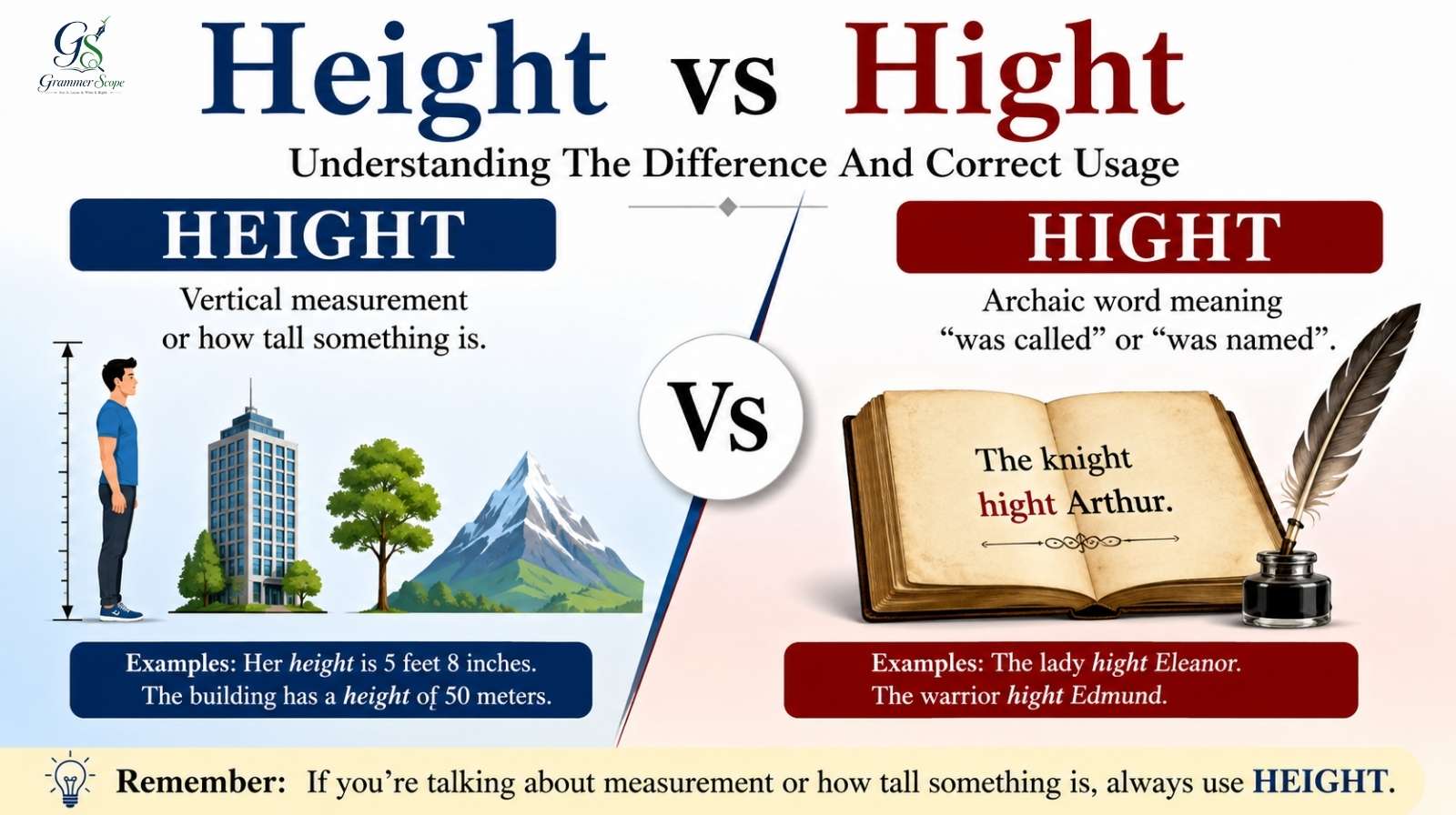
The good news is that the answer is simple. In modern English, height is the correct word when you are talking about how tall something is or the vertical distance from bottom to top. Hight, on the other hand, is a real but archaic English word with a completely different meaning.
Understanding the difference between height vs hight can help you avoid spelling errors in essays, emails, schoolwork, professional documents, and everyday writing. This guide explains what each word means, why people confuse them, and exactly when to use the correct spelling.
What Is the Difference Between Height vs Hight?
The main difference is simple:
Height is the standard modern English noun used for measurement, stature, elevation, or vertical distance.
Hight is an archaic word meaning “was called” or “was named” and is rarely used in modern English.
Merriam-Webster defines height as the vertical distance from the bottom to the top of something and also recognizes broader meanings involving elevation, a high point, or the greatest stage of something. By contrast, it labels hight as archaic and defines it as “being called” or “named.”
Height vs Hight: Quick Comparison
| Feature | Height | Hight |
|---|---|---|
| Modern English word | Yes | Rarely |
| Main meaning | Vertical measurement or stature | Was called or named |
| Part of speech | Usually a noun | Archaic verb form |
| Used in everyday writing | Yes | No |
| Used for a person’s measurement | Yes | No |
| Used in academic writing | Yes | Usually no |
| Used in business writing | Yes | No |
| Common in modern English | Very common | Extremely rare |
| Example | Her height is 5 feet 8 inches. | The knight hight Arthur. |
| Correct choice for measurement | Height | No |
For almost every modern writing situation involving a person, building, tree, mountain, or object, height is the word you need.
The Simple Memory Trick for Height vs Hight
Think about the word high.
Something can be high, and you can talk about its height.
For example:
- The wall is high.
- The height of the wall is 10 feet.
This connection can help you remember the spelling:
High → Height
Do not assume that adding -t to high creates the noun. English spelling developed historically, which is why the standard noun has the spelling height rather than hight.
Read More: Gage or Gauge: What’s The Difference? Explained Simply
What Does “Height” Mean?
Height is a noun. Its most common meaning is the distance from the bottom to the top of something or the measurement of how tall a person or object is.
For example:
- What is your height?
- The building has a height of 50 meters.
- The tree reached a remarkable height.
- The child’s height increased significantly this year.
- The mountain’s height makes it visible from miles away.
Dictionary definitions also show that height can refer to elevation, a high point, or the highest stage of something. For example, someone can be “at the height of their career,” which does not describe physical measurement at all.
Height as a Physical Measurement
This is the meaning most people know.
You can use height when measuring:
- A person’s stature
- A building
- A tree
- A mountain
- A wall
- A piece of furniture
- An animal
- Any object measured vertically
Examples:
- The doctor recorded the baby’s height.
- Please check the height of the doorway.
- The tower has a height of 300 meters.
- We measured the table’s height before buying chairs.
- His height gives him an advantage in basketball.
The important idea is vertical measurement.
If you can ask, “How tall is it?” or “How far is it from bottom to top?” then height will usually be appropriate.
Height in Figurative Expressions
The word is not limited to physical size.
Height can also describe the highest, strongest, most advanced, or most intense point of something.
Examples:
- She was at the height of her popularity.
- The company reached the height of its success in the 1990s.
- Tensions were at their height during the negotiations.
- The festival takes place at the height of summer.
- His career reached new heights after the award.
This figurative usage is another reason height is such a versatile English word.
Common Expressions With Height
Learning common word combinations can make correct spelling easier to remember.
Common phrases include:
- average height
- full height
- maximum height
- considerable height
- height requirement
- height and weight
- fear of heights
- at the height of
- reach new heights
- height above sea level
Examples:
- There is a minimum height requirement for the ride.
- The pilot reported the aircraft’s height above sea level.
- Her business has reached new heights.
- He suffers from a fear of heights.
Notice that every one of these expressions uses height, never hight.
What Does “Hight” Mean?
Here is where the confusion becomes more interesting: hight is technically a real word.
However, that does not mean it is an alternative spelling of height.
Merriam-Webster lists hight as an archaic word meaning “being called” or “named,” with its recorded history reaching back to the 15th century.
Hight Is an Archaic Word
In older English, hight could be used in a sense similar to:
- was called
- was named
- was known as
For example:
- The warrior hight Edmund.
- A lady hight Eleanor lived in the castle.
In modern English, these sentences would normally be written as:
- The warrior was called Edmund.
- A lady named Eleanor lived in the castle.
That is why seeing hight in a modern document can be confusing. It may either be an intentional historical or literary choice or, much more commonly, a misspelling of height.
When Might You Actually See “Hight”?
You may encounter hight in:
- Old literature
- Historical writing
- Poetry using archaic language
- Reproductions of older texts
- Discussions about the history of English
You generally should not use it in modern:
- School essays
- Job applications
- Business emails
- News articles
- Academic papers
- Product descriptions
- Social media captions
- Everyday communication
Unless you are deliberately using an archaic style, hight is almost certainly not the word you want.
Read More: Due To or Do To: Stop Making This Common Grammar Mistake
Why Do People Confuse Height and Hight?
The height vs hight confusion happens for several understandable reasons. English learners and native speakers alike may type hight because the word seems to follow a logical spelling pattern.
The Connection With “High”
The biggest source of confusion is the word high.
People often reason:
high + t = hight
However, English words do not always form related words through simple spelling changes.
The correct noun connected to high is height.
Compare:
- The shelf is high.
- What is the height of the shelf?
The spelling changes because height developed through its own historical path in English. The modern standard spelling is firmly established as height.
They Sound Similar
In ordinary speech, the difference between the pronunciation of height and the archaic word hight does not help a writer choose the correct spelling.
That means spelling depends heavily on knowing:
- The meaning you want.
- The context of the sentence.
- The standard spelling used in modern English.
If you mean vertical measurement, stature, or elevation, write height.
Typing and Autocorrect Errors
A simple typing error can also create the problem.
Someone may type:
What is your hight?
The sentence is understandable, but standard modern English requires:
What is your height?
Because the incorrect form differs by only one letter, it can easily survive a quick proofread.
This is why context-based proofreading is more useful than checking whether a word merely “looks familiar.”
Read More: Courtesy vs Curtesy: What’s The Difference? (Complete Guide)
Height vs Hight: Correct Usage Rules
The easiest way to choose between the two words is to focus on meaning.
Rule 1: Use “Height” for How Tall Something Is
Use height for physical measurement.
Correct:
- Her height is 170 centimeters.
- We measured the height of the cabinet.
- The bridge’s height is impressive.
- The giraffe’s height makes it easy to spot.
Incorrect in modern standard usage:
- Her hight is 170 centimeters.
- We measured the hight of the cabinet.
Rule 2: Use “Height” for Vertical Distance
Use height when something is measured from a lower point to an upper point.
Examples:
- The height of the ceiling is 12 feet.
- Check the height of the package before shipping it.
- The fence’s height must meet local regulations.
This usage can apply whether the object is naturally tall, built by humans, or simply measured vertically.
Rule 3: Use “Height” in Figurative Meanings
Use height when referring to a peak or maximum stage.
Examples:
- At the height of his career, he worked with major clients.
- The excitement reached its height before the announcement.
- The singer rose to the height of international fame.
You can also use the plural heights in expressions such as:
- The business reached new heights.
- Her confidence took her to greater heights.
Rule 4: Reserve “Hight” for Archaic Contexts
Use hight only when intentionally discussing or reproducing old-fashioned English.
For example:
In the historical poem, the hero is hight Roland.
For modern writing, rewrite it as:
In the story, the hero is named Roland.
For nearly all contemporary readers and writers, height is the practical word to remember.
Real-Life Example: A Small Spelling Mistake With a Big Professional Impact
Imagine a university student named Daniel preparing an application for a summer internship. The company asks applicants to complete a simple online profile that includes personal details. Daniel writes:
“My hight is 6 feet 1 inch.”
The recruiter understands what he means. The sentence does not make the application impossible to read. However, the mistake appears in a section that requires only basic personal information, so it can create an unnecessary impression that Daniel did not proofread carefully.
Later, Daniel notices the same spelling in an email draft about an event venue:
“Please confirm the hight of the main entrance.”
Again, the intended meaning is clear, but the correct spelling should be height.
After learning the difference, Daniel begins using a simple checking method. Whenever he writes the word, he asks himself: “Am I talking about how tall, high, or vertically measured something is?” If the answer is yes, he writes height. If he sees hight, he checks whether he is intentionally referring to archaic language meaning “called” or “named.”
Within a few weeks, the error disappears from his writing. The lesson is simple: many spelling mistakes are not difficult because the rule is complex. They happen because familiar-looking words are used without checking their meaning. A short pause for context can prevent the same error from appearing repeatedly in school, work, and professional communication.
Read More: Winner or Winer: Meaning, Difference And Correct Usage
Height vs Hight in 2025–2026: What Current Language Evidence Shows
Current dictionary and language-reference material continues to make a clear distinction between these words.
Merriam-Webster’s current dictionary entry describes height as the standard noun for vertical distance, stature, elevation, and related meanings, while its entry for hight labels the word archaic and gives the meaning “being called” or “named.” Recent 2026 example material also continues to show height as the normal modern spelling in contemporary published English.
The Most Important Data Point: Modern Standard Usage
For this particular spelling question, a dictionary classification is more useful than an unreliable percentage of online searches.
The evidence is straightforward:
| Usage Context | Standard Choice in 2025–2026 |
|---|---|
| Person’s measurement | Height |
| Building measurement | Height |
| Tree measurement | Height |
| Vertical distance | Height |
| Elevation-related description | Height |
| Peak or highest stage | Height |
| Modern professional writing | Height |
| Academic writing | Height |
| Historical/archaic “was called” meaning | Hight |
Therefore, the practical rule for modern writers remains unchanged: use height for measurement and use hight only when an archaic meaning is specifically intended.
This distinction is also consistent with how current grammar references separate related ideas such as high, tall, and vertical measurement. For example, Cambridge Grammar explains that high and tall have different contexts of use, reinforcing the importance of choosing words based on meaning rather than appearance alone.
Height, High, and Tall: How Are They Different?
Although the main question is height vs hight, many learners also confuse height, high, and tall.
These words are related, but they do different jobs.
Height Is a Noun
Use height to name a measurement or quality.
Examples:
- What is the height of the door?
- Her height is above average.
- The height of the mountain is difficult to estimate.
Ask yourself:
What is the measurement?
The answer may involve height.
High Is Usually an Adjective
Use high to describe something positioned far above a lower level or extending a great distance upward.
Examples:
- That shelf is too high.
- The plane is flying high.
- They climbed a high mountain.
Merriam-Webster also distinguishes high as a word describing something that rises or extends upward, including something having a specified elevation.
Tall Usually Describes Stature or Vertical Shape
Use tall especially for people and things with noticeable vertical length.
Examples:
- She is very tall.
- They live in a tall building.
- The garden has several tall trees.
Cambridge Grammar specifically notes that we normally use tall, not high, when talking about people’s stature.
A quick comparison:
- She is tall.
- Her height is 180 centimeters.
- The building is high.
- The building has a height of 100 meters.
Understanding these relationships can make the spelling of height easier to remember.
Read More: Dwarfs or Dwarves: Which Plural Should You Use?
Common Mistakes to Avoid When Using Height
Knowing the correct definition is helpful, but avoiding repeated mistakes requires recognizing the most common problem patterns.
Mistake 1: Writing “Hight” for a Measurement
Incorrect:
What is the hight of the wall?
Correct:
What is the height of the wall?
If the sentence involves measurement, use height.
Mistake 2: Assuming “Hight” Is a Modern Alternative Spelling
It is not a standard alternative spelling for height.
Although hight exists as an archaic word, that does not make it interchangeable with height.
Incorrect:
Both height and hight can describe how tall a person is.
Correct:
Height describes how tall a person is; hight has an archaic meaning related to being called or named.
Mistake 3: Using the Wrong Word Because It Sounds Logical
English spelling is full of historical forms that do not always match simple modern patterns.
Do not choose a spelling based only on what seems logical.
Instead, remember the complete word:
H-E-I-G-H-T
Mistake 4: Confusing “Height” With “High”
These words are related but serve different grammatical roles.
Incorrect:
What is the high of the building?
Usually better:
What is the height of the building?
Or:
How high is the building?
Both questions ask about a similar idea, but the grammar changes.
Mistake 5: Missing the Error During Proofreading
Spell-checking tools are helpful, but proofreading should also involve meaning.
When you see hight, ask:
Does this sentence mean “was called,” or am I talking about a measurement?
If you mean measurement, correct it to height.
Read More: Attornies or Attorneys? Correct Spelling Explained (2026)
How to Remember the Correct Spelling of Height
A reliable memory method can save time, especially if you have made this mistake before.
Step 1: Connect Height With Measurement
Think:
Height = How high something measures vertically
Examples:
- person’s height
- building height
- tree height
- mountain height
Step 2: Remember the “E”
The most common error is dropping the e after the initial h.
Correct:
H E I G H T
Incorrect for modern measurement:
H I G H T
A simple reminder is:
Height has an extra “E.”
Step 3: Use a Sentence Check
Before finalizing your writing, place the word in this question:
“What is the ___ of it?”
If the answer means “how tall or vertically large is it?” use height.
For example:
- What is the height of the desk?
- What is the height of the child?
- What is the height of the mountain?
Step 4: Remember That Hight Means Something Else
You do not need to think of hight as “another possible spelling.”
Think of it as a different, archaic word.
That mental distinction is important:
- height = modern measurement word
- hight = archaic “called/named” word
Once you separate their meanings, the spelling choice becomes much easier.
Practical Checklist for Correct Height Usage
Before using the word, run through this quick checklist:
- Am I talking about how tall someone is?
- Am I measuring an object from bottom to top?
- Am I describing vertical distance or elevation?
- Am I referring to the highest point or peak of something?
- Am I using a phrase such as “height requirement” or “new heights”?
If you answered yes to any of these, use height.
Use hight only if:
- You are intentionally using archaic English.
- The word means “was called” or “was named.”
- You are quoting or discussing historical literature.
For everyday English, the answer will almost always be height.
Read More: Weiner or Wiener: Meaning And Correct Usage Explained (2026)
Examples of Height vs Hight in Sentences
Examples are one of the fastest ways to make the difference clear.
Correct Examples With “Height”
- The child’s height was measured at school.
- What is the height of this chair?
- The mountain reaches an impressive height.
- There is a minimum height requirement for the ride.
- The company reached the height of its success last year.
- Her height and weight were recorded.
- The tower’s height can be seen from across the city.
- He has always been afraid of heights.
- The shelf was installed at the correct height.
- The athlete’s height gives her a competitive advantage.
Examples Showing the Archaic Meaning of “Hight”
These examples are deliberately old-fashioned:
- The old king hight William.
- A warrior hight Marcus entered the hall.
- The maiden hight Elinor appeared in the poem.
Modern alternatives would be:
- The old king was called William.
- A warrior named Marcus entered the hall.
- A maiden named Elinor appeared in the poem.
Incorrect Modern Examples to Avoid
Incorrect:
My hight is 175 centimeters.
Correct:
My height is 175 centimeters.
Incorrect:
Please tell us the hight of the package.
Correct:
Please tell us the height of the package.
Incorrect:
The hight requirement is 48 inches.
Correct:
The height requirement is 48 inches.
Read More: Seel or Seal – Correct Word Explained With Examples (2026)
Mini Quiz: Height vs Hight
Quiz 1: Pick the Correct Word
My ______ is 5 feet 9 inches.
A) Hight
B) Height
Answer: Height — We use height to talk about how tall a person or object is.
Quiz 2: Fill in the Blank
What is the ______ of the building?
Answer: Height — The sentence asks about the building’s vertical measurement.
Quiz 3: Quick Choice
Which word is correct in modern English for vertical measurement?
A) Hight
B) Height
Answer: Height — Height is the standard spelling for measurement.
Quiz 4: Spot the Correct Sentence
Which sentence is correct?
A) The hight of the tree is 20 feet.
B) The height of the tree is 20 feet.
Answer: B) The height of the tree is 20 feet. — Always use height when measuring how tall something is.
Quiz 5: Fill in the Blank
There is a minimum ______ requirement for this roller coaster.
Answer: Height — The correct phrase is height requirement.
Quiz 6: True or False
Hight is the correct modern spelling when talking about a person’s measurement.
Answer: False — The correct modern spelling is height.
Quiz 7: Which One Fits?
She checked the ______ of the table before buying new chairs.
A) Height
B) Hight
Answer: Height — A table’s vertical measurement is its height.
Quiz 8: Fill in the Blank
The mountain has an impressive ______.
Answer: Height — Use height for the vertical measurement of a mountain.
Quiz 9: Easy Meaning Check
What does hight traditionally mean in archaic English?
A) Very tall
B) Was called or named
C) A vertical measurement
D) Extremely high
Answer: B) Was called or named — Hight is an old-fashioned word related to being called or named.
Quiz 10: Choose the Correct Spelling
Which spelling should you use in this sentence?
“Please tell me your ______.”
A) Hight
B) Height
Answer: Height — When asking how tall someone is, height is correct.
Quiz 11: Fill in the Blank
At the ______ of her career, she became internationally famous.
Answer: Height — Here, height means the highest point or peak of her career.
Quiz 12: Find the Mistake
Which word is wrong in this sentence?
The hight of the door is 7 feet.
Answer: Hight — It should be height because the sentence refers to a measurement.
Quiz 13: Quick Grammar Challenge
Complete the sentence:
The shelf is very ______, but its ______ is only 6 feet.
A) height / high
B) high / height
C) hight / height
D) high / hight
Answer: B) high / height — High describes something, while height is the measurement.
Quiz 14: Fill in the Blank
Her fear of ______ made climbing the tall tower difficult.
Answer: Heights — The common expression is fear of heights.
Quiz 15: Final Challenge
Choose the best answer:
If you are writing about how tall a person, building, tree, or object is, which word should you use?
A) Hight
B) Height
C) Highness
D) Highty
Answer: B) Height — That’s the simple rule to remember: if you mean measurement, use HEIGHT.
References
For further reading and authoritative definitions, consult these trusted sources:
Frequently Asked Questions
Q1: Is it “height” or “hight”?
A: For modern English measurement, height is correct. Use height when referring to how tall someone or something is, vertical distance, elevation, or a high point. Hight is an archaic word with a different meaning.
Q2: Is “hight” a real word?
A: Yes. Hight is a real word, but it is archaic. It historically means “being called” or “named.” It is not the standard spelling of height.
Q3: What is the correct spelling for a person’s height?
A: The correct spelling is height.
Example:
Her height is 5 feet 6 inches.
Never use hight for a person’s physical measurement in standard modern English.
Q4: Why is “height” spelled with “ei”?
A: English spelling reflects the history and development of words, so related words do not always follow a simple letter pattern. The standard modern spelling is height, while high has a different spelling structure. Dictionary word-history information traces height back to earlier forms of English.
Q5: Can I use “hight” in formal writing?
A: Generally, no. You should not use hight in formal modern writing when you mean vertical measurement. Use height instead. The main exception would be a deliberate quotation, historical discussion, or intentionally archaic literary style.
Q6: What is the difference between height and high?
A: Height is usually a noun referring to vertical measurement or stature.
The height of the wall is 8 feet.
High can describe something positioned or extending far upward.
The wall is high.
Q7: Is “height” used in both American and British English?
A: Yes. Height is the standard spelling in both American and British English when referring to vertical measurement, stature, elevation, or related meanings.
Conclusion
The difference between height vs hight is easy once you focus on meaning rather than appearance.
Height is the correct modern English word for the measurement of how tall something is, vertical distance, elevation, and even figurative expressions such as “the height of success.” Hight is not an alternative spelling for measurement. It is an archaic word meaning “was called” or “was named.”
So, the next time you write about a person’s stature, the size of a building, the measurement of a tree, or the vertical distance of an object, remember one simple rule:
If you mean measurement, use HEIGHT.
Learning this small distinction can make your writing more accurate, professional, and confident. Before you publish, submit, or send your next piece of writing, take a moment to check common spelling mistakes like height vs hight those small details can make a noticeable difference in how polished your English appears.
Want to improve your spelling and grammar even further? Explore more clear, practical guides on commonly confused words and build stronger writing habits one word at a time.
Discover More Articles
- Labeller or Labeler: Which Spelling Is Correct?
- Puddy or Putty: Which Spelling Is Correct? (2026 Guide)
- Girlie or Girly: Correct Usage, Meaning And Examples (2026)
Ready to improve your English? Read more guides on Grammer Scope

Bilal Khalid is a professional blogger specializing in grammar guides and practical writing tips. He helps readers improve clarity, accuracy, and confidence in communication through simple explanations, actionable advice, and easy-to-follow strategies for everyday and professional writing.