Have you ever paused while typing a message and wondered whether to write “you too” or “you to”?
You’re not alone. This is one of the most common grammar mistakes in everyday English. The confusion happens because both phrases sound exactly the same when spoken. However, their meanings and grammatical functions are completely different.
In today’s world of emails, social media posts, text messages, and professional communication, using the correct phrase matters more than ever. A small grammar mistake can change the meaning of a sentence and sometimes make your writing look less polished.
This guide explains the difference between you too and you to, provides practical examples, explores common mistakes, and shows you how to remember the correct usage every time.
What Is the Difference Between “You Too” and “You To”?
The simplest explanation is this:
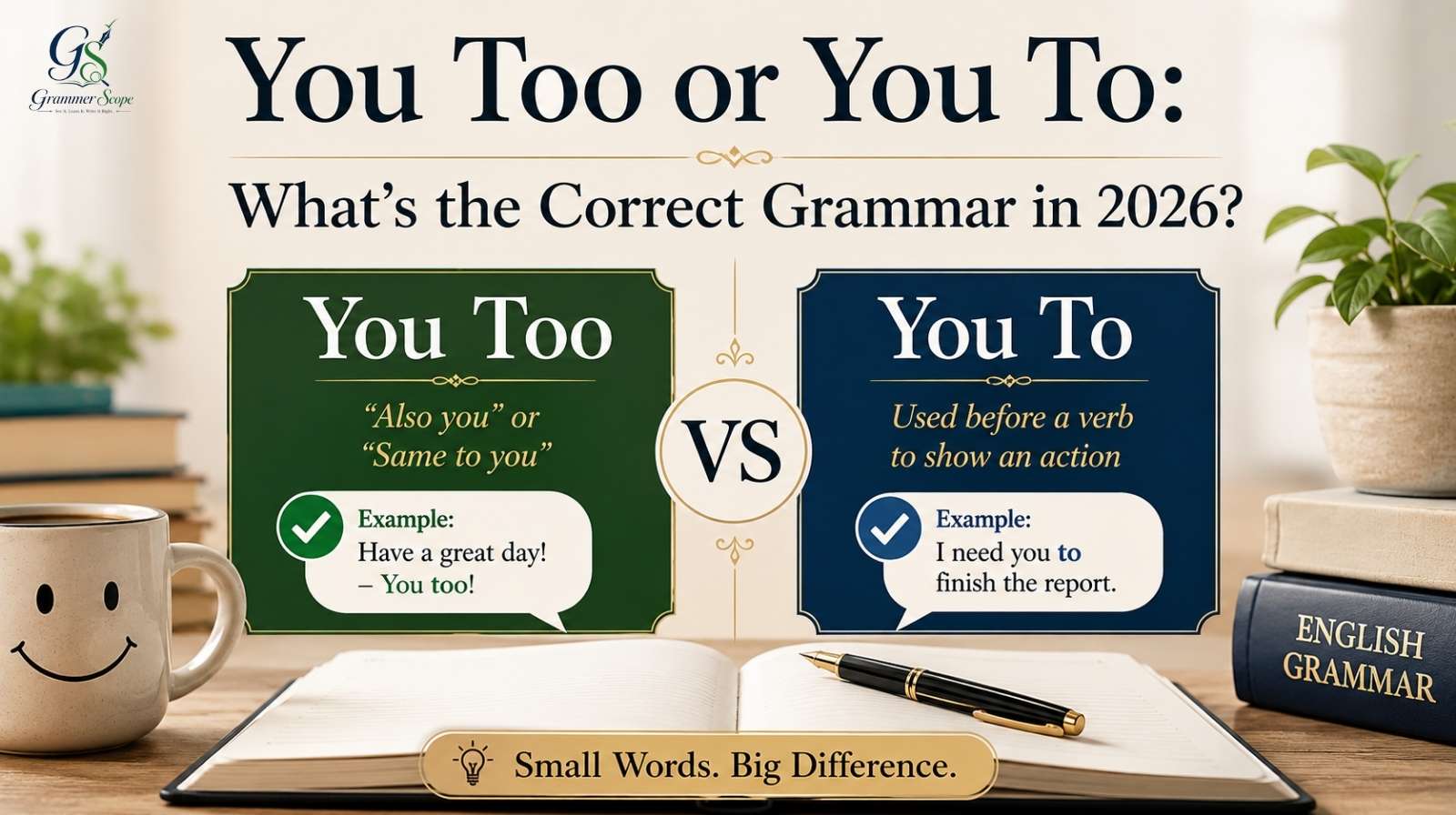
- You too means also you or the same to you.
- You to is usually incomplete and often appears as part of a larger grammatical structure.
Quick Answer
| Phrase | Meaning | Correct Usage |
|---|---|---|
| You too | Also you; same to you | Correct in responses and conversations |
| You to | Usually incomplete | Often incorrect when used alone |
Examples:
✅ Have a wonderful day! You too!
✅ Good luck on your interview. You too!
❌ Have a wonderful day! You to!
❌ Thanks, you to.
In almost every conversational situation, you too is the correct choice.
Read More: Pre vs Post: Correct Usage & Meaning Guide 2026
Why “You Too” Is Usually Correct
The word too is an adverb that means:
- Also
- As well
- In addition
When someone says something positive to you, replying with you too means you wish the same thing back to them.
Examples of “You Too”
- Enjoy your vacation!
- You too!
- Have a great weekend.
- You too!
- Stay safe.
- You too!
- Good luck with your project.
- You too!
Why It Works
The phrase is actually a shortened version of a longer sentence.
For example:
“Have a nice day.”
Response:
“You too.”
Full meaning:
“I hope you have a nice day too.”
English speakers naturally omit the repeated words because the meaning is already clear.
Common Situations
Casual Conversations
- See you later.
- You too!
Emails
- Have a productive week.
- You too, thanks.
Social Media
- Happy holidays!
- You too!
These are all standard and grammatically correct.
When Is “You To” Correct?
Although many people assume you to is always wrong, that’s not entirely true.
The phrase can be correct when to functions as a preposition or part of an infinitive structure.
Examples
✅ I want you to attend the meeting.
✅ We need you to finish the report.
✅ The teacher asked you to submit the assignment.
✅ I’d like you to join our team.
Notice that you to is not standing alone.
Instead, it forms part of a larger grammatical pattern:
you + to + verb
Structure
Subject + Verb + You + To + Verb
Examples:
- I expect you to arrive on time.
- We need you to help us.
- They want you to participate.
This is the most common situation where “you to” is grammatically correct.
Important Rule
If you’re responding to someone’s greeting, compliment, or good wishes, use you too.
If you’re introducing an action someone should perform, you to may be correct.
You Too vs You To: Side-by-Side Comparison
Understanding the differences becomes easier when viewed together.
| Feature | You Too | You To |
|---|---|---|
| Part of Speech | Adverb phrase | Pronoun + preposition/infinitive marker |
| Meaning | Also you; same to you | Indicates a following action |
| Common in replies | Yes | No |
| Can stand alone | Yes | Usually no |
| Frequently confused | Yes | Yes |
Example Comparison
Correct
- Have fun tonight!
- You too!
Incorrect
- Have fun tonight!
- You to!
Correct
- I need you to call me tomorrow.
Incorrect
- I need you too call me tomorrow.
The second mistake is extremely common because “too” and “to” sound identical.
Also Read: Hustle or Hussle: Which Spelling Is Correct?
Common Mistakes People Make
Many English learners and native speakers accidentally interchange these words.
Let’s examine the most frequent errors.
Mistake 1: Using “To” Instead of “Too”
❌ Have a nice day. You to!
✅ Have a nice day. You too!
Why It’s Wrong:
The sentence requires the meaning “also you,” which is expressed by too.
Mistake 2: Using “Too” Instead of “To”
❌ I need you too finish the project.
✅ I need you to finish the project.
Why It’s Wrong:
The sentence requires the infinitive marker to before the verb.
Mistake 3: Auto-Correct Errors
Modern keyboards sometimes replace one word with another, especially during fast typing.
Examples:
❌ Thanks, you to.
❌ Need you too review this.
Always proofread before sending professional messages.
Real-Life Example: How One Small Grammar Mistake Changed a Professional Email
In 2025, a marketing manager shared an experience on a professional communication forum involving a simple grammar error.
The manager received an email from a potential client that ended with:
“Have a great weekend.”
The intended reply was:
“Thank you. You too!”
However, the sender quickly typed:
“Thank you. You to!”
Although the client understood the message, the mistake stood out because it appeared in an important business conversation involving a six-figure contract.
Later, the client jokingly mentioned the typo during a video meeting. Fortunately, it did not affect the relationship, but it highlighted how minor grammar errors can influence first impressions.
This example demonstrates why understanding the difference between you too and you to matters. While most readers will understand your meaning, correct grammar helps create a more professional and polished image.
In competitive workplaces where communication skills are valued, attention to detail can make a significant difference.
Grammar Rule: Understanding “Too”
Definition of Too
The word too has two primary meanings:
- Also
- Excessively
Meaning 1: Also
Examples:
- I like coffee, and she does too.
- We are going too.
- You too!
Meaning 2: Excessively
Examples:
- The coffee is too hot.
- The box is too heavy.
- The movie was too long.
When discussing you too, we’re using the first meaning: also.
Easy Memory Trick
The word too contains an extra “o.”
Think of that extra letter as meaning:
Extra = Also
So:
- too = also
- too = extra
This memory trick helps many learners remember the correct spelling.
Grammar Rule: Understanding “To”
The word to serves several grammatical functions.
Function 1: Showing Direction
Examples:
- Go to the store.
- Drive to the airport.
- Walk to school.
Function 2: Forming Infinitives
Examples:
- To learn
- To study
- To write
Function 3: Connecting Actions
Examples:
- I need you to help.
- We expect you to arrive early.
- They asked you to participate.
Notice that to often introduces an action.
2025–2026 Writing Trends and Grammar Statistics
Digital communication continues to dominate personal and professional interactions.
Recent reports from major communication platforms and workplace productivity studies indicate that billions of messages, emails, and social posts are exchanged daily. As online communication grows, grammar-related mistakes remain among the most common writing errors.
Language-learning platforms and grammar-checking tools consistently report confusion between:
- To
- Too
- Two
as one of the most frequently corrected word groups.
Several workplace communication surveys conducted during 2025 found that employers still associate clear writing with professionalism, attention to detail, and credibility.
As a result, mastering simple distinctions such as you too versus you to remains important in 2026 for students, job seekers, professionals, and content creators.
Read More: Challenge or Challange: Which Is Correct? (2026 Guide)
How to Remember the Difference Every Time
Follow this simple checklist.
Ask Yourself a Question
Are You Saying “Also You”?
If yes:
Use you too.
Example:
- Have fun!
- You too!
Is a Verb Coming Next?
If yes:
Use you to.
Example:
- I want you to listen carefully.
Quick Checklist
✔ Replying to someone’s good wishes → You too
✔ Meaning “also” → You too
✔ Followed by a verb → You to
✔ Part of an instruction → You to
✔ Standing alone as a response → You too
Examples in Everyday Situations
Text Messages
Friend:
“Good luck tomorrow!”
Reply:
“Thanks! You too!”
Workplace Emails
Manager:
“Have a productive afternoon.”
Reply:
“Thank you. You too.”
School Setting
Teacher:
“I need you to complete the worksheet.”
Correct phrase:
“I need you to…”
Not:
“I need you too…”
Family Conversation
Parent:
“Drive safely.”
Response:
“You too!”
Mini Quiz: You Too or You To
Mini Quiz 1: Which One Means “Also You”?
Question: Which phrase means “also you” or “the same to you”?
A) You to
B) You too
Answer: ✅ B) You too
Mini Quiz 2: Spot the Correct Reply
Question: Someone says, “Have a great day!” Which reply is correct?
A) You to!
B) You too!
Answer: ✅ B) You too!
Mini Quiz 3: Fill in the Blank
Question: I need you ___ finish the report.
A) too
B) to
Answer: ✅ B) to
Mini Quiz 4: True or False?
Question: “You too” is commonly used in emails and text messages.
Answer: ✅ True
Mini Quiz 5: Grammar Challenge
Question: Which sentence is correct?
A) Thanks, you to.
B) Thanks, you too.
Answer: ✅ B) Thanks, you too.
Mini Quiz 6: Quick Pick
Question: Which word is an adverb meaning “also”?
A) To
B) Too
Answer: ✅ B) Too
Mini Quiz 7: Everyday English Test
Question: Your friend says, “Good luck!” What should you reply?
A) You too!
B) You to!
Answer: ✅ A) You too!
Mini Quiz 8: Find the Mistake
Question: Which sentence contains a grammar mistake?
A) We need you to help us.
B) We need you too help us.
Answer: ✅ B) We need you too help us.
Mini Quiz 9: One-Word Check
Question: Which phrase can stand alone as a response?
A) You too
B) You to
Answer: ✅ A) You too
Mini Quiz 10: Final Grammar Test
Question: Complete the sentence: “I’d like you ___ join our team.”
A) too
B) to
Answer: ✅ B) to
Credible References
For additional grammar guidance, consult:
Frequently Asked Questions
Q1: Is “You To” Ever Correct?
A: Yes. It is correct when followed by a verb or when functioning as part of a larger grammatical structure.
Example:
“I want you to succeed.”
Q2: Why Do People Confuse “Too” and “To”?
A: They are homophones, meaning they sound identical when spoken but have different meanings and spellings.
Q3: Can I Say “You Too” in Professional Emails?
A: Absolutely. It is widely accepted and commonly used in professional communication.
Example:
“Have a great week.”
“Thank you. You too.”
Q4: Is “You Too” Formal or Informal?
A: It works in both formal and informal settings. The phrase is polite, natural, and universally understood.
Q5: How Do I Remember Which One to Use?
A: Remember:
- Too = Also
- To = Action or Direction
If you mean “also,” choose too.
Q6: Is “You Too” a Complete Sentence?
A: Technically, it is an abbreviated response rather than a complete sentence. However, it is perfectly acceptable in English conversation.
Q7: What Is the Most Common Mistake?
A: The most common mistake is writing:
“You to”
when the intended meaning is:
“You too.”
Conclusion
Understanding the difference between You Too or You To is much easier once you know the role each word plays in a sentence.
Use you too when you mean also you or the same to you. This is the correct choice in most greetings, replies, and everyday conversations.
Use you to only when it is part of a larger grammatical structure, usually before a verb, such as “I need you to help.”
The next time someone says, “Have a great day,” you’ll know exactly how to respond:
“You too!”
Mastering small grammar details like this improves your writing, strengthens your communication skills, and helps you make a professional impression wherever you write.
Discover More Articles
- Jobsite or Job Site: What’s The Difference And Correct Use?
- Reinforce or Reenforce? The Correct Spelling Explained In Seconds
- Acception vs Exception: Definitions, Examples And Tricks
Ready to improve your English? Read more guides on Grammer Scope