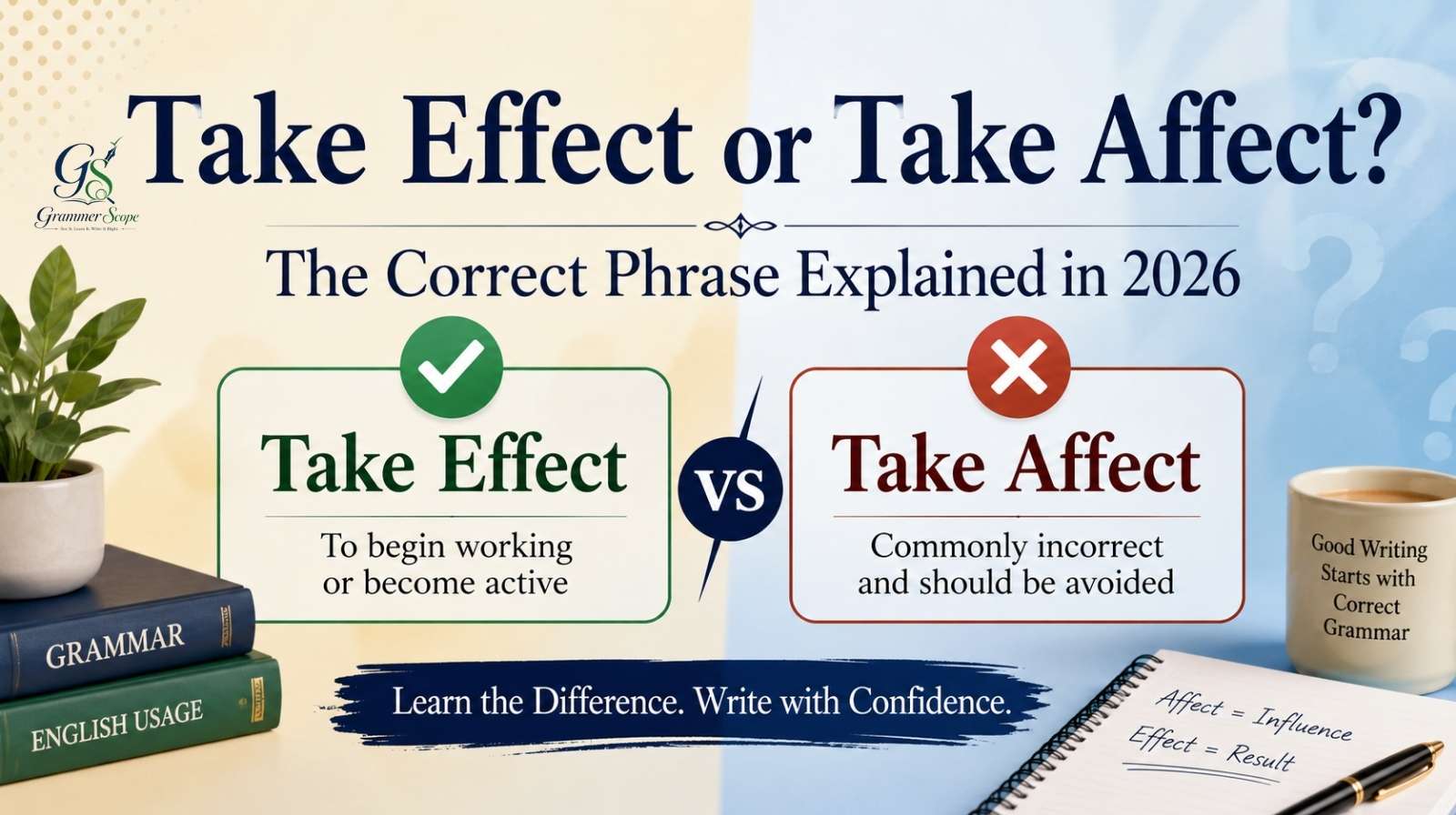
Have you ever wondered whether you should write “take effect” or “take affect”?
You’re not alone. This is one of the most common English grammar mistakes because the words effect and affect sound very similar. Many writers, students, bloggers, and even professionals accidentally use the wrong phrase.
The good news is that the difference is actually quite simple once you understand how these words function in a sentence.
In this guide, you’ll learn the correct phrase, why it is correct, when to use it, common mistakes to avoid, real-world examples, and an easy trick to remember the difference forever.
What Is the Correct Phrase: Take Effect or Take Affect?
The correct phrase is:
✅ Take Effect
The phrase take effect means:
To begin working, become active, or start producing results.
Examples of “Take Effect”
- The new company policy will take effect next Monday.
- The medicine should take effect within thirty minutes.
- The law officially takes effect on January 1.
- The software update will take effect after restarting your computer.
In each example, something is beginning to work or become active.
Is “Take Affect” Ever Correct?
In standard English, take affect is almost always incorrect.
Because affect is usually a verb meaning “to influence,” it does not fit naturally after the word take in this expression.
Incorrect:
- The new rules will take affect tomorrow.
- The medication took affect quickly.
Correct:
- The new rules will take effect tomorrow.
- The medication took effect quickly.
Therefore, if you’re referring to something beginning to work or become operational, always use take effect.
Read More: Of Course or Ofcourse: Which One Should You Use?
Understanding the Difference Between Affect and Effect
To understand why take effect is correct, you need to know the difference between affect and effect.
Affect Meaning
Most commonly, affect is a verb.
It means:
To influence or change something.
Examples:
- Lack of sleep can affect your performance.
- Weather conditions affect crop production.
- Stress affects mental health.
Here, affect describes an action.
Effect Meaning
Effect is most commonly a noun.
It means:
A result, consequence, or outcome.
Examples:
- The effect of exercise is improved health.
- The new strategy had a positive effect.
- The campaign created a significant effect on sales.
Why “Take Effect” Works
The phrase take effect uses the noun effect in an idiomatic expression.
It literally means:
To become effective.
Examples:
- The changes will take effect immediately.
- The discount takes effect today.
This construction has been used in English for centuries and remains the accepted standard.
Take Effect Meaning in Everyday English
People often encounter the phrase take effect in everyday situations.
Laws and Regulations
Governments frequently announce when new laws will begin.
Examples:
- The tax law will take effect in July.
- The regulation takes effect next year.
Medicine and Healthcare
Doctors often explain when treatments begin working.
Examples:
- The painkiller should take effect soon.
- The vaccine takes effect after several weeks.
Business and Workplace Policies
Organizations use the phrase when introducing new procedures.
Examples:
- The updated attendance policy will take effect next month.
- Employee benefits take effect after ninety days.
Technology and Software
Technology companies frequently use the expression.
Examples:
- Changes will take effect after logging out.
- Security updates take effect automatically.
Because the phrase is so common, using take affect can appear unprofessional or grammatically incorrect.
Take Effect vs Take Affect: Quick Comparison Table
| Feature | Take Effect | Take Affect |
|---|---|---|
| Correct English Phrase | ✅ Yes | ❌ No |
| Meaning | Begin working or become active | Usually incorrect |
| Common Usage | Laws, medicine, policies, technology | Rarely used |
| Grammar Status | Standard English | Considered an error |
| Professional Writing | Recommended | Avoid |
Simple Rule to Remember
Ask yourself:
Is something starting to work or become active?
If yes, use:
✅ Take Effect
Never use:
❌ Take Affect
Why Do People Confuse Take Effect and Take Affect?
Several factors contribute to this mistake.
Similar Pronunciation
The words sound very similar when spoken.
Many people hear the phrase without seeing it written, leading to confusion later.
Affect and Effect Are Commonly Mixed Up
English learners and native speakers alike often struggle with these two words because they have related meanings.
Autocorrect Doesn’t Always Help
Some spelling tools recognize both words as correctly spelled, which means they may not catch the phrase-level error.
Lack of Grammar Awareness
Many writers know both words exist but are unsure which one belongs in the expression.
As a result, they accidentally write take affect instead of take effect.
Real-Life Example: How One Small Grammar Mistake Changed a Professional Email
A human resources manager at a growing technology company sent a company-wide email announcing updates to employee benefits.
The email stated:
“The new healthcare benefits will take affect on January 1.”
Several employees immediately noticed the mistake. While everyone understood the intended meaning, the error became a topic of discussion internally.
The HR department later corrected the announcement and changed the sentence to:
“The new healthcare benefits will take effect on January 1.”
Although the mistake was minor, it demonstrated how small grammar errors can affect credibility in professional communication.
This example highlights an important lesson. Grammar mistakes do not always change the meaning of a message, but they can influence how readers perceive professionalism, expertise, and attention to detail.
Whether you’re writing blog posts, academic papers, business emails, or social media content, choosing the correct phrase helps establish trust and authority.
That’s why understanding the difference between take effect and take affect matters more than many people realize.
Read More: Writing or Writting? Correct Spelling Explained
Grammar Rule: When to Use Affect and Effect
A useful rule is:
Affect = Action
Think of affect as a verb.
Examples:
- Advertising affects consumer behavior.
- Exercise affects overall health.
- Weather affects travel plans.
Effect = End Result
Think of effect as a noun.
Examples:
- The effect was immediate.
- The effect of the campaign was positive.
- The treatment produced the desired effect.
Applying the Rule
Correct:
- The medication will take effect.
Incorrect:
- The medication will take affect.
Because effect refers to the result becoming active, it fits naturally in the phrase.
Statistics: Why Grammar Accuracy Matters in 2025–2026
Recent studies continue to show that grammar influences credibility and reader trust.
Key Findings
- Business communication surveys indicate that grammatical errors can negatively impact perceptions of professionalism.
- Content marketing research shows that readers are more likely to trust well-edited content.
- Hiring managers frequently report that writing quality influences candidate evaluations.
- Educational assessments continue to identify affect/effect confusion as one of the most common English usage mistakes.
For writers competing online in 2026, clear grammar remains an essential component of authority and user trust.
According to guidance from professional writing resources such as the Purdue OWL, understanding commonly confused words helps improve communication accuracy.
Similarly, Merriam-Webster and Cambridge Dictionary define take effect as beginning to operate or produce results.
Common Examples of Take Effect
Below are examples you can model in your own writing.
Government
- The new legislation will take effect in September.
- Tax changes take effect next year.
Healthcare
- The treatment takes effect within hours.
- The medication took effect sooner than expected.
Education
- The updated grading policy will take effect next semester.
- Curriculum changes take effect immediately.
Workplace
- Salary adjustments take effect on July 1.
- The revised handbook takes effect next week.
Technology
- Settings changes take effect after saving.
- The update takes effect automatically.
Common Mistakes to Avoid
Mistake 1: Writing Take Affect
Incorrect:
- The changes will take affect tomorrow.
Correct:
- The changes will take effect tomorrow.
Mistake 2: Using Affect as a Noun
Incorrect:
- The affect of the decision was significant.
Correct:
- The effect of the decision was significant.
Mistake 3: Mixing Both Words Randomly
Incorrect:
- The new policy affected a positive effect.
Better:
- The new policy had a positive effect.
- The new policy affected employee satisfaction.
Choosing the right word improves clarity and professionalism.
How to Remember the Difference Forever
A simple memory trick can help.
The A-E Rule
Affect = Action
Both words start with the letter A.
Affect usually performs an action.
Effect = End Result
Both words start with the letter E.
Effect usually refers to the end result.
Applying the Trick
- The weather affects travel.
- The effect is delayed flights.
- The weather alert takes effect tomorrow.
This simple approach helps many writers avoid confusion.
Read More: Vendor or Vender: Which Is Correct In 2026?
Mini Quiz: Take Effect or Take Affect
Quiz 1: Which Phrase Is Correct?
Question:
Which sentence is grammatically correct?
A) The new law will take affect tomorrow.
B) The new law will take effect tomorrow.
Answer:
✅ B) The new law will take effect tomorrow.
Quiz 2: Spot the Right Word
Question:
The medicine should _____ within 30 minutes.
A) Take affect
B) Take effect
Answer:
✅ B) Take effect
The phrase means the medicine will begin working.
Quiz 3: Affect or Effect?
Question:
Lack of sleep can _____ your concentration.
A) Affect
B) Effect
Answer:
✅ A) Affect
“Affect” is usually a verb meaning “to influence.”
Quiz 4: Fill in the Blank
Question:
The new company policy will _____ next Monday.
A) Take affect
B) Take effect
Answer:
✅ B) Take effect
Policies, laws, and rules always “take effect.”
Quiz 5: Quick Grammar Challenge
Question:
Which word usually acts as a noun?
A) Affect
B) Effect
Answer:
✅ B) Effect
“Effect” typically means a result or outcome.
Quiz 6: Real-Life Scenario
Question:
Your doctor says, “This medication will begin working in one hour.” Which phrase matches that meaning?
A) Take affect
B) Take effect
Answer:
✅ B) Take effect
When something starts working, it takes effect.
Quiz 7: True or False
Question:
“Take affect” is the standard phrase used in professional writing.
Answer:
❌ False
The correct expression is “take effect.”
Quiz 8: Choose the Best Sentence
Question:
Which sentence would you use in a business email?
A) Salary changes will take affect on July 1.
B) Salary changes will take effect on July 1.
Answer:
✅ B) Salary changes will take effect on July 1.
Quiz 9: Meaning Check
Question:
What does “take effect” mean?
A) To influence something
B) To begin working or become active
C) To create a problem
Answer:
✅ B) To begin working or become active
Quiz 10: Grammar Detective
Question:
Find the mistake:
“The software update will take affect after restarting your device.”
Answer:
✅ The word “affect” is incorrect.
Correct sentence:
“The software update will take effect after restarting your device.”
Quiz 11: Memory Trick Test
Question:
Which reminder is correct?
A) Affect = Action, Effect = End Result
B) Affect = End Result, Effect = Action
Answer:
✅ A) Affect = Action, Effect = End Result
This is one of the easiest ways to remember the difference.
Final Bonus Quiz
Question:
Complete the sentence:
“The new regulations will _____ on January 1, 2027.”
A) Take affect
B) Take effect
Answer:
✅ B) Take effect
If something is becoming official, active, or operational, the correct phrase is always “take effect.”
Frequently Asked Questions
Q1: Is “take affect” ever grammatically correct?
A: In standard English usage, no. The correct phrase is almost always take effect.
Q2: What does “take effect” mean?
A: It means to begin operating, become active, or start producing results.
Q3: Why do people write “take affect”?
A: Because affect and effect sound similar, many writers accidentally substitute one for the other.
Q4: Is affect always a verb?
A: Usually, yes. Although there are rare exceptions in psychology, affect functions primarily as a verb in everyday English.
Q5: Is effect always a noun?
A: Most of the time, yes. It generally refers to a result or consequence.
Q6: What is an example of take effect?
A: “The new security policy will take effect next month.”
Q7: How can I remember the difference?
A: Remember:
- Affect = Action
- Effect = End Result
This rule works in most situations.
Conclusion
If you’ve been wondering whether to use take effect or take affect, the answer is straightforward:
✅ Take Effect is the correct phrase.
It means that something begins working, becomes active, or starts producing results. The phrase is commonly used for laws, policies, medications, software updates, and many other situations.
Meanwhile, take affect is generally considered incorrect because affect is usually a verb and does not fit the established expression.
By remembering that affect = action and effect = end result, you’ll avoid one of the most common grammar mistakes in English.
The next time you write about a policy, law, medication, or update that is beginning to work, confidently use take effect and keep your writing accurate, professional, and clear.
Ready to improve your English? Read more guides on Grammer Scope