Have you ever typed “I don’t know weather to go” and then paused because something looked wrong? Or perhaps you have seen wether, weather, and whether and wondered why three almost identical words can mean completely different things?
You are not alone. These commonly confused English words sound very similar, but they belong in completely different situations. One relates to the atmosphere, one introduces uncertainty or choices, and one is a much less common word connected to sheep.
The key to understanding wether vs weather vs whether is learning what each word means and recognizing the clues around it. Once you know those clues, choosing the correct spelling becomes much easier.
This guide explains the meaning of all three words, shows you exactly when to use them, gives real examples, highlights common mistakes, and shares simple memory tricks so you can write confidently every time.
Featured Snippet Answer: Wether or Weather or Whether
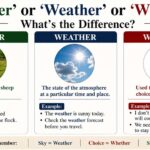
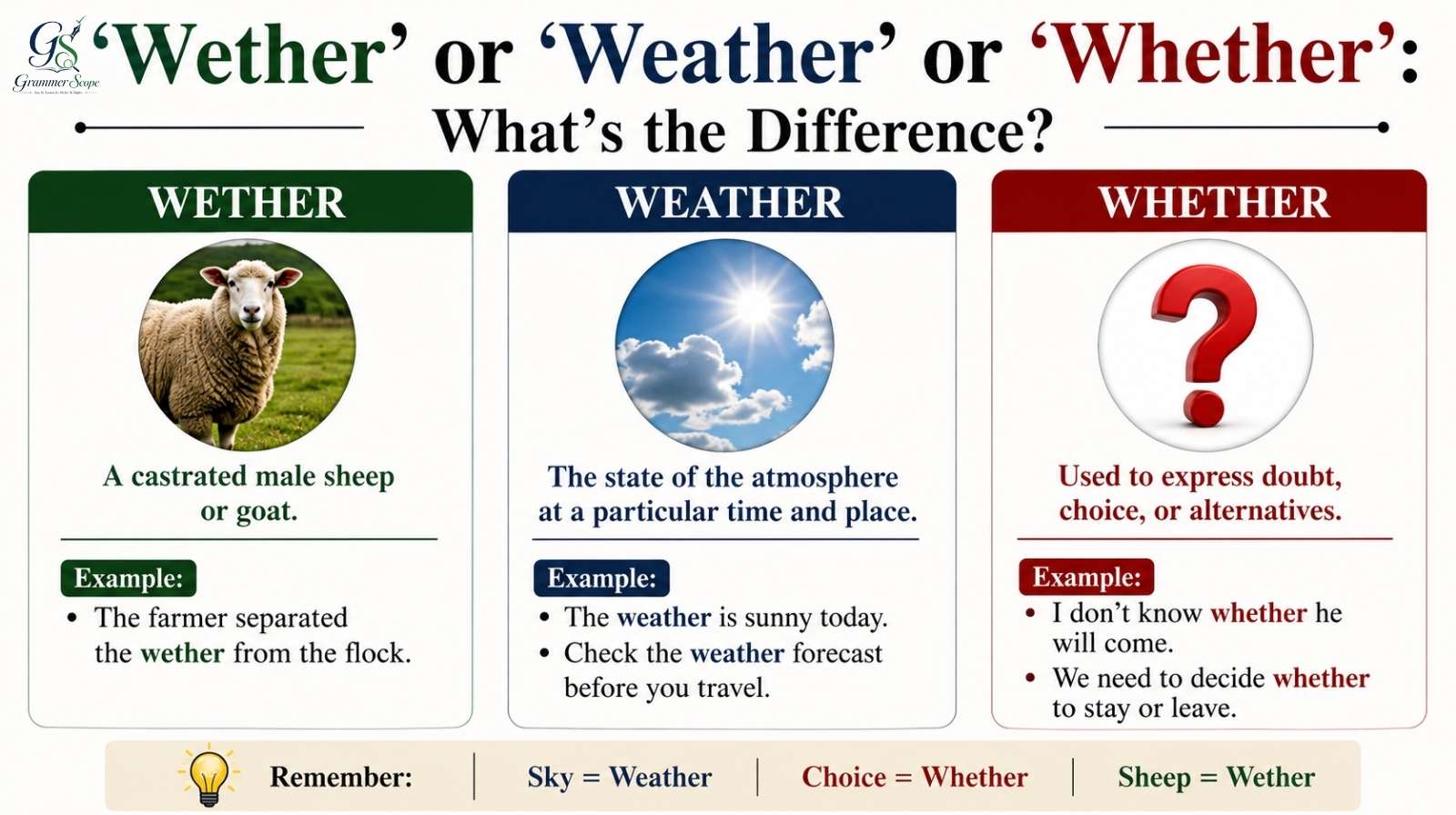
Wether, weather, and whether have different meanings. Wether is a castrated male sheep or goat. Weather refers to atmospheric conditions such as rain, wind, and temperature. Whether is used to express uncertainty, possibilities, or alternatives.
Example:
“I don’t know whether the weather will improve, but the wether is safely in the barn.”
What Is the Difference Between Wether, Weather, and Whether?
The quickest answer is simple:
| Word | Meaning | Example |
|---|---|---|
| Wether | A castrated male sheep or goat | The farmer separated the wether from the flock. |
| Weather | Atmospheric conditions, such as rain, wind, or temperature | The weather is expected to be sunny tomorrow. |
| Whether | Used to introduce uncertainty, alternatives, or possibilities | I don’t know whether she will come. |
Although the three words are pronounced similarly in many accents, their meanings are unrelated.
Wether: A Word About Sheep
A wether is a male sheep that has been castrated before reaching sexual maturity. The word can also refer to a castrated male goat. It is a specialized term, so most people will encounter it far less often than weather or whether.
Example:
The farmer checked that the wether was healthy.
Unless you are writing about sheep, farming, animal husbandry, or the word bellwether, you will probably not need to use wether very often.
Weather: Conditions Outside
Weather refers to the atmospheric conditions in a particular place and time. This can include rain, sunshine, snow, wind, clouds, humidity, and temperature.
Examples:
- The weather was cold and rainy.
- We checked the weather before leaving.
- Bad weather delayed the flight.
- Summer weather can change quickly.
Whether: Choice, Doubt, or Uncertainty
Whether is usually a conjunction used when discussing possibilities, alternatives, or an indirect question.
Examples:
- I don’t know whether he is coming.
- She asked whether the store was open.
- We need to decide whether to stay or leave.
- I am unsure whether this is the right answer.
Cambridge Dictionary explains that whether is commonly used when reporting questions, expressing doubt, or referring to alternatives.
The easiest summary is this:
If you are talking about the sky, use weather. If you are talking about a choice or uncertainty, use whether. If you are talking about a particular kind of sheep, use wether.
What Does “Weather” Mean and When Should You Use It?
Weather is the word most people use when discussing conditions in the atmosphere.
It can describe what is happening outside now, what happened earlier, or what may happen in the future.
Weather Refers to Atmospheric Conditions
Think about these things:
- Rain
- Snow
- Wind
- Sunshine
- Storms
- Temperature
- Humidity
- Clouds
All of these can be connected to weather.
For example:
The weather forecast predicts heavy rain.
We canceled the picnic because of the weather.
I love warm weather.
In every example, weather relates to conditions in the atmosphere.
“Weather” Can Also Be a Verb
This is an important point. Weather is not only a noun.
As a verb, weather can mean to survive, endure, or come through a difficult situation.
For example:
The company managed to weather the economic crisis.
Here, the sentence is not about rain or sunshine. Instead, weather means to successfully survive or endure something difficult.
You may also see it in phrases such as:
- weather the storm
- weather a crisis
- weather difficult times
For example:
The team weathered several challenges before finishing the project.
Therefore, context matters. If weather is used as a verb, it may refer to enduring a difficult period rather than atmospheric conditions.
Easy Memory Trick for “Weather”
Remember:
Weather = atmosphere = sky
You can also notice that weather contains “ea.” Think of the earth’s atmosphere or simply remember:
Weather is what happens in the air.
This memory connection can help you separate weather from whether.
Read More: Totalling vs Totaling: Which Spelling Is Correct?
What Does “Whether” Mean and How Do You Use It?
Whether is the correct word when you are discussing uncertainty, possibilities, alternatives, or indirect yes-or-no questions.
It often means something similar to if, although the two words are not always interchangeable.
Use “Whether” for Uncertainty
Consider this sentence:
I don’t know whether she will attend.
The speaker is uncertain. The question behind the sentence is:
Will she attend?
Because the sentence expresses uncertainty about a possibility, whether is correct.
More examples:
- We don’t know whether the meeting will happen.
- He wondered whether they had arrived.
- She asked whether I needed help.
- I’m not sure whether this information is correct.
Merriam-Webster defines whether as a word used in situations involving whether something is true or when alternatives or possibilities are being considered.
Use “Whether” When There Are Alternatives
Whether is especially useful when two or more possibilities are presented.
For example:
I can’t decide whether to walk or take the bus.
The alternatives are:
- Walk
- Take the bus
More examples:
We need to decide whether to buy the house or continue renting.
She hasn’t chosen whether to study science or history.
Whether you agree or disagree, please listen carefully.
The word helps connect alternatives or possible outcomes.
Use “Whether or Not” for Either Outcome
The phrase whether or not means that the result does not depend on which of two possibilities is true.
For example:
Whether or not it rains, the event will continue.
This means:
- If it rains, the event will continue.
- If it does not rain, the event will still continue.
Cambridge Dictionary describes whether or not as a phrase used when it does not matter which of two possibilities is true.
Other examples include:
- I will finish the project whether or not I feel motivated.
- Whether or not they agree, the decision has been made.
- The trip will happen whether or not the weather improves.
Notice something interesting in the final example: whether and weather can appear in the same sentence because they perform completely different jobs.
When “Whether” Is Better Than “If”
Sometimes if and whether can both introduce an indirect yes-or-no question.
For example:
I don’t know if she is home.
I don’t know whether she is home.
Both can work in many contexts.
However, there are situations where whether is the better or required choice. For example, Merriam-Webster notes that whether is used before an infinitive in constructions such as “whether to go.”
Correct:
She is deciding whether to apply.
Not standard in this structure:
She is deciding if to apply.
Another useful pattern is whether…or:
We need to decide whether to stay or leave.
So, if you see a choice, alternatives, or not, or to + verb, whether is often the strongest choice.
What Does “Wether” Mean?
Now for the least common member of the group: wether.
A wether is a castrated male sheep. It may also refer to a castrated male goat. This meaning is completely unrelated to climate, rain, or grammar.
Why Is “Wether” So Rare?
Most everyday conversations involve weather conditions and choices far more often than livestock terminology.
That is why people sometimes assume wether is simply a misspelling of weather or whether. However, wether is a real English word with a specific meaning.
For example:
The shepherd identified the wether by its tag.
The farm kept several wethers in a separate enclosure.
If you are not discussing animals, wether is probably not the word you want.
The Connection Between “Wether” and “Bellwether”
You may be more familiar with bellwether than with wether itself.
A bellwether originally referred to a sheep that led a flock while wearing a bell. Over time, the word developed a figurative meaning: a person, group, or thing that leads or indicates a trend.
For example:
The company is considered a bellwether for the technology industry.
This means the company is viewed as an important indicator of broader trends.
The wether in bellwether has nothing to do with rain or climate. It comes from the sheep-related meaning.
Therefore, remember:
Wether = sheep
Weather = atmosphere
Whether = possibility
Read More: Persue or Pursue? Learn The Correct Spelling of Pursue
Wether vs Weather vs Whether: A Detailed Comparison
If you still confuse these words, look at what the sentence is actually talking about.
Quick Comparison Checklist
Ask yourself these questions:
- Is the sentence about rain, wind, sunshine, temperature, or the atmosphere? Use weather.
- Is the sentence about uncertainty, a question, a decision, or alternatives? Use whether.
- Is the sentence about a castrated male sheep or goat? Use wether.
- Does the sentence contain whether or not? Use whether.
- Does the sentence use whether…or to compare alternatives? Use whether.
- Are you describing a storm or forecast? Use weather.
- Are you writing about sheep farming? Wether may be the correct word.
Compare the Words in Similar Sentences
Weather:
The weather will determine whether we go hiking.
Whether:
I don’t know whether we will go hiking.
Wether:
The wether stayed with the rest of the sheep.
These examples make the difference clear.
The first sentence discusses atmospheric conditions.
The second discusses uncertainty.
The third discusses an animal.
The One-Question Method
When choosing between the three words, ask:
What is my sentence actually about?
If the answer is the atmosphere, choose weather.
If the answer is uncertainty or alternatives, choose whether.
If the answer is a sheep, choose wether.
This simple method works because meaning not spelling similarity is the real key.
Read More: Combating vs Combatting: Which One Should You Use?
Common Mistakes People Make With Weather and Whether
The most frequent mistake is using weather when whether is needed.
For example:
❌ I don’t know weather he is coming.
✅ I don’t know whether he is coming.
Why? The sentence expresses uncertainty. It is not about atmospheric conditions.
Mistake 1: “Weather You Like It or Not”
Incorrect:
❌ Weather you like it or not, I am leaving.
Correct:
✅ Whether you like it or not, I am leaving.
The phrase whether you like it or not discusses two possibilities: you like it, or you do not.
Mistake 2: “Check Whether Forecast”
Incorrect:
❌ Check the whether forecast.
Correct:
✅ Check the weather forecast.
A forecast predicts atmospheric conditions, so weather is required.
Mistake 3: Using “Wether” as a General Alternative
Incorrect:
❌ I wonder wether we should leave.
Correct:
✅ I wonder whether we should leave.
Again, wether has a specific animal-related meaning. It is not another spelling option for whether.
Mistake 4: Confusing Sound With Meaning
These words may sound similar, especially when spoken quickly. However, English spelling cannot always be chosen by pronunciation alone.
That is why context is essential.
Consider:
I don’t know whether the weather will improve.
This sentence is perfectly correct because:
- whether = uncertainty
- weather = atmospheric conditions
The sentence asks about one thing while mentioning another.
A Real-Life Writing Example: How Context Prevents an Expensive Mistake
Imagine a small outdoor event company preparing a message for hundreds of registered attendees. The event manager needs to explain that the team has not yet decided if the event will move indoors because the forecast remains uncertain.
A rushed draft says:
“We are monitoring the whether closely and will decide tomorrow weather to move the event indoors.”
At first glance, the sentence may look understandable because the reader can guess what the writer means. However, both spellings are incorrect for their intended meanings.
The corrected version is:
“We are monitoring the weather closely and will decide tomorrow whether to move the event indoors.”
The first correction matters because the company is monitoring atmospheric conditions. Therefore, weather is the correct word. The second correction matters because the company has not yet made a decision and is considering a possible action. Therefore, whether is correct.
Now imagine this message appearing on a website, in an email, and on social media. A simple spelling confusion can be repeated across multiple public channels. Although the audience may still understand the intended meaning, visible mistakes can make professional communication look rushed or poorly edited.
The lesson is practical: when words sound alike, do not choose based on pronunciation. Stop and identify the meaning first. Is the sentence about the sky? A decision? An animal? Once you answer that question, the correct spelling becomes much easier to select.
For writers, students, businesses, and content creators, this habit is especially useful. Proofreading for meaning not just checking whether a word “looks right” can catch mistakes that automated spelling tools may sometimes miss.
Read More: Due To or Do To: Stop Making This Common Grammar Mistake
Why Correct Word Choice Still Matters in 2025–2026
Correct spelling remains important because more written communication is published and shared digitally than ever before.
According to DataReportal’s global digital reporting, internet use passed 6 billion users, with roughly 73% of the world’s population online in the reported 2025–2026 data. That scale means written content can potentially reach enormous audiences across websites, search engines, emails, social platforms, and digital publications.
What the Data Means for Everyday Writing
The statistic does not mean that every spelling mistake will have a major consequence. However, it does highlight why clear digital communication matters.
A sentence can now travel through:
- Search results
- Blog posts
- Business websites
- Emails
- Social media
- Online applications
- Educational platforms
- Product pages
- Newsletters
For example, a blog article containing “weather or not” instead of “whether or not” may confuse readers and reduce the perceived quality of the writing.
Similarly, a business that repeatedly publishes obvious errors may unintentionally weaken the professional impression it creates.
Accuracy Supports Clarity and Trust
Good writing is not about using complicated vocabulary. It is about helping readers understand exactly what you mean.
Compare:
We don’t know weather the delivery will arrive.
with:
We don’t know whether the delivery will arrive.
The second sentence clearly communicates uncertainty.
Now compare:
The whether caused flight delays.
with:
The weather caused flight delays.
The correct spelling immediately tells the reader that atmospheric conditions caused the problem.
Therefore, accurate word choice improves communication by reducing unnecessary confusion.
Read More: Courtesy vs Curtesy: What’s The Difference? (Complete Guide)
How to Remember Wether, Weather, and Whether
The best memory tricks connect each word with its meaning.
Remember: Weather Has “EA”
Think of:
Weather → Earth and atmosphere
You do not need this to be a perfect spelling rule. It is simply a memory association.
When you think of:
- Rain
- Snow
- Wind
- Sun
- Storms
Think weather.
Remember: Whether Is About “Which”
Both whether and which can help you think about choices or alternatives.
For example:
Which option should I choose?
I don’t know whether to choose option A or option B.
This connection can remind you that whether is about possibilities and decisions.
Remember: Wether Is the Sheep Word
The simplest approach is to memorize wether as the unusual animal word.
Think:
Wether = sheep
Because it is much less common, this memory trick can prevent you from accidentally using it in ordinary sentences.
The Three-Word Formula
Memorize this:
Sky → Weather
Choice → Whether
Sheep → Wether
That one formula solves most cases immediately.
Read More: Winner or Winer: Meaning, Difference And Correct Usage
How to Use “Whether” Correctly in Different Sentence Patterns
Understanding common sentence patterns can make whether much easier to use.
Whether in Indirect Questions
An indirect question reports or refers to a question without asking it directly.
Direct question:
Is the restaurant open?
Indirect question:
I wonder whether the restaurant is open.
More examples:
- She asked whether I was ready.
- They wanted to know whether the package had arrived.
- We need to find out whether the information is accurate.
In each example, whether introduces an uncertain yes-or-no question.
Whether…Or
Use whether…or when discussing alternatives.
Examples:
I don’t know whether to laugh or cry.
Decide whether you want tea or coffee.
We must determine whether the issue is temporary or permanent.
The alternatives may be explicitly stated, or the second possibility may be understood from context.
Whether or Not
Use whether or not when both possible outcomes are relevant.
Examples:
Whether or not she agrees, we will continue.
I need to know whether or not the payment was received.
Whether or not it snows, the school will remain open.
However, you do not always need to repeat or not when the meaning is already clear.
For example:
I don’t know whether she is coming.
This is already complete.
Whether Before “To + Verb”
Use whether before an infinitive when discussing a choice about an action.
Correct:
I am wondering whether to apply.
She can’t decide whether to stay.
We need to determine whether to continue.
This is one of the most useful clues for choosing whether rather than if.
Can “Weather” and “Whether” Appear in the Same Sentence?
Yes, and this is one of the easiest ways to understand their difference.
Consider:
We don’t know whether the weather will improve.
This sentence contains both words correctly.
Whether introduces uncertainty.
Weather refers to atmospheric conditions.
Here are more examples:
Whether we travel depends on the weather.
I am not sure whether the weather will be warm enough.
Whether the match happens will depend on the weather.
These sentences are excellent reminders that the words are not interchangeable, even though they sound alike.
Read More: Dwarfs or Dwarves: Which Plural Should You Use?
Mini Quiz: ‘Wether’ or ‘Weather’ or ‘Whether’
Quiz 1: Pick the Right Word
I don’t know _____ we should leave now or wait until later.
A) Wether
B) Weather
C) Whether
Answer: C) Whether — It is used when there is uncertainty or a choice.
Quiz 2: Fill in the Blank
The _____ looks sunny, so let’s plan a picnic.
A) Whether
B) Weather
C) Wether
Answer: B) Weather — It refers to atmospheric conditions like sunshine, rain, or wind.
Quiz 3: Spot the Correct Sentence
Which sentence is correct?
A) I wonder weather she is coming.
B) I wonder whether she is coming.
C) I wonder wether she is coming.
Answer: B) I wonder whether she is coming. — Whether is correct because the sentence expresses uncertainty.
Quiz 4: Fill in the Blank
Whether it rains or not, we will check the _____ before starting our road trip.
A) weather
B) whether
C) wether
Answer: A) weather — You check the weather for rain, wind, temperature, and other outdoor conditions.
Quiz 5: Quick Choice Challenge
Which word refers to a castrated male sheep?
A) Weather
B) Whether
C) Wether
Answer: C) Wether — This is the rare animal-related meaning of wether.
Quiz 6: Can You Complete It?
I can’t decide _____ to order pizza or burgers tonight.
A) wether
B) whether
C) weather
Answer: B) whether — The sentence presents a choice between two options.
Quiz 7: Find the Mistake
Which sentence uses the wrong word?
A) The weather is getting colder.
B) I don’t know whether he agrees.
C) We need to check whether forecast tomorrow.
Answer: C) — It should be “We need to check the weather forecast tomorrow.”
Quiz 8: Double Word Challenge
Choose the correct words:
I don’t know _____ the _____ will be good enough for a beach day.
A) weather / whether
B) whether / weather
C) wether / weather
Answer: B) whether / weather — Whether shows uncertainty, while weather refers to outdoor conditions.
Quiz 9: Fill in the Blank
She is trying to decide _____ to stay home or go to the party.
A) whether
B) weather
C) wether
Answer: A) whether — Use whether when choosing between possibilities.
Quiz 10: The Easy Memory Test
Complete this sentence:
Sky = Weather | Choice = Whether | Sheep = _____
A) Whether
B) Wether
C) Weather
Answer: B) Wether — A wether is the sheep-related word.
References
For further reading and authoritative definitions, consult these trusted sources:
Frequently Asked Questions
Q1: Is it “whether or weather” when talking about a choice?
A: Use whether when talking about a choice, uncertainty, or possibility.
Correct:
I don’t know whether to go.
Weather is only correct when referring to atmospheric conditions or, in some contexts, enduring a difficult situation.
Q2: What is the meaning of “wether”?
A: A wether is a castrated male sheep. The word can also refer to a castrated male goat. It is a specialized animal-related term and is much less common in everyday writing.
Q3: Is “weather” a noun or a verb?
A: Weather can be both.
As a noun:
The weather is beautiful today.
As a verb:
The business weathered the financial crisis.
As a verb, it can mean to survive or endure a difficult situation.
Q4: Can “if” replace “whether”?
A: Sometimes, yes. Both can be used in many indirect yes-or-no questions.
For example:
I don’t know if she is coming.
I don’t know whether she is coming.
However, whether is preferred or required in some structures, including before to + verb, such as “whether to go.”
Q5: Is “whether or not” always necessary?
A: No. Often, whether alone is enough.
For example:
I don’t know whether he will come.
You do not need to add or not unless you want to emphasize both possibilities.
Q6: Why do people confuse weather and whether?
A: They are commonly confused because they sound similar while having completely different spellings and meanings. The best way to avoid the mistake is to check the sentence’s meaning: use weather for atmospheric conditions and whether for uncertainty or alternatives.
Q7: Can all three words appear in one sentence?
A: Yes.
For example:
Whether the weather changes, the farmer still needs to care for the wether.
This sentence uses:
- Whether for possibility
- Weather for atmospheric conditions
- Wether for the animal
Final Thoughts: Wether or Weather or Whether
The difference between wether vs weather vs whether is easy once you focus on meaning instead of sound.
Use weather when you are talking about the atmosphere, including rain, wind, sunshine, and temperature. Use whether when you are discussing uncertainty, asking an indirect question, or presenting alternatives. Use wether only when referring to a castrated male sheep or goat.
Remember the simple formula:
Weather = Sky
Whether = Choice
Wether = Sheep
So, the next time you write a sentence such as “I don’t know whether the weather will change,” you will know exactly why each word is spelled differently.
Learning the difference between commonly confused words is one of the easiest ways to make your writing clearer, more accurate, and more professional. Keep practicing these small distinctions, and you will notice that difficult-looking spelling choices become much easier over time.
Want to improve your grammar and avoid more common spelling mistakes? Explore more clear, practical English guides and build stronger writing skills one word at a time.
Discover More Articles
- Seel or Seal – Correct Word Explained With Examples (2026)
- Weiner or Wiener: Meaning And Correct Usage Explained (2026)
- Attornies or Attorneys? Correct Spelling Explained (2026)
Ready to improve your English? Read more guides on Grammer Scope

Bilal Khalid is a professional blogger specializing in grammar guides and practical writing tips. He helps readers improve clarity, accuracy, and confidence in communication through simple explanations, actionable advice, and easy-to-follow strategies for everyday and professional writing.