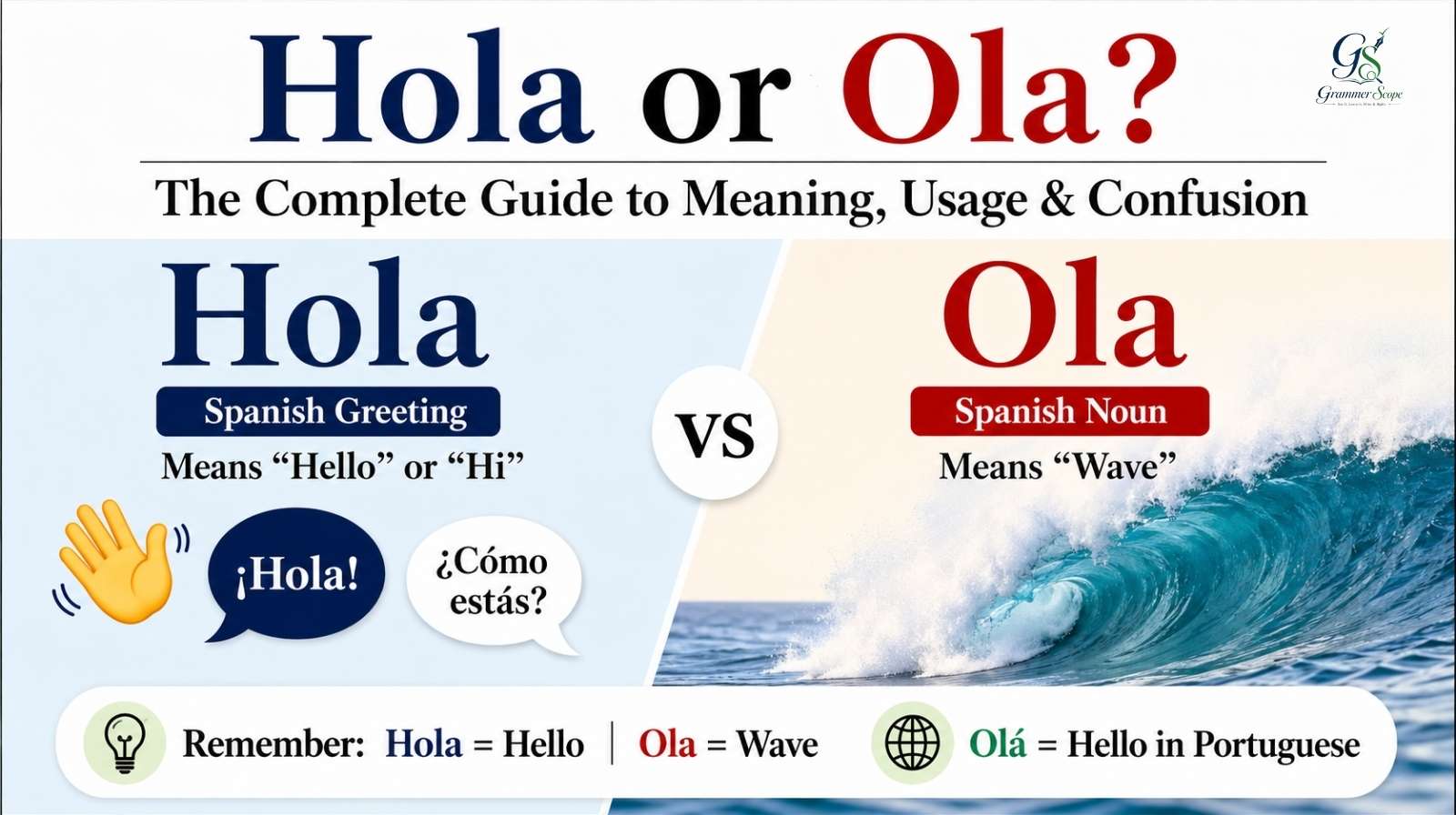
Have you ever wondered whether Hola or Ola is the correct word when you want to say “hello”? You are not alone. These two words look and sound almost identical, but they can have completely different meanings depending on the language and context.
In Spanish, hola is the familiar word for “hello” or “hi,” while ola is a noun meaning “wave.” In Portuguese, however, olá with an accent mark is a greeting meaning “hello.” That small spelling difference can completely change what a word means.
This guide explains Hola or Ola in simple terms, including their meanings, pronunciation, correct usage, examples, common mistakes, and the important difference between Spanish and Portuguese. By the end, you will know exactly which form to use and why.
Hola or Ola: What Is the Difference?
The quickest way to understand the difference is this:
- Hola = “hello” or “hi” in Spanish.
- Ola = “wave” in Spanish.
- Olá = “hello” or “hi” in Portuguese.
So, if you are writing in Spanish and want to greet someone, hola is the correct spelling. If you are talking about a wave in the ocean, ola is correct.
The distinction is especially important because hola and ola are homophones in Spanish: they are pronounced alike but have different spellings and meanings. WordReference specifically warns Spanish learners not to confuse hola, the familiar greeting, with ola, the word for a wave.
Hola Meaning in Spanish
In Spanish, hola is an interjection used as a familiar greeting. It corresponds to English words such as:
- Hello
- Hi
- Hey
For example:
¡Hola! ¿Cómo estás?
This means:
Hello! How are you?
The Real Academia Española (RAE) defines hola as an interjection used as a familiar greeting.
You can use hola when meeting someone, starting a conversation, answering informally, or greeting someone in a message.
Examples:
- Hola, María.
- ¡Hola! ¿Cómo estás?
- Hola a todos.
- Hola, ¿puedes ayudarme?
Ola Meaning in Spanish
In Spanish, ola is a feminine noun referring primarily to a wave, especially a wave formed on the surface of the sea or another body of water.
For example:
La ola era enorme.
This means:
The wave was enormous.
Other examples include:
- Una ola golpeó la costa. A wave hit the coast.
- La ola arrastró la tabla. The wave carried away the board.
- Había olas enormes en el océano. There were enormous waves in the ocean.
Spanish Dictionary also lists ola as the Spanish noun for “wave” and gives related meanings such as a wave of heat, cold, or other phenomena.
Olá Meaning in Portuguese
There is one important twist.
In Portuguese, olá with an accent over the final a is a greeting meaning “hello.” Portuguese dictionaries define olá as an interjection used for greeting or calling someone and also for expressing surprise.
For example:
Olá! Como está?
means:
Hello! How are you?
Therefore, a person learning both Spanish and Portuguese may encounter all three forms:
| Word | Language | Meaning |
|---|---|---|
| hola | Spanish | hello / hi |
| ola | Spanish | wave |
| olá | Portuguese | hello / hi |
That is why simply saying “one of them is wrong” does not tell the whole story.
Read More: Carrer vs Career: The Correct Spelling Explained
Hola or Ola: Which One Should You Use?
If your question is specifically about Spanish, the answer is straightforward: use hola when you mean “hello,” and use ola when you mean “wave.”
The correct choice depends on what you are trying to communicate.
Use Hola When Greeting Someone
Use hola when you are saying hello or starting a conversation.
Correct examples:
- Hola, John!
- ¡Hola! Nice to meet you.
- Hola, ¿qué tal?
- Hola a todos.
- Hola, ¿cómo estás?
You should not write:
- Ola, John! ❌
if your intention is to say “Hello, John!” in Spanish.
The missing h changes the word from a greeting into the noun wave.
Use Ola When Talking About a Wave
Use ola when you are referring to a physical wave or, depending on context, a figurative “wave” of something.
Examples:
- La ola llegó a la playa. The wave reached the beach.
- Una ola gigante golpeó el barco. A giant wave hit the boat.
- Los surfistas esperaban una buena ola. The surfers were waiting for a good wave.
- Una ola de calor afectó la región. A heat wave affected the region.
Notice how ola functions as a noun rather than a greeting.
Use Olá in Portuguese
If you are writing in Portuguese and want to say “hello,” the standard form is olá, with an accent.
Examples:
- Olá! Tudo bem? Hello! How are you?
- Olá, Pedro. Hello, Pedro.
- Olá a todos! Hello everyone!
- Olá, prazer em conhecê-lo. Hello, nice to meet you.
This is an important distinction for multilingual writers. Olá is not simply a Portuguese spelling mistake of Spanish hola. It is a genuine Portuguese greeting.
Read More: Suing or Sueing: Which Spelling Is Correct?
Why Do Hola and Ola Cause So Much Confusion?
At first glance, the problem seems simple: one word has an h, and the other does not. In practice, however, several factors make the confusion surprisingly common.
They Sound the Same in Spanish
In Spanish pronunciation, the h at the beginning of hola is silent.
Therefore:
hola → approximately “OH-la”
The word ola is also pronounced approximately:
ola → “OH-la”
Because the pronunciation is essentially the same, a learner cannot always rely on hearing the difference.
This is a classic spelling problem: the speaker knows the sound but must remember which spelling represents the intended meaning.
The Meaning Depends on Context
Compare these two sentences:
¡Hola, Ana!
and
La ola es grande.
The first sentence contains a greeting. The second describes a wave.
The pronunciation may sound nearly identical, but the surrounding words immediately reveal the intended meaning.
For example:
- Hola, Carlos. → greeting
- Una ola enorme. → wave
- Hola, ¿cómo estás? → greeting
- La ola golpeó la playa. → wave
Context is therefore one of the easiest ways to identify the correct word.
English Learners May Rely Too Heavily on Sound
English speakers are accustomed to words in which spelling often provides clues about pronunciation. Spanish presents a different challenge here.
The h in hola is silent, so a beginner may hear “ola” and naturally write ola.
That produces a perfectly recognizable Spanish word but the wrong one if the intended meaning is “hello.”
This is why memorizing hola = hello as a complete pair is often more useful than trying to reconstruct the spelling from pronunciation.
Hola vs Ola: A Simple Comparison Guide
If you regularly confuse these words, use the following shortcut.
The Easy Memory Trick
Think:
H = Hello
When you want to greet someone in Spanish, remember:
Hola = Hello
This is not a formal grammatical rule; it is simply a useful memory device.
For the other word:
Ola = wave
Think of the o in ola as the start of ocean. Again, this is only a mnemonic, but it can help beginners remember the difference.
Quick Decision Checklist
Ask yourself one question:
Am I greeting someone?
- Yes → Hola
- No → Continue.
Am I talking about a wave?
- Yes → Ola
- If you are writing Portuguese and mean “hello” → Olá
This makes the choice much easier.
| What you mean | Correct form | Example |
|---|---|---|
| Hello in Spanish | Hola | Hola, ¿cómo estás? |
| Wave in Spanish | Ola | La ola es enorme. |
| Hello in Portuguese | Olá | Olá, tudo bem? |
| Waves in Spanish | Olas | Las olas son grandes. |
| Hello everyone in Spanish | Hola a todos | Hola a todos, bienvenidos. |
| Hello everyone in Portuguese | Olá a todos | Olá a todos! |
Read More: Commit vs Comit: Correct Spelling And Usage Guide
Common Mistakes With Hola and Ola
These words are short, but they can create several common spelling and usage mistakes.
Mistake 1: Writing Ola as a Spanish Greeting
Incorrect:
Ola, ¿cómo estás? ❌
Correct:
Hola, ¿cómo estás? ✅
Why? Because hola is the Spanish greeting. Ola means “wave.”
This mistake is especially understandable because the two words sound alike. Nevertheless, in written Spanish, the distinction matters.
Mistake 2: Adding an Accent to Spanish Hola
Some learners write:
Holá ❌
The standard Spanish greeting is:
Hola ✅
There is no accent mark on the final a.
Do not confuse this with Portuguese olá, which does have an accent.
So:
- Spanish: hola
- Portuguese: olá
That one accent is meaningful.
Mistake 3: Assuming Olá Is Always Wrong
If you are writing Spanish, olá is not the standard spelling for the ordinary greeting.
However, it is perfectly legitimate in Portuguese.
For example:
Olá, tudo bem?
is Portuguese for “Hello, how are you?”
The Portuguese dictionary entry from Infopédia identifies olá as an interjection used as a greeting or call and notes that it can also express surprise.
Mistake 4: Confusing Ola With Other Types of “Waves”
Spanish ola commonly refers to waves on water. However, Spanish also uses the word in figurative expressions.
For example:
una ola de calor
means:
a heat wave
You can also encounter expressions referring to a wave of something happening or spreading.
Therefore, ola does not always have to describe a literal ocean wave.
Read More: Transferred vs Transfered: Which Is Correct?
A Real-Life Example: The Beginner Who Wrote “Ola”
Imagine a student named Daniel who has recently started learning Spanish.
During his first week, Daniel learns that “hello” is pronounced roughly like OH-la. Later that evening, he sends a message to a Spanish-speaking classmate:
Ola! ¿Cómo estás?
His classmate understands what he means because the context makes his intention obvious. However, Daniel has made a spelling mistake.
The correct sentence is:
Hola! ¿Cómo estás?
Daniel then sees the word ola in his textbook:
La ola es muy grande.
The textbook translates this as:
The wave is very big.
At first, Daniel is confused. He realizes that he has been using a real Spanish word, but not the word he intended.
This is an excellent example of why pronunciation alone is not enough when learning a language. Daniel heard “OH-la” and wrote what he heard. The problem was not pronunciation; it was spelling and vocabulary association.
His teacher gives him a simple memory trick:
Hola = hello. Ola = wave.
Daniel starts practicing the words in pairs:
- Hola, amigo.
- La ola es grande.
- Hola, ¿qué tal?
- Las olas están altas.
After a few repetitions, the difference becomes automatic.
This small example reflects a broader language-learning principle: when two words sound alike, learners should connect each spelling with its meaning rather than relying only on pronunciation. In this case, the silent h is particularly easy to forget because it does not produce an audible sound.
The same lesson also applies to multilingual learning. A student who later studies Portuguese may encounter olá and initially wonder whether it is simply another spelling of Spanish hola. It is not. Portuguese has its own standard form, olá, while Spanish uses hola.
Hola and Ola in Modern Language Learning: 2025–2026 Data
The confusion between these words is especially relevant because Spanish continues to have an enormous global learning community.
According to the Instituto Cervantes 2025 report, the global Spanish-speaking population reached more than 635 million potential speakers, while the number of native Spanish speakers exceeded 500 million, reaching approximately 520 million.
The same 2025 report identifies Spanish as having one of the world’s largest native-speaking communities.
There is also evidence of continuing interest in learning Spanish. Instituto Cervantes reported approximately 143,000 candidates worldwide for the official DELE Spanish examinations in 2025, representing about a 4% increase from 2024.
These figures do not measure how many people specifically search for “Hola or Ola,” and there is no reliable public statistic showing that exact spelling-confusion rate. However, they demonstrate why seemingly small Spanish vocabulary distinctions remain useful for a large international audience.
For learners, the takeaway is simple: even a two- or three-letter distinction can matter when a language has hundreds of millions of speakers and a growing global learning community.
Read More: Submission vs Submittion: Learn The Correct Spelling
How to Remember Hola vs Ola Forever
The best way to remember these words is to connect spelling directly to meaning.
Method 1: Remember “H = Hello”
Use this simple association:
Hola = Hello
Both begin with H.
Whenever you want to greet someone in Spanish, think:
H → Hello → Hola
Method 2: Associate Ola With the Ocean
Think:
Ola → Ocean → Wave
This can help you remember that ola is the noun associated with a wave.
For example:
La ola golpeó el barco.
The context immediately points toward water.
Method 3: Practice Them Together
Instead of memorizing only one word, learn the contrast:
Hola = hello
Ola = wave
Then create two sentences:
Hola, amigo.
and
La ola es grande.
This method helps your brain distinguish the spelling through context.
Method 4: Remember the Portuguese Exception
If you are studying Portuguese too, add one more item:
Olá = hello in Portuguese
Now your mental chart becomes:
Spanish: hola = hello
Spanish: ola = wave
Portuguese: olá = hello
That three-part distinction prevents many future mistakes.
Read More: Other Than or Other Then: Which Spelling Is Right?
Mini Quiz: Hola or Ola
Quiz 1. Quick Pick: Which Means “Hello” in Spanish?
Which word should you use when greeting someone in Spanish?
A) Ola
B) Hola
C) Olá
D) Holla
Answer: B) Hola ✅
Quiz 2. Fill in the Blank
Complete the sentence:
_____! ¿Cómo estás?
A) Ola
B) Hola
C) Olá
D) Olla
Answer: Hola ✅
Quiz 3. What Does “Ola” Mean?
In Spanish, what does ola mean?
A) Hello
B) Goodbye
C) Wave
D) Friend
Answer: C) Wave
Quiz 4. Spot the Correct Sentence
Which sentence correctly uses hola?
A) Ola, Maria.
B) Hola, Maria.
C) Holá, Maria.
D) Olla, Maria.
Answer: B) Hola, Maria. ✅
Quiz 5. Fill in the Blank: Think Ocean
Complete the sentence:
La _____ es enorme.
A) hola
B) olá
C) ola
D) holla
Answer: ola ✅
Quiz 6. Spanish or Portuguese?
Which word means “hello” in Portuguese?
A) Hola
B) Ola
C) Olá
D) Olla
Answer: C) Olá ✅
Quiz 7. True or False?
Hola and ola can sound the same in Spanish.
Answer: True ✅
The h in Spanish hola is silent.
Quiz 8. Fill in the Blank: Greeting Time
You meet a Spanish-speaking friend and want to say hello:
_____! Mucho gusto.
Answer: Hola ✅
Quiz 9. Which One Means “Wave”?
Choose the correct word:
Una _____ golpeó la playa.
A) Hola
B) Ola
C) Olá
D) Hóla
Answer: B) Ola
Quiz 10. Don’t Let the Silent H Fool You!
Why does hola contain an h even though you don’t hear it?
A) The h is pronounced very softly.
B) The h is silent and helps distinguish the word from ola.
C) The h changes hola into Portuguese.
D) The h is optional.
Answer: B) The h is silent and helps distinguish the word from ola. ✅
Quiz 11. Fill in the Blank: Portuguese Edition
Complete this Portuguese greeting:
_____! Tudo bem?
A) Hola
B) Ola
C) Olá
D) Olla
Answer: Olá ✅
Quiz 12. Which Sentence Talks About a Wave?
A) Hola, Carlos.
B) Hola a todos.
C) La ola era enorme.
D) Hola, ¿cómo estás?
Answer: C) La ola era enorme.
Quiz 13. The Easy Memory Test
Which memory trick can help you remember hola?
A) H = Hello
B) O = Ocean
C) L = Language
D) A = Answer
Answer: A) H = Hello ✅
Quiz 14. Fill in the Blank: Final Challenge
Choose the correct word:
_____ a todos, bienvenidos.
A) Ola
B) Olá
C) Hola
D) Olla
Answer: C) Hola
Quiz 15. Final Boss: Can You Get This Right?
Which statement is correct?
A) Hola means “wave” in Spanish.
B) Ola means “hello” in Spanish.
C) Hola means “hello” in Spanish, while ola means “wave.”
D) Hola and ola always mean exactly the same thing.
Answer: C) Hola means “hello” in Spanish, while ola means “wave.”
References
Frequently Asked Questions
Q1: Is “hola” or “ola” correct for hello?
A: Hola is correct when you mean “hello” or “hi” in Spanish. Ola means “wave” in Spanish. If you are writing Portuguese, olá means “hello.”
Q2: Is ola a Spanish word?
A: Yes. Ola is a Spanish word meaning “wave,” particularly a wave on the surface of water. It can also appear in figurative expressions such as ola de calor, meaning “heat wave.”
Q3: Why does hola have an H if the H is silent?
A: The h in Spanish hola is silent. The spelling distinguishes hola from ola, which has a different meaning. Therefore, although the words are pronounced alike, their written forms are different.
Q4: Does hola mean hello in Spanish?
A: Yes. Hola is a standard Spanish greeting equivalent to “hello” or “hi.” The RAE classifies it as an interjection used as a familiar greeting.
Q5: Does ola mean hello in Portuguese?
A: Not in standard Portuguese spelling. The Portuguese greeting is olá, with an accent on the final a. Portuguese dictionaries list olá as a greeting and a call to someone.
Q6: Is “Holá” correct?
A: For the normal Spanish greeting, hola is the correct form, without an accent. Holá should not be used as the standard Spanish spelling of “hello.”
Q7: Are hola and ola pronounced the same?
A: In Spanish, they are pronounced alike because the initial h in hola is silent. Their meanings and spellings, however, are different.
Final Verdict: Hola or Ola?
So, Hola or Ola which one should you use?
The answer depends entirely on what you mean.
If you want to say “hello” in Spanish, use:
Hola ✅
If you are talking about a wave in Spanish, use:
Ola ✅
If you want to say “hello” in Portuguese, use:
Olá ✅
The easiest rule to remember is:
Hola = hello
Ola = wave
Olá = hello in Portuguese
The difference may look tiny, but it changes the meaning completely. Because hola and ola sound the same in Spanish, spelling is especially important. Once you connect each word with its meaning and practice a few examples, the confusion becomes much easier to avoid.
Discover More Articles
- Lable or Label: Which Spelling Is Correct?
- Goodmorning or Good Morning: Which One Is Correct?
- Striping vs Stripping: Meaning, Grammar And Usage Guide
Ready to improve your English? Read more guides on Grammer Scope

Bilal Khalid is a professional blogger specializing in grammar guides and practical writing tips. He helps readers improve clarity, accuracy, and confidence in communication through simple explanations, actionable advice, and easy-to-follow strategies for everyday and professional writing.