Have you ever stopped while writing and wondered whether drier or dryer is the correct word? You are not alone. These two words look almost identical, sound the same, and are both legitimate English words. The confusion becomes even greater because drier and dryer can sometimes refer to the same kind of machine.
The key is context.
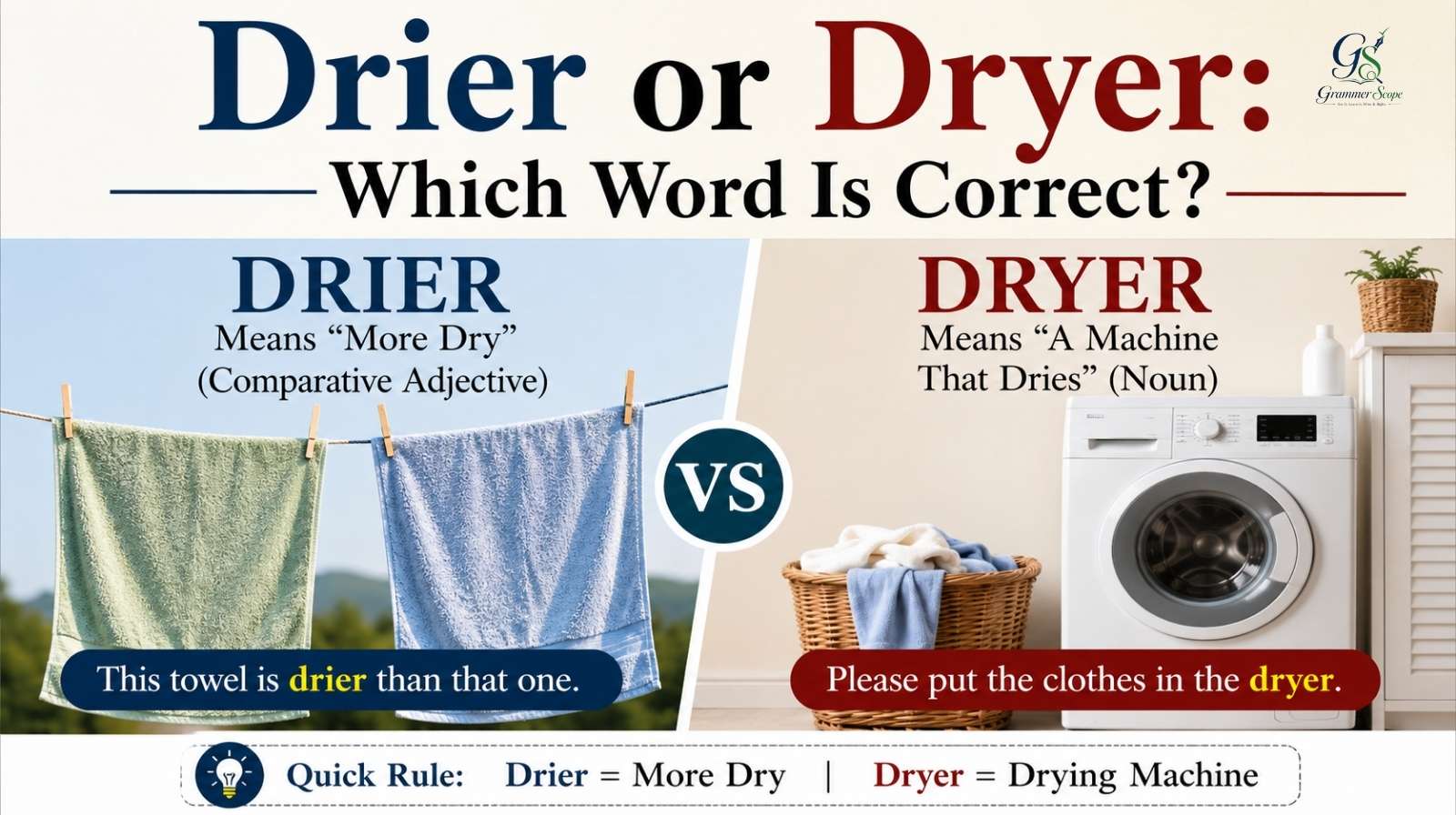
Usually, drier is the comparative form of the adjective dry, meaning “more dry.” For example, “The towel is drier now.”
Dryer, on the other hand, commonly refers to a machine or device that dries something, such as a clothes dryer or hair dryer.
However, there is an important detail: drier can also be used as a noun for a drying device, and major dictionaries recognize drier and dryer as variant spellings in that sense.
So, which spelling should you choose? This guide explains the difference, gives practical examples, explores American and British usage, and provides a simple rule you can remember.
Drier or Dryer: What Is the Correct Word?
The short answer is that both “drier” and “dryer” are correct words, but they are most commonly used in different situations.
Drier is normally the comparative form of dry. It means that something has less moisture than something else.
This shirt is drier than the one I washed yesterday.
Dryer is most commonly a noun referring to a machine or device that removes moisture.
I put the clothes in the dryer.
The distinction becomes slightly more interesting because dictionaries also recognize drier as a noun meaning a device or substance that causes something to dry. Merriam-Webster lists dryer as a variant spelling of drier and notes that dryer is usually preferred for a device.
Drier as a Comparative Adjective
When drier describes something that has become less wet or contains less moisture, it is the comparative form of dry.
For example:
- This towel is drier than that one.
- The weather is drier today.
- My skin feels drier in winter.
- The soil is drier than it was last week.
- This climate is drier than the coastal region.
Here, drier is describing a condition. It is not naming a machine.
Dryer as a Machine or Device
Dryer is commonly used as a noun for equipment designed to remove moisture.
Examples include:
- clothes dryer
- hair dryer
- hand dryer
- grain dryer
- tumble dryer
- spin dryer
For example:
Please put the wet clothes in the dryer.
Here, dryer is the name of a device.
The Quickest Rule to Remember
A useful everyday rule is:
Drier = more dry
Dryer = a machine that dries
This rule works for the vast majority of ordinary writing situations.
However, remember that drier is not automatically wrong when referring to a machine. Major dictionaries recognize it as a variant noun spelling.
Read More: Recurring vs Reoccurring: The Complete Guide To Correct Usage
What Does “Drier” Mean?
The word drier has two important uses. Understanding both explains why this spelling causes so much confusion.
Drier Means “More Dry”
The most common grammatical use of drier is as the comparative form of dry.
The basic pattern is:
dry → drier → driest
For example:
- The clothes are dry.
- The clothes outside are drier than the clothes inside.
- These are the driest clothes in the basket.
The same pattern appears in many sentences involving weather, skin, soil, food, paint, and other things affected by moisture.
Consider these examples:
The desert climate is drier than the forest climate.
My hands become drier during the winter.
Leave the paint outside so it becomes drier.
In each sentence, drier means “more dry.”
Drier Can Also Be a Noun
Here is where things become less straightforward.
Drier can also function as a noun. Merriam-Webster defines the noun drier as something that extracts or absorbs moisture, a substance that speeds drying, or, usually, a device for drying.
Oxford similarly lists drier as another spelling of dryer when the word means a machine for drying something.
So this sentence is not necessarily incorrect:
Put the clothes in the drier.
But in everyday modern English, especially when referring to household appliances, dryer is generally the safer and more recognizable choice.
Why “Drier” Looks Like the Obvious Choice
The spelling drier follows the familiar comparative pattern used with dry:
- dry → drier
- dry → driest
That makes it natural for the comparative adjective.
But English spelling is not always perfectly logical. Over time, dryer developed as a variant spelling for the noun referring to a drying device.
That is why both forms appear in dictionaries.
What Does “Dryer” Mean?
Dryer is primarily a noun. It refers to something that dries another object or material.
The word can describe household appliances, industrial equipment, and other drying devices.
Clothes Dryer
One of the most familiar uses is clothes dryer.
A clothes dryer is a machine that dries wet clothing, usually by circulating heated or otherwise conditioned air.
For example:
The washing machine has finished, so I will put the clothes in the dryer.
The dryer stopped before the clothes were completely dry.
In American English, dryer is particularly common for this appliance.
Hair Dryer
Another common expression is hair dryer.
She used a hair dryer after washing her hair.
Both hair dryer and hair drier can be found, but hair dryer is the familiar modern spelling for the appliance.
Cambridge lists hair dryer as an example of dryer used for a machine that dries things.
Other Types of Dryers
The word appears in many technical and everyday compounds:
- hand dryer
- grain dryer
- tumble dryer
- spin dryer
- industrial dryer
- food dryer
- clothes dryer
For example:
The restaurant installed a new hand dryer.
Farmers use a grain dryer to reduce moisture in harvested grain.
The hotel has a washing machine and tumble dryer.
In technical writing, you may also encounter drier, depending on the industry, terminology, and regional preference.
Read More: Cocoon or Cacoon? Which Spelling Is Correct? (Complete Grammar Guide)
Drier vs Dryer: The Main Difference
The easiest way to distinguish these words is to look at their grammatical role.
Drier Is Usually an Adjective
When drier means more dry, it compares two conditions.
Compare:
The towel is dry.
with:
The towel is drier now.
And:
This towel is drier than that one.
Here, drier tells us about the condition of the towel.
Dryer Is Usually a Noun
When dryer refers to an appliance or device, it names something.
For example:
The dryer is running.
The dryer needs to be cleaned.
We bought a new dryer.
The word is not describing how dry something is. It is identifying the machine.
A Simple Comparison Table
| Word | Typical role | Meaning | Example |
|---|---|---|---|
| drier | Adjective | More dry | This towel is drier. |
| dryer | Noun | A machine/device that dries | The clothes are in the dryer. |
| drier | Noun | A drying device/substance | The clothes are in the drier. |
| dry | Adjective | Free from moisture | The towel is dry. |
| driest | Superlative adjective | Most dry | This is the driest towel. |
The table reveals an important point: the words overlap when “drier” is used as a noun.
Therefore, the popular rule “drier is always an adjective and dryer is always a machine” is useful for beginners, but it is not the complete dictionary story.
Drier or Dryer in American and British English
Regional usage can make this spelling question even more confusing.
American English
In American English, dryer is the familiar spelling for a machine that dries clothes, hair, or other materials.
Examples:
I need to buy a new clothes dryer.
Where is the hair dryer?
The dryer is making a strange noise.
Merriam-Webster identifies dryer as a variant of drier but specifically notes that a drying device is “usually dryer.”
Therefore, if you are writing for a general American audience, dryer is normally the best choice for the appliance.
British English
British English also uses dryer, although drier appears as a recognized variant.
Oxford lists dryer as a noun for a machine used for drying and gives examples such as hairdryer, spin dryer, tumble dryer, and washer-dryer.
Cambridge likewise lists dryer and identifies drier as another spelling.
So the important lesson is not that one spelling belongs exclusively to one country.
Instead:
Dryer is the clearest modern choice for a drying appliance, while drier remains a valid dictionary variant.
Which Form Should Writers Prefer?
If you are writing an article, email, school assignment, product description, or general website content, choose the spelling that makes your meaning immediately obvious.
Use:
The clothes are drier now.
when you mean more dry.
Use:
Put the clothes in the dryer.
when you mean the machine.
That distinction gives readers the least possible room for confusion.
Read More: Defence or Defense: Which Spelling Is Correct?
Drier or Dryer: Common Examples You Can Copy
Seeing the words in real sentences is one of the fastest ways to understand the difference.
Examples With “Drier”
Use drier when comparing dryness:
- The air is drier today than yesterday.
- My skin feels drier during cold weather.
- This towel is drier than the other one.
- The soil becomes drier during the summer.
- The paint will be drier by tomorrow.
- The northern region is generally drier than the south.
- These clothes are drier because they were left outside.
- The climate is getting drier each year.
Notice that drier describes a condition in each example.
Examples With “Dryer”
Use dryer when referring to a machine or device:
- The clothes are in the dryer.
- I bought a new dryer last month.
- The dryer stopped working.
- Please clean the dryer filter.
- Where did you put the hair dryer?
- The hotel provides a hair dryer.
- The grain dryer removes excess moisture.
- The hand dryer is near the restroom entrance.
Here, dryer identifies a device.
Examples Where Both Words Appear
Sometimes both words can naturally appear in one sentence:
The clothes are drier because I put them in the dryer.
The first word describes the clothes.
The second word identifies the machine.
Another example:
The towel became drier after I put it in the dryer.
This is an excellent way to remember the distinction.
A Real-Life Example: Choosing the Right Word While Writing
Imagine that someone is writing a product review about a household laundry appliance.
They begin with this sentence:
“This drier is one of the best machines I have ever purchased.”
Is the sentence wrong?
Not necessarily.
Major dictionaries recognize drier as a noun for something that dries, including a drying device. Merriam-Webster lists dryer as a variant of drier, while also indicating that dryer is usually used for a device. Oxford and Cambridge similarly recognize the connection between the two spellings.
However, if the goal is to make the review immediately clear to a broad online audience, the writer would probably be better off writing:
“This dryer is one of the best machines I have ever purchased.”
Why?
Because modern readers are more likely to interpret dryer immediately as the appliance.
Now imagine a different sentence:
“This towel is much dryer than the one I used yesterday.”
Here, the intended meaning is “more dry.” In traditional everyday writing, drier is the clearer choice:
“This towel is much drier than the one I used yesterday.”
The two sentences demonstrate why context matters more than simply memorizing a spelling.
The practical editing process is simple:
Step 1: Ask what the word is doing in the sentence.
Step 2: If it means “more dry,” use drier.
Step 3: If it names a machine, dryer is normally the best modern choice.
Step 4: If you are working with specialized terminology, check the style guide or terminology used by your field.
This approach is especially useful for writers because it avoids treating English as a collection of rigid spelling rules. Some words have overlapping forms, and dictionaries document that variation.
Read More: Gage or Gauge: What’s The Difference? Explained Simply
2025–2026 Usage and Dictionary Evidence
Because spelling advice can become outdated, it is worth checking current dictionary evidence rather than relying only on old grammar rules.
What Current Dictionaries Show
A 2026 review of major English dictionaries provides several useful data points:
- Merriam-Webster lists drier as both the comparative form of dry and a noun, with dryer as a variant. Its noun entry gives three main senses, including something that removes moisture and a device for drying.
- Merriam-Webster’s current dryer entry identifies dryer as a variant spelling of drier and says it is the usual form for a drying device. The entry was updated in March 2026.
- Oxford Advanced Learner’s Dictionary lists dryer as a machine for drying something and explicitly notes drier as another form.
- Cambridge Dictionary defines dryer as a machine that dries things and also identifies drier as an alternative spelling.
These sources agree on the most useful practical distinction: drier is the standard comparative form of dry, while dryer is the clearest choice for a drying machine.
A Useful 2026 Evidence Snapshot
| Evidence point | Current finding |
|---|---|
| Comparative of dry | drier |
| Superlative of dry | driest |
| Device spelling commonly preferred | dryer |
| Drier as a noun | Recognized |
| Dryer as a noun | Recognized |
| Major dictionaries recognize both | Yes |
| Merriam-Webster noun “drier” first known use | 1528 |
| Merriam-Webster “dryer” entry update | March 2026 |
Merriam-Webster’s historical record gives 1528 as the first known use of the noun drier, showing that the noun form is not a recent spelling mistake.
The 2025–2026 evidence therefore supports a nuanced answer: both spellings exist, but they are not equally natural in every context.
Read More: In-Person vs In Person: What’s The Difference?
Common Mistakes With Drier and Dryer
Many errors happen because writers learn the simplified rule but do not consider grammar.
Mistake 1: Treating “Drier” as Always Wrong
Incorrect assumption:
“Drier is never correct.”
That is false.
Drier is the normal comparative form of dry, and dictionaries also recognize it as a noun.
Correct:
The weather is drier this year.
Mistake 2: Using “Dryer” When You Mean “More Dry”
Consider:
This towel is dryer than that one.
Although readers will understand the sentence, drier is the standard comparative form.
Better:
This towel is drier than that one.
Mistake 3: Assuming “Dryer” Is Incorrect
Some people learn that the adjective must be drier and conclude that dryer is a misspelling.
That is also incorrect.
Dryer is a fully established noun for a machine or device that dries something. Cambridge, Oxford, and Merriam-Webster all recognize it.
Mistake 4: Ignoring the Context
The sentence itself usually gives you the answer.
Ask:
Am I comparing dryness?
If yes, drier is probably correct.
Ask:
Am I naming a machine?
If yes, dryer is usually the clearest choice.
How to Remember Drier vs Dryer
If you frequently confuse these words, use this simple memory trick.
Think “More Dry” for Drier
Break it down mentally:
dry → drier
Just like:
- bright → brighter
- light → lighter
- quiet → quieter
So:
The room is drier.
means:
The room is more dry.
Think “Device” for Dryer
When you see dryer, think of an appliance:
clothes dryer
hair dryer
hand dryer
tumble dryer
The -er ending is associated with something that performs an action, such as:
- toaster
- washer
- mixer
- cleaner
- dryer
This is not a universal spelling rule, but it is a helpful memory aid for everyday writing.
Read More: Totalling vs Totaling: Which Spelling Is Correct?
Drier or Dryer: A Quick Decision Guide
When you are unsure which spelling to use, follow these steps.
Step 1: Replace the Word With “More Dry”
Try replacing the word with more dry.
If the sentence still makes sense, use drier.
The air is more dry today.
Therefore:
The air is drier today.
Step 2: Ask Whether It Names a Machine
If the word refers to an appliance or device, dryer is normally the best choice.
Put the clothes in the dryer.
I need a new hair dryer.
Step 3: Consider Your Audience
For general American or international online writing, dryer is usually the clearest spelling for the appliance.
If you are working with a technical document, British publication, or specialized industry terminology, you may encounter drier as a noun.
Step 4: Check the Meaning, Not Just the Spelling
The best spelling depends on what you mean.
| If you mean… | Prefer… |
|---|---|
| More dry | drier |
| Most dry | driest |
| A clothes machine | dryer |
| A hair appliance | dryer |
| A hand-drying machine | dryer |
| A drying substance/device in technical terminology | drier may occur |
This approach is more reliable than memorizing “one is right and one is wrong.”
Read More: Persue or Pursue? Learn The Correct Spelling of Pursue
Mini Quiz: Drier or Dryer
Quiz 1. Quick Pick: Which Word Means “More Dry”?
Choose the correct word:
A) Dryer
B) Drier
C) Dryest
D) Dryor
Answer: B) Drier
Quiz 2. Fill in the Blank
The towel is ______ than it was an hour ago.
A) dryer
B) drier
Answer: B) drier
Quiz 3. Which One Names a Machine?
Which word usually refers to a machine that dries clothes?
A) Drier
B) Dryer
C) Driest
D) Drying
Answer: B) Dryer
Quiz 4. Spot the Correct Sentence
Which sentence is correct?
A) The weather is dryer today.
B) The weather is drier today.
C) The weather is dryest today.
D) The weather is dryor today.
Answer: B) The weather is drier today.
Quiz 5. Fill in the Blank
Please put the wet clothes in the ______.
A) drier
B) dryer
Answer: B) dryer
Quiz 6. True or False?
“Drier” can be the comparative form of the adjective dry.
Answer: True ✅
Quiz 7. Hair Care Challenge
Which spelling is most commonly used in hair dryer?
A) Hair drier
B) Hair dryer
C) Hair driest
D) Hair dry
Answer: B) Hair dryer
Quiz 8. Complete the Pattern
Which word correctly completes this sequence?
dry → drier → ______
A) dryer
B) driest
C) dryest
D) drying
Answer: B) driest
Quiz 9. Which Sentence Uses “Dryer” Correctly?
A) My skin is dryer in winter.
B) The dryer stopped working.
C) Today is dryer than yesterday.
D) This towel is dryer than that one.
Answer: B) The dryer stopped working.
Quiz 10. Fill in the Blank
The desert climate is ______ than the rainforest climate.
A) dryer
B) drier
Answer: B) drier
Quiz 11. Can Both Words Be Correct?
Which statement is true?
A) Only “drier” is a real English word.
B) Only “dryer” is a real English word.
C) Both “drier” and “dryer” are recognized English words.
D) Neither word is correct.
Answer: C) Both “drier” and “dryer” are recognized English words.
Quiz 12. Think About the Meaning
Choose the correct word:
The clothes became ______ after sitting outside in the sun.
A) dryer
B) drier
Answer: B) drier
Quiz 13. Final Boss: Can You Get This One Right?
Complete the sentence:
The shirt is ______, but I still need to put it in the ______.
A) dryer / drier
B) drier / dryer
C) dryer / dryer
D) drier / drier
Answer: B) drier / dryer
References
Frequently Asked Questions
Q1: Is “drier” or “dryer” correct?
A: Both are correct, but they usually serve different purposes. Drier is normally the comparative form of dry, meaning “more dry.” Dryer is commonly a noun for a machine or device that dries something. Dictionaries also recognize drier as a noun variant for a drying device.
Q2: Is it “drier clothes” or “dryer clothes”?
A: The correct phrase is usually “drier clothes” when you mean clothes that are more dry.
For example:
These clothes are drier than the others.
You would use dryer if you were naming a machine:
Put the clothes in the dryer.
Q3: Is “dryer” a real word?
A: Yes. Dryer is a standard English word. It is a noun meaning a machine or device that dries something. Cambridge, Oxford, and Merriam-Webster all recognize it.
Q4: Can “drier” refer to a machine?
A: Yes. Drier can be used as a noun for a device or substance that dries something. Major dictionaries recognize this usage. However, dryer is generally the clearer and more common choice for an everyday household appliance.
Q5: Is “drier” the comparative form of “dry”?
A: Yes.
The standard forms are:
dry → drier → driest
For example:
Today is drier than yesterday.
This is the driest month of the year.
Q6: Should I write “hair dryer” or “hair drier”?
A: Hair dryer is the safest and most widely recognizable choice for general modern writing. Dictionaries list hair dryer as a standard expression, although hair drier can also be encountered.
Q7: Is “drier” or “dryer” preferred for a clothes machine?
A: For a modern household appliance, dryer is generally the preferred choice, especially in general American English and broad online writing. Nevertheless, drier is recognized as a variant noun spelling by major dictionaries.
Final Verdict: Drier or Dryer?
So, drier or dryer which word is correct?
The answer is both, but context determines which one you should normally choose.
Use drier when you mean “more dry.”
The clothes are drier now.
Use dryer when you mean a machine or device that dries something.
The clothes are in the dryer.
There is one important qualification: drier can also be a noun, and major dictionaries recognize it as a variant of dryer. Therefore, calling drier “wrong” when referring to a drying device would be too simplistic.
For everyday writing, however, the easiest rule is still:
Drier = more dry.
Dryer = drying machine.
Remember that distinction, and you will be able to choose the right word confidently in emails, essays, articles, schoolwork, product descriptions, and everyday conversation.
If you found this drier or dryer guide helpful, explore more practical spelling and grammar guides to make confusing English words easier to understand and use correctly.
Discover More Articles
- Courtesy vs Curtesy: What’s The Difference? (Complete Guide)
- Due To or Do To: Stop Making This Common Grammar Mistake
- Combating vs Combatting: Which One Should You Use?
Ready to improve your English? Read more guides on Grammer Scope

Bilal Khalid is a professional blogger specializing in grammar guides and practical writing tips. He helps readers improve clarity, accuracy, and confidence in communication through simple explanations, actionable advice, and easy-to-follow strategies for everyday and professional writing.