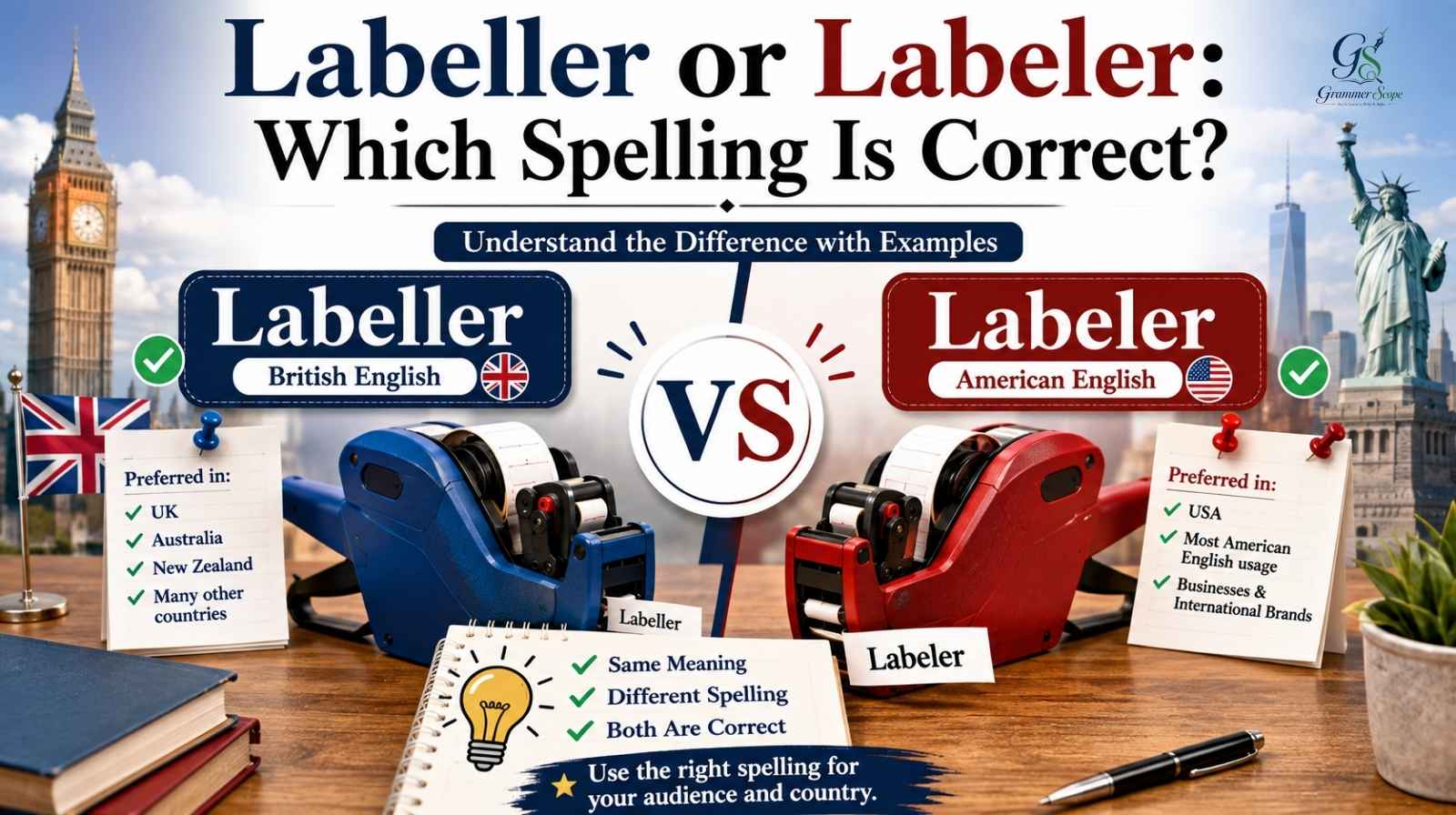
If you’ve ever typed labeller into one document and labeler into another, you’re not alone. Many English words have different spellings depending on whether you’re writing in American or British English, and this is one of them.
So, which spelling is actually correct?
The short answer is that both are correct, but they are used in different varieties of English. Labeler is the preferred spelling in American English, while labeller is the standard spelling in British English and many other countries that follow British spelling conventions.
In this guide, you’ll learn the difference between labeller or labeler, discover why the spellings vary, see real-world examples, and understand which version you should use in different writing situations.
Is It Labeller or Labeler?
The correct spelling depends on the variety of English you’re using.
- Labeler is the preferred spelling in American English.
- Labeller is the preferred spelling in British English, Australian English, and New Zealand English.
Both words refer to a person or machine that attaches labels to products, packages, files, or other items. Their meanings are identical; only the spelling changes.
Labeler in American English
American English generally favors simpler spellings with fewer doubled consonants before suffixes.
Examples:
- The warehouse purchased a new labeler for shipping boxes.
- Every labeler in the factory was inspected before production began.
- She works as a product labeler at a food packaging company.
- The handheld labeler prints barcode stickers in seconds.
If your audience is mainly in the United States, labeler is the spelling you should use.
Labeller in British English
British English usually doubles the final l before adding certain suffixes, especially when the stress pattern allows it.
Examples:
- The company installed a modern labeller in its packaging line.
- Each labeller was tested before use.
- The automatic labeller improved production efficiency.
- A trained labeller checked every product before shipment.
If you’re writing for readers in the United Kingdom or countries that follow British English, labeller is the preferred choice.
Quick Answer
| Audience | Correct Spelling |
|---|---|
| United States | Labeler |
| United Kingdom | Labeller |
| Canada | Usually Labeller, though both appear |
| Australia | Labeller |
| New Zealand | Labeller |
Read More: In-Person vs In Person: What’s The Difference?
Why Are There Two Different Spellings?
The difference comes from the spelling conventions of American and British English.
American English underwent several spelling reforms that simplified many words. One common pattern was reducing doubled consonants in certain derived words.
For example:
| American English | British English |
|---|---|
| traveler | traveller |
| counselor | counsellor |
| labeling | labelling |
| labeled | labelled |
| labeler | labeller |
These variations do not change the meaning of the word. They simply reflect different spelling standards adopted by different English-speaking countries.
How the Word Is Formed
The word comes from the base word label.
- Label + -er → Labeler (American English)
- Label + -ler with doubled l → Labeller (British English)
Both forms describe the same person, profession, or machine.
Why Dictionaries Accept Both Spellings
Major dictionaries recognize both spellings because English has multiple accepted standards.
American dictionaries typically list labeler as the primary spelling, while British dictionaries list labeller as the standard form.
Instead of asking which spelling is universally correct, it’s better to ask:
Which English variety am I writing in?
Choosing the spelling that matches your audience creates consistency and makes your writing appear more professional.
Read More: Totalling vs Totaling: Which Spelling Is Correct?
Common Examples of Labeler and Labeller in Everyday English
The word is widely used in manufacturing, logistics, retail, healthcare, and office environments.
Examples with “Labeler”
- The barcode labeler reduced packaging errors.
- Our office ordered a portable labeler for organizing files.
- The shipping department uses a thermal labeler every day.
- The technician repaired the broken labeler before the morning shift.
Examples with “Labeller”
- The automatic labeller increased production speed.
- Every bottle passed through the labeller before inspection.
- The packaging company invested in a high-speed labeller.
- The labeller applies labels accurately to every container.
Related Word Forms
| Base Word | American English | British English |
|---|---|---|
| Verb | labeling | labelling |
| Past Form | labeled | labelled |
| Noun | labeler | labeller |
| Root Word | label | label |
Read More: Persue or Pursue? Learn The Correct Spelling of Pursue
The Grammar Rule Behind Labeller vs Labeler
The difference between labeller and labeler follows a broader spelling pattern that separates British English from American English. Understanding this rule will help you spell many other words correctly, not just this one.
In British English, the final l is often doubled before adding suffixes such as -er, -ing, or -ed.
In American English, the final l is usually not doubled unless the stress falls on the last syllable.
British English Pattern
British English commonly doubles the final l.
Examples:
| Base Word | British English |
|---|---|
| label | labeller |
| label | labelling |
| label | labelled |
| travel | traveller |
| travel | travelling |
| cancel | cancelled |
American English Pattern
American English generally keeps a single l.
| Base Word | American English |
|---|---|
| label | labeler |
| label | labeling |
| label | labeled |
| travel | traveler |
| travel | traveling |
| cancel | canceled |
Remember This Simple Rule
If your audience is primarily in the United States, choose labeler.
If you’re writing for readers in the United Kingdom, Australia, New Zealand, or other regions that follow British English, choose labeller.
The most important rule is consistency. Avoid switching between American and British spellings within the same article, report, website, or document.
Read More: Pre vs Post: Correct Usage & Meaning Guide 2026
Real-World Case Study: How One Company Improved Content Consistency
Imagine an international e-commerce company that sells barcode printers, shipping labels, and packaging equipment in more than 30 countries. Its website includes separate pages for customers in the United States and the United Kingdom.
Initially, the marketing team used the spelling labeler across every regional website. While this wasn’t technically incorrect, British customers noticed that the language sounded American. At the same time, some product pages mixed spellings such as labelling, labeler, and labelled, making the content inconsistent.
To solve the problem, the company created a regional style guide. Every page targeting the United States used labeler, labeling, and labeled. Meanwhile, pages for the United Kingdom, Australia, and New Zealand consistently used labeller, labelling, and labelled.
After updating the website, editors found proofreading much easier because everyone followed the same rules. Customers also reported that the content felt more natural and professional. Consistent regional spelling strengthened the company’s brand voice and reduced confusion for international readers.
The lesson is simple: both spellings are correct, but choosing the version that matches your audience creates a better reading experience and demonstrates attention to detail.
Language Usage Trends (2025–2026)
Recent language trends continue to show that both spellings are widely accepted, but their popularity depends on geographic location rather than correctness.
What Current Usage Shows
- Labeler remains the dominant spelling in the United States.
- Labeller is still the preferred form in the United Kingdom, Australia, and New Zealand.
- International businesses often localize spelling based on the country they serve.
- Most modern spell-checkers automatically recommend the spelling that matches the selected language setting (for example, English (US) or English (UK)).
- Publishers and organizations encourage writers to maintain one spelling style throughout a document rather than mixing regional variants.
These trends reflect a growing emphasis on localization. Instead of asking which spelling is “better,” professional writers focus on using the spelling that aligns with their audience’s expectations.
Read More: Hustle or Hussle: Which Spelling Is Correct?
Common Mistakes to Avoid
Although the difference between labeller and labeler is straightforward, writers often make a few common mistakes.
Mixing British and American Spellings
❌ The labeler finished labelling every package.
✅ The labeler finished labeling every package. (American English)
✅ The labeller finished labelling every package. (British English)
Changing Spellings Mid-Article
If your article starts with labeler, don’t switch to labeller halfway through. Readers may assume it’s an editing mistake.
Ignoring Your Audience
A company targeting American customers should normally use labeler.
A business serving British customers should generally use labeller.
Matching regional spelling improves readability and creates a more professional impression.
Trusting Auto-Correct Without Checking
Word processors and browser spell-checkers follow the language settings you’ve selected. If your document is set to English (US), labeller may be flagged even though it is perfectly correct in British English.
Always verify your language settings before accepting spelling suggestions.
Read More: Challenge or Challange: Which Is Correct? (2026 Guide)
Step-by-Step Guide: How to Choose the Correct Spelling
When you’re unsure which spelling to use, follow these simple steps.
Step 1: Identify Your Audience
Ask yourself where most of your readers are located.
- United States → Labeler
- United Kingdom → Labeller
- Australia → Labeller
- New Zealand → Labeller
Step 2: Check Your Style Guide
Many businesses, schools, and publishers follow a specific style guide.
For example:
- American organizations usually prefer American English.
- British publishers generally require British English.
Follow the style guide whenever one is provided.
Step 3: Keep Related Words Consistent
If you choose labeler, use:
- labeling
- labeled
If you choose labeller, use:
- labelling
- labelled
Keeping related words consistent makes your writing look polished and professional.
Step 4: Review Before Publishing
Before submitting or publishing your work:
- Check every occurrence of the word.
- Ensure only one regional spelling is used.
- Confirm your spell-check language matches your target audience.
A final proofreading pass can prevent small spelling inconsistencies from slipping into your finished content.
Expert Tips for Writers
- Choose one English variety before you begin writing.
- Match your spelling to your readers, not your personal preference.
- Keep related spellings consistent throughout the document.
- Use reputable dictionaries and style guides when in doubt.
- For SEO, maintain the same primary keyword across headings, body text, meta elements, and image alt text without overusing it.
By following these best practices, you’ll avoid common spelling mistakes and produce content that feels natural, trustworthy, and professionally edited.
Read More: Vendor or Vender: Which Is Correct In 2026?
Mini Quiz: Labeller or Labeler
Quiz 1: Which Spelling Fits American English?
Question: Which spelling is preferred in American English?
A) Labeller
B) Labeler
C) Labelar
D) Labler
✅ Answer: B) Labeler
Quiz 2: Fill in the Blank
Question: British English usually prefers __________ instead of labeler.
✅ Answer: Labeller
Quiz 3: True or False
Question: Both labeller and labeler have the same meaning.
✅ Answer: True
Quiz 4: Choose the Correct Sentence
Question: Which sentence is correct for American English?
A) The labeller printed 100 stickers.
B) The labeler printed 100 stickers.
✅ Answer: B) The labeler printed 100 stickers.
Quiz 5: Fill in the Blank
Question: If you’re writing for a UK audience, use __________.
✅ Answer: Labeller
Quiz 6: What Does It Mean?
Question: A labeler/labeller is:
A) A person or machine that applies labels
B) Someone who removes labels
C) A type of printer paper
D) A grammar book
✅ Answer: A) A person or machine that applies labels
Quiz 7: Spot the Audience
Question: Which country typically prefers the spelling labeler?
A) United Kingdom
B) Australia
C) United States
D) New Zealand
✅ Answer: C) United States
Quiz 8: Fill in the Blank
Question: The company bought a new __________ to print barcode stickers. (American English)
✅ Answer: Labeler
Quiz 9: True or False
Question: You should mix labeler and labeller in the same article.
✅ Answer: False
Quiz 10: Which Pair Matches?
Question: Which set follows British English spelling?
A) Labeler – Labeling – Labeled
B) Labeller – Labelling – Labelled
✅ Answer: B) Labeller – Labelling – Labelled
Quiz 11: Fill in the Blank
Question: American English usually uses __________ and labeled.
✅ Answer: Labeling
Quiz 12: Quick Choice
Question: Which spelling is standard in Australia?
A) Labeler
B) Labeller
✅ Answer: B) Labeller
Quiz 13: Complete the Sentence
Question: The warehouse installed a new __________ to speed up packaging. (British English)
✅ Answer: Labeller
Quiz 14: Which Statement Is Correct?
Question: Choose the correct statement.
A) Only labeler is correct.
B) Only labeller is correct.
C) Both are correct, depending on the type of English you use.
✅ Answer: C) Both are correct, depending on the type of English you use.
Quiz 15: Fill in the Blank
Question: The best writing practice is to stay __________ with your chosen spelling style.
✅ Answer: Consistent
References
For additional guidance on English spelling conventions, consult these trusted resources:
- Merriam-Webster Dictionary – American English spelling and word definitions.
https://www.merriam-webster.com/ - Cambridge Dictionary – British and American English usage, meanings, and pronunciation.
https://dictionary.cambridge.org/
Frequently Asked Questions
Q1: Is labeller or labeler the correct spelling?
A: Both spellings are correct. Labeler is the preferred spelling in American English, while labeller is the standard spelling in British English. The meaning is exactly the same.
Q2: What is the difference between labeller and labeler?
A: The only difference is regional spelling. Both words refer to a person or machine that applies labels. American English uses labeler, whereas British English uses labeller.
Q3: Is labeler accepted in the UK?
A: Although British readers will understand labeler, labeller is the standard and preferred spelling in the United Kingdom. For professional or academic writing, it’s best to use labeller.
Q4: Is labeller wrong in the United States?
A: No. American readers will usually recognize labeller, but labeler is the standard spelling in the United States. If you’re writing for a U.S. audience, using labeler is the better choice.
Q5: Why do British and American English use different spellings?
A: Many spelling differences stem from the historical development of English. American English simplified the spelling of certain words, while British English retained traditional forms. This is why pairs like labeler/labeller, traveler/traveller, and labeled/labelled coexist today.
Q6: Should I use both spellings in the same article?
A: No. Mixing labeler and labeller in one article can make your writing appear inconsistent. Choose the spelling that matches your target audience and use it consistently throughout your content.
Conclusion
The answer to “Labeller or Labeler: Which Spelling Is Correct?” is straightforward: both spellings are correct, but each belongs to a different variety of English.
If you’re writing for an American audience, use labeler. If your readers are in the United Kingdom, Australia, or other regions that follow British English, labeller is the preferred choice.
The key to professional writing isn’t choosing one spelling over the other it’s maintaining consistency. Once you’ve selected either American or British English, use that style throughout your document, including related words such as labeling/labelling and labeled/labelled.
Whether you’re writing blog posts, business documents, academic papers, or product descriptions, using the correct regional spelling improves readability, strengthens credibility, and helps create a polished experience for your audience.
Want to avoid more common English spelling mistakes? Explore our grammar and spelling guides to write with greater confidence and accuracy.
Discover More Articles
- Trailer or Trailor: Which Spelling Is Correct?
- Of Course or Ofcourse: Which One Should You Use?
- Writing or Writting? Correct Spelling Explained
Ready to improve your English? Read more guides on Grammer Scope

Bilal Khalid is a professional blogger specializing in grammar guides and practical writing tips. He helps readers improve clarity, accuracy, and confidence in communication through simple explanations, actionable advice, and easy-to-follow strategies for everyday and professional writing.