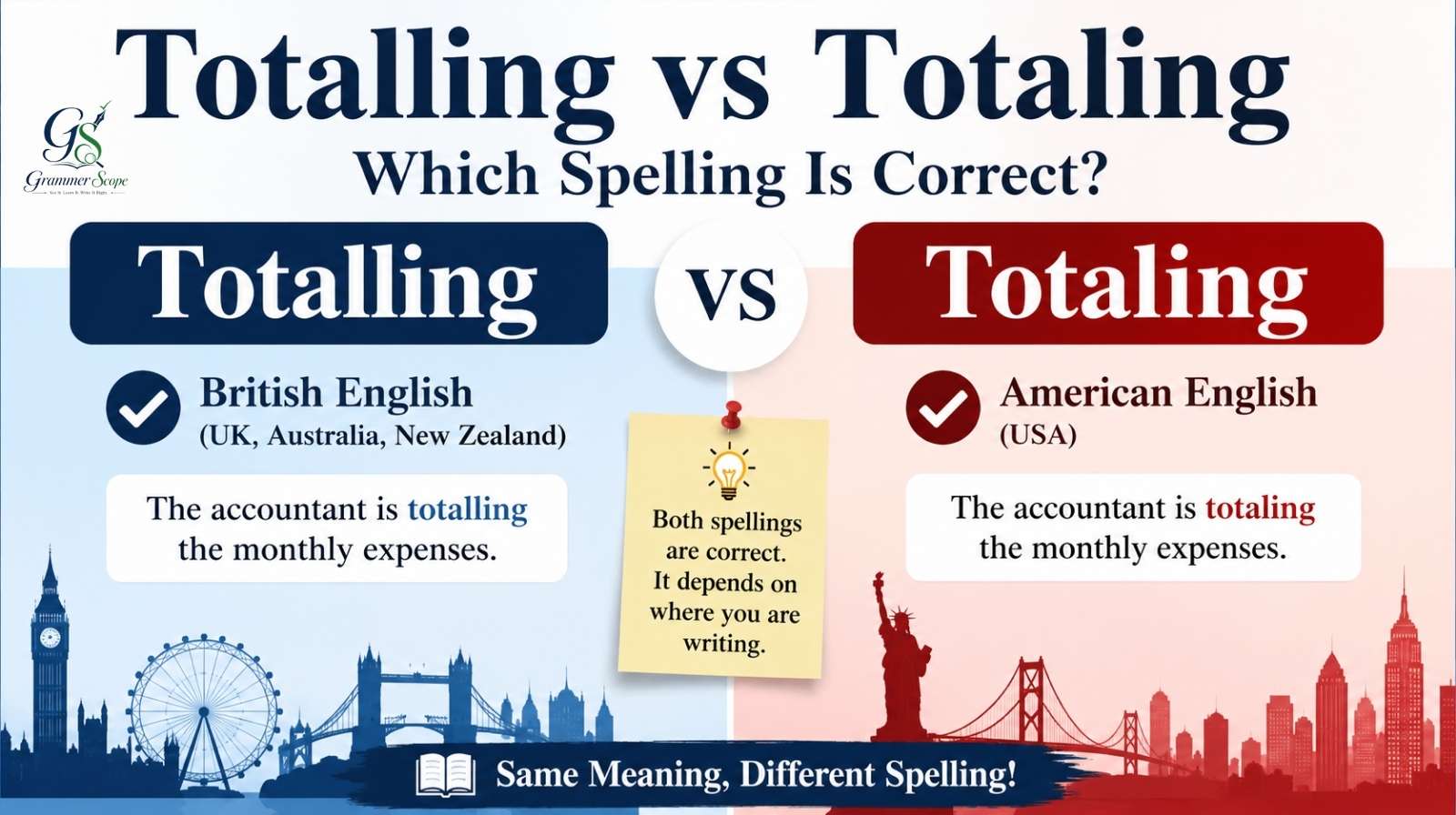
Have you ever written totalling in an email or article only to have your spell checker suggest totaling instead? If so, you’re not alone. Many English writers are confused about which spelling is correct and whether one is considered a mistake.
The confusion exists because English spelling rules vary between countries, particularly between British English and American English. What appears incorrect in one region may be perfectly acceptable in another.
In this guide, you’ll learn the difference between totalling vs totaling, discover when each spelling should be used, see real-world examples, and understand the grammar rule behind the variation. By the end, you’ll know exactly which spelling fits your audience and writing style.
What Is the Difference Between Totalling and Totaling?
The short answer is simple:
- Totalling is the preferred spelling in British English.
- Totaling is the preferred spelling in American English.
Both words come from the verb total, which means:
- To add numbers together
- To reach a final amount
- To calculate a sum
Quick Definition
Totalling/Totaling means:
Calculating the total amount of something or reaching a combined sum.
Examples
British English
- She is totalling the expenses for the project.
- The accountant spent hours totalling the monthly invoices.
American English
- She is totaling the expenses for the project.
- The accountant spent hours totaling the monthly invoices.
The meaning remains exactly the same. Only the spelling changes based on regional English conventions.
Read More: Tacet or Tacit: What’s The Difference And Which One Should You Use?
Why Does British English Use “Totalling”?
British English often follows a spelling rule that doubles the final consonant before adding suffixes such as:
- –ing
- -ed
when the stress falls on the final syllable or when traditional British spelling conventions apply.
Understanding the Rule
The base word is:
Total
When adding -ing, British English generally doubles the l:
- total → totalling
- travel → travelling
- cancel → cancelling
Why the Double “L”?
Historically, British English retained the doubled consonant in many words ending in -l before suffixes.
This pattern has remained standard across the United Kingdom, Australia, New Zealand, and many Commonwealth countries.
British English Examples
- We are totalling the yearly sales figures.
- The finance team is totalling customer payments.
- She finished totalling the receipts before lunch.
Why Does American English Use “Totaling”?
American English simplified many spelling conventions over time.
As a result, words ending in -l often drop one l when suffixes are added.
Common American Pattern
American English prefers:
| Base Word | British English | American English |
|---|---|---|
| Travel | Travelling | Traveling |
| Cancel | Cancelling | Canceling |
| Model | Modelling | Modeling |
| Total | Totalling | Totaling |
Examples in American English
- The software is totaling all expenses automatically.
- She spent the afternoon totaling customer orders.
- The accountant is totaling this quarter’s revenue.
American style guides generally recognize totaling as the standard spelling.
Totalling vs Totaling: Side-by-Side Comparison
| Feature | Totalling | Totaling |
|---|---|---|
| Meaning | Adding up numbers | Adding up numbers |
| Correct? | Yes | Yes |
| British English | Preferred | Less common |
| American English | Less common | Preferred |
| Australian English | Preferred | Rare |
| Canadian English | Often accepted | Also accepted |
| Formal Writing | Correct in UK style | Correct in US style |
Which Should You Choose?
Use totalling if your audience is primarily:
- United Kingdom
- Australia
- New Zealand
- Ireland
Use totaling if your audience is primarily:
- United States
Consistency matters more than choosing one universally.
The Grammar Rule Behind Totalling and Totaling
Many writers wonder whether there is an official grammar rule that determines the correct spelling.
The British Rule
British English frequently doubles the final l before adding suffixes.
Examples include:
- enrol → enrolling
- signal → signalling
- fuel → fuelling
- total → totalling
The American Rule
American English often avoids doubling the final l unless pronunciation requires it.
Examples include:
- enroll → enrolling
- signal → signaling
- fuel → fueling
- total → totaling
Why the Difference Exists
The distinction developed over centuries as American English adopted simplified spelling patterns while British English maintained many traditional forms.
Neither spelling is grammatically wrong.
The key is matching the spelling to the variety of English you’re using.
Real-Life Example: A Business Reporting Mistake
Imagine a multinational company with offices in both London and New York.
The finance department prepares a quarterly report.
A British employee writes:
“The accounting team is totalling all regional expenses.”
Later, an American editor reviews the report and changes the sentence to:
“The accounting team is totaling all regional expenses.”
The British team believes the change is unnecessary because totalling is standard in their region. Meanwhile, the American editor assumes the original spelling was an error.
Eventually, the company establishes a style guide. Reports intended for UK audiences use totalling, while reports intended for US audiences use totaling.
This scenario happens frequently in international organizations, publishing companies, and digital businesses. The lesson is that spelling should align with the target audience rather than personal preference.
For global brands, consistency across all content often matters more than selecting one spelling over the other.
Read More: Dysregulated vs Disregulated: Correct Usage Explained
Usage Trends and Language Data (2025–2026)
Modern language databases and search trend analyses continue to show regional preferences for these spellings.
Key Findings
- Totaling remains dominant in the United States.
- Totalling remains dominant in the United Kingdom.
- Global businesses often choose one style based on brand guidelines.
- Search engines recognize both spellings as valid variants.
- Most grammar-checking tools adjust recommendations based on selected language settings.
What This Means for Writers
If your website targets American readers, using totaling aligns with audience expectations.
If your content serves British readers, totalling generally appears more natural and professional.
For international audiences, either spelling works as long as usage remains consistent throughout the content.
Authority Sources
For further reference, consult:
- Google Search Central Writing Guidelines
- HubSpot Content Style Resources
- Merriam-Webster Dictionary
- Cambridge Dictionary
These respected sources acknowledge regional spelling differences across English varieties.
How to Choose the Right Spelling
Step 1: Identify Your Audience
Ask yourself:
- Are my readers mostly American?
- Are my readers mostly British?
- Is my audience international?
Step 2: Follow a Style Guide
Common examples include:
- AP Style
- Chicago Manual of Style
- Oxford Style Guide
- Company Editorial Guidelines
Step 3: Stay Consistent
Avoid mixing spellings like:
❌ The team is totalling expenses and totaling invoices.
Instead choose one style:
✅ The team is totalling expenses and totalling invoices.
OR
✅ The team is totaling expenses and totaling invoices.
Step 4: Configure Your Writing Tools
Most spell checkers allow you to select:
- English (US)
- English (UK)
- English (Australia)
This helps maintain consistency automatically.
Common Mistakes Writers Make
Mixing British and American Spellings
Many writers accidentally combine spellings from different English varieties.
Example:
❌ The company is totalling costs while optimizing its organization.
Here, optimizing follows American spelling while totalling follows British spelling.
Ignoring Audience Expectations
Readers may perceive unfamiliar spellings as errors even when they’re technically correct.
Relying Solely on Spell Check
Spell-check software follows language settings. If those settings are incorrect, valid words may appear as mistakes.
Read More: Nominator vs Nominee: Key Differences Explained
Mini Quiz: Totalling vs Totaling
Quiz 1:
Which spelling is British English?
Answer: Totalling is the British English spelling, commonly used in the UK, Australia, and other Commonwealth countries.
Quiz 2:
Which sentence is correct in American English?
A) She is totalling the invoices.
B) She is totaling the invoices.
Answer: B) She is totaling the invoices.
Quiz 3:
Do “totalling” and “totaling” have different meanings?
Answer: No. Both words have exactly the same meaning. The only difference is regional spelling.
Quiz 4:
What is the root word of both spellings?
Answer: The root word is “total,” which means to add up or calculate a sum.
Quiz 5:
True or False — Mixing both spellings in one article is acceptable in formal writing.
Answer: False. You should stay consistent with one spelling style throughout your writing.
Quiz 6:
Which English variety prefers dropping the double “l” in words like totaling?
Answer: American English prefers dropping one “l” in words like totaling, canceling, and traveling.
Fill in the Blanks (Totalling vs Totaling Practice)
Fill in Blank 1
The accountant is ________ all monthly expenses before submitting the report.
Answer: totalling / totaling (both correct depending on UK or US English)
Fill in Blank 2
In American English, the correct spelling is ________ instead of totalling.
Answer: totaling
Fill in Blank 3
She spent the afternoon ________ customer payments for the final report.
Answer: totalling / totaling
Fill in Blank 4
The process of ________ numbers helps businesses understand total profit.
Answer: totalling / totaling
Fill in Blank 5
British English usually doubles the final “l” when forming ________ from total.
Answer: totalling
Fill in Blank 6
Whether you write totalling or totaling, the meaning stays ________.
Answer: the same
References
Frequently Asked Questions
Q1: Is totalling a correct spelling?
A: Yes. Totalling is the standard British English spelling of the verb form of total.
Q2: Is totaling correct in American English?
A: Yes. Totaling is the preferred American English spelling and is widely accepted in the United States.
Q3: Which spelling is more common worldwide?
A: Both are common, but usage depends heavily on geographic location and audience.
Q4: Do totalling and totaling have different meanings?
A: No. Both words have exactly the same meaning. Only the spelling differs.
Q5: Should I use totalling or totaling for SEO?
A: Use the spelling your target audience searches for most often. For UK audiences, use totalling. For US audiences, use totaling.
Q6: Does Google treat the spellings differently?
A: Google recognizes both spellings as legitimate English variants and generally understands them as equivalent terms.
Q7: Can I use both spellings in one article?
A: It’s best not to. Choose one spelling style and use it consistently throughout your content.
Conclusion
When comparing totalling vs totaling, the answer is straightforward: both spellings are correct.
The difference comes down to regional English conventions:
- Totalling is preferred in British English.
- Totaling is preferred in American English.
Neither version changes the meaning of the word. What matters most is using the spelling that matches your audience and maintaining consistency throughout your writing.
Whether you’re creating business reports, academic papers, blog posts, or professional communications, understanding this distinction helps your writing appear polished, credible, and regionally appropriate.
The next time you encounter totalling or totaling, you’ll know exactly which version to choose and why.
Explore More Helpful Articles
- Suing or Sueing: Which Spelling Is Correct?
- Carrer vs Career: The Correct Spelling Explained
- Nominator vs Nominee: Key Differences Explained
Ready to improve your English? Read more guides on Grammer Scope

Bilal Khalid is a professional blogger specializing in grammar guides and practical writing tips. He helps readers improve clarity, accuracy, and confidence in communication through simple explanations, actionable advice, and easy-to-follow strategies for everyday and professional writing.