English grammar can be tricky, especially when two phrases look almost identical but have very different meanings. One common point of confusion is “it’s called” vs “it called.” Many writers, students, and English learners use these expressions interchangeably, even though only one is grammatically correct in most situations.
Understanding the difference is important because using the wrong phrase can make your writing sound awkward or incorrect. Whether you’re writing an email, creating content, completing academic work, or simply improving your English skills, knowing when to use each phrase will help you communicate more clearly.
In this guide, you’ll learn what “it’s called” and “it called” mean, why one is usually correct, how grammar rules apply, and how to avoid common mistakes. By the end, you’ll be able to use these phrases confidently in both spoken and written English.
What Is the Difference Between “It’s Called” and “It Called”?
The primary difference is grammatical structure.
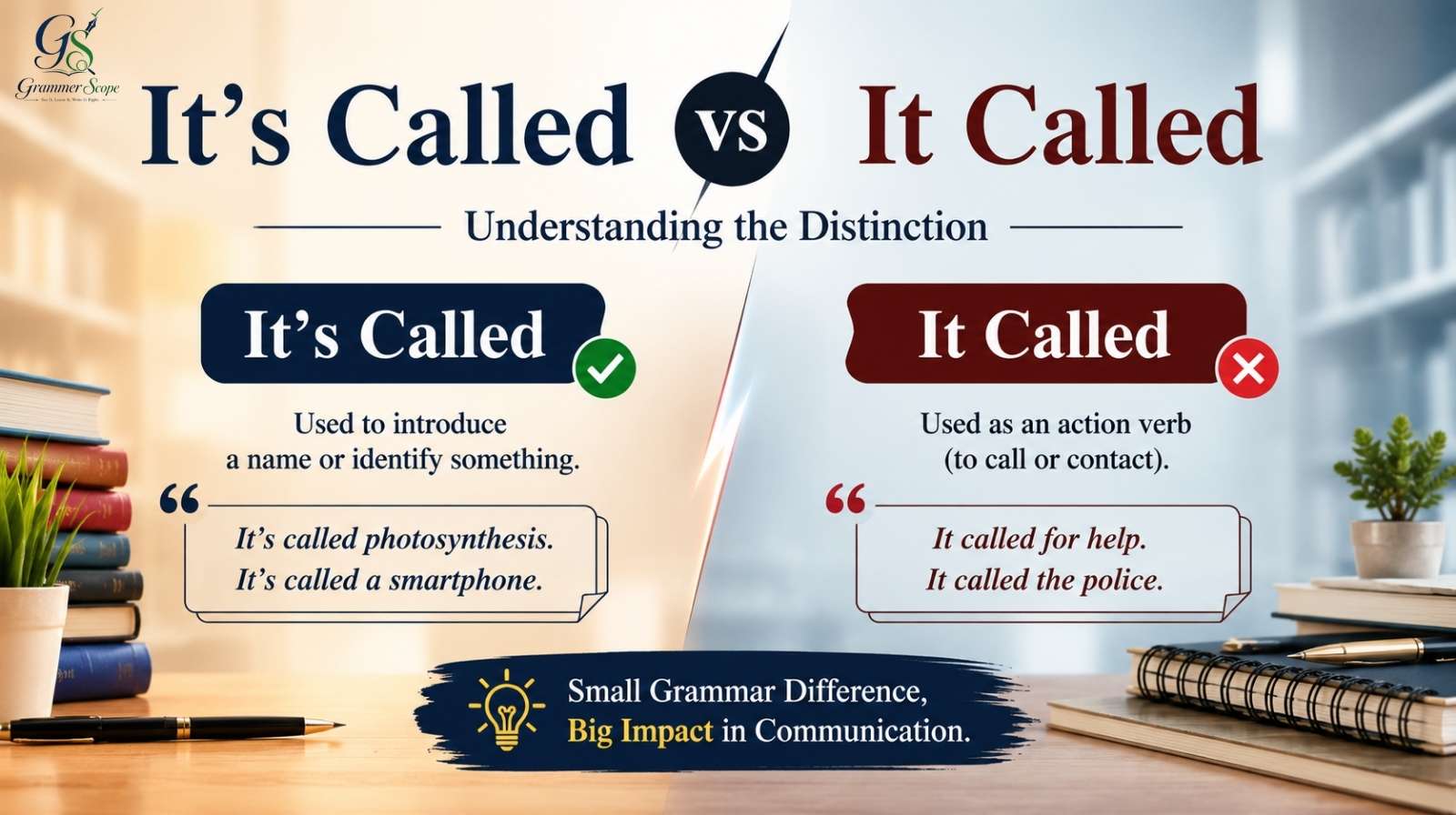
“It’s called” is a complete and grammatically correct phrase because “it’s” is a contraction of “it is.”
Example:
- It’s called a smartphone because it combines many functions into one device.
- It’s called photosynthesis because plants use light to create energy.
Meanwhile, “it called” is usually incomplete because the verb structure is missing a helping verb.
Incorrect:
- It called a smartphone.
Correct:
- It is called a smartphone.
- It’s called a smartphone.
Why “It’s Called” Works
The phrase uses the passive voice structure:
It + is + called + noun/name
Examples:
- It’s called a rainbow.
- It’s called artificial intelligence.
- It’s called grammar.
The helping verb “is” allows the sentence to function correctly.
Why “It Called” Usually Doesn’t Work
Without a helping verb, the sentence lacks proper grammatical structure.
Incorrect:
- It called artificial intelligence.
Readers naturally expect additional information, such as:
- It called its owner yesterday.
In this case, called acts as an action verb rather than part of a naming structure.
Quick Answer
If you’re naming or identifying something, “it’s called” is almost always the correct choice.
Read More: Amount or Ammount: Which Spelling Is Correct? (2026)
Understanding the Grammar Behind “It’s Called”
To fully understand the distinction, it helps to examine the grammar.
Breaking Down “It’s”
The contraction “it’s” means:
- It is
- It has
In the phrase “it’s called,” the meaning is “it is called.”
Example:
- It’s called a telescope.
- It is called a telescope.
Both sentences mean exactly the same thing.
The Passive Voice Structure
“It’s called” uses passive voice.
Structure:
Subject + be verb + past participle
Example:
- It is called a telescope.
- The process is called evaporation.
- The condition is called insomnia.
Passive voice emphasizes the name or label rather than the person who gave the name.
Why Passive Voice Is Common Here
When explaining names, the person who created the name is often irrelevant.
For example:
- It’s called gravity.
- It’s called a keyboard.
- It’s called machine learning.
The focus is on the term itself.
When Can “It Called” Be Correct?
Although “it called” is usually incorrect when discussing names, there are situations where it can be grammatically valid.
“Called” as an Action Verb
In these cases, called means to contact or communicate.
Examples:
- It called attention to the issue.
- It called the emergency services automatically.
- The device malfunctioned because it called the wrong number.
Here, it is performing the action.
Complete Sentences vs Incomplete Sentences
Correct:
- It called its owner.
- It called for help.
- It called attention to the problem.
Incorrect:
- It called a laptop.
- It called a rainbow.
These examples lack the grammatical structure needed to identify or name something.
Context Matters
Always ask yourself:
Is “called” describing a name or an action?
If it’s a name, use “it’s called.”
If it’s an action, “it called” may be correct.
It’s Called vs It Called: Side-by-Side Comparison
The table below highlights the key differences.
| Feature | It’s Called | It Called |
|---|---|---|
| Grammar | Usually correct | Often incomplete |
| Meaning | Refers to a name or label | Refers to an action |
| Structure | It is called | It performed calling |
| Common Usage | Very common | Less common |
| Formal Writing | Accepted | Depends on context |
| Example | It’s called a microscope | It called for assistance |
Easy Memory Trick
Remember this simple rule:
If you can replace it with “it is called,” use “it’s called.”
Example:
- It’s called a dictionary.
- It is called a dictionary.
The sentence still works.
However:
- It is called for assistance.
This changes the meaning entirely, showing that the original phrase likely involved an action.
Common Mistakes People Make
Many English learners make predictable mistakes when using these phrases.
Mistake 1: Dropping the Helping Verb
Incorrect:
- It called a volcano.
Correct:
- It’s called a volcano.
Mistake 2: Misunderstanding Contractions
Some people avoid contractions because they seem informal.
However:
- It is called a volcano.
- It’s called a volcano.
Both are correct.
Mistake 3: Confusing Naming With Actions
Incorrect:
- It called artificial intelligence.
Correct:
- It’s called artificial intelligence.
Mistake 4: Translating Directly From Another Language
Many languages use different sentence structures for naming objects. Direct translation often causes errors in English.
How to Avoid These Errors
Before writing:
- Identify the purpose of the sentence.
- Determine whether you’re naming something.
- Check if “it is called” fits naturally.
- If yes, use “it’s called.”
Read More: Repore or Rapport: Which Spelling Is Correct? (2026 Guide)
Real-Life Example: How a Content Writer Fixed a Common Grammar Error
Sarah, a freelance content writer, regularly produced educational articles for technology websites. While reviewing her work, an editor noticed repeated grammar mistakes involving naming phrases.
Sarah often wrote sentences such as:
- It called cloud computing.
- It called machine learning.
- It called data analytics.
Although the intended meaning was clear, these constructions sounded unnatural to native English speakers.
The editor explained that whenever she introduced a term or concept, she needed a passive structure:
- It’s called cloud computing.
- It’s called machine learning.
- It’s called data analytics.
Sarah then audited more than 100 articles and discovered similar mistakes throughout her content. After correcting them, she noticed several benefits.
First, her writing became easier to read. Second, clients spent less time editing her work. Third, her content appeared more professional and trustworthy.
Over the next six months, Sarah received positive feedback from both editors and readers. She realized that mastering small grammar distinctions can significantly improve communication quality.
This example demonstrates how understanding a seemingly minor difference can have a meaningful impact on professional writing and credibility.
Why Grammar Accuracy Matters in Digital Content
In today’s online environment, grammar influences user trust and engagement.
According to research published by Google Search Central Documentation, content should be helpful, accurate, and focused on users.
Similarly, HubSpot’s Content Marketing Resources emphasize clarity and readability as important factors in effective communication.
2025–2026 Language Learning Trends
Recent language-learning industry reports show:
- Millions of learners worldwide continue studying English through online platforms.
- Grammar-related searches remain among the most common educational search queries.
- AI-assisted writing tools have increased awareness of grammatical accuracy.
- Content creators increasingly prioritize readability and correctness.
These trends highlight why understanding phrases like “it’s called” vs “it called” remains relevant in 2025 and 2026.
Benefits of Correct Grammar
Using correct grammar:
- Improves credibility.
- Enhances readability.
- Builds audience trust.
- Reduces misunderstandings.
- Supports professional communication.
How to Remember the Correct Usage
Step 1: Look for a Name
Ask:
“Am I introducing a name or term?”
Example:
- It’s called renewable energy.
Step 2: Expand the Contraction
Replace “it’s” with “it is.”
Example:
- It is called renewable energy.
If the sentence still works, you’re correct.
Step 3: Check for an Action
Ask:
“Is something performing the action of calling?”
Example:
- It called for assistance.
If yes, “it called” may be correct.
Step 4: Read the Sentence Aloud
Reading aloud often reveals awkward grammar instantly.
Quick Checklist
Before using the phrase:
✔ Am I naming something?
✔ Can I say “it is called”?
✔ Does the sentence sound complete?
✔ Does the meaning remain clear?
If yes, use “it’s called.”
Read More: Knaw or Gnaw: Correct Spelling Explained (2026)
Mini Quiz: It’s Called vs It Called
Quiz 1: Which Phrase Is Correct?
Which sentence is grammatically correct when naming something?
A) It called a telescope.
B) It’s called a telescope.
Answer: B) It’s called a telescope.
Because “it’s” means “it is,” creating the correct phrase: “It is called a telescope.”
Quiz 2: Spot the Grammar Mistake
Which sentence contains a grammar error?
A) It’s called renewable energy.
B) It called renewable energy.
Answer: B) It called renewable energy.
The sentence is missing the helping verb “is.” The correct form is “It’s called renewable energy.”
Quiz 3: Name or Action?
In the sentence below, is “called” being used as a name or an action?
“It’s called artificial intelligence.”
A) Name
B) Action
Answer: A) Name
The phrase introduces the name of a concept, so “called” refers to naming something.
Quiz 4: Fill in the Blank
Choose the correct option:
“_____ a rainbow when sunlight passes through water droplets.”
A) It called
B) It’s called
Answer: B) It’s called
The sentence explains what something is named.
Quiz 5: True or False?
“It’s called” is a contraction of “It is called.”
Answer: True ✅
“It’s” is the shortened form of “it is.”
Quiz 6: Which One Sounds Natural?
A) It’s called a smartphone because it combines many functions.
B) It called a smartphone because it combines many functions.
Answer: A) It’s called a smartphone because it combines many functions.
This is the grammatically complete and natural sentence.
Quiz 7: Action or Naming?
In the sentence below, how is “called” being used?
“The device malfunctioned because it called the wrong number.”
A) Naming
B) Action
Answer: B) Action
Here, “called” means the device performed the action of making a call.
Quiz 8: Quick Grammar Check
Which sentence can be expanded to “It is called”?
A) It’s called photosynthesis.
B) It called for assistance.
Answer: A) It’s called photosynthesis.
“It is called photosynthesis” makes perfect grammatical sense.
Quiz 9: Choose the Best Correction
Original sentence:
“It called machine learning.”
What is the best correction?
A) It’s called machine learning.
B) It called machine learning yesterday.
Answer: A) It’s called machine learning.
The sentence is defining a term, so it needs the passive structure.
Quiz 10: The Final Challenge
What’s the easiest way to check whether “it’s called” is correct?
A) Remove the word “called.”
B) Replace “it’s” with “it is.”
Answer: B) Replace “it’s” with “it is.”
If the sentence still sounds correct, then “it’s called” is the right choice.
Quiz 11: Grammar Master Test
Which sentence is completely correct?
A) It called a microscope.
B) It’s called a microscope.
C) It calling a microscope.
Answer: B) It’s called a microscope.
This follows the correct structure for naming or identifying something.
Frequently Asked Questions
Q1: Is “it called” grammatically correct?
A: Yes, but only when called functions as an action verb.
Example:
- It called for help.
Q2: Is “it’s called” correct English?
A: Yes. It is a standard and grammatically correct expression used to identify or name something.
Q3: Can I use “it is called” instead of “it’s called”?
A: Absolutely. Both forms are correct.
Example:
- It is called a telescope.
- It’s called a telescope.
Q4: Why do people confuse these phrases?
A: The phrases look similar, and many learners focus on vocabulary rather than sentence structure.
Q5: Is “it’s called” formal or informal?
A: The contraction is slightly more conversational, while “it is called” can sound more formal. Both are widely accepted.
Q6: Which phrase is more common?
A: “It’s called” is far more common when introducing names, definitions, or terminology.
Q7: How can I remember the difference easily?
A: Try replacing “it’s” with “it is.” If the sentence still makes sense, you’re using the correct form.
Conclusion
Understanding “it’s called” vs “it called” is easier once you recognize the grammatical structure behind each phrase. In most situations where you’re introducing a name, definition, or label, “it’s called” is the correct choice because it means “it is called.”
On the other hand, “it called” is only appropriate when something is actually performing the action of calling. Recognizing this distinction helps you avoid common grammar mistakes and improves both your writing and speaking skills.
The next time you encounter these phrases, pause for a moment and ask whether you’re naming something or describing an action. If you’re introducing a term, remember: it’s called is almost certainly the right answer. Mastering small grammar details like this can make your English clearer, more professional, and more effective.
Ready to improve your English? Read more guides on Grammer Scope