
Have you ever typed “persue” and wondered whether it was correct? You’re not alone. Thousands of English learners, students, bloggers, and professionals make this spelling mistake every day.
The confusion between persue or pursue is common because both words look similar and sound nearly identical when spoken quickly. However, only one spelling is correct in standard English.
In this complete guide, you’ll learn the correct spelling, meaning, pronunciation, grammar rules, examples, common mistakes, and easy tricks to remember the difference. By the end, you’ll never confuse persue and pursue again.
What Is the Correct Spelling: Persue or Pursue?
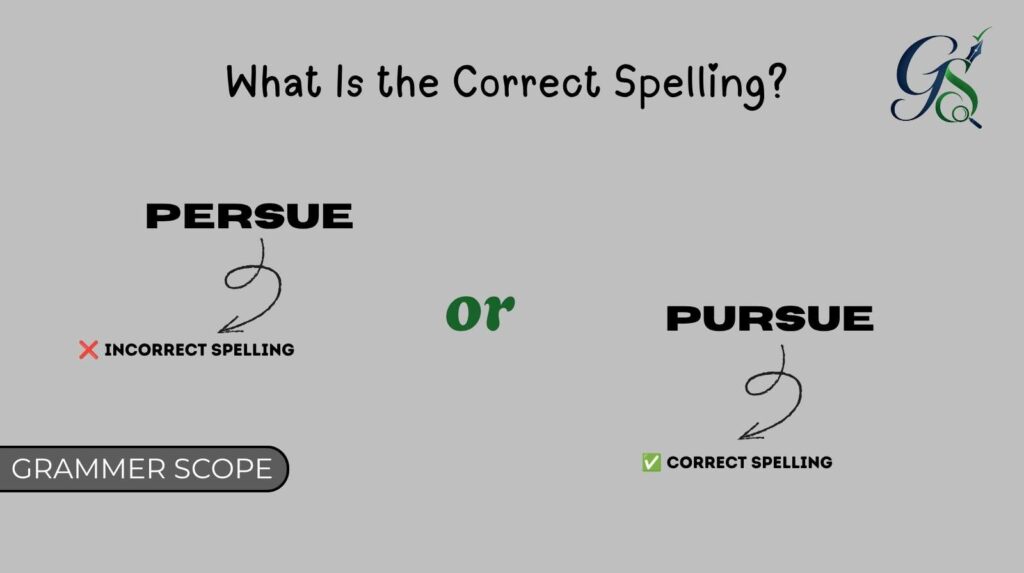
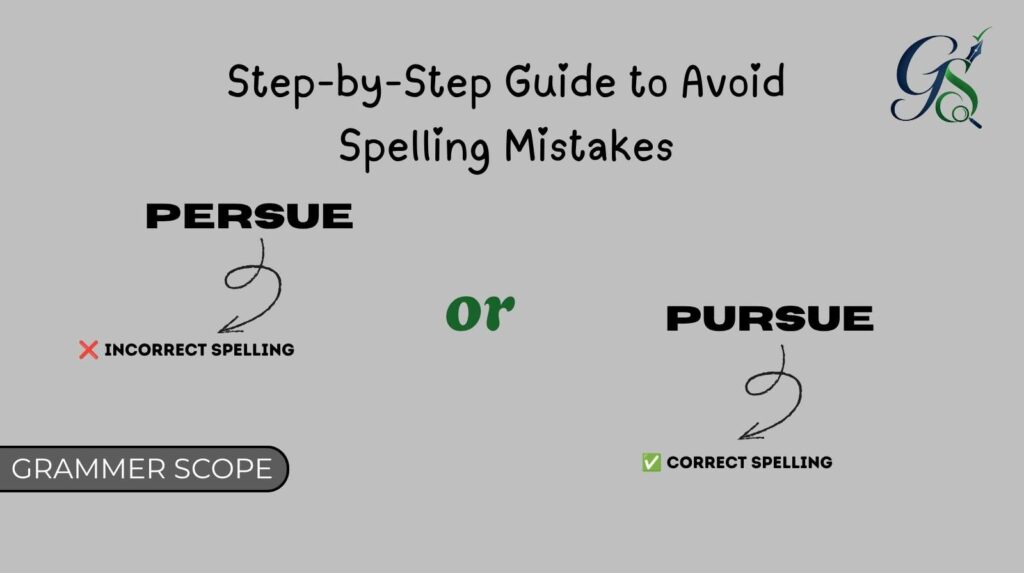
The correct spelling is pursue.
❌ Persue: Incorrect spelling
✅ Pursue: Correct spelling
Pursue is a verb that means:
- To follow a goal
- To continue trying to achieve something
- To chase or follow someone or something
- To engage in an activity over time
Quick Answer
| Word | Correct? | Meaning |
|---|---|---|
| Persue | ❌ No | Misspelling |
| Pursue | ✅ Yes | To follow, chase, or work toward something |
If you’re writing an essay, email, article, resume, or business document, always use pursue.
Read More: Other Than or Other Then: Which Spelling Is Right?
Why Do People Misspell Pursue as Persue?
Many English words beginning with “per” are common:
- Perfect
- Perhaps
- Personal
- Percent
Because of this pattern, people naturally assume the word should be written as persue instead of pursue.
However, the word originates from older forms of English and Latin that preserved the “pur-“ spelling.
The Pronunciation Confusion
The word is pronounced:
/pərˈsuː/
Because the first syllable sounds like “per,” many writers mistakenly replace pur with per.
Common Situations Where Mistakes Occur
People often write:
- Persue your dreams
- Persue a career
- Persue higher education
- Persue legal action
All of these are incorrect.
Correct versions:
- Pursue your dreams
- Pursue a career
- Pursue higher education
- Pursue legal action
Meaning of Pursue in English
The verb pursue has several meanings depending on context.
Pursue a Goal
This is the most common use.
Examples:
- She decided to pursue her dream of becoming a doctor.
- They pursued success despite many challenges.
- I want to pursue a career in technology.
Pursue Someone or Something
It can mean to follow or chase.
Examples:
- The police pursued the suspect.
- The cat pursued the mouse across the yard.
- Hunters pursued the animal through the forest.
Pursue an Activity
It can also mean continuing an interest or hobby.
Examples:
- He pursues photography in his free time.
- She pursued research for several years.
- They pursue environmental projects worldwide.
Read More: Striping vs Stripping: Meaning, Grammar And Usage Guide
Persue vs Pursue: Side-by-Side Comparison
The easiest way to understand the difference is through comparison.
| Feature | Persue | Pursue |
|---|---|---|
| Spelling Status | Incorrect | Correct |
| Dictionary Entry | No | Yes |
| Accepted in Formal Writing | No | Yes |
| Meaning | None | Follow, chase, achieve |
| Used in Academic Writing | No | Yes |
| Used in Business Communication | No | Yes |
Key Takeaway
If you’re unsure which version to use, choose pursue every time.
How to Remember the Correct Spelling of Pursue
Remembering spellings becomes easier when you use memory tricks.
Trick 1: Think of “Pure Success”
The word pursue starts with pur.
You can remember:
PURsue = PURe Success
Since many people pursue success, this association helps reinforce the spelling.
Trick 2: Remember the “U”
Notice there are two u letters in pursue:
P-U-R-S-U-E
The first u appears after P.
The second u appears before E.
Trick 3: Visual Memory Method
Look at the word several times:
PURSUE
PURSUE
PURSUE
Your brain gradually stores the correct visual pattern.
Trick 4: Use It in Sentences
Practice writing:
- I will pursue my goals.
- She wants to pursue medicine.
- They pursue excellence every day.
Repetition improves retention.
Read More: Goodmorning or Good Morning: Which One Is Correct?
Real-Life Example: How One Misspelling Cost a Job Applicant
A university graduate was applying for multiple positions in a competitive job market. His resume included the sentence:
“I wish to persue opportunities that allow professional growth.”
The resume was submitted to dozens of companies.
Although his qualifications were strong, one recruiter noticed the spelling mistake immediately. Since communication skills were important for the role, the error created a negative first impression.
After receiving feedback, the applicant corrected the sentence:
“I wish to pursue opportunities that allow professional growth.”
Within weeks, he secured several interviews.
This example highlights an important lesson: spelling mistakes may seem small, but they can affect credibility, professionalism, and trustworthiness.
Whether you’re writing a resume, cover letter, business proposal, academic paper, or website content, using the correct spelling demonstrates attention to detail. While a single typo may not always lead to rejection, consistent errors can influence how readers perceive your expertise.
Therefore, learning the difference between persue and pursue is more valuable than many people realize.
Pursue in Different Contexts
The word appears frequently across professional and academic environments.
Education
Examples:
- Students pursue higher education after graduation.
- Many learners pursue advanced degrees.
Career Development
Examples:
- She pursued a management position.
- They pursued leadership opportunities.
Business
Examples:
- The company pursued new markets.
- Investors pursued long-term growth.
Personal Goals
Examples:
- Pursue happiness.
- Pursue financial freedom.
- Pursue personal development.
Read More: Lable or Label: Which Spelling Is Correct?
Common Examples of Correct Usage
Here are examples you can copy and use.
In Everyday Conversation
- I want to pursue my passion.
- You should pursue your dreams.
- We decided to pursue a new opportunity.
In Academic Writing
- Researchers continue to pursue innovative solutions.
- Students often pursue graduate studies.
- Scientists pursue knowledge through experimentation.
In Business Writing
- Our organization will pursue strategic growth.
- We intend to pursue new partnerships.
- The company pursued expansion aggressively.
Language Trends and Spelling Accuracy Statistics (2025–2026)
Spelling accuracy remains a significant issue in digital communication.
According to research and language studies published by organizations such as Google Trends, Merriam-Webster, and Grammarly, spelling-related searches continue to generate millions of queries annually.
Key observations from 2025–2026 language trends include:
- Misspelled-word searches remain among the most common grammar-related searches online.
- Users frequently search for correct spellings before publishing content.
- Professional writers increasingly rely on spelling verification tools.
- Words with similar pronunciation often create the highest error rates.
The confusion between persue and pursue fits this pattern because pronunciation does not clearly reveal the correct spelling.
Therefore, verifying spelling before publishing content remains an essential writing habit.
Step-by-Step Guide to Avoid Spelling Mistakes
Follow this simple process whenever you write.
Step 1: Write Naturally
Focus on ideas first.
Step 2: Run a Spell Check
Use trusted writing tools before publishing.
Step 3: Read Aloud
Hearing the sentence often reveals mistakes.
Step 4: Verify Uncertain Words
Look up words you frequently misspell.
Step 5: Create a Personal Error List
Keep a document of commonly confused words such as:
- Pursue
- Definitely
- Separate
- Necessary
- Accommodation
This habit dramatically improves writing quality over time.
Read More: Transferred vs Transfered: Which Is Correct?
Commonly Confused Words Similar to Pursue
Many spelling errors follow similar patterns.
Accept vs Except
- Accept = receive
- Except = exclude
Advice vs Advise
- Advice = noun
- Advise = verb
Loose vs Lose
- Loose = not tight
- Lose = fail to keep
Affect vs Effect
- Affect = influence
- Effect = result
Persue vs Pursue
- Persue = incorrect
- Pursue = correct
Understanding these pairs helps improve overall English accuracy.
Read More: You Too or You To: What’s the Correct Grammar in 2026?
Mini Quiz: Persue or Pursue
Quiz 1: Choose the Correct Spelling
Which word is correct?
A) Persue
B) Pursue
Answer: ✅ B) Pursue
Quiz 2: Fill in the Blank
“I want to _____ a career in medicine.”
A) Pursue
B) Persue
Answer: ✅ A) Pursue
Quiz 3: True or False?
“Persue” is the correct spelling.
Answer: ❌ False
Quiz 4: Meaning Check
What does “pursue” mean?
A) To give up
B) To follow or work toward something
C) To ignore
Answer: ✅ B) To follow or work toward something
Quiz 5: Spot the Correct Sentence
A) She decided to persue her dreams.
B) She decided to pursue her dreams.
Answer: ✅ B) She decided to pursue her dreams.
Quiz 6: One-Letter Challenge
Which letter comes after “P” in “pursue”?
A) E
B) U
Answer: ✅ B) U
Quiz 7: Workplace Writing Test
Which sentence looks professional?
A) We will pursue new opportunities.
B) We will persue new opportunities.
Answer: ✅ A) We will pursue new opportunities.
Quiz 8: Quick Grammar Check
“Pursue” is a:
A) Noun
B) Verb
C) Adjective
Answer: ✅ B) Verb
Quiz 9: Find the Mistake
Which word is incorrect?
“I plan to persue higher education.”
Answer: ✅ Persue
The correct spelling is pursue.
Quiz 10: Dream Chaser Test
Complete the sentence:
“Never stop _____ your goals.”
A) pursuing
B) persuing
Answer: ✅ A) pursuing
Quiz 11: Dictionary Check
Which word appears in English dictionaries?
A) Pursue
B) Persue
Answer: ✅ A) Pursue
Quiz 12: Correct or Incorrect?
“The police pursued the suspect.”
Answer: ✅ Correct
Quiz 13: Multiple Choice
Which spelling should you use in an essay?
A) Persue
B) Pursue
Answer: ✅ B) Pursue
Quiz 14: Finish the Word
P U R S _ E
A) U
B) E
Answer: ✅ A) U
The correct spelling is PURSUE.
Quiz 15: Final Challenge
Which sentence is written correctly?
A) Students should pursue their passions.
B) Students should persue their passions.
Answer: ✅ A) Students should pursue their passions.
Frequently Asked Questions
Q1: Is persue a real word?
A: No. Persue is not recognized as a standard English word. It is a common misspelling of pursue.
Q2: What does pursue mean?
A: Pursue means to follow, chase, continue, or work toward a goal, opportunity, activity, or objective.
Q3: Why do people write persue instead of pursue?
A: The mistake usually happens because the pronunciation makes the first syllable sound similar to “per,” leading writers to spell it incorrectly.
Q4: How do you spell pursue correctly?
A: The correct spelling is:
P-U-R-S-U-E
Q5: Is pursue a verb?
A: Yes. Pursue is a verb used to describe following, chasing, or working toward something.
Q6: Can I use pursue in formal writing?
A: Absolutely. Pursue is widely accepted in academic, professional, legal, and business writing.
Q7: What is a sentence with pursue?
A: Example:
“She plans to pursue a career in software engineering.”
Conclusion
If you’ve ever wondered whether persue or pursue is correct, the answer is simple: pursue is the only correct spelling.
While the mistake is extremely common, remembering the spelling P-U-R-S-U-E can help you avoid errors in academic papers, professional emails, resumes, business documents, and everyday writing.
Whenever you want to describe following a goal, chasing an opportunity, or continuing an activity, use pursue with confidence. The next time you see persue, you’ll immediately recognize it as a misspelling.
Start applying this rule today and pursue stronger, more professional English writing skills.
Discover More Articles
- Long Term or Longterm: Which Spelling Is Correct in 2026?
- Take Effect or Take Affect? The Correct Phrase Explained
- As Well or Aswell – Which One Is Correct?
Ready to improve your English? Read more guides on Grammer Scope

Bilal Khalid is a professional blogger specializing in grammar guides and practical writing tips. He helps readers improve clarity, accuracy, and confidence in communication through simple explanations, actionable advice, and easy-to-follow strategies for everyday and professional writing.