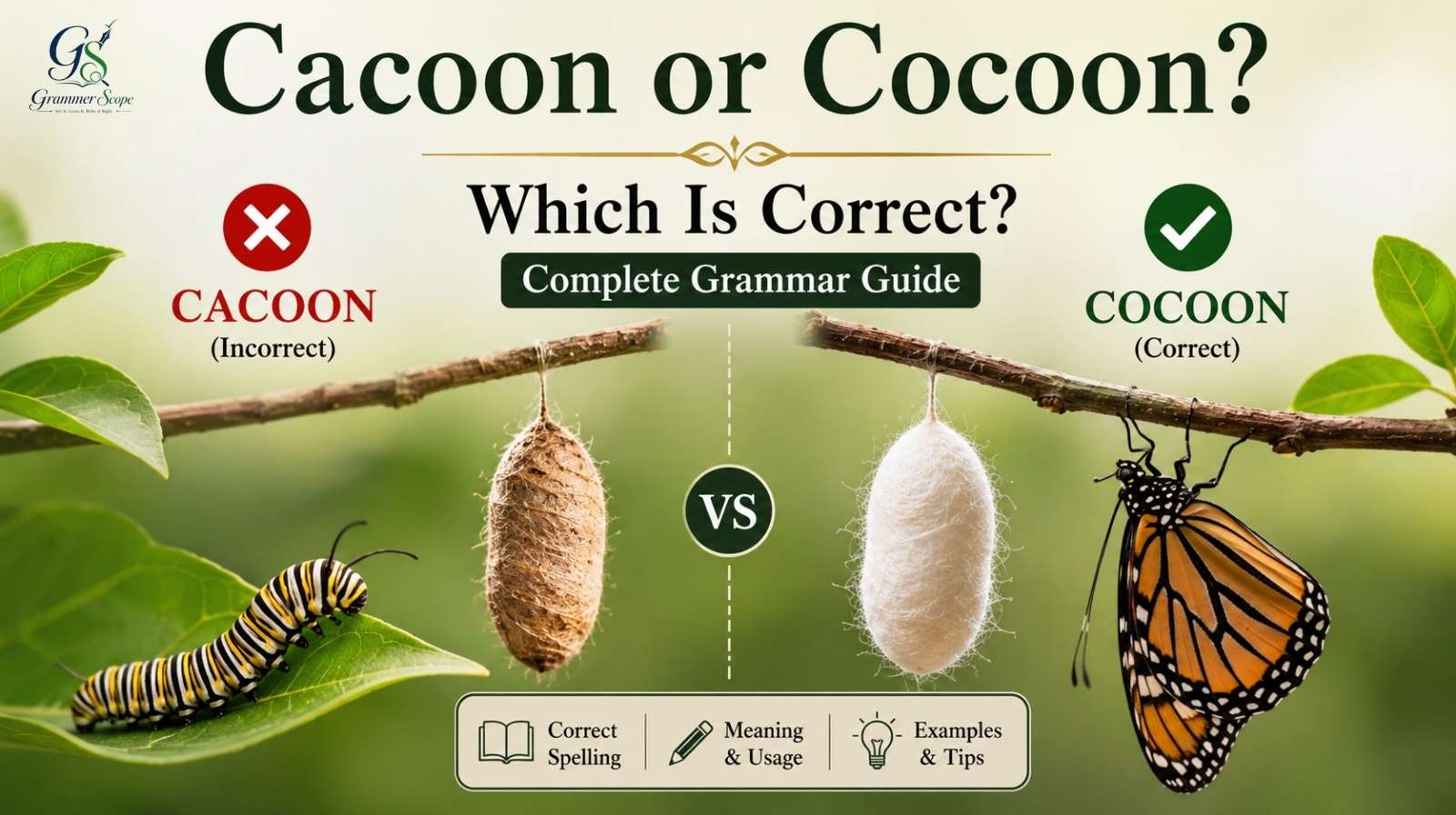
Have you ever typed “cacoon” and wondered whether it was the correct spelling? You’re not alone. Many English learners, writers, students, and even native speakers occasionally confuse cacoon and cocoon because the words sound somewhat similar when spoken quickly.
The good news is that the answer is straightforward: “cocoon” is the correct English word, while “cacoon” is generally considered a misspelling.
However, understanding why this confusion happens and how to avoid it can help improve your writing accuracy and confidence.
In this guide, you’ll learn the difference between cacoon or cocoon, discover the correct meaning and usage of cocoon, explore real-world examples, review common spelling mistakes, and learn practical strategies for remembering the correct spelling.
What Is the Correct Spelling: Cacoon or Cocoon?
The correct spelling is cocoon.
Quick Answer
| Word | Correct? | Meaning |
|---|---|---|
| Cocoon | ✅ Yes | Protective casing formed by insects during development |
| Cacoon | ❌ No | Common misspelling of “cocoon” |
If you’re writing in English, you should always use cocoon unless you’re referring to a specific brand, product name, or proper noun intentionally spelled differently.
What Does Cocoon Mean?
A cocoon is a protective covering spun by insects such as moths and some butterflies during their transformation into adults.
Example:
The caterpillar built a cocoon before becoming a moth.
The word can also be used figuratively to describe a safe, comfortable, or protected environment.
Example:
She spent the winter in a cocoon of warmth and comfort.
Why Do People Write “Cacoon”?
People often spell it as cacoon because:
- The pronunciation can be misleading.
- English spelling patterns are sometimes inconsistent.
- Typing errors occur frequently.
- Learners may assume the first vowel is “a” instead of “o.”
Read More: Suing or Sueing: Which Spelling Is Correct?
Understanding the Meaning of Cocoon
The word cocoon has both literal and figurative meanings.
Literal Meaning
In biology, a cocoon is a silk casing created by certain insect larvae.
Example:
The scientist observed a cocoon hanging from the branch.
Figurative Meaning
In everyday language, cocoon often represents protection, comfort, or isolation.
Examples:
The cabin became a cocoon during the snowstorm.
Parents often create a cocoon of safety for young children.
Business and Lifestyle Usage
Many writers and marketers use cocoon metaphorically.
Examples:
- Cocoon of luxury
- Cocoon of comfort
- Cocoon-like workspace
- Cocooning lifestyle
Why the Spelling Confusion Happens
English contains many words whose pronunciation doesn’t perfectly match their spelling.
Similar Sound Patterns
Words like these often create confusion:
| Correct Word | Common Misspelling |
|---|---|
| Balloon | Baloon |
| Occasion | Ocassion |
| Cocoon | Cacoon |
| Committee | Comitee |
Because the first syllable in cocoon is unstressed, some people hear it differently and accidentally replace the “o” with an “a.”
Influence of Regional Accents
Different accents can slightly change vowel sounds. As a result, listeners may incorrectly assume the spelling is cacoon.
Auto-Correct Doesn’t Always Help
While most modern spell-checkers recognize cocoon, typing quickly can still result in errors that go unnoticed.
Cacoon vs Cocoon: Side-by-Side Comparison
| Feature | Cocoon | Cacoon |
|---|---|---|
| Valid English Word | Yes | No |
| Found in Dictionaries | Yes | No |
| Accepted in Academic Writing | Yes | No |
| Commonly Used | Yes | No |
| Recommended Usage | Always | Never |
Dictionary Recognition
Major dictionaries recognize cocoon as the standard spelling.
You can verify this through trusted sources such as:
None of these dictionaries list cacoon as a standard English word.
Writing Recommendation
Whenever you need the term, use:
✅ Cocoon
Never:
❌ Cacoon
Read More: Commit vs Comit: Correct Spelling And Usage Guide
Real-Life Example: How a Small Spelling Error Can Affect Professional Writing
Imagine a university student preparing a biology research report about insect metamorphosis.
The student writes:
“The moth develops inside a cacoon before emerging.”
Although readers may understand the intended meaning, the misspelling immediately reduces the document’s credibility. Professors, editors, and academic reviewers often view spelling accuracy as a reflection of attention to detail.
Now consider an online business selling educational science materials. If product descriptions repeatedly use cacoon instead of cocoon, several problems can occur:
- Readers may question the site’s professionalism.
- Search engines may struggle to associate the content with the correct keyword.
- Educational value decreases because learners see incorrect spelling.
- Brand trust can suffer over time.
The company eventually updates all content to use cocoon consistently. Within months, user engagement improves because visitors perceive the content as more reliable and authoritative.
This example highlights an important lesson: even a single-letter spelling mistake can influence credibility, user trust, and overall communication effectiveness. Whether you’re writing academic papers, blog posts, marketing content, or social media updates, using the correct spelling matters.
Language and Search Trends: Why Correct Spelling Matters in 2025–2026
According to ongoing search behavior studies from organizations such as Google Search Central and industry research published by HubSpot, search engines have become increasingly effective at understanding user intent and correcting common spelling mistakes.
Key Trends
- Search engines automatically suggest corrected spellings.
- Users are more likely to trust grammatically correct content.
- Accurate spelling improves readability and professionalism.
- Educational and informational websites benefit from language precision.
What This Means for Writers
If your article, report, or website consistently uses the correct spelling cocoon, it appears more authoritative and trustworthy.
This is especially important for:
- Bloggers
- Students
- Teachers
- Content creators
- Business owners
- SEO professionals
How to Remember the Correct Spelling of Cocoon
Spelling mistakes happen, but a few simple memory tricks can help.
Trick 1: Think of Two O’s for Protection
The word cocoon contains two pairs of the letter “o.”
co + coon
Imagine the two “o” pairs forming a protective shell around the insect.
Trick 2: Associate It with Common Words
Notice similar patterns:
- Cool
- Moon
- Balloon
- Cocoon
These words use the “oo” sound.
Trick 3: Visual Memory
Picture a caterpillar wrapped inside a round protective cocoon.
The rounded shape can remind you of the rounded letter o.
Common Examples of Cocoon in Sentences
Biological Usage
The caterpillar remained inside the cocoon for several weeks.
Scientists examined the cocoon under a microscope.
Everyday Usage
The blanket created a cozy cocoon around her.
The hotel room felt like a cocoon of comfort.
Professional Writing
The brand promises customers a cocoon-like experience of relaxation.
The architecture was designed to create a cocoon of privacy.
Common Mistakes to Avoid
Mistake 1: Writing Cacoon
Incorrect:
The butterfly emerged from its cacoon.
Correct:
The butterfly emerged from its cocoon.
Mistake 2: Using Spellings Based on Pronunciation
English spelling often differs from pronunciation.
Always verify unfamiliar words using a dictionary.
Mistake 3: Ignoring Spell Check Suggestions
Modern writing tools usually identify cacoon as an error.
Take a moment to review suggested corrections.
Read More: Submission vs Submittion: Learn The Correct Spelling
Mini Quiz: Cocoon or Cacoon
Quiz 1: Which spelling is correct?
Question: Cocoon or Cacoon — which is correct?
Answer: Cocoon
Quiz 2: Fill in the blank
Question: The correct spelling is ______.
Answer: cocoon
Quiz 3: What is wrong spelling?
Question: Which word is incorrect?
Answer: Cacoon
Quiz 4: Fill in the blank
Question: A cocoon is made by a ______ (insect stage).
Answer: caterpillar
Quiz 5: Meaning check
Question: What does cocoon mainly mean?
Answer: A protective covering for insects
Quiz 6: Fill in the blank
Question: The butterfly comes out of a ______.
Answer: cocoon
Quiz 7: True or False
Question: “Cacoon” is a correct English word.
Answer: False
Quiz 8: Fill in the blank
Question: Cocoon can also mean a place of ______ and comfort.
Answer: safety
Quiz 9: Choose the correct option
Question: Which is used in English writing?
A) Cacoon
B) Cocoon
Answer: B) Cocoon
Quiz 10: Fill in the blank
Question: A cocoon is part of insect ______ process.
Answer: transformation
Quiz 11: Spelling test
Question: Which spelling is correct?
Answer: Cocoon
Quiz 12: Fill in the blank
Question: Many people mistakenly write ______ instead of cocoon.
Answer: cacoon
Quiz 13: Quick understanding
Question: Cocoon is mainly related to which field?
Answer: Biology
Frequently Asked Questions
Q1: Is cacoon a real word?
A: No. Cacoon is generally considered a misspelling of cocoon and is not recognized as a standard English word.
Q2: Which spelling is correct: cacoon or cocoon?
A: Cocoon is the correct spelling.
Q3: What does cocoon mean?
A: A cocoon is a protective casing created by certain insect larvae. It can also refer metaphorically to a safe or comfortable environment.
Q4: Why do people spell cocoon as cacoon?
A: The mistake usually occurs because of pronunciation confusion, typing errors, or unfamiliarity with the word.
Q5: Is cocoon used outside biology?
A: Yes. It is frequently used figuratively to describe comfort, safety, privacy, or protection.
Q6: Can using “cacoon” hurt SEO?
A: Potentially. While search engines often understand misspellings, using the correct spelling improves professionalism, clarity, and keyword relevance.
Q7: How can I remember the correct spelling?
A: Remember that cocoon contains two “o” pairs, creating a visual image of a protective shell.
Conclusion
If you’ve been wondering whether cacoon or cocoon is correct, the answer is simple: cocoon is the proper spelling, while cacoon is a misspelling.
Understanding the difference helps you communicate more clearly, write more professionally, and avoid common language mistakes. Whether you’re discussing insect metamorphosis, describing a cozy environment, or creating online content, using cocoon correctly strengthens your credibility and improves readability.
The next time you see cacoon, remember that the correct word is cocoon with two pairs of “o” letters forming the protective shell that the word represents.
By practicing accurate spelling and verifying unfamiliar terms, you’ll become a stronger and more confident writer.
Explore More Helpful Articles
- Goodmorning or Good Morning: Which One Is Correct?
- Striping vs Stripping: Meaning, Grammar And Usage Guide
- Other Than or Other Then: Which Spelling Is Right?
Ready to improve your English? Read more guides on Grammer Scope

Bilal Khalid is a professional blogger specializing in grammar guides and practical writing tips. He helps readers improve clarity, accuracy, and confidence in communication through simple explanations, actionable advice, and easy-to-follow strategies for everyday and professional writing.