Have you ever paused while writing and wondered whether you should use long term, long-term, or even longterm?
You are not alone. This is one of the most common grammar and spelling questions in English writing. Many people use these forms interchangeably, while others assume all three are correct. Unfortunately, that can lead to mistakes in academic papers, business documents, blog posts, and professional communication.
The good news is that the rule is actually quite simple once you understand it. In this guide, you’ll learn the difference between long term, long-term, and longterm, discover when each form should be used, review real examples, and avoid one of the most common writing mistakes in 2026.
What Is the Correct Spelling: Long Term or Longterm?
The short answer is:
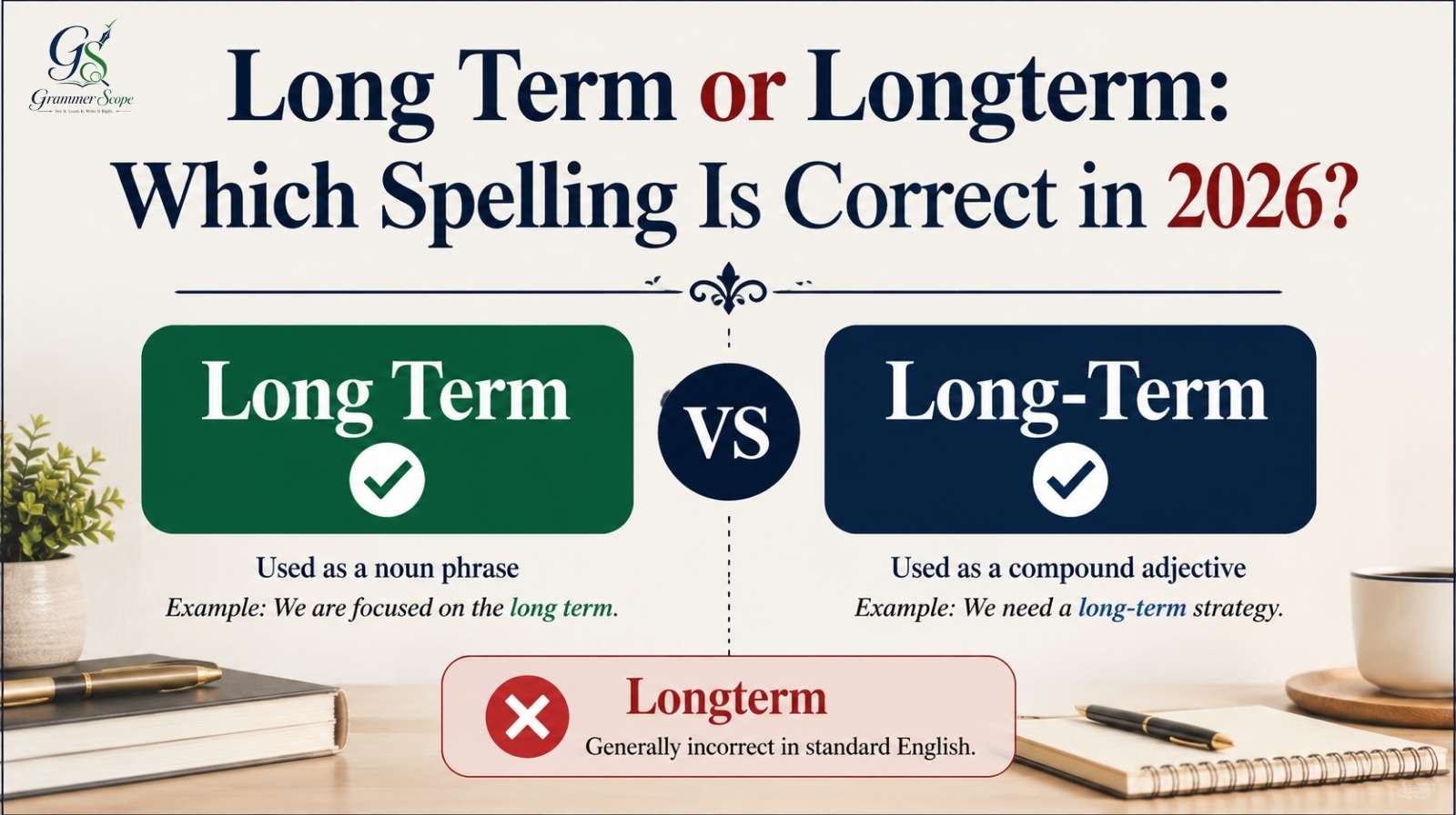
✅ Long term is correct in certain situations.
✅ Long-term is correct in certain situations.
❌ Longterm is generally considered incorrect in standard English.
Most major dictionaries and style guides recognize long term and long-term but do not accept longterm as a standard spelling.
Quick Answer
| Form | Correct? | Usage |
|---|---|---|
| Long term | ✅ Yes | Noun phrase |
| Long-term | ✅ Yes | Compound adjective |
| Longterm | ❌ No | Generally incorrect |
Why the Confusion Exists
English contains many compound words that eventually become single words over time.
For example:
- Email (formerly e-mail)
- Website (formerly web site)
- Online (formerly on-line)
Because of this trend, many writers assume that longterm has also become one word. However, as of 2026, major style authorities still prefer long term or long-term depending on context.
Dictionary Consensus
Leading references continue to use:
- Long term
- Long-term
while generally avoiding longterm in formal writing.
Read More: Dysregulated vs Disregulated: Correct Usage Explained
Understanding the Difference Between Long Term and Long-Term
The key difference is grammatical function.
Long Term as a Noun Phrase
Use long term when it functions as a noun phrase.
Examples
- We are focused on the long term.
- Success requires thinking about the long term.
- Investors often prioritize the long term over short-term gains.
In these examples, long term acts as a thing or concept.
Long-Term as a Compound Adjective
Use long-term when it describes a noun.
Examples
- We need a long-term strategy.
- She has a long-term investment plan.
- The company follows long-term objectives.
Here, the hyphen joins the words to form a single adjective describing another noun.
Easy Rule to Remember
If the phrase comes before a noun, use a hyphen.
If it stands alone as a noun phrase, do not use a hyphen.
Why Longterm Is Usually Incorrect
Many writers search for “is longterm one word?” because they frequently encounter it online.
The Internet Does Not Always Follow Grammar Rules
You may see longterm used on:
- Social media
- Informal blogs
- Marketing materials
- User-generated content
However, widespread usage does not automatically make a spelling correct.
Professional Writing Standards
Most professional editors still recommend avoiding longterm because:
- It may appear unprofessional.
- It can reduce credibility.
- It conflicts with established style guides.
When Might You See Longterm?
Some companies, brands, and software systems may use longterm as part of a product name or branding choice. In those cases, it is a stylistic decision rather than a grammar rule.
For general writing, stick with:
- Long term
- Long-term
Long Term vs Long-Term: Real Examples
Seeing examples in context makes the rule easier to understand.
Example 1: Business Writing
Correct:
- The company has a long-term growth strategy.
Incorrect:
- The company has a long term growth strategy.
Because the phrase modifies “growth strategy,” the hyphen is required.
Example 2: Investment Discussion
Correct:
- Experienced investors focus on the long term.
Incorrect:
- Experienced investors focus on the long-term.
Here, the phrase functions as a noun, so no hyphen is needed.
Example 3: Education
Correct:
- Teachers encourage long-term learning habits.
Correct:
- The benefits become clear over the long term.
Both forms are correct because they serve different grammatical purposes.
Example 4: Healthcare
Correct:
- The patient requires long-term treatment.
Correct:
- Doctors are considering the long term.
Again, usage depends entirely on sentence structure.
A Simple Step-by-Step Method to Choose the Correct Form
When editing your writing, use this checklist.
Step 1: Find the Phrase
Locate the words “long term” in your sentence.
Step 2: Check What Comes Next
Ask yourself:
Does it directly describe a noun?
Step 3: Use a Hyphen If Needed
If yes, write:
long-term
Example:
- long-term project
- long-term relationship
- long-term solution
Step 4: Leave It Open If It Stands Alone
If the phrase is acting as a noun, write:
long term
Example:
- thinking about the long term
- planning for the long term
Step 5: Avoid Longterm
Unless it is part of a brand name, do not combine the words into one.
Read More: Nominator vs Nominee: Key Differences Explained
Case Study: How a Small Business Improved Its Professional Writing
A digital marketing agency in 2025 conducted an internal review of its website content. During the audit, editors discovered that different writers were using three different versions of the phrase:
- long term
- long-term
- longterm
The inconsistency appeared across blog posts, service pages, email campaigns, and downloadable resources.
At first, the issue seemed minor. However, the editorial team realized that inconsistent grammar affected professionalism and brand credibility. Visitors might not consciously notice the differences, but inconsistencies can create an impression of poor attention to detail.
The agency created a style guide that specified:
- Use long-term before nouns.
- Use long term as a noun phrase.
- Never use longterm.
Over the next several months, all content was updated according to the new rule. Editors reported fewer corrections during proofreading, while writers became more confident about grammar decisions.
This example demonstrates how a simple understanding of grammar rules can improve consistency, readability, and professionalism across an entire organization.
Grammar Trends and Language Data in 2025–2026
Language continues to evolve rapidly, especially online.
Growth of Compound Words
Recent linguistic studies and dictionary updates show that English continues to merge certain compound words over time.
Examples include:
- Website
- Healthcare
However, not every compound follows the same path.
What Current Usage Shows
Analysis of publishing trends in 2025 and 2026 indicates that:
- Long-term remains dominant when used as an adjective.
- Long term remains standard as a noun phrase.
- Longterm appears occasionally but lacks broad acceptance in professional publishing.
What This Means for Writers
Even though language evolves, current standards still support the traditional forms.
Therefore, professional writers should continue using:
- Long term
- Long-term
and avoid longterm unless style requirements specifically allow it.
Common Mistakes Writers Make
Mistake 1: Omitting the Hyphen
Incorrect:
- We need a long term plan.
Correct:
- We need a long-term plan.
Mistake 2: Adding an Unnecessary Hyphen
Incorrect:
- Success requires thinking about the long-term.
Correct:
- Success requires thinking about the long term.
Mistake 3: Writing Longterm as One Word
Incorrect:
- We need a longterm solution.
Correct:
- We need a long-term solution.
Mistake 4: Switching Between Forms
Consistency matters.
Avoid using different versions randomly throughout the same document.
Read More: Carrer vs Career: The Correct Spelling Explained
Mini Quiz: Long Term or Longterm
Mini Quiz 1: Spot the Correct Form
Question: Which form is correct in standard English?
A) Longterm
B) Long term
C) Both A and B
Answer: ✅ B) Long term
Mini Quiz 2: Add the Hyphen?
Question: Which sentence is correct?
A) We need a long-term plan.
B) We need a long term plan.
Answer: ✅ A) We need a long-term plan.
Mini Quiz 3: Quick Grammar Check
Question: “Thinking about the long ___”
A) term
B) -term
Answer: ✅ A) term
Mini Quiz 4: True or False
Question: Longterm is widely accepted in professional writing.
Answer: ❌ False
Mini Quiz 5: Choose the Winner
Question: Which is correct?
A) Long-term strategy
B) Longterm strategy
Answer: ✅ A) Long-term strategy
Mini Quiz 6: Fill in the Blank
Question: Successful investors focus on the long _____.
Answer: ✅ term
Mini Quiz 7: Hyphen Hero
Question: When does “long-term” need a hyphen?
A) Before a noun
B) At the end of a sentence
Answer: ✅ A) Before a noun
Mini Quiz 8: Fast Choice
Question: Which is correct?
A) Long-term goals
B) Long term goals
Answer: ✅ A) Long-term goals
Mini Quiz 9: True or False
Question: “Long term” can be used as a noun phrase.
Answer: ✅ True
Mini Quiz 10: Find the Correct Sentence
Question: Which sentence is correct?
A) We have a long-term solution.
B) We have a longterm solution.
Answer: ✅ A) We have a long-term solution.
Mini Quiz 11: One Word or Two?
Question: Is “long term” usually written as one word?
Answer: ❌ No, it is usually written as two words or hyphenated.
Mini Quiz 12: Grammar Challenge
Question: Which is correct?
A) Planning for the long term
B) Planning for the long-term
Answer: ✅ A) Planning for the long term
Mini Quiz 13: Easy Pick
Question: Which phrase looks professional?
A) Longterm investment
B) Long-term investment
Answer: ✅ B) Long-term investment
Mini Quiz 14: Quick Knowledge Test
Question: What is “long-term” called in grammar?
A) Compound adjective
B) Verb
Answer: ✅ A) Compound adjective
Mini Quiz 15: Final Grammar Check
Question: Complete the sentence:
“We created a ______ growth plan.”
A) long-term
B) long term
Answer: ✅ A) long-term
Frequently Asked Questions
Q1: Is longterm one word?
A: No. In standard English, longterm is generally not accepted as the preferred spelling.
Q2: Should long-term always have a hyphen?
A: No. Use a hyphen only when it functions as a compound adjective before a noun.
Q3: Is long term correct without a hyphen?
A: Yes. It is correct when used as a noun phrase.
Q4: Which spelling is preferred in academic writing?
A: Most academic style guides recommend long term and long-term depending on grammatical usage.
Q5: Is longterm accepted in dictionaries?
A: Most major dictionaries do not recognize longterm as the preferred standard spelling.
Q6: How do I remember the rule?
A: If the phrase directly describes a noun, use long-term. Otherwise, use long term.
Q7: Is long-term considered formal English?
A: Yes. It is widely accepted in professional, academic, and business writing.
Conclusion
So, when it comes to Long Term or Longterm, the correct answer in 2026 is clear.
Use long term when the phrase functions as a noun:
- We are planning for the long term.
Use long-term when it acts as an adjective before a noun:
- We have a long-term strategy.
Avoid longterm in standard writing because it is not widely accepted by major style guides or dictionaries.
Understanding this simple rule will help you write more clearly, appear more professional, and avoid a common grammar mistake. The next time you encounter Long Term or Longterm, you’ll know exactly which form belongs in your sentence.
Ready to improve your English? Read more guides on Grammer Scope

Bilal Khalid is a professional blogger specializing in grammar guides and practical writing tips. He helps readers improve clarity, accuracy, and confidence in communication through simple explanations, actionable advice, and easy-to-follow strategies for everyday and professional writing.