Have you ever typed “seel” when you actually meant “seal”? You’re not alone. Many English learners and even native speakers accidentally misspell words that sound similar. Because spell check doesn’t always catch every mistake, it’s easy for this typo to slip into emails, assignments, blog posts, or social media.
The good news is that the answer is simple. Seal is the correct spelling in almost every modern English context, while seel is a rare historical word with a completely different meaning.
In this guide, you’ll discover the difference between seel and seal, learn when each word is appropriate, explore grammar rules, see real-life examples, and avoid one of the most common English spelling mistakes in 2026.
What Is the Correct Spelling: Seel or Seal?
The correct word in nearly all situations is seal.
Seal is a common English word used as both a noun and a verb.
For example:
- Please seal the envelope before mailing it.
- The company placed its official seal on the document.
- We watched a playful seal swimming near the beach.
- The jar has an airtight seal.
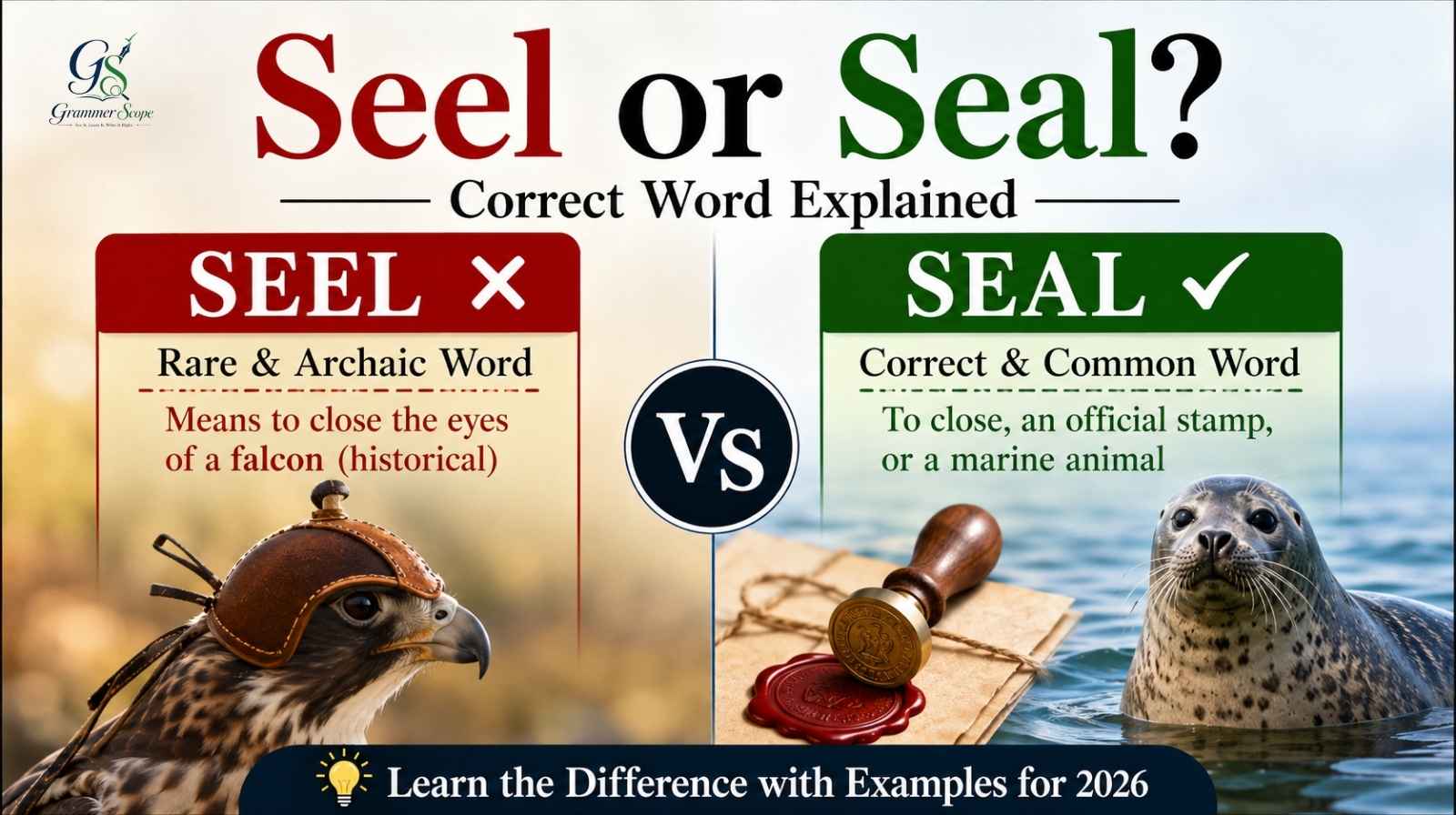
Meanwhile, seel is an old English word that very few people use today. Unless you’re reading historical literature or studying medieval language, you probably won’t encounter it.
Quick Answer
| Word | Correct? | Modern Usage |
|---|---|---|
| Seal | ✅ Yes | Everyday English |
| Seel | ❌ Rare | Historical or literary English only |
If you’re writing for school, work, business, or online content, seal is almost certainly the word you need.
Read More: Amount or Ammount: Which Spelling Is Correct? (2026)
Understanding the Meaning of “Seal”
The word seal has several meanings depending on the context.
Seal as a Verb
As a verb, seal means to close something tightly so that air, water, or other substances cannot enter or escape.
Examples:
- Seal the package carefully.
- Workers sealed the cracks in the wall.
- Make sure the container is sealed properly.
Seal as a Noun
Seal can also refer to an official stamp, mark, or emblem.
Examples:
- The certificate carries the university’s official seal.
- The king’s seal confirmed the agreement.
Seal as an Animal
A seal is also a marine mammal that lives in oceans and coastal waters.
Examples:
- The children enjoyed watching the seals at the aquarium.
- Harbor seals are excellent swimmers.
What Does “Seel” Mean?
Unlike seal, seel is an uncommon word found mainly in historical texts.
Traditionally, seel meant:
To close the eyes of a hawk or falcon by sewing the eyelids together during falconry training.
Although this practice existed centuries ago, the word has almost disappeared from modern English.
Why You Rarely See “Seel”
Several reasons explain its rarity:
- It belongs to historical falconry terminology.
- It is considered obsolete in everyday writing.
- Modern dictionaries often label it as archaic.
- Most people have never used it in conversation.
Unless you’re reading Shakespeare, historical documents, or books about medieval hunting, you won’t need this word.
Read More: Tacet or Tacit: What’s The Difference And Which One Should You Use?
Seel vs Seal: Key Differences
| Feature | Seal | Seel |
|---|---|---|
| Modern English | ✅ Yes | Rare |
| Everyday Use | Yes | No |
| Dictionary Status | Common | Archaic |
| Used in Business | Yes | No |
| Used in School Writing | Yes | No |
| Appears in Daily Conversation | Frequently | Almost Never |
The Easy Rule to Remember
If you’re talking about:
- closing something
- an official stamp
- a marine animal
- waterproofing
- protecting something
Always use seal.
Common Situations Where People Misspell Seal
Many people type seel simply because English pronunciation can be misleading.
Here are common situations where the mistake happens.
Fast Typing
People often swap letters accidentally while typing.
Incorrect:
Please seel the box.
Correct:
Please seal the box.
Autocorrect Doesn’t Catch It
Since seel is technically a real word, some spell checkers don’t automatically replace it.
That’s why proofreading remains important.
Pronunciation Confusion
Both words sound almost identical in many accents.
English contains many homophones and near-homophones that create similar spelling mistakes.
Read More: Dysregulated vs Disregulated: Correct Usage Explained
Grammar Rule: Why “Seal” Is Correct
English spelling often follows historical development rather than pronunciation.
The word seal comes from Old French and Latin roots associated with stamping, closing, and authentication.
Today, dictionaries universally recognize seal for everyday communication.
Meanwhile, seel survived only in specialized historical vocabulary.
Memory Trick
Think:
SEAL lives in the SEA.
The shared letters “SEA” make it easier to remember the correct spelling.
Real-Life Case Study: A Small Typo That Changed the Meaning
Sarah, a university student, was submitting an assignment about environmental conservation. In one paragraph, she wrote:
“Factories should seel chemical containers properly.”
Her professor circled the word and commented that although seel exists historically, it was completely incorrect in this context.
Sarah assumed spell check would catch the mistake, but because seel is listed in some dictionaries as an archaic word, her writing software accepted it without warning.
After researching the difference, she realized that seal means to close or secure something, while seel refers to an outdated falconry practice that has nothing to do with containers or packaging.
She corrected every occurrence before publishing the final version.
This small experience highlights an important lesson: not every correctly spelled word is the right word. Context matters just as much as spelling. Whether you’re writing academic papers, business emails, or blog articles, choosing the correct word improves professionalism and prevents confusion. A quick proofread and dictionary check can save you from embarrassing mistakes that automated tools sometimes overlook.
Read More: Nominator vs Nominee: Key Differences Explained
Usage Examples in Everyday English
Business
- Please seal the contract before sending it.
- The lawyer verified the official seal.
Home
- Seal the food container tightly.
- Check whether the bottle seal is broken.
School
- The teacher asked students to seal their envelopes.
- The science project required an airtight seal.
Nature
- We photographed several seals resting on the rocks.
- Baby seals depend on their mothers for protection.
Data & Statistics (2025–2026)
Recent search behavior shows that spelling confusion remains one of the most common grammar-related topics online.
According to search trend data and major language platforms during 2025–2026:
- Google continues to process millions of spelling-correction queries every month.
- Commonly confused words remain among the most searched grammar topics.
- Mobile typing errors account for a significant share of spelling mistakes due to predictive keyboards.
- Educational websites have reported continued growth in searches related to English spelling, grammar, and commonly confused words as learners increasingly rely on online resources. These trends highlight the importance of understanding correct spelling rather than relying solely on autocorrect.
These trends demonstrate that even simple spelling differences like seel vs seal continue to confuse writers worldwide.
Read More: Carrer vs Career: The Correct Spelling Explained
Common Mistakes to Avoid
Here are the most common mistakes:
Mistake 1
❌ Please seel the package.
✅ Please seal the package.
Mistake 2
❌ The official seel was missing.
✅ The official seal was missing.
Mistake 3
❌ We visited the seel exhibit.
✅ We visited the seal exhibit.
Tips to Always Remember the Correct Spelling
Here are a few easy tricks to avoid confusing the two words:
Remember the Ocean Trick
SEA + L = SEAL
Since seals live in the sea, remembering “SEA” helps reinforce the correct spelling.
Think About Closing
Whenever you think about closing, protecting, or stamping something, use seal.
Proofread Carefully
Don’t rely completely on spell check because some programs recognize seel as an archaic English word.
Read More: Vendor or Vender: Which Is Correct In 2026?
Mini Quiz: Seel or Seal
Quiz 1: Which Word Is Correct?
Which spelling is correct in modern English?
A) Seel
B) Seal
✅ Answer: B) Seal
Quiz 2: Fill in the Blank
Please ______ the envelope before mailing it.
✅ Answer: Seal
Quiz 3: True or False
The word “seel” is commonly used in everyday English.
✅ Answer: False
Quiz 4: What Does “Seal” Mean?
Which of these is NOT a meaning of seal?
A) To close something tightly
B) A marine animal
C) An official stamp
D) A type of bird
✅ Answer: D) A type of bird
Quiz 5: Fill in the Blank
The company placed its official ______ on the certificate.
✅ Answer: Seal
Quiz 6: Spot the Correct Sentence
Which sentence is correct?
A) Please seel the package carefully.
B) Please seal the package carefully.
✅ Answer: B) Please seal the package carefully.
Quiz 7: Quick Choice
Which word is considered archaic (old-fashioned)?
A) Seal
B) Seel
✅ Answer: B) Seel
Quiz 8: Fill in the Blank
We saw a playful ______ swimming near the shore.
✅ Answer: Seal
Quiz 9: True or False
“Seal” can be used as both a noun and a verb.
✅ Answer: True
Quiz 10: Which One Fits?
You want to close a food container tightly. Which word should you use?
A) Seel
B) Seal
✅ Answer: B) Seal
Quiz 11: Fill in the Blank
The rare word ______ was historically used in falconry.
✅ Answer: Seel
Quiz 12: Final Challenge
Complete the sentence with the correct word:
“Always ______ important documents before sending them.”
✅ Answer: Seal
References
For further reading and authoritative definitions, consult these trusted sources:
Frequently Asked Questions
Q1: Is “seel” a real English word?
A: Yes. However, it is an obsolete word mainly associated with historical falconry and is almost never used today.
Q2: Is “seal” always the correct spelling?
A: For modern English writing, yes. Whether referring to an animal, an official stamp, or closing something securely, seal is the correct choice.
Q3: Why doesn’t spell check always correct “seel”?
A: Because seel exists in historical dictionaries, some spelling tools recognize it as a valid though archaic word.
Q4: Which word should students use?
A: Students should almost always use seal unless discussing historical falconry or analyzing old literature.
Q5: Can “seal” be both a noun and a verb?
A: Yes. It functions as both:
- Noun: an official seal or marine animal
- Verb: to close securely
Q6: Is “seel” acceptable in formal writing?
A: Only if you’re intentionally discussing its historical meaning. Otherwise, use seal.
Conclusion
When comparing seel or seal, the correct choice for modern English is almost always seal. It refers to closing something securely, an official stamp, or the marine mammal everyone recognizes. Although seel is technically a real word, it belongs to historical English and is rarely appropriate today.
Whenever you’re unsure, remember the simple trick:
Seals live in the SEA, so the correct spelling is SEAL.
Using the right spelling makes your writing clearer, more professional, and easier for readers to understand. The next time you see seel, you’ll know exactly why seal is the correct word in nearly every situation.
Discover More Articles
- Challenge or Challange: Which Is Correct? (2026 Guide)
- Hustle or Hussle: Which Spelling Is Correct?
- Pre vs Post: Correct Usage & Meaning Guide 2026
Ready to improve your English? Read more guides on Grammer Scope