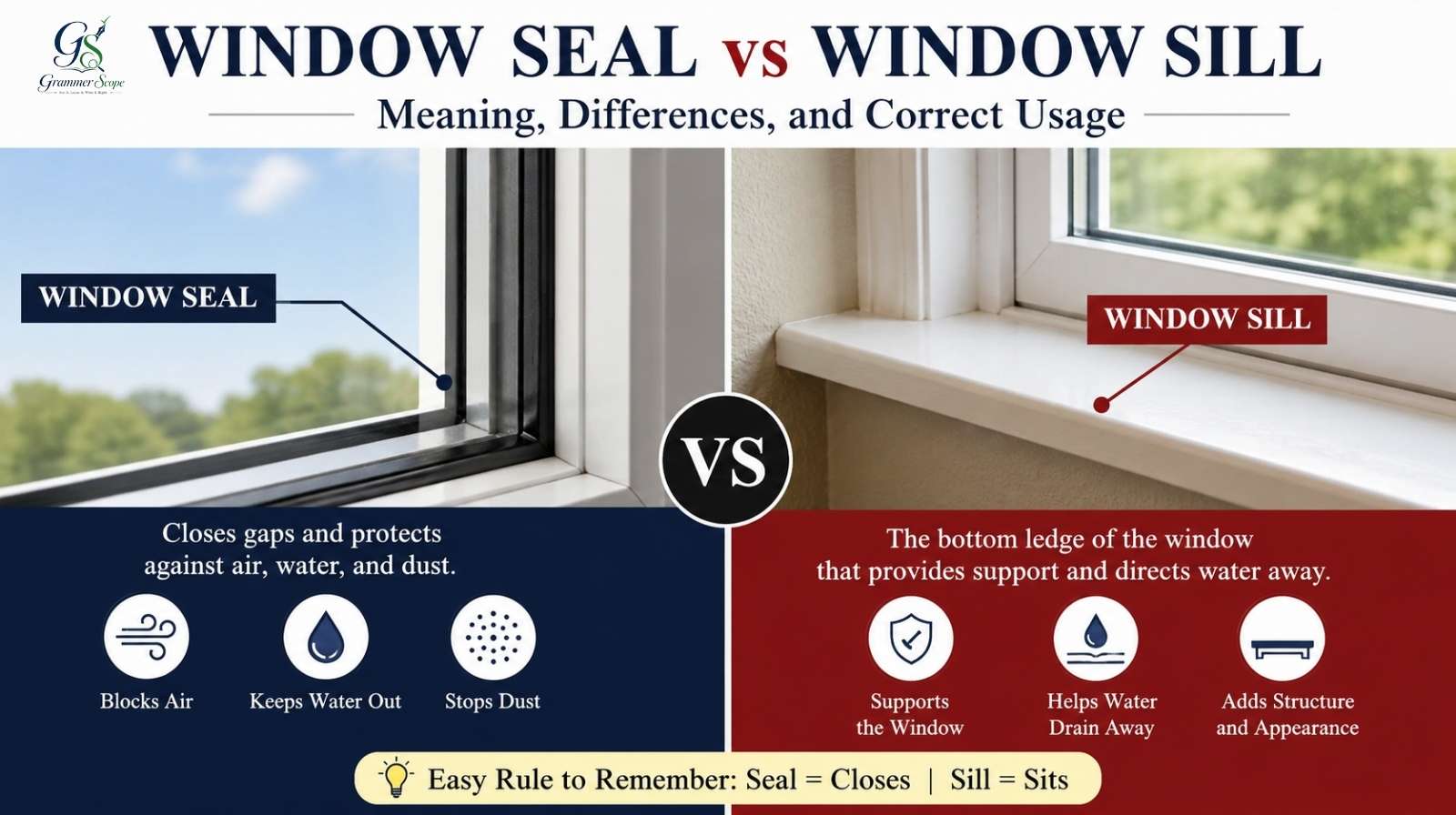
If you have ever noticed a draft, water near your window, or a damaged ledge, you may have wondered whether the problem involves the window seal vs window sill. The two terms sound similar, and because both relate to the same window, they are often confused.
However, a window seal and a window sill are not the same thing.
A window seal helps close gaps and protect the window from unwanted air and moisture. A window sill, on the other hand, is the horizontal part at the bottom of a window opening. Using the wrong term can create confusion when describing a repair, searching for replacement parts, or speaking with a contractor.
This guide explains the meaning, differences, correct usage, and common problems associated with both terms. You will also see real examples, an easy comparison table, practical identification tips, and answers to common questions.
What Is the Difference Between a Window Seal and a Window Sill?
The easiest answer is this:
A window seal is used to close and protect gaps, while a window sill is the horizontal base or ledge at the bottom of a window.
Merriam-Webster defines a sill as a horizontal member forming the base of a window, while windowsill specifically refers to the horizontal member at the bottom of a window opening.
In simple terms:
- Seal = closes and protects
- Sill = sits at the bottom
For example:
- “The window seal is damaged, so cold air is getting inside.”
- “There is water sitting on the window sill.”
- “The contractor checked the seal around the window.”
- “She placed a plant on the window sill.”
The confusion is understandable because the words seal and sill sound somewhat alike in everyday speech. However, they describe different components and should not be used interchangeably.
Window Seal vs Window Sill: Quick Comparison
| Feature | Window Seal | Window Sill |
|---|---|---|
| Main purpose | Closes gaps and helps block air and moisture | Forms the bottom base or ledge of a window |
| Typical location | Around window glass, frame, or window components | At the bottom of the window opening |
| Main role | Protection and insulation | Support, structure, and water management |
| Usually visible | Often partly hidden | Usually visible |
| Common problems | Drafts, leaks, condensation, failed glazing | Cracks, rot, water damage, peeling paint |
| Example | “The seal around the glass failed.” | “The plant is on the window sill.” |
The key point is that a seal protects by closing, whereas a sill is a physical structural or finishing component at the bottom of the window.
The Simple Memory Trick
A useful way to remember the difference is:
S-E-A-L = Seals something shut.
S-I-L-L = Sits below the window.
Think about placing a cup or a small plant on a window sill. You can physically see and touch the sill. A seal, by contrast, is associated with closing gaps or maintaining a barrier.
This simple distinction makes the correct usage much easier.
What Is a Window Seal?
A window seal is a sealing system or material that helps prevent unwanted air, moisture, and other outside elements from passing through gaps in a window assembly.
The exact meaning can vary slightly depending on the type of window and the context. For example, someone may use “window seal” to refer to the seal around the glass, weatherstripping around an opening section, sealant between building materials, or the seals within an insulated glass unit.
The important idea remains the same: the seal helps create a barrier.
What Does a Window Seal Do?
A properly functioning window seal can help:
- Reduce unwanted air movement
- Limit water intrusion
- Support thermal performance
- Protect parts of the window assembly
- Keep insulating components functioning as intended
- Reduce the risk of drafts around the window
For example, imagine a cold, windy day. If air is entering through a gap around the window, the issue may involve a failed or incomplete sealing component.
Likewise, if moisture appears between panes of insulated glass, the problem may involve the seal system that maintains the insulated glass unit.
That does not mean every window problem is automatically a “broken window seal.” Accurate diagnosis matters because several different components can cause drafts, condensation, or leaks.
Common Types of Window Sealing Components
The phrase “window seal” can describe more than one type of sealing element.
Glazing Seal:
A glazing seal helps secure and seal the area where glass meets the sash or frame.
Its job may include helping keep water away from vulnerable areas and maintaining a weather-resistant connection around the glass.
For example:
“The technician inspected the glazing seal around the edge of the pane.”
Insulated Glass Unit Seal:
Modern double- or triple-pane windows often contain an insulated glass unit, commonly called an IGU. The glass panes are separated and sealed as part of the unit. If this seal system fails, moisture may enter the space between the panes. A common sign can be persistent fogging or condensation between the glass layers.
For example:
“The fog between the panes may indicate a failed insulated glass seal.”
Weatherstripping or Air-Sealing Components:
Opening windows may also contain weatherstripping and similar materials designed to reduce air leakage when the window is closed.
For example:
“The weatherstripping seal around the sash has become worn.”
These examples show why context matters. “Window seal” is a functional term associated with closing, separating, and protecting gaps or interfaces.
Read More: Persue or Pursue? Learn The Correct Spelling of Pursue
What Is a Window Sill?
A window sill is the horizontal member or ledge located at the bottom of a window opening.
Merriam-Webster describes a windowsill as “the horizontal member at the bottom of a window opening.”
This is usually the part people immediately recognize because it is visible.
An interior window sill may provide a flat surface where people place:
- Small plants
- Books
- Decorations
- Photographs
- Other lightweight items
An exterior sill, depending on the design, can also play an important role in directing water away from the wall and supporting the overall window installation.
Where Is the Window Sill Located?
Look at the bottom edge of a window.
The horizontal base or ledge you see there is generally the window sill.
For example:
“Dust collected along the window sill.”
“The painter repaired the damaged wooden window sill.”
“Rainwater was not draining properly from the exterior sill.”
The sill is therefore a physical part of the window opening, not a material designed primarily to close a gap.
What Does a Window Sill Do?
The exact design depends on the building and window system, but a sill may serve several functions.
It can:
- Form the lower part of the window opening
- Support or integrate with the window structure
- Provide a finished surface
- Help manage water on exterior installations
- Protect adjacent wall materials
- Provide a practical ledge on interior windows
Because a sill is exposed and often visible, damage can usually be easier to spot than damage to a hidden seal.
Common Window Sill Problems
A damaged window sill may show signs such as:
- Cracks
- Peeling paint
- Soft or rotting wood
- Water stains
- Mold or mildew nearby
- Deteriorated caulking at nearby joints
- Visible gaps
- Surface warping
However, the presence of water near a sill does not automatically mean the sill itself caused the problem. Water can enter from damaged flashing, failed sealant, cracks, roofing issues, wall defects, or other parts of the window system.
Therefore, it is important to identify the source before ordering a replacement sill or paying for repairs.

Window Seal vs Window Sill: The Main Differences Explained
Understanding the window seal vs window sill distinction becomes easier when you focus on purpose, position, and function.
A Seal Is About Closing
The word seal is connected with making something closed, tight, or protected against passage through an opening.
In window terminology, this usually means a component designed to help prevent air or water from passing through a joint or gap.
For example:
“The window seal needs repair because water is entering around the glass.”
The emphasis is on the barrier.
A Sill Is About Position and Structure
The word sill refers to a horizontal member at the base of a window.
For example:
“The cat jumped onto the window sill.”
Here, “seal” would make no sense. The cat is sitting on a physical ledge, so sill is the correct word.
They Can Both Affect Water Problems
This is one reason people confuse them.
A damaged seal can allow water or air to enter through an opening.
A damaged sill can also contribute to moisture problems if its condition, design, drainage, or connection with surrounding materials is compromised.
However, they fail in different ways.
A seal problem might involve:
- Drafts
- Air leakage
- Water penetration through a joint
- Fogging between insulated glass panes
A sill problem might involve:
- Rotting wood
- Cracks
- Surface deterioration
- Improper drainage
- Water staining below the window
Therefore, saying “my window has a seal problem” is different from saying “my window sill is damaged.”
Read More: Totalling vs Totaling: Which Spelling Is Correct?

How to Tell Whether You Mean Window Seal or Window Sill
When you are unsure which word to use, ask yourself one simple question:
Am I talking about something that closes a gap, or am I talking about the bottom ledge of the window?
If it closes or protects a gap, use seal.
If it is the bottom horizontal ledge or base, use sill.
Use “Window Seal” When Talking About Protection
Use window seal in situations involving:
- Air leaks
- Sealing around glass
- Moisture entering through joints
- Failed insulated glass seals
- Worn sealing materials
- Weather protection
Examples:
- “There is a gap in the window seal.”
- “The seal around the glass needs inspection.”
- “A failed seal may allow moisture between the panes.”
Use “Window Sill” When Talking About the Bottom Ledge
Use window sill when discussing:
- The horizontal bottom part of the window
- Cleaning the ledge
- Placing an object on the ledge
- Rotting wood below the window
- Cracks in the lower window base
Examples:
- “Please clean the window sill.”
- “The wooden window sill needs repainting.”
- “She placed flowers on the window sill.”
A Fast Identification Checklist
Ask these questions:
- Is it located around a gap or joint? → Probably a seal
- Is it the horizontal part at the bottom? → A sill
- Is the problem fog between glass panes? → Possibly a seal-related issue
- Is the visible bottom ledge cracked or rotting? → A sill-related issue
- Can you place an object directly on it? → Usually a sill
- Is its main purpose to create a barrier? → Usually a seal
This checklist is especially useful when searching online for repair information.
Read More: In-Person vs In Person: What’s The Difference?
Why the Correct Term Matters in Repairs and Home Maintenance
At first, the difference may seem like a minor vocabulary issue. However, correct terminology can make communication much clearer.
Imagine calling a contractor and saying:
“My window sill is broken, and there is fog between the panes.”
The contractor may immediately understand that you could be describing two separate issues: a damaged sill and a possible insulated glass seal problem.
Now imagine saying:
“My window seal is broken because the bottom ledge is rotting.”
This description may be unclear because “bottom ledge” points toward the sill, while “seal” refers to something different.
Correct terminology helps when:
- Searching for replacement parts
- Reading repair instructions
- Talking to contractors
- Comparing repair quotes
- Ordering materials
- Describing damage to an insurer or property manager
- Writing home maintenance notes
In short, using the right word can help you describe the actual problem rather than simply naming the general area.
Real-Life Example: Diagnosing a Confusing Window Problem
Consider a homeowner named Daniel who notices two problems in his bedroom. During winter, he feels cold air near the window. A few weeks later, he also sees dark stains and peeling paint on the wooden ledge below it.
Daniel searches online for “broken window sill” because the visible damage is on the bottom ledge. He initially assumes that replacing the sill will solve everything.
During a closer inspection, however, the situation appears more complicated. The wooden sill has absorbed moisture and deteriorated, but the source of the moisture may not be the sill alone. There is also deteriorated sealing material around part of the window assembly. In addition, one area where exterior water should be directed away needs professional assessment.
Daniel learns an important lesson: the sill is the damaged bottom component he can see, while the sealing system is related to how gaps and joints are protected from air and moisture.
Replacing only the sill without identifying the water source could allow the same damage to happen again. On the other hand, repairing a seal without addressing already deteriorated wood might leave a separate problem unresolved.
The correct approach is to identify each component accurately and diagnose the underlying cause before making repairs. This is exactly why understanding window seal vs window sill matters in real home maintenance.
Window Seal and Window Sill Problems: Signs You Should Not Ignore
Knowing the difference also helps you recognize which type of issue may be developing.
Signs of a Possible Window Seal Problem
Depending on the type of seal involved, watch for:
- Drafts around the window
- Water entering through a joint
- Worn or cracked sealing material
- Persistent fog between panes
- Condensation trapped between insulated glass layers
- Increased discomfort near a closed window
These signs do not prove the cause on their own. A draft, for example, can come from several locations.
Therefore, if the problem is persistent or involves significant moisture, a proper inspection is better than guessing.
Signs of a Possible Window Sill Problem
Look for:
- Soft wood
- Rot
- Cracking
- Peeling or blistering paint
- Water stains
- Warping
- Visible deterioration
- Mold growth near persistently damp areas
Again, the sill may show the result of a moisture problem rather than being the original cause.
That distinction is crucial.
A damaged sill tells you that something needs attention. It does not automatically tell you where the water started.
Read More: Gage or Gauge: What’s The Difference? Explained Simply
Window and Housing Data: Why Maintenance Still Matters in 2025–2026
Current housing data reinforces the importance of paying attention to the condition of homes and their components. The U.S. Census Bureau’s American Housing Survey is designed to provide current information about housing quality, maintenance, costs, and physical conditions. The survey moved toward a new sample and a more continuous collection approach, with the goal of producing more up-to-date national and metropolitan housing estimates.
The Census Bureau’s housing resources also continue to publish data and analysis on household conditions. For example, its 2023 American Housing Survey findings, still referenced in 2025–2026 housing reporting, found that 13.2 million households were uncomfortably hot for 24 hours or more in 2023. While that figure does not measure window seal failure specifically, it shows why building performance, cooling, insulation, and home maintenance remain significant housing concerns.
What This Means for Homeowners
The lesson is not that every comfort problem comes from a window seal or sill.
Instead, it is that homes are systems. Windows, insulation, ventilation, walls, roofing, and HVAC equipment can all influence comfort and moisture management.
For example:
- A draft may involve weatherstripping or another air-leak path.
- Fog between panes may point toward an insulated glass issue.
- A rotting sill may indicate prolonged moisture exposure.
- Condensation can have multiple causes involving humidity, surface temperature, ventilation, or window performance.
Therefore, accurate language is the first step, but accurate diagnosis is equally important.
Common Mistakes People Make With Window Seal and Window Sill

Mistake 1: Calling the Bottom Ledge a Seal
The horizontal ledge at the bottom of a window is the sill, not the seal.
Correct:
“The window sill is cracked.”
Incorrect if referring to the ledge:
“The window seal is cracked.”
Mistake 2: Calling Every Leak a Sill Problem
Water near the bottom of a window does not automatically mean the sill is defective.
The water could originate from another part of the window or surrounding wall.
Before replacing a sill, identify where the moisture is entering.
Mistake 3: Assuming Every Seal Problem Looks the Same
“Window seal failure” can describe different issues depending on the window construction.
For example, a failed insulated glass seal is different from damaged exterior sealant or worn weatherstripping.
Always describe what you observe:
- “There is fog between the panes.”
- “Air enters when the window is closed.”
- “The sealant around the exterior frame is cracked.”
Clear observations make diagnosis easier.
Mistake 4: Ignoring Small Damage
Small cracks, peeling paint, and deteriorating sealing materials can become more serious if moisture continues reaching vulnerable surfaces.
Early inspection may prevent a relatively small maintenance issue from becoming a larger repair.
Read More: Defence or Defense: Which Spelling Is Correct?
How to Use “Window Seal” and “Window Sill” Correctly in a Sentence
Here are practical examples.
Correct Examples With “Window Seal”
- The technician inspected the window seal around the glass.
- A damaged window seal may allow air or moisture to pass through a gap.
- The fog between the panes could indicate a problem with the insulated glass seal.
- We replaced worn sealing material to improve the window’s weather resistance.
Correct Examples With “Window Sill”
- I cleaned dust from the window sill.
- The flowers are sitting on the window sill.
- Water damaged the wooden window sill.
- The contractor repaired the cracked exterior window sill.
Example Showing Both Terms Together
“The window seal around the frame needs inspection, while the window sill at the bottom shows visible water damage.”
This sentence clearly distinguishes the two components.
Is It “Windowsill” or “Window Sill”?
Both windowsill and window sill are commonly understood.
Merriam-Webster lists windowsill as a noun referring to the horizontal member at the bottom of a window opening.
In general writing, window sill is also widely used as two words, particularly when emphasizing the combination of “window” and “sill.”
For SEO and everyday readability, the two-word form window sill is especially clear because it helps readers immediately understand that you are discussing a sill associated with a window.
The most important distinction for this article, however, is not spacing. It is knowing that sill and seal have completely different meanings.
Read More: Cocoon or Cacoon? Which Spelling Is Correct? (Complete Grammar Guide)
Expert Tips for Remembering the Difference

Think “Seal = Stop”
A seal helps stop unwanted movement through a gap.
Think:
Seal the gap.
This connects the word to its function.
Think “Sill = Shelf”
A window sill often looks and functions like a small ledge or shelf.
Think:
Sill = the shelf-like bottom of the window.
Focus on the Location
If you point to the bottom horizontal member, say sill.
If you point to material that closes a joint or gap, say seal.
Describe the Problem Before Naming the Part
When you are unsure, describe what happened first.
For example:
- “There is fog between the panes.”
- “Cold air enters near the frame.”
- “The bottom wooden ledge is soft.”
- “Rainwater is collecting below the window.”
This can prevent you from using the wrong technical term before the actual cause is known.
Read More: Recurring vs Reoccurring: The Complete Guide To Correct Usage
Mini Quiz: Window Seal vs Window Sill
Quiz 1: Pick the Right Word
Which word refers to the horizontal ledge at the bottom of a window?
A. Window seal
B. Window sill
C. Window frame
Answer: B. Window sill — The sill is the horizontal bottom ledge of a window.
Quiz 2: Fill in the Blank
A window ______ helps close gaps and protect against unwanted air and moisture.
Answer: Seal — A window seal is designed to help create a protective barrier.
Quiz 3: What’s Sitting There?
You place a small plant at the bottom ledge of your bedroom window. Where is the plant?
A. On the window seal
B. On the window sill
C. Inside the window glass
Answer: B. On the window sill — A window sill is the ledge where small items can sit.
Quiz 4: Fill in the Blank
The wooden ______ below the window is cracked and needs repair.
Answer: Sill — The visible bottom part or ledge is called the window sill.
Quiz 5: Stop That Draft!
Cold air is entering through a gap around a closed window. Which part is more likely related to closing that gap?
A. Window seal
B. Window sill
C. Window ledge
Answer: A. Window seal — A seal helps close gaps and reduce unwanted air movement.
Quiz 6: Seal or Sill?
Choose the correct sentence:
A. “I put my books on the window seal.”
B. “I put my books on the window sill.”
C. “I put my books in the window seal.”
Answer: B. “I put my books on the window sill.” — Books can sit on the horizontal window ledge, which is the sill.
Quiz 7: Fill in the Blank
Think of it this way: Seal = ______ gaps.
Answer: Closes — A seal is connected with closing and protecting gaps.
Quiz 8: The Foggy Window Clue
You notice persistent fog between the panes of a double-pane window. Which issue could this suggest?
A. A possible insulated glass seal problem
B. A dusty window sill
C. A missing curtain rod
Answer: A. A possible insulated glass seal problem — Fog between panes can indicate a problem with the insulated glass seal system.
Quiz 9: Spot the Correct Term
Which sentence uses window seal correctly?
A. “The cat slept on the window seal.”
B. “The plant is growing on the window seal.”
C. “The damaged window seal may allow air through a gap.”
Answer: C. “The damaged window seal may allow air through a gap.” — A seal is associated with closing and protecting gaps.
Quiz 10: Fill in the Blank
The cat jumped onto the window ______ to watch the birds outside.
Answer: Sill — The window sill is the bottom ledge where the cat can sit.
Quiz 11: What Does It Do?
What is the main difference between a window seal and a window sill?
A. A seal closes gaps, while a sill is the bottom ledge
B. A seal is the bottom ledge, while a sill closes gaps
C. They are exactly the same thing
Answer: A. A seal closes gaps, while a sill is the bottom ledge — This is the easiest way to remember the difference.
Quiz 12: Fill in the Blank
If the bottom wooden ledge is soft or rotting, you may have a problem with the window ______.
Answer: Sill — A sill, especially a wooden one, can deteriorate after long-term moisture exposure.
Quiz 13: Can You Identify the Problem?
Rainwater is collecting near a damaged bottom window ledge. Which part is visibly damaged?
A. Window seal
B. Window sill
C. Window pane
Answer: B. Window sill — The bottom ledge is the sill. However, the actual source of the water should still be identified.
Quiz 14: True Meaning Challenge
Which statement is correct?
A. Every water problem near a window means the sill caused the leak.
B. A damaged sill always means the window seal has failed.
C. Water near a sill can come from different parts of the window system.
Answer: C. Water near a sill can come from different parts of the window system. — The sill may show water damage without being the original source of the leak.
Quiz 15: Final Fill in the Blank
Complete this easy memory trick:
Window ______ = closes and protects
Window ______ = sits at the bottom
Answer: Seal; Sill — Seal = closes and protects. Sill = the horizontal bottom ledge. Easy, right?
References
For further reading and authoritative definitions, consult these trusted sources:
Frequently Asked Questions
Q1: What is the difference between a window seal and a window sill?
A: A window seal helps close gaps and protect the window from unwanted air and moisture. A window sill is the horizontal member or ledge at the bottom of a window opening. In short, a seal protects by closing, while a sill forms the bottom part of the window.
Q2: Is the bottom of a window called a seal or a sill?
A: The visible horizontal bottom part of a window is called the window sill.
If you are talking about a component that closes gaps around the glass or frame, the correct term is seal.
Q3: What does a window seal do?
A: A window seal helps create a barrier against unwanted air and moisture. Depending on the window design, it may refer to glazing seals, insulated glass seals, weatherstripping, or other sealing components.
Q4: What happens when a window seal fails?
A: The symptoms depend on which seal has failed. Possible signs include drafts, moisture intrusion, or fogging between panes in an insulated glass unit. A professional inspection may be necessary to identify the exact component causing the issue.
Q5: Can a damaged window sill cause water problems?
A: Yes, a damaged sill can be associated with water problems. However, the sill is not always the original source of the leak. Water may come from other parts of the window or surrounding building materials, so identifying the source is important before making repairs.
Q6: Is “windowsill” one word?
A: Yes. Windowsill is a recognized dictionary word for the horizontal member at the bottom of a window opening. Window sill is also commonly used in everyday writing and construction-related contexts.
Q7: Why do people confuse window seal and window sill?
A: The words sound similar and both relate to windows. However, their meanings are different. A seal is associated with closing and protecting a gap, while a sill is the horizontal base or ledge at the bottom of a window.
Conclusion
When comparing window seal vs window sill, the correct term depends entirely on what you mean.
Use window seal when discussing a component or material that helps close gaps and protect against unwanted air or moisture.
Use window sill when discussing the horizontal base or ledge at the bottom of a window.
The easiest way to remember the difference is:
Seal = closes and protects.
Sill = sits at the bottom.
Knowing this distinction can improve your everyday English, make home-maintenance conversations clearer, and help you search for the right repair information. If you are dealing with a draft, leak, foggy glass, or visible damage, describe the exact symptoms and identify the correct component before deciding on a repair.
Now that you know the difference between a window seal and a window sill, use the correct term with confidence and explore more clear, practical grammar and word-meaning guides to sharpen your everyday English.
Discover More Article
- It’s Called vs It Called: Understanding The Distinction
- Appreciate It or Appreciated It? The Ultimate Guide To Choosing The Right Phrase
- Accomodation vs Accommodation: What’s The Correct Spelling?
Ready to improve your English? Read more guides on Grammer Scope

Bilal Khalid is a professional blogger specializing in grammar guides and practical writing tips. He helps readers improve clarity, accuracy, and confidence in communication through simple explanations, actionable advice, and easy-to-follow strategies for everyday and professional writing.