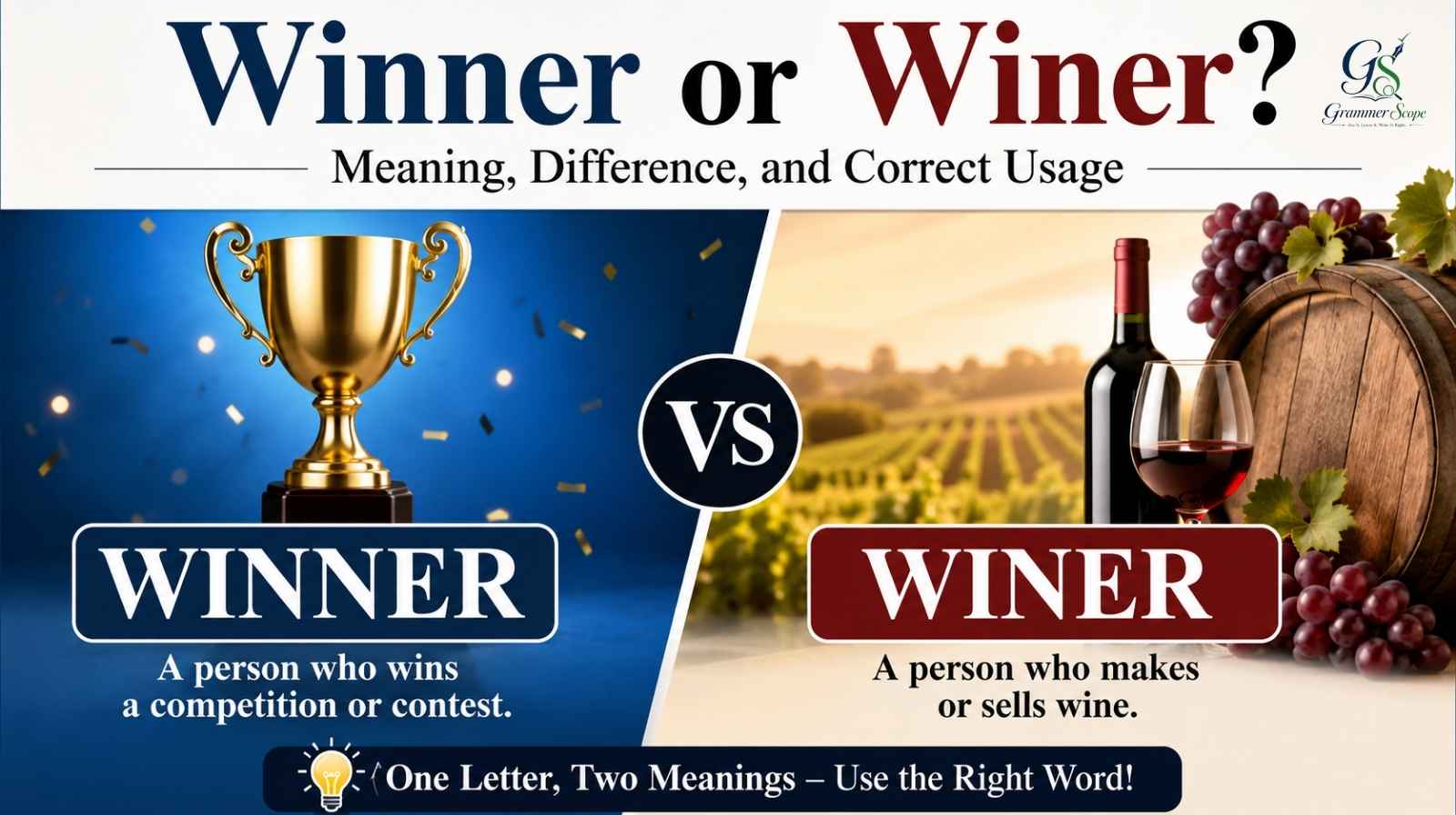
Have you ever typed winer when you actually meant winner? You’re not alone. This spelling mistake appears in emails, social media posts, school assignments, and even business documents. Since the two words differ by only one letter, it’s easy to confuse them. However, they have completely different meanings.
If you’re unsure which word is correct, this guide will clear up the confusion. You’ll learn the meaning of both words, when to use each one, common grammar mistakes, pronunciation tips, and practical examples. By the end, you’ll never hesitate between winner and winer again.
Winner or Winer: What’s the Difference?
The simplest way to remember the difference is this:
| Word | Meaning | Correct Usage |
|---|---|---|
| Winner | A person or thing that wins a competition, contest, or award | ✅ Very common |
| Winer | A person who produces or sells wine (rarely used) | ✅ Correct but uncommon |
If you’re talking about someone who wins a race, competition, lottery, election, or award, winner is always the correct word.
If you’re referring to someone involved in making or selling wine, winer can technically be correct, although winemaker is much more common in modern English.
Why People Confuse Winner and Winer
Several factors contribute to this common spelling mistake:
- Both words sound similar.
- Spell check may not flag winer because it is a real word.
- Many learners assume removing one “n” doesn’t change the meaning.
- Fast typing often results in missing one letter.
Understanding the meanings makes the difference much easier to remember.
Read More: Other Than or Other Then: Which Spelling Is Right?
What Does “Winner” Mean?
A winner is someone or something that achieves victory or success.
It can refer to:
- Winning a competition
- Receiving an award
- Being successful in business
- Achieving first place
- Becoming the best option
Examples of Winner
- Sarah became the winner of the spelling competition.
- Congratulations to the lottery winner.
- The company was the winner of the innovation award.
- Every tournament has only one winner.
- Our team finally found a winning strategy.
Common Phrases with Winner
- Overall winner
- Lucky winner
- Award winner
- Prize winner
- Winner takes all
- Clear winner
These phrases appear frequently in newspapers, sports reports, marketing campaigns, and everyday conversations.
What Does “Winer” Mean?
Unlike winner, the word winer has nothing to do with competitions.
A winer is traditionally defined as:
A person who makes, produces, or sells wine.
However, modern English speakers rarely use winer today.
Instead, they almost always say:
- Winemaker
- Wine producer
- Vintner
- Wine merchant
Examples of Winer
Although uncommon, these sentences are grammatically correct:
- The local winer introduced a new red wine.
- The experienced winer explained the aging process.
Today, these would normally be written as:
- The local winemaker introduced a new red wine.
- The experienced wine producer explained the aging process.
Therefore, unless you’re discussing wine production, winner is almost certainly the word you need.
Read More: Striping vs Stripping: Meaning, Grammar And Usage Guide
Winner vs Winer: Grammar Rules You Should Know
One useful spelling rule involves suffixes.
The verb win becomes winner by adding:
- win
- n
- er
This follows a common English spelling pattern where the final consonant is doubled before adding “-er.”
Examples include:
| Verb | Person |
|---|---|
| Run | Runner |
| Swim | Swimmer |
| Begin | Beginner |
| Win | Winner |
Notice that each word doubles the final consonant before adding -er.
Why Isn’t It Winer?
Because English spelling rules require doubling the final consonant after a short vowel before adding certain suffixes.
That is why:
- Win → Winner ✅
- Run → Runner ✅
- Swim → Swimmer ✅
Writing winer when you mean someone who wins breaks this spelling pattern.
Read More: Take Effect or Take Affect? The Correct Phrase Explained
Common Mistakes People Make
Here are some examples of incorrect and correct usage.
Incorrect
❌ She was the winer of the contest.
Correct:
✅ She was the winner of the contest.
❌ Every winer receives a certificate.
Correct:
✅ Every winner receives a certificate.
❌ The Olympic winer celebrated with her team.
Correct:
✅ The Olympic winner celebrated with her team.
Quick Editing Tip
If your sentence talks about:
- Success
- Victory
- Competition
- Award
- Contest
- Prize
Then winner is the correct spelling.
Real-Life Example: How One Letter Changed a Marketing Campaign
A small online business launched a giveaway on social media to celebrate reaching 100,000 followers. The promotional graphic announced, “One Lucky Winer Will Be Selected Every Friday.”
Within hours, followers began commenting about the typo. Some joked that the prize was a bottle of wine because the post referred to a “winer” instead of a “winner.” Others questioned the professionalism of the brand, and a few even shared screenshots on social media.
Although the giveaway itself was genuine, the spelling error distracted people from the campaign. Instead of discussing the prizes, users focused on the typo. The company eventually deleted the graphic, redesigned it, and reposted the corrected version.
The updated image used the phrase “One Lucky Winner Every Friday,” and engagement quickly shifted back to the contest itself.
This example highlights how a single missing letter can affect credibility, user trust, and marketing performance. Whether you’re writing a blog post, an advertisement, or a social media caption, careful proofreading helps your message stay clear and professional.
Read More: Long Term or Longterm: Which Spelling Is Correct in 2026?
Statistics: Why Correct Spelling Still Matters (2025–2026)
Accurate spelling is more important than ever because written communication influences trust, readability, and search visibility.
Recent industry findings show:
- Microsoft reports that clear and accurate writing improves workplace communication and reduces misunderstandings.
- Google’s Search Quality Evaluator Guidelines continue to emphasize high-quality, trustworthy content where spelling and grammar contribute to a positive user experience.
- HubSpot’s content marketing research consistently finds that professionally written content builds greater audience trust and engagement.
For bloggers, businesses, and students, a simple spelling error such as confusing winner with winer may not directly hurt search rankings, but it can reduce reader confidence and make content appear less polished.
How to Remember the Correct Spelling
Use these simple memory tricks.
Remember the Double N
A winner needs two Ns because winning requires extra effort.
Think About Success
If someone wins:
Winner = Victory
Think About Wine
If the discussion is about wine production:
Winer = Wine
This simple association helps many learners remember the correct word instantly.
Read More: You Too or You To: What’s the Correct Grammar in 2026?
Step-by-Step Guide to Choosing the Right Word
When you’re unsure which spelling to use, follow these steps:
- Ask yourself what you’re talking about.
- Is someone winning a contest or award?
- If yes, write winner.
- Is the sentence about making or selling wine?
- If yes, winer may be correct, though winemaker is usually preferred.
- Proofread your writing before publishing or submitting it.
Following this checklist eliminates most spelling mistakes.
Winner or Winer in Everyday English
You’ll encounter winner almost everywhere.
Examples include:
- Sports news
- Award ceremonies
- TV competitions
- School contests
- Business awards
- Gaming tournaments
- Sweepstakes
- Election coverage
By contrast, winer appears mainly in specialized discussions about wine production and is uncommon in everyday writing.
For this reason, if you’re unsure, winner is almost always the word you want.
Read More: Flier vs Flyer: Which Spelling Is Correct in 2026?
Mini Quiz: Winner or Winer
Quiz 1: Winner or Winer?
Which word refers to a person who wins a competition?
Answer: Winner
Quiz 2: Fill in the Blank
The Olympic ______ received a gold medal.
Answer: winner
Quiz 3: Spot the Correct Spelling
Which spelling is correct?
A. Winer
B. Winner
Answer: B. Winner
Quiz 4: True or False
The word winer usually means someone who wins a contest.
Answer: False
Quiz 5: Fill in the Blank
A person who makes wine can be called a ______.
Answer: winer (though winemaker is more commonly used today)
Quiz 6: Choose the Right Word
“Our school’s spelling contest ______ received a trophy.”
A. Winer
B. Winner
Answer: Winner
Quiz 7: Which Sentence Is Correct?
A. She was the winer of the race.
B. She was the winner of the race.
Answer: B. She was the winner of the race.
Quiz 8: Fill in the Blank
The lucky ______ will be announced tomorrow.
Answer: winner
Quiz 9: Quick Meaning Check
What does winner mean?
A. Someone who sells wine
B. Someone who wins
Answer: B. Someone who wins
Quiz 10: True or False
“Winner” is the correct word for someone who wins an award.
Answer: True
Quiz 11: Fill in the Blank
The spelling bee ______ celebrated with their classmates.
Answer: winner
Quiz 12: Which Word Fits Best?
“The local ______ explained how red wine is produced.”
A. Winner
B. Winer
Answer: B. Winer
Quiz 13: Find the Mistake
Which word is spelled incorrectly?
“The contest winer smiled proudly.”
Answer: winer → It should be winner
Quiz 14: Finish the Sentence
Every competition has at least one ______.
Answer: winner
Quiz 15: Choose the Correct Option
Which word is used much more often in everyday English?
A. Winner
B. Winer
Answer: A. Winner
Quiz 16: Fill in the Blank
Congratulations to the ______ of the science fair!
Answer: winner
Quiz 17: True or False
The word winner has two N’s.
Answer: True
Quiz 18: Which One Sounds Right?
A. Prize winner
B. Prize winer
Answer: A. Prize winner
Quiz 19: Fill in the Blank
The marathon ______ crossed the finish line first.
Answer: winner
Quiz 20: Final Challenge
Complete the sentence:
“If you’re talking about someone who wins a game, the correct spelling is ______.”
Answer: winner
References
Frequently Asked Questions
Q1: Is “winer” a real word?
A: Yes. It refers to a person who makes or sells wine. However, it is uncommon in modern English, where winemaker is generally preferred.
Q2: Which spelling is correct for someone who wins?
A: The correct spelling is winner.
Q3: Why does “winner” have two Ns?
A: English spelling rules double the final consonant after a short vowel before adding the suffix -er.
Q4: Can spell check miss this mistake?
A: Yes. Since winer is a legitimate English word, spell check may not identify it as an error if it’s used in the wrong context.
Q5: Is “winner” more common than “winer”?
A: Absolutely. Winner is used millions of times more frequently in books, websites, newspapers, and everyday conversation.
Q6: What is the easiest way to remember the difference?
A: Remember that winner has two Ns because it refers to someone who wins. Winer relates to wine.
Conclusion
The difference between winner and winer is simple once you understand their meanings. A winner is someone who wins a competition, award, or contest, making it the correct choice in almost every everyday situation. A winer, on the other hand, is an uncommon term for someone involved in making or selling wine, and modern English usually replaces it with winemaker.
Whenever you’re writing about success, achievement, prizes, or competitions, always choose winner. Taking a few extra seconds to proofread your work can prevent confusing mistakes and help your writing appear more polished and trustworthy.
For more grammar tips, spelling guides, and easy-to-understand English lessons, explore the rest of the resources on Grammer Scope and continue building your confidence in written English.
Discover More Articles
- Accomodation vs Accommodation: What’s The Correct Spelling?
- Appreciate It or Appreciated It? The Ultimate Guide To Choosing The Right Phrase
- It’s Called vs It Called: Understanding The Distinction
Ready to improve your English? Read more guides on Grammer Scope

Bilal Khalid is a professional blogger specializing in grammar guides and practical writing tips. He helps readers improve clarity, accuracy, and confidence in communication through simple explanations, actionable advice, and easy-to-follow strategies for everyday and professional writing.