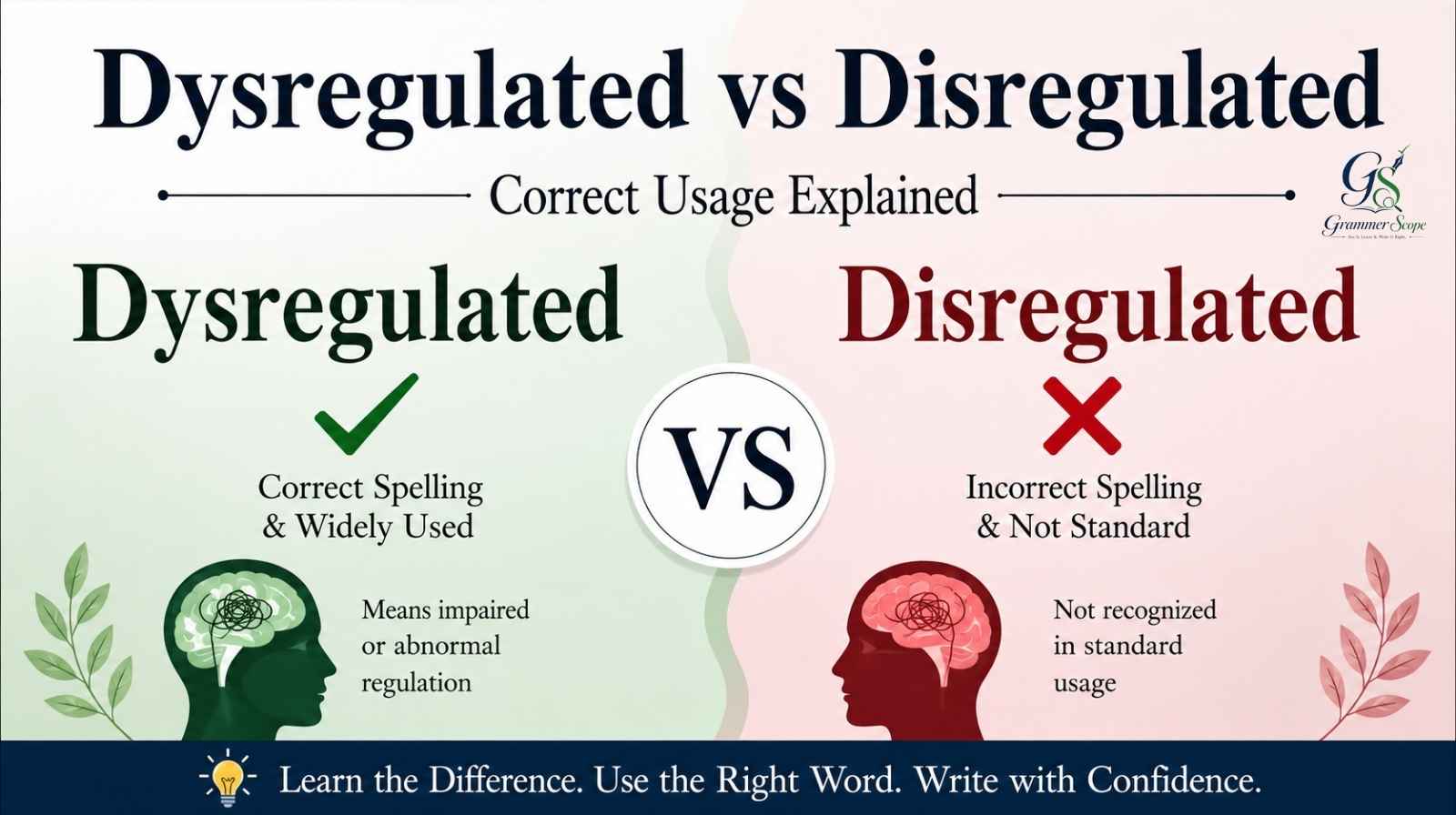
Have you ever seen the word “disregulated” online and wondered whether it’s actually correct? You’re not alone. Many writers, students, healthcare professionals, and even native English speakers confuse dysregulated vs disregulated because the words look similar at first glance.
However, only one version is considered correct in modern English usage.
In this guide, you’ll learn the real difference between dysregulated and disregulated, how to use the correct spelling confidently, and why the confusion happens in the first place. We’ll also explore examples, expert insights, grammar tips, and real-world usage so you never make this mistake again.
What Does Dysregulated Mean?
The word dysregulated refers to something that is not functioning or regulating properly. It is commonly used in psychology, medicine, neuroscience, biology, and emotional health discussions.
Definition of Dysregulated
“Dysregulated” describes an impaired or abnormal regulation process.
For example:
- Emotional responses can become dysregulated during severe stress.
- Hormones may become dysregulated because of illness.
- Sleep cycles sometimes become dysregulated after long-term anxiety.
The prefix “dys-” means:
- difficult
- abnormal
- impaired
- unhealthy
Therefore, dysregulated literally means “regulated in an abnormal or impaired way.”
Common Contexts Where Dysregulated Is Used
The term frequently appears in:
- Mental health
- Child psychology
- Trauma therapy
- Neuroscience
- Medical research
- Behavioral science
Example Sentences
Here are a few natural examples:
- The patient experienced a dysregulated nervous system after the traumatic event.
- Children with emotional dysregulation may struggle to manage frustration.
- Poor sleep can lead to a dysregulated immune response.
Is Disregulated a Real Word?
Technically, disregulated occasionally appears online, but it is generally considered incorrect or nonstandard in modern English.
Most dictionaries, academic publications, and style guides do not recognize “disregulated” as the preferred spelling.
Why People Write “Disregulated”
The confusion usually happens because:
- Many English words begin with “dis-”
- The prefixes “dis-” and “dys-” sound somewhat similar
- Spellcheck tools sometimes fail to catch the error
- Writers assume “disregulated” follows patterns like:
- disconnected
- disorganized
- disoriented
However, language experts and medical professionals overwhelmingly use dysregulated instead.
Quick Answer
| Word | Correct? | Common Usage |
|---|---|---|
| Dysregulated | ✅ Yes | Standard and accepted |
| Disregulated | ❌ No | Usually considered incorrect |
Dysregulated vs Disregulated: Key Differences
Understanding the prefixes makes the difference much clearer.
Meaning of the Prefix “Dys-”
The prefix dys- comes from Greek and means:
- impaired
- abnormal
- difficult
- faulty
Examples include:
- dysfunction
- dyslexia
- dysphoria
- dysregulated
Meaning of the Prefix “Dis-”
The prefix dis- usually means:
- opposite of
- not
- apart
- removed
Examples include:
- disconnect
- disagree
- disapprove
- disorganized
Why “Dysregulated” Is Correct
The concept involves impaired regulation, not the removal of regulation itself. Therefore, the prefix “dys-” fits the meaning accurately.
For example:
- A dysregulated nervous system still functions, but improperly.
- A disregulated system would imply regulation has been entirely undone, which is not the intended meaning in medical or psychological contexts.
Simple Memory Trick
Remember this:
“Dys-” = dysfunctional
If something functions abnormally, “dysregulated” is usually the correct word.
How Dysregulated Is Used in Psychology and Medicine
The word has become especially common in mental health discussions over the past decade.
Emotional Dysregulation
Emotional dysregulation occurs when a person struggles to manage emotional reactions effectively.
Symptoms may include:
- sudden anger
- emotional outbursts
- panic responses
- mood instability
- impulsive behavior
Mental health professionals often use the term when discussing:
- ADHD
- PTSD
- anxiety disorders
- borderline personality disorder
- trauma recovery
Nervous System Dysregulation
A dysregulated nervous system may stay in a constant “fight-or-flight” state.
This can lead to:
- chronic stress
- fatigue
- insomnia
- concentration problems
- anxiety symptoms
Hormonal Dysregulation
Medical experts also use the term for hormone imbalance.
Examples include:
- thyroid dysregulation
- insulin dysregulation
- cortisol dysregulation
According to the National Institute of Mental Health, emotional regulation plays a critical role in overall mental wellness and behavioral stability.
Real-Life Example: How One Word Mistake Impacts Professional Writing
A healthcare blogger published an article discussing trauma recovery and emotional regulation. Throughout the article, the writer repeatedly used the spelling “disregulated nervous system.”
Although the content itself was informative, readers in psychology communities quickly noticed the mistake. Several professionals commented that the article appeared less credible because the terminology was inaccurate.
As a result:
- Reader trust decreased
- Engagement dropped
- The article received corrections on social media
- Search visibility weakened because authoritative medical sources used “dysregulated” instead
Later, the writer updated the content using the correct terminology. Within weeks, the article began performing better in search rankings because it matched standard medical language used across trusted sources.
This example shows how even a small spelling difference can affect:
- SEO performance
- professional credibility
- audience trust
- readability
- topical authority
Therefore, using “dysregulated” correctly matters more than many people realize.
2025–2026 Language and Search Trends Around Dysregulated
The term “dysregulated” has seen significant growth online due to increasing awareness of mental health and nervous system regulation.
Recent Trends
According to language trend analysis and healthcare content reports from 2025:
- Searches related to “emotional dysregulation” continue rising globally
- Mental health terminology is increasingly used in everyday conversations
- Trauma-informed education content has expanded across blogs and social platforms
- Medical SEO keywords related to emotional regulation have become highly competitive
Additionally, platforms like Google Trends show consistent interest in topics involving nervous system regulation, emotional wellness, and psychological terminology.
Meanwhile, trusted educational organizations such as Merriam-Webster consistently recognize “dysregulated” while “disregulated” remains largely absent from standard dictionary usage.
Dysregulated vs Disregulated Comparison Table
| Feature | Dysregulated | Disregulated |
|---|---|---|
| Correct spelling | ✅ Yes | ❌ Usually no |
| Dictionary recognized | ✅ Yes | ❌ Rarely |
| Used in psychology | ✅ Frequently | ❌ Almost never |
| Used in medicine | ✅ Frequently | ❌ Incorrect in most cases |
| Prefix meaning | Impaired or abnormal | Opposite or removed |
| Recommended for professional writing | ✅ Yes | ❌ No |
Common Mistakes Writers Make
Many people accidentally misuse the term because they rely on pronunciation rather than word origins.
Mistake #1: Assuming “Dis-” Fits All Negative Words
Not every negative-sounding word begins with “dis-.”
For example:
- dyslexia
- dysfunction
- dysphoria
all use the “dys-” prefix because they involve abnormal functioning.
Mistake #2: Trusting Autocorrect Too Much
Some writing tools fail to flag “disregulated,” especially in informal platforms.
Always verify terminology using reliable dictionaries or medical references.
Mistake #3: Copying Incorrect Usage Online
Many blog posts contain spelling errors. Unfortunately, copied mistakes spread quickly across the internet.
Therefore, checking authoritative sources is essential.
How to Remember the Correct Spelling
If you struggle to remember the difference, these quick tricks can help.
Easy Memory Tricks
Think of “Dysfunction”
Both words share the same prefix:
- dysfunction
- dysregulated
Since both involve abnormal functioning, the spelling becomes easier to remember.
Associate It With Medical Vocabulary
Most medical terms involving impaired functioning use “dys-.”
Examples:
- dyslexia
- dysplasia
- dyspepsia
- dysregulated
Use This Formula
\text{Dys-} = \text{abnormal functioning}
That simple association helps many writers avoid the mistake permanently.
Mini Quiz: Dysregulated vs Disregulated
1: Pick the Correct Spelling
Which word is the correct English spelling?
- A) Disregulated
- B) Dysregulated
Answer: B) Dysregulated
2: Meaning of “Dys-”
What does the prefix “dys-” usually mean?
- A) Abnormal or impaired
- B) Perfect or normal
Answer: A) Abnormal or impaired
3: Correct Sentence Challenge
Which sentence sounds correct?
- A) He felt dysregulated after the stressful meeting.
- B) He felt disregulated after the stressful meeting.
Answer: A) He felt dysregulated after the stressful meeting.
4: Psychology Word Check
Which word is commonly used in psychology and mental health?
- A) Dysregulated
- B) Disregulated
Answer: A) Dysregulated
5: True or False
“Disregulated” is the preferred dictionary spelling.
Answer: ❌ False
6: Fill in the Blank
“A ______ nervous system may cause anxiety and stress.”
- A) Dysregulated
- B) Relaxed
Answer: A) Dysregulated
7: Professional Writing Test
Which spelling should you use in professional writing?
- A) Dysregulated
- B) Disregulated
Answer: A) Dysregulated
8: Emotional Meaning Quiz
What does emotional dysregulation mean?
- A) Trouble managing emotions
- B) Always feeling calm
Answer: A) Trouble managing emotions
9: Prefix Power
Which prefix relates to impaired functioning?
- A) Dys-
- B) Ultra-
Answer: A) Dys-
10: Quick Grammar Check
Which word is recognized by most dictionaries?
- A) Dysregulated
- B) Disregulated
Answer: A) Dysregulated
11: Real Usage Quiz
Doctors and therapists mostly use which spelling?
- A) Dysregulated
- B) Disregulated
Answer: A) Dysregulated
12: Final Brain Test
If something functions abnormally, which word fits best?
- A) Dysregulated
- B) Disregulated
Answer: A) Dysregulated
Frequently Asked Questions
Q1: Is dysregulated a medical term?
A: Yes. “Dysregulated” is widely used in medicine, psychology, neuroscience, and behavioral health discussions.
Q2: Is disregulated wrong?
A: In most modern English contexts, yes. “Disregulated” is generally considered incorrect or nonstandard compared to “dysregulated.”
Q3: What does emotionally dysregulated mean?
A: It means someone has difficulty managing emotional responses effectively. This can involve intense mood swings, impulsive reactions, or emotional overwhelm.
Q4: Why do people confuse dysregulated and disregulated?
A: The confusion happens because many English words begin with “dis-,” and both prefixes sound somewhat similar when spoken quickly.
Q5: Is dysregulated used in psychology?
A: Absolutely. Psychologists frequently use the term when discussing emotional regulation, trauma responses, ADHD, PTSD, and nervous system functioning.
Q6: Which spelling should I use in professional writing?
A: Always use dysregulated unless quoting a source that intentionally uses the alternative spelling.
Q7: Does Google recognize dysregulated as the correct term?
A: Yes. Search engines strongly associate “dysregulated” with authoritative medical, psychological, and educational sources.
Conclusion
Understanding the difference between dysregulated vs disregulated is important for accurate communication, professional credibility, and effective writing.
The correct and widely accepted spelling is dysregulated because the prefix “dys-” refers to impaired or abnormal functioning. Meanwhile, “disregulated” is generally viewed as incorrect or nonstandard in modern English.
Whether you’re writing about psychology, emotional health, neuroscience, or medical topics, using the right terminology helps build trust with readers and improves clarity.
Next time you encounter these words, remember:
If something is functioning abnormally, “dysregulated” is the correct choice.
Ready to improve your English? Read more guides on Grammer Scope

Bilal Khalid is a professional blogger specializing in grammar guides and practical writing tips. He helps readers improve clarity, accuracy, and confidence in communication through simple explanations, actionable advice, and easy-to-follow strategies for everyday and professional writing.