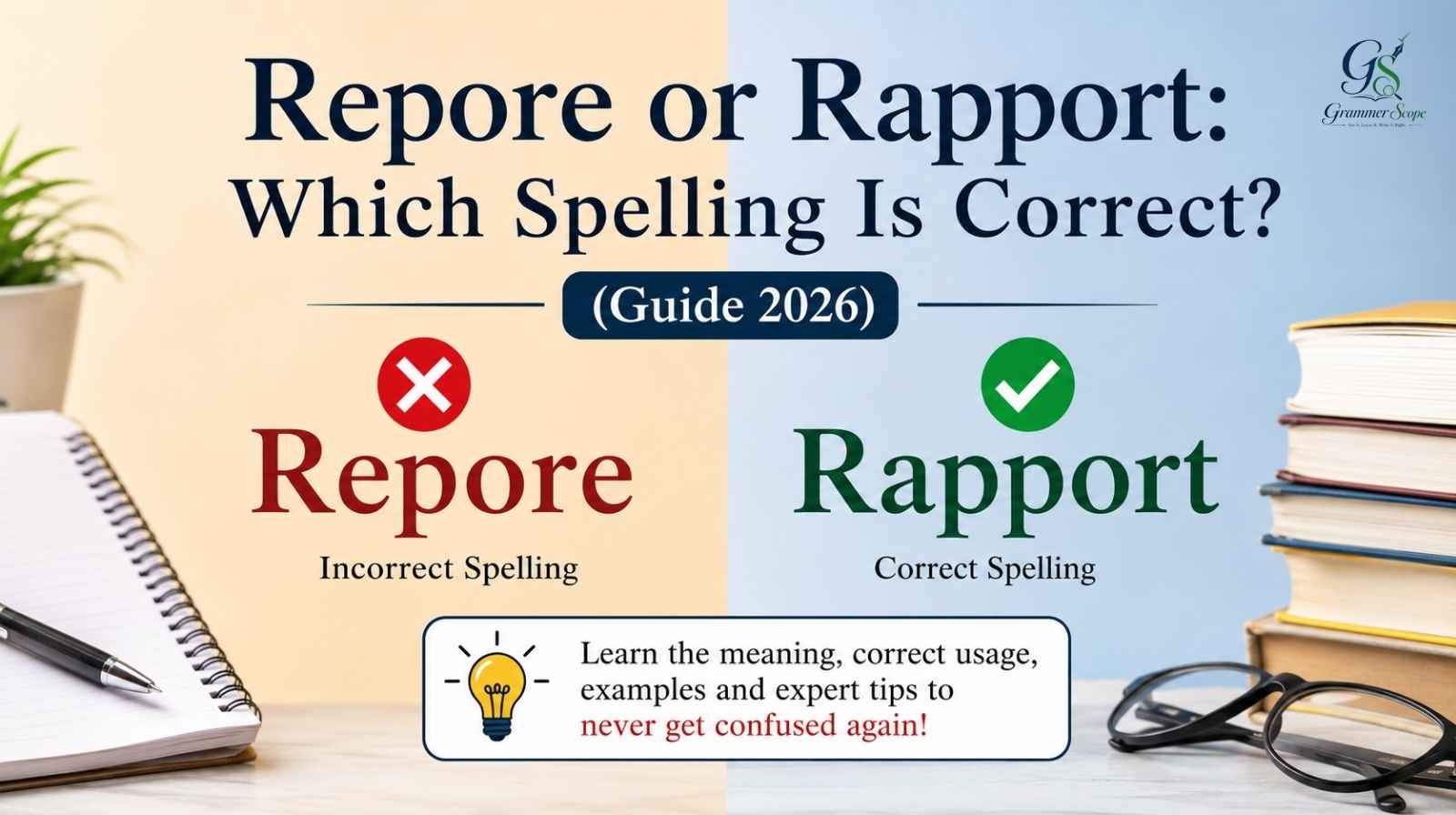
Have you ever typed “repore” while writing an email or conversation and wondered if it was actually correct? You are not alone. Many English learners and even native speakers confuse repore with rapport because both words sound somewhat similar when spoken quickly.
However, only one spelling is correct in standard English.
In this guide, you will learn the correct spelling, meaning, pronunciation, usage examples, grammar rules, and common mistakes related to repore vs rapport. By the end, you will confidently know when and how to use the word properly in professional and casual communication.
What Is the Correct Spelling: Repore or Rapport?
The correct spelling is rapport.
❌ Repore is not a recognized English word.
✅ Rapport is the proper word used in English grammar and communication.
Definition of Rapport
Rapport means:
A close, harmonious, or positive relationship between people.
It is commonly used when discussing communication, trust, teamwork, customer relationships, teaching, counseling, and leadership.
Quick Example
- ✅ The manager built a strong rapport with her team.
- ❌ The manager built a strong repore with her team.
Therefore, if you want to sound professional and grammatically correct, always use rapport.
Why Do People Confuse Repore and Rapport?
There are several reasons why this spelling confusion happens frequently online.
Similar Pronunciation
The word rapport is pronounced like:
“ra-PORE”
Because the ending sounds like “pore,” many people incorrectly spell it as repore.
Fast Typing Errors
People often type words based on sound rather than spelling. Since English contains many silent letters and French-origin words, mistakes like this are common.
Influence of Informal Writing
Social media, texting, and casual chats have increased spelling variations. Many users see incorrect spellings online and assume they are acceptable.
However, dictionaries and grammar experts confirm that rapport is the only correct spelling.
Meaning and Usage of Rapport in English
The word rapport is mainly used to describe trust, understanding, and emotional connection between people.
Common Situations Where Rapport Is Used
| Situation | Example |
|---|---|
| Workplace | Building rapport with clients |
| Teaching | Teachers creating rapport with students |
| Counseling | Therapists establishing rapport |
| Sales | Salespeople gaining customer trust |
| Friendships | Strong rapport between friends |
Rapport in Professional Communication
In business communication, rapport is extremely important because it helps improve teamwork, trust, and collaboration.
Example:
- The consultant quickly developed rapport with the client during the meeting.
Rapport in Personal Relationships
The word can also describe natural comfort between people.
Example:
- They had an instant rapport after their first conversation.
Rapport in Interviews and Networking
Recruiters and communication experts often mention rapport-building skills during interviews and networking events.
Example:
- Candidates who build rapport usually perform better in interviews.
Repore vs Rapport: Key Differences Explained
Here is a simple comparison table to remove confusion completely.
| Feature | Repore | Rapport |
|---|---|---|
| Correct English Word? | ❌ No | ✅ Yes |
| Found in Dictionaries? | ❌ No | ✅ Yes |
| Meaning | None | Positive relationship |
| Used in Professional Writing | ❌ Never | ✅ Frequently |
| Grammar Status | Misspelling | Correct spelling |
Easy Trick to Remember the Correct Spelling
Think of this phrase:
“Good relationships require rapport.”
The double “p” and silent “t” are part of the original French spelling.
Origin and History of the Word Rapport
The word rapport comes from the French language. It originally meant:
“To carry something back” or “relationship.”
English adopted the term during the 17th century, especially in communication and psychology contexts.
Today, the word is widely used in:
- Business communication
- Leadership training
- Human psychology
- Customer service
- Public speaking
- Education
According to the Merriam-Webster dictionary, rapport refers to a friendly and understanding relationship between people.
The Merriam-Webster official website also confirms the correct spelling and pronunciation.
How to Build Rapport Effectively
Building rapport is an essential communication skill in both personal and professional life.
Step-by-Step Rapport Building Checklist
1. Listen Actively
Pay attention when others speak instead of waiting for your turn to respond.
2. Maintain Eye Contact
Natural eye contact helps build trust and confidence.
3. Show Genuine Interest
Ask meaningful questions and engage sincerely.
4. Use Positive Body Language
Smiling and open posture improve communication.
5. Find Common Interests
Shared experiences create stronger connections.
6. Be Respectful and Empathetic
People trust those who understand their emotions and viewpoints.
Real-Life Example: How Rapport Helped a Small Business Grow
In 2025, a small digital marketing agency struggled to retain clients despite offering quality services. The owner realized the issue was not technical skill but communication.
Instead of focusing only on sales presentations, the team started improving client relationships. They listened more carefully during meetings, personalized conversations, and followed up regularly with helpful advice.
Within six months, the agency noticed major improvements:
- Client retention increased significantly
- Referrals grew through word-of-mouth
- Customer satisfaction scores improved
- Long-term contracts became more common
The owner later explained that building genuine rapport changed how clients viewed the business. Customers no longer saw the agency as just another service provider. Instead, they trusted the team as long-term partners.
This example shows that rapport is not just a vocabulary word. It directly affects communication success, business growth, and relationship quality.
Why Rapport Matters More in 2026
As communication becomes increasingly digital, interpersonal skills are becoming more valuable.
According to research published by LinkedIn and workplace communication experts, soft skills like relationship-building and emotional intelligence remain among the top professional skills in 2025–2026.
2025–2026 Communication Statistics
- Over 90% of employers value communication skills during hiring.
- Teams with stronger workplace communication show higher productivity.
- Customer trust significantly increases brand loyalty and retention.
These trends highlight why understanding and using words like rapport correctly matters in professional settings.
You can explore more workplace communication insights on the official LinkedIn Talent Blog.
Additionally, the Harvard Business Review frequently discusses the importance of trust and workplace relationships in leadership success.
Official resource:
Harvard Business Review
Common Mistakes People Make With Rapport
Even though rapport is a common English word, people still misuse it in several ways.
Incorrect Spellings
Common misspellings include:
- Repore
- Rapore
- Rappor
- Raport
Only rapport is correct.
Wrong Pronunciation Assumptions
Many learners expect pronunciation to match spelling exactly. However, the final “t” in rapport is usually silent.
Correct pronunciation:
ra-PORE
Using Rapport in the Wrong Context
Rapport refers specifically to relationships and connection between people.
Incorrect:
- ❌ I bought a rapport yesterday.
Correct:
- ✅ The teacher created rapport with the students.
SEO-Friendly Examples of Rapport in Sentences
Here are natural examples showing correct usage.
Workplace Examples
- A strong rapport between managers and employees improves teamwork.
- Good leaders build rapport through honest communication.
Social Examples
- She developed instant rapport with her new classmates.
- Their rapport made the conversation feel natural.
Business Examples
- Sales professionals rely on rapport to gain customer trust.
- Building rapport helps businesses retain loyal clients.
Mini Quiz: Repore or Rapport?
1. Which spelling is correct?
A) Repore
B) Rapport
Answer: B) Rapport
2. What does “rapport” mean?
A) A type of report
B) A good relationship
C) A writing tool
Answer: B) A good relationship
3. Which sentence is correct?
A) She built strong repore with clients.
B) She built strong rapport with clients.
Answer: B) She built strong rapport with clients.
4. Is “repore” a real English word?
A) Yes
B) No
Answer: B) No
5. Where is the word “rapport” commonly used?
A) Communication
B) Business
C) Education
D) All of these
Answer: D) All of these
6. How is “rapport” usually pronounced?
A) Rap-port
B) Ra-pore
C) Ray-port
Answer: B) Ra-pore
7. Which word shows trust and connection?
A) Rapport
B) Repore
Answer: A) Rapport
8. Fill in the blank:
“A teacher should build good ______ with students.”
A) Repore
B) Rapport
Answer: B) Rapport
9. Which one would look professional in writing?
A) Rapport
B) Repore
Answer: A) Rapport
Frequently Asked Questions
Is repore a real word?
No, repore is not a real English word. It is a misspelling of rapport.
What does rapport mean?
Rapport means a positive, trusting, and understanding relationship between people.
How do you pronounce rapport?
Rapport is usually pronounced as:
ra-PORE
The “t” is generally silent.
Why is rapport spelled differently from how it sounds?
The word comes from French, which is why its spelling and pronunciation differ slightly from typical English words.
Is rapport formal or informal?
Rapport can be used in both formal and informal situations. It is especially common in workplaces, education, psychology, and communication.
Can rapport be used in business communication?
Yes. In fact, rapport is one of the most commonly used words in leadership, customer service, networking, and sales communication.
What is another word for rapport?
Common synonyms include:
- Connection
- Relationship
- Understanding
- Harmony
- Trust
Conclusion
If you were confused between repore and rapport, the answer is now clear:
✅ Rapport is the correct spelling.
❌ Repore is incorrect.
Rapport refers to a positive relationship, trust, and mutual understanding between people. It is widely used in business, communication, education, and everyday conversations.
Understanding the correct spelling not only improves your grammar but also makes your writing look more professional and trustworthy.
The next time you write an email, article, or conversation about relationships or communication, remember to use rapport confidently and correctly.
Ready to improve your English? Read more guides on Grammer Scope

Bilal Khalid is a professional blogger specializing in grammar guides and practical writing tips. He helps readers improve clarity, accuracy, and confidence in communication through simple explanations, actionable advice, and easy-to-follow strategies for everyday and professional writing.