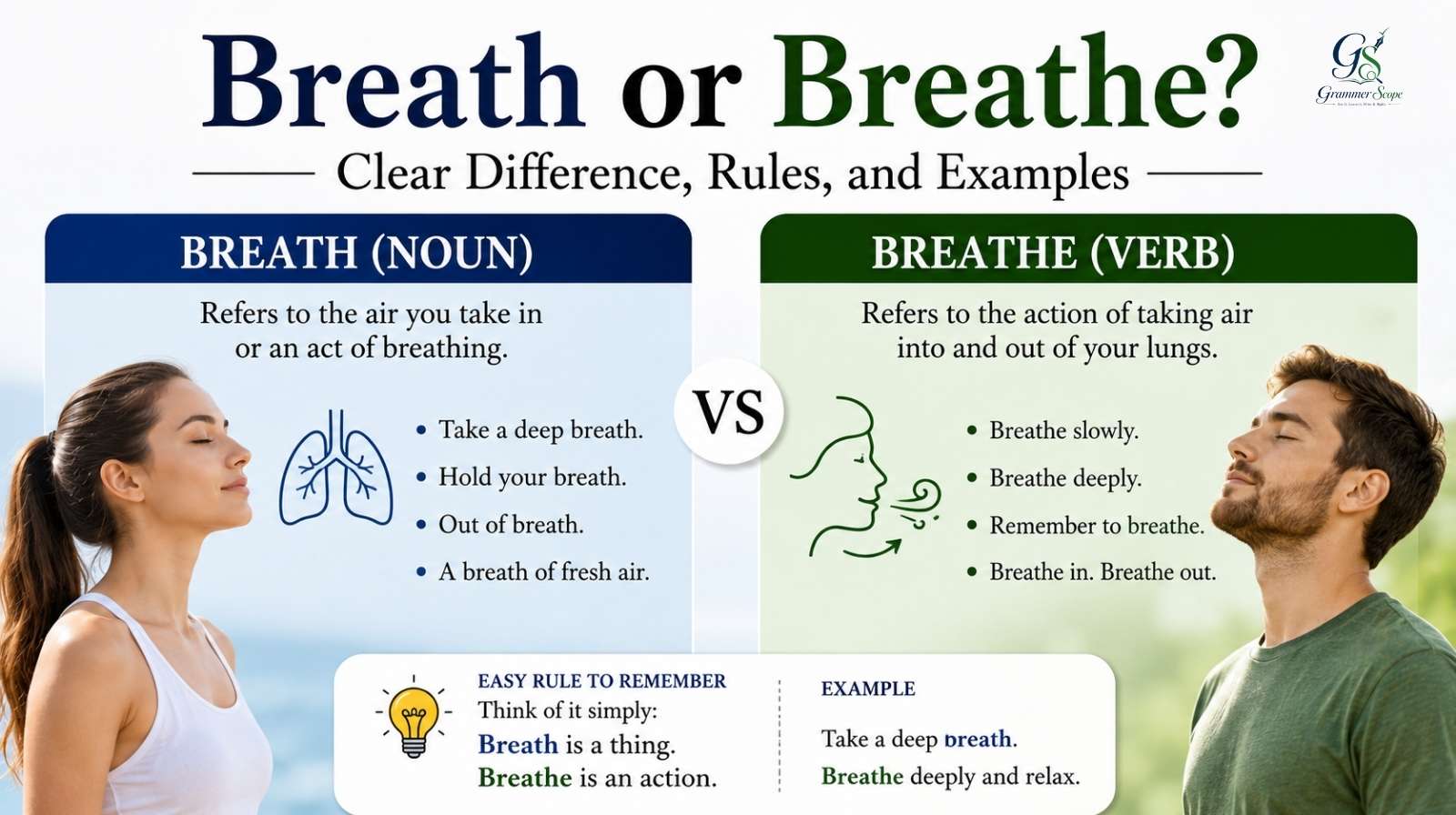
Have you ever written “take a breathe” and then wondered whether it should be “take a breath”? You are not alone. Breath or breathe is one of those English word pairs that looks almost identical but works differently in a sentence.
The key difference is simple: breath is a noun, while breathe is a verb. Breath refers to the air you inhale or exhale, or to an act of breathing. Breathe describes the action of taking air into and releasing it from your lungs. Cambridge Dictionary gives the same basic distinction: breath is the noun and breathe is the verb.
Once you understand that noun-versus-verb difference, choosing the right word becomes much easier.
In this guide, you will learn the meaning of breath and breathe, their pronunciation, the most important grammar rules, common mistakes, practical examples, a quick comparison table, and a simple memory trick that can help you remember the difference.
Breath or Breathe: What Is the Difference?
The fastest way to understand breath or breathe is to remember their parts of speech.
Breath is a noun.
It names the air that enters and leaves your lungs or an instance of breathing.
Breathe is a verb.
It describes the action of moving air into and out of your lungs.
Merriam-Webster defines breath as the air inhaled and exhaled during breathing and defines breathe as drawing air into and expelling it from the lungs.
Breath Is a Noun
Use breath when you are talking about a thing, amount, instance, or sensation related to breathing.
For example:
- I took a deep breath.
- She held her breath.
- He was out of breath after running.
- Take a breath before you answer.
- His breath smelled like coffee.
Notice that breath does not describe an action by itself. Instead, it names the breath or the result of breathing.
You can often place words such as a, one, deep, short, or long before breath:
- a breath
- one breath
- a deep breath
- a short breath
- a long breath
That is a useful clue that you are dealing with a noun.
Breathe Is a Verb
Use breathe when you are describing the action of inhaling and exhaling.
Examples include:
- Try to breathe slowly.
- I can hardly breathe in this smoke.
- She breathes deeply before meditation.
- Remember to breathe while exercising.
- The baby is breathing normally.
Here, breathe tells us what someone or something does.
It can also appear in different verb forms:
- breathe
- breathes
- breathed
- breathing
For example:
I breathe slowly when I am relaxed.
She breathes through her nose.
He breathed a sigh of relief.
They were breathing heavily after the race.
The One-Second Rule
If you are unsure which word to use, ask:
“Am I naming the thing, or describing the action?”
- Naming the thing → breath
- Describing the action → breathe
Compare:
Take a breath.
Here, breath is the thing you take.
Breathe slowly.
Here, breathe is the action you perform.
That single distinction solves most breath vs breathe mistakes.
Read More: Lable or Label: Which Spelling Is Correct?
Breath vs Breathe: Grammar Rules You Need to Know
The difference between these words is not simply an extra letter. Their grammatical roles are different, which is why they cannot normally be swapped.
Use “Breath” After Articles and Determiners
Because breath is a noun, it can follow an article or determiner.
Examples:
- Take a breath.
- I held my breath.
- She took another breath.
- He lost his breath.
- We could see each breath in the cold air.
A very common mistake is writing:
Take a breathe. ❌
The correct version is:
Take a breath. ✅
Why? Because take needs a noun in this expression, and breath is the noun.
Use “Breathe” After “To”
Because breathe is a verb, it commonly follows to in its base form.
Examples:
- I need to breathe.
- Try to breathe slowly.
- She wants to breathe fresh air.
- It is difficult to breathe here.
- Remember to breathe.
This gives you another useful test:
to breathe → correct
to breath → usually incorrect
For example:
I need to breathe.
Not:
I need to breath.
Watch the Verb Forms
The base verb is breathe, but its forms change depending on the sentence.
| Form | Example |
|---|---|
| Breathe | I breathe slowly. |
| Breathes | She breathes deeply. |
| Breathed | He breathed a sigh of relief. |
| Breathing | They are breathing normally. |
The noun breath, however, does not become breathe simply because you are talking about breathing.
For example:
She took a deep breath.
The noun remains breath.
A Helpful Grammar Test
Try replacing the word with another obvious noun or verb.
If you can replace it with air, pause, or breath itself, you probably need breath.
If you can replace it with inhale and exhale, you probably need breathe.
For example:
Take a breath.
You could think of this as taking an instance of air or breathing.
But:
Breathe deeply.
You could replace breathe with the action inhale and exhale.
This is not a perfect test for every figurative use, but it works extremely well in everyday sentences.
Read More: As Well or Aswell – Which One Is Correct?
How to Pronounce Breath and Breathe
Pronunciation is another reason breath or breathe can be confusing. The words are spelled similarly, but the final th sound is different.
Breath is commonly pronounced /brɛθ/, with a voiceless th sound.
Breathe is commonly pronounced /briːð/, with a voiced th sound.
In simple terms:
- breath sounds like breth
- breathe sounds like breeth
The vowel sound also changes.
Breath: Short “e” Sound
In breath, the vowel is similar to the sound in words such as:
- bed
- red
- head
- said
So:
breath → breth
Example:
Take a deep breath.
Breathe: Long “ee” Sound
In breathe, the vowel has a long ee sound, similar to:
- see
- tree
- free
- need
So:
breathe → breeth
Example:
Try to breathe slowly.
The “TH” Difference
There is another important pronunciation distinction.
In breath, the final sound is unvoiced, like the th in:
- think
- bath
- math
In breathe, the final sound is voiced, like the th in:
- this
- those
- mother
You do not necessarily need to master phonetic symbols to remember this. Simply listen for the difference:
breath → short vowel + softer/unvoiced “th”
breathe → long “ee” + voiced “th”
This pronunciation difference can actually help reinforce the spelling difference.
Read More: Take Effect or Take Affect? The Correct Phrase Explained
Common Expressions With Breath and Breathe
Learning common phrases is one of the easiest ways to stop confusing these words.
Common Expressions With “Breath”
Here are several everyday expressions using the noun breath:
Take a breath
Take a breath and try again.
Hold your breath
I held my breath while waiting for the result.
Out of breath
She was out of breath after climbing the stairs.
Catch your breath
We stopped for a moment to catch our breath.
Under your breath
He muttered something under his breath.
A breath of fresh air
The new manager was a breath of fresh air.
Last breath
He continued fighting until his last breath.
Because these expressions use breath as a noun, you should not replace it with breathe.
Common Expressions With “Breathe”
Now look at expressions that use the verb breathe:
Breathe deeply
Breathe deeply and relax.
Breathe slowly
Try to breathe slowly.
Breathe in
Breathe in through your nose.
Breathe out
Breathe out slowly.
Breathe easily
After the problem was solved, everyone could breathe easily.
Breathe life into something
The redesign breathed new life into the old website.
Don’t breathe a word
Please don’t breathe a word about the surprise.
These examples show why context matters. The word breathe describes an action, while breath identifies the noun connected with that action.
Read More: Long Term or Longterm: Which Spelling Is Correct in 2026?
Breath or Breathe: Examples You Can Copy
Seeing the words side by side makes the difference much easier to remember.
Correct “Breath” Examples
- I took a deep breath before speaking.
- She held her breath underwater.
- He was out of breath after the race.
- Take a breath and relax.
- I could see his breath in the cold air.
- She needed a moment to catch her breath.
- He whispered the answer under his breath.
- Take one more breath before you begin.
- The exercise made my breath faster.
- I could smell garlic on his breath.
Correct “Breathe” Examples
- Try to breathe slowly.
- Remember to breathe during the exercise.
- She breathes deeply when she meditates.
- I can hardly breathe in this room.
- He stopped to breathe after running.
- The baby is breathing normally.
- She breathed a sigh of relief.
- You should breathe through your nose.
- It was difficult to breathe in the smoke.
- Take your time and breathe.
Incorrect vs Correct
| Incorrect | Correct | Why? |
|---|---|---|
| Take a breathe. | Take a breath. | Noun needed |
| I need to breath. | I need to breathe. | Verb needed |
| Try to breath slowly. | Try to breathe slowly. | Verb needed |
| She took a deep breathe. | She took a deep breath. | Noun after “a” |
| I can hardly breath. | I can hardly breathe. | Action is required |
| Hold your breathe. | Hold your breath. | Fixed noun expression |
| He was out of breathe. | He was out of breath. | Fixed noun expression |
| Breathe deeply. | Breathe deeply. | Verb is correct |
Read More: You Too or You To: What’s the Correct Grammar in 2026?
A Real-Life Example: Why the Difference Matters
Imagine a student named Daniel preparing for an important presentation at school. He has practiced his speech several times, but when he stands in front of the class, he becomes nervous. His teacher notices and says, “Take a deep breath and breathe slowly.”
Daniel understands the instruction because the two words have different jobs.
When the teacher says “take a deep breath,” she is referring to a noun. Daniel needs to take one breath before continuing.
When she says “breathe slowly,” she is telling him what action to perform. He needs to control the process of inhaling and exhaling.
Later, Daniel writes about the experience:
“I took a deep breath before starting my presentation. I tried to breathe slowly so I would not speak too quickly.”
Both words are correct because they perform different grammatical functions.
This example also shows why simply memorizing spelling is not enough. Daniel could remember that breathe has an extra e, but that does not automatically tell him when to use it. Understanding the noun-versus-verb distinction is much more reliable.
The same issue appears in emails, school assignments, social media posts, workplace communication, and everyday conversations. Someone might write, “I couldn’t breath after running,” when the intended meaning is “I couldn’t breathe after running.” In another sentence, “Take a breathe” should be “Take a breath.”
The easiest solution is to stop thinking of these as two spellings of the same word. Think of them as two related words with different grammatical jobs.
That small mental shift makes the difference much easier to remember.
2025–2026 English Learning Data: Why Word Accuracy Still Matters
Small spelling and grammar distinctions remain important for people learning and using English worldwide. Current language-learning data also shows how large the global English-learning audience is.
EF Education First’s 2025 EF English Proficiency Index analyzed test results from approximately 2.2 million adults across 123 countries and regions. The 2025 edition also expanded its assessment to include speaking and writing alongside reading and listening, giving a broader picture of English skills.
The report found that speaking was the weakest English skill in more than half of the countries measured, highlighting how difficult precise English production can be for many learners.
For an additional regional snapshot, EF’s 2025 data lists Pakistan with an overall score of 493, compared with a global average of 488 in the index. Its reported skill scores include 512 for reading, 470 for listening, 515 for writing, and 517 for speaking.
These figures do not show how many people specifically confuse breath and breathe, and they should not be interpreted as a direct measurement of that spelling mistake. However, they demonstrate why clear explanations of everyday English vocabulary and grammar remain useful for learners and writers.
The broader lesson is simple: knowing individual words is not enough. Effective English also requires understanding how words function in real sentences.
Read More: Flier vs Flyer: Which Spelling Is Correct in 2026?
A Simple Step-by-Step Method to Choose the Right Word
If you still hesitate between breath or breathe, use this four-step method.
Step 1: Look at the Sentence
Read the complete sentence instead of focusing only on the two words.
For example:
I need to ___.
The sentence needs an action, so breathe is correct.
I took a deep ___.
The sentence needs a noun, so breath is correct.
Step 2: Ask “Thing or Action?”
This is the most important question.
Thing → breath
Action → breathe
For example:
Take a breath.
Breathe slowly.
Step 3: Look for Clue Words
Some words provide strong clues.
Words and expressions commonly associated with breath include:
- a
- my
- your
- his
- her
- deep
- short
- hold
- catch
- out of
Words and structures commonly associated with breathe include:
- to
- can
- should
- try to
- need to
- breathe in
- breathe out
- slowly
- deeply
These are not absolute rules, but they can help you make a quick decision.
Step 4: Read It Aloud
If you are still uncertain, pronounce both options.
Breath → “breth”
Breathe → “breeth”
The pronunciation difference can help your brain connect the correct spelling with the correct grammatical role.
The Easiest Memory Trick for Breath vs Breathe
Here is a simple trick:
Breath = noun
Breathe = verb
You can also remember:
Breathe has an extra “e” because it does the action.
Think:
Breathe = do something
Breath = the thing
For example:
Take a breath.
Breathe deeply.
Another useful pair is:
One breath.
Two breaths.
But:
Breathe slowly.
She breathes slowly.
Notice that the noun can become plural:
breath → breaths
The verb changes differently:
breathe → breathes / breathed / breathing
This contrast is another clue that they belong to different grammatical categories.
Read More: It’s Called vs It Called: Understanding The Distinction
Mini Quiz: Breath or Breathe
Quiz 1. Quick Pick: Breath or Breathe?
Choose the correct word:
“Take a deep ___ before you speak.”
A) Breathe
B) Breath
Answer: B) Breath ✅
Quiz 2. Fill in the Blank
Complete the sentence:
“Try to ___ slowly when you feel nervous.”
Answer: Breathe ✅
Quiz 3. Which One Sounds Right?
Which sentence is correct?
A) I need to breath.
B) I need to breathe.
Answer: B) I need to breathe. ✅
Quiz 4. Noun or Verb?
In this sentence, what is breath?
“She took a deep breath.”
A) Noun
B) Verb
Answer: A) Noun ✅
Quiz 5. Fill in the Blank
“He was out of ___ after running up the stairs.”
A) breathe
B) breath
Answer: B) breath ✅
Quiz 6. Can You Spot the Mistake?
Which sentence needs correction?
A) Breathe deeply and relax.
B) Take a deep breathe.
Answer: B) Take a deep breathe. ❌
Correct: Take a deep breath. ✅
Quiz 7. The Action Test
Which word describes an action?
A) Breath
B) Breathe
Answer: B) Breathe ✅
Quiz 8. Fill in the Blank
“Remember to ___ while exercising.”
Answer: Breathe ✅
Quiz 9. Choose the Correct Phrase
Which phrase is correct?
A) Hold your breathe
B) Hold your breath
Answer: B) Hold your breath ✅
Quiz 10. Pronunciation Challenge
Which word has the longer “ee” sound?
A) Breath
B) Breathe
Answer: B) Breathe ✅
Quiz 11. Fill in the Blank
“She took another ___ and continued speaking.”
Answer: Breath ✅
Quiz 12. Grammar Check
Which sentence uses breathe correctly?
A) Take a deep breathe.
B) Try to breathe deeply.
C) I held my breathe.
Answer: B) Try to breathe deeply. ✅
Quiz 13. One-Second Challenge ⚡
Complete this rule:
Breath = ______
Breathe = ______
A) Verb / Noun
B) Noun / Verb
Answer: B) Noun / Verb 🎯
Quiz 14. Final Boss: Can You Get It Right?
Fill in both blanks:
“Take a deep ___, then ___ slowly.”
A) breathe / breath
B) breath / breathe
Answer: B) breath / breathe 🏆
Quick reminder:
👉 Breath = noun (thing)
👉 Breathe = verb (action)
References
FAQs
Q1: Is “take a breathe” correct?
A: No. The standard expression is “take a breath.” Here, breath is a noun because it refers to the thing being taken.
Correct:
Take a deep breath.
Incorrect:
Take a deep breathe.
Q2: Is it “I can’t breath” or “I can’t breathe”?
A: The correct sentence is “I can’t breathe.” The word describes an action, so you need the verb breathe.
I can’t breathe.
Cambridge uses the same distinction when explaining that breathe is the verb used for the action of moving air into and out of the lungs.
Q3: What is the difference between breath and breathe?
A: Breath is a noun, while breathe is a verb.
- Breath: Take a deep breath.
- Breathe: Breathe deeply.
That is the central rule to remember.
Q4: Is “hold your breath” correct?
A: Yes. “Hold your breath” is correct because breath is a noun.
For example:
Hold your breath while I count to ten.
Q5: Is “breathe deeply” correct?
A: Yes. “Breathe deeply” is correct because breathe is a verb describing an action.
For example:
Close your eyes and breathe deeply.
Q6: How do you pronounce breath and breathe?
A: Breath is generally pronounced with a short vowel, approximately “breth,” while breathe has a long “ee” sound, approximately “breeth.”
The final th sound also differs: breath uses an unvoiced sound, while breathe uses a voiced sound.
Q7: What is the past tense of breathe?
A: The past tense of breathe is breathed.
For example:
She breathed deeply and relaxed.
Do not confuse this with the noun breath.
Final Takeaway: Breath or Breathe?
The difference between breath or breathe becomes easy once you stop treating them as interchangeable spellings.
Breath is a noun. It refers to the air you inhale or exhale, an act of breathing, or something associated with breathing.
Breathe is a verb. It describes the action of inhaling and exhaling.
Remember the basic pattern:
Take a breath.
Breathe slowly.
If you are talking about the thing, choose breath.
If you are talking about the action, choose breathe.
The next time you hesitate, ask yourself one question: “Do I need a noun or a verb?” That quick check will help you choose the correct word in emails, essays, messages, assignments, and everyday English.
Discover More Articles
- Recurring vs Reoccurring: The Complete Guide To Correct Usage
- Accomodation vs Accommodation: What’s The Correct Spelling?
- Appreciate It or Appreciated It? The Ultimate Guide To Choosing The Right Phrase
Ready to improve your English? Read more guides on Grammer Scope

Bilal Khalid is a professional blogger specializing in grammar guides and practical writing tips. He helps readers improve clarity, accuracy, and confidence in communication through simple explanations, actionable advice, and easy-to-follow strategies for everyday and professional writing.