Have you ever seen the words tacet or tacit and wondered if they mean the same thing? At first glance, they look almost identical. However, these two words have completely different meanings and are used in very different situations.
Many writers, students, musicians, and English learners confuse them because of their similar spelling and pronunciation. Therefore, understanding the distinction can help you avoid embarrassing writing mistakes and improve your communication skills.
In this guide, you’ll learn:
- The exact meaning of tacet and tacit
- When to use each word
- Easy examples you can remember
- Common mistakes people make
- A quick comparison table
- Expert tips to never confuse them again
By the end of this article, you’ll confidently know which word to use in any situation.
What Does “Tacet” Mean?
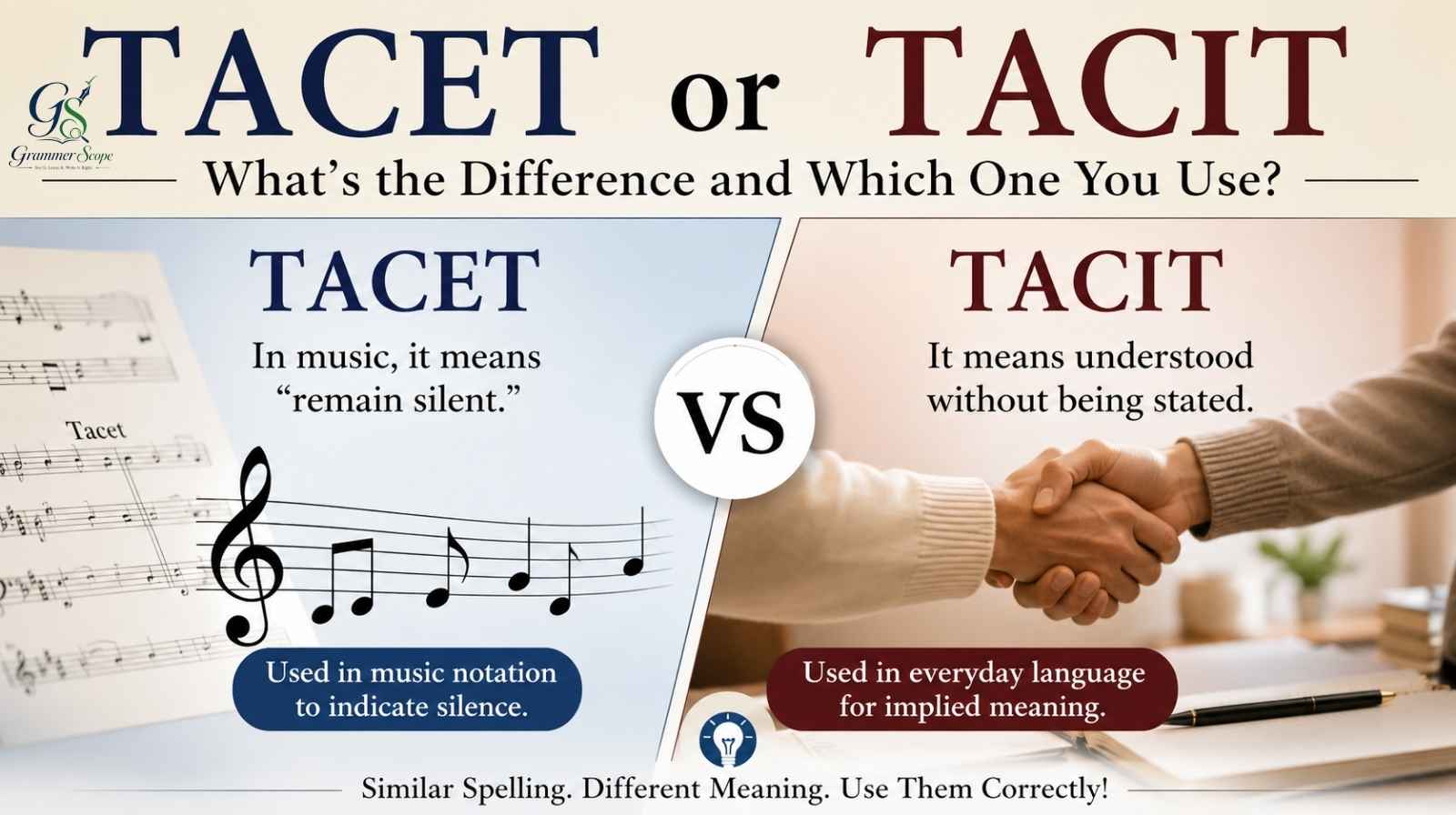
The word tacet is mainly used in music. It comes from Latin and means “it is silent.”
In musical notation, tacet tells a performer not to play during a section of a composition. Instead of writing many empty bars, composers simply write “tacet.”
Simple Definition of Tacet
Tacet means a musician should remain silent or not perform for a period of time.
Examples of Tacet in Sentences
- The trumpet section was marked tacet during the second movement.
- In the orchestra score, the violin player saw “tacet” and waited quietly.
- The choir remained tacet until the final verse.
Where You’ll Usually See “Tacet”
You’ll commonly find this word in:
- Orchestra music
- Choir arrangements
- Band performances
- Classical music scores
- Musical instruction sheets
Therefore, if you are not discussing music, you probably do not need the word tacet.
Why Musicians Use Tacet
Using tacet makes sheet music cleaner and easier to read. Instead of counting dozens of silent measures, musicians instantly understand they should pause until instructed otherwise.
For example, in symphonies, some instruments may stay silent for several minutes. Writing “tacet” saves space and avoids confusion.
What Does “Tacit” Mean?
Unlike tacet, the word tacit is commonly used in everyday English. It means something is understood without being directly stated.
Simple Definition of Tacit
Tacit refers to something implied, unspoken, or understood indirectly.
Examples of Tacit in Sentences
- There was a tacit agreement between the coworkers not to discuss the incident.
- Her smile gave tacit approval to the plan.
- The team had a tacit understanding about deadlines.
Common Situations Where “Tacit” Is Used
The word appears often in:
- Business communication
- Relationships
- Politics
- Legal discussions
- Workplace culture
- Social expectations
For example, a manager may never officially say employees should arrive early, but everyone understands it. That is a tacit expectation.
Tacit Meaning in Everyday Life
People use tacit communication more often than they realize. Body language, silence, gestures, and social norms all create tacit understanding.
Examples include:
- Nodding instead of saying “yes”
- Staying quiet to show agreement
- Following unwritten office rules
- Understanding social cues without explanation
Therefore, tacit is closely connected to human interaction and implied meaning.
Tacet vs Tacit: The Main Difference
Although these words look similar, their meanings are unrelated.
| Word | Meaning | Used In | Example |
|---|---|---|---|
| Tacet | Remain silent in music | Music & orchestras | “The flute part is tacet.” |
| Tacit | Implied or understood without words | Everyday English | “They had a tacit agreement.” |
Quick Memory Trick
Here’s an easy way to remember:
- Tacet → Think of concert
- Tacit → Think of implicit
This small association can help you instantly choose the correct word.
Why People Confuse Tacet and Tacit?
These words are commonly confused for three main reasons:
1. Similar Spelling
Only one letter changes between them. Therefore, many readers assume they are variations of the same word.
2. Similar Pronunciation
Both words sound somewhat alike, especially in fast speech. Non-native English speakers often mix them up while writing.
3. Rare Usage of Tacet
Most people rarely encounter the word tacet unless they study music. As a result, they mistakenly replace it with tacit.
For example:
❌ Incorrect: “The violin remained tacit during the performance.”
✔ Correct: “The violin remained tacet during the performance.”
Similarly:
❌ Incorrect: “There was a tacet agreement.”
✔ Correct: “There was a tacit agreement.”
Real-Life Example: How One Word Changed the Meaning
A university music student once submitted a concert review describing a brass section as “tacit” during part of a symphony. His professor quickly corrected the sentence.
Why?
Because “tacit” means implied or unspoken agreement not musical silence.
The correct term was “tacet,” since the instruments were intentionally silent according to the score.
This small spelling mistake completely changed the meaning of the review. Instead of discussing music notation, the sentence accidentally suggested the musicians silently agreed on something.
Situations like this happen frequently in academic writing, blogs, and social media posts. Many autocorrect tools also fail to identify the error because both words are legitimate English terms.
The lesson is simple: context matters.
If the topic involves music performance or notation, use tacet. If the topic involves implied understanding or unspoken communication, use tacit.
Professional writers and editors often double-check confusing word pairs because even tiny mistakes can affect credibility and clarity.
Tacit in Business, Communication, and Psychology
The word tacit appears frequently in professional environments.
Tacit Knowledge
One of the most common phrases is tacit knowledge.
Tacit knowledge refers to skills or experience that are difficult to explain in words.
For example:
- Riding a bicycle
- Reading social cues
- Leadership instincts
- Negotiation skills
A person may know how to do something perfectly but struggle to explain the process.
Tacit Communication
Tacit communication includes:
- Facial expressions
- Eye contact
- Silence
- Tone of voice
In workplaces, tacit communication can shape company culture more than written rules.
Tacit Approval
This phrase means silent agreement.
Example:
“The manager’s silence was seen as tacit approval.”
Therefore, tacit often describes hidden understanding rather than direct speech.
Data and Language Trends (2025–2026)
According to language trend analysis from grammar tools and educational platforms in 2025, confusing word pairs remain one of the most common English writing mistakes.
Recent data shows:
- “Tacit agreement” receives thousands of monthly searches globally.
- Searches for “tacet meaning” have increased due to online music education growth.
- Grammar correction tools report that homophone-style word confusion remains a top editing issue among students and bloggers.
Additionally, educational experts note that contextual learning improves vocabulary retention better than memorization alone.
This means learning words through real examples rather than dictionary definitions only helps writers remember correct usage longer.
Sources from educational language platforms and writing research also emphasize that precise vocabulary improves readability, professionalism, and trustworthiness in digital content.
How to Remember the Difference Easily
Here are a few simple strategies to avoid confusion forever.
Associate the Words With Context
- Tacet = Music
- Tacit = Communication
Use Sentence Testing
Ask yourself:
“Am I talking about silence in music or implied understanding?”
If it’s music → use tacet
If it’s implied agreement → use tacit
Practice With Examples
Create your own examples:
- “The drummer was tacet.”
- “We had a tacit understanding.”
Writing sentences helps reinforce memory naturally.
Common Mistakes Writers Make
Here are some errors people often make:
| Incorrect Usage | Correct Usage |
|---|---|
| Tacit in sheet music | Tacet in sheet music |
| Tacet agreement | Tacit agreement |
| Tacit orchestra pause | Tacet orchestra pause |
| Tacet approval | Tacit approval |
Therefore, always check the context before choosing the word.
Mini Quiz: Tacet vs Tacit
Q1. What does “tacet” mainly relate to?
A) Business agreement
B) Music silence
C) Legal rule
Answer: B) Music silence
Q2. “Tacit” means:
A) Loud and clear
B) Written clearly
C) Unspoken or implied
Answer: C) Unspoken or implied
Q3. Which sentence is correct?
A) The orchestra was tacit during the pause
B) The orchestra was tacet during the pause
C) The orchestra was talking during tacet
Answer: B) The orchestra was tacet during the pause
Q4. A tacit agreement is:
A) A written contract
B) A silent understanding
C) A legal document
Answer: B) A silent understanding
Q5. “Tacit knowledge” means:
A) Knowledge that is written in books
B) Knowledge hard to explain in words
C) Knowledge about music only
Answer: B) Knowledge hard to explain in words
Q6. Which word is used in music notation?
A) Tacit
B) Tacet
C) Tactic
Answer: B) Tacet
FAQs
Q1: Is tacet a real English word?
A: Yes. Tacet is a legitimate musical term used in orchestras, choirs, and music notation.
Q2: What does tacit mean in simple words?
A: Tacit means something understood or implied without being directly spoken.
Q3: Can tacet and tacit be used interchangeably?
A: No. They have completely different meanings and contexts.
Q4: Is tacet only used in music?
A: Mostly yes. The word is strongly associated with musical performance and notation.
Q5: What is a tacit agreement?
A: A tacit agreement is an unspoken understanding between people.
Q6: How do you pronounce tacet?
A: “Tacet” is commonly pronounced as TAH-ket or TASS-et, depending on regional style.
Q7: Why do people confuse tacet and tacit?
A: Because the words look and sound similar, many writers accidentally mix them up.
Final Thoughts
Understanding the difference between tacet and tacit is easier once you focus on context.
- Tacet belongs to the world of music and means silence during performance.
- Tacit belongs to everyday communication and means something implied or understood without words.
Although they look similar, using the wrong one can completely change the meaning of your sentence. Therefore, remembering the simple connection music versus implied understanding can help you avoid mistakes permanently.
The next time you encounter these words, you’ll know exactly which one to use confidently.
External References
Ready to improve your English? Read more guides on Grammer Scope