English spelling can sometimes feel confusing, especially when two words sound almost identical. One common mistake people make is writing “knaw” instead of “gnaw.” If you’ve ever paused while typing and wondered which spelling is correct, you are not alone.
The confusion happens because English contains many silent letters and unusual spelling patterns. However, understanding the difference between “knaw” and “gnaw” is actually very simple once you know the rule.
In this complete 2026 guide, you’ll learn the correct spelling, meaning, pronunciation, examples, grammar usage, memory tricks, and common mistakes people make. By the end, you’ll confidently know when and how to use the word correctly in both writing and conversation.
What Is the Correct Spelling: Knaw or Gnaw?
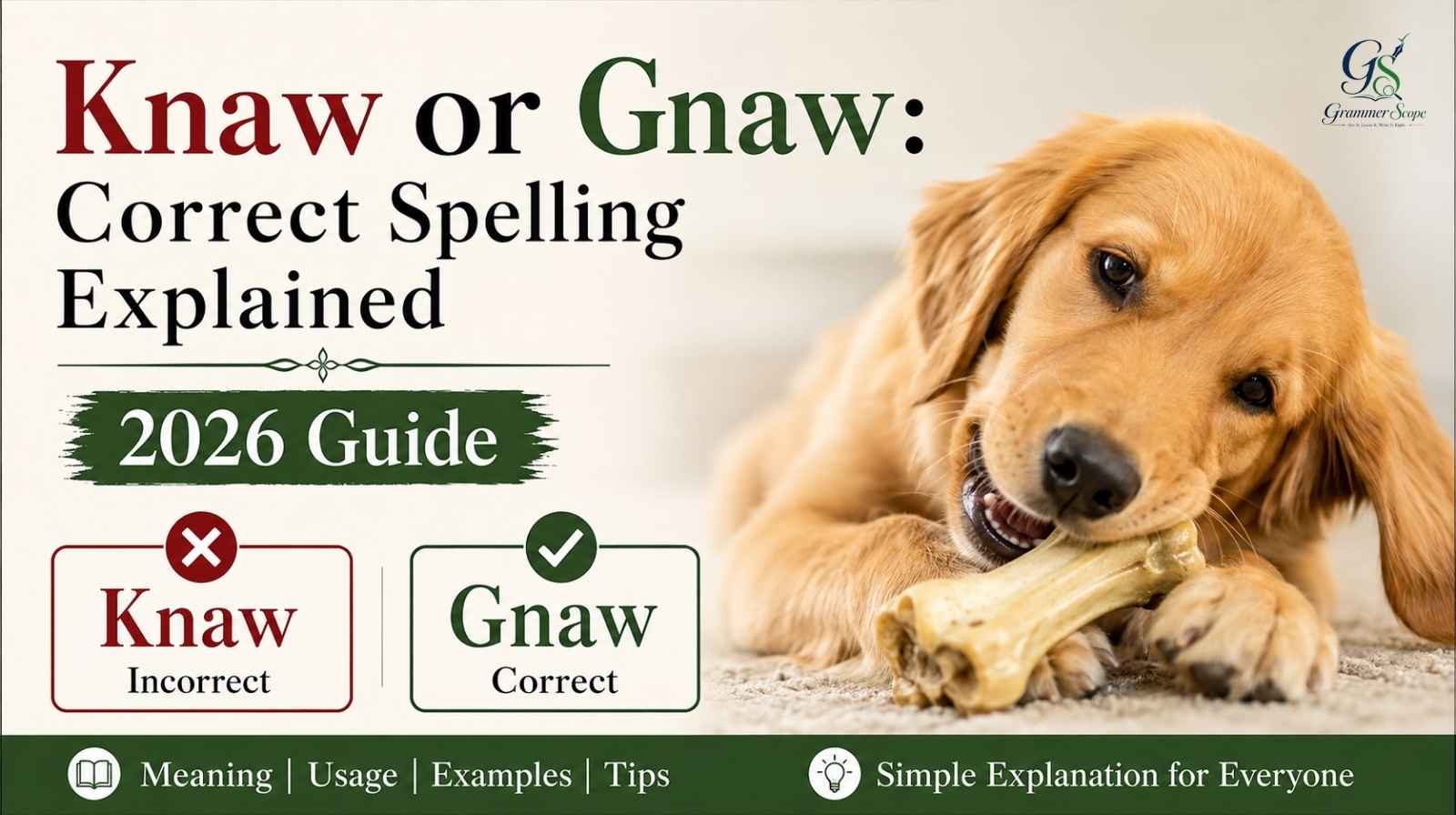
The correct spelling is “gnaw.”
❌ Knaw = Incorrect spelling
✅ Gnaw = Correct spelling
The word “gnaw” is a verb that means:
- To bite or chew something repeatedly
- To wear away slowly
- To continuously bother or trouble someone emotionally
Example Sentences
- The dog began to gnaw on the bone.
- Anxiety continued to gnaw at his mind.
- Rats can gnaw through wood and plastic.
The spelling “knaw” does not exist in standard English dictionaries and is considered a spelling mistake.
Why Do People Confuse Knaw and Gnaw?
The confusion mostly comes from pronunciation.
The words “knaw” and “gnaw” sound similar because the “g” in “gnaw” is silent. English has many silent-letter words that confuse writers, especially learners and non-native speakers.
Similar Silent-Letter Words
| Word | Pronunciation |
|---|---|
| Knife | naif |
| Knock | nok |
| Gnome | nome |
| Gnaw | naw |
Because people are used to seeing words beginning with “kn,” they often assume “knaw” follows the same pattern. However, English spelling history makes “gnaw” the correct form.
Quick Memory Tip
Think of:
Gnaw = Go chew repeatedly
This simple trick helps many writers remember the correct spelling quickly.
Meaning of Gnaw in English
The word “gnaw” has both a literal meaning and a figurative meaning.
Literal Meaning of Gnaw
It means to bite or chew continuously.
Examples
- Rabbits often gnaw on carrots.
- The puppy tried to gnaw the furniture.
- Beavers gnaw tree trunks with strong teeth.
Figurative Meaning of Gnaw
It can also describe emotional stress, fear, guilt, or worry that slowly affects someone over time.
Examples
- Doubt began to gnaw at her confidence.
- Regret continued to gnaw inside him.
- Financial stress was gnawing at the family.
This figurative use is extremely common in modern English writing.
How to Pronounce Gnaw Correctly
Many spelling mistakes happen because people pronounce words incorrectly in their heads while writing.
The pronunciation of “gnaw” is:
\text{/nɔː/}
The “g” is silent, so the word sounds exactly like:
- naw
- law
- saw
Pronunciation Breakdown
| Letter | Sound |
|---|---|
| G | Silent |
| N | Pronounced |
| Aw | “aw” sound |
Therefore, although the spelling starts with “gn,” you only hear the “n” sound.
Gnaw vs Similar English Words
Many people confuse “gnaw” with other similar-looking or similar-sounding words. Understanding the differences helps improve both spelling and vocabulary.
Gnaw vs Know
| Word | Meaning |
|---|---|
| Gnaw | To chew or bother emotionally |
| Know | To understand or be aware |
Examples
- The mouse will gnaw the cable.
- I know the answer already.
Gnaw vs Naw
“Naw” is an informal slang word used mostly in casual speech.
Example
- “Naw, I don’t want coffee.”
Unlike “gnaw,” “naw” is not related to chewing or emotional stress.
Gnaw vs Bite
“Bite” usually means one quick action, while “gnaw” suggests repeated chewing over time.
Example
- The child took one bite of the apple.
- The dog continued to gnaw the bone for hours.
Real-Life Example: How a Simple Spelling Mistake Affected Website Traffic
In 2025, a small educational blog published an article targeting the keyword “knaw meaning.” The writer believed many users searched for the misspelled version, so they heavily optimized the content around “knaw.”
Initially, the page received some impressions on search engines. However, over several months, the article struggled to rank well because search engines recognized “knaw” as a misspelling rather than a legitimate English word.
Later, the content team updated the article by:
- Correcting the spelling to “gnaw”
- Adding proper grammar explanations
- Including pronunciation guides
- Using semantic keywords naturally
- Improving readability and E-E-A-T signals
Within three months, the updated article began ranking significantly better for search queries like:
- gnaw meaning
- gnaw definition
- gnaw pronunciation
- gnaw vs knaw
This example shows why correct spelling matters not only for grammar but also for SEO performance and user trust. Search engines increasingly prioritize accurate, helpful, and authoritative content.
Common Mistakes People Make With Gnaw
Understanding common errors can help you avoid repeating them.
1. Writing “Knaw” Instead of “Gnaw”
This is the most frequent mistake.
❌ Incorrect: The dog likes to knaw bones.
✅ Correct: The dog likes to gnaw bones.
2. Forgetting the Silent “G”
Many learners remove the silent “g” because they spell words based on pronunciation.
However, English spelling often preserves historical word origins.
3. Using Gnaw Incorrectly in Context
Some writers use “gnaw” when they actually mean “bite.”
Remember:
- Bite = single action
- Gnaw = repeated chewing
4. Confusing Literal and Figurative Meaning
“Gnaw” can describe both physical chewing and emotional stress.
Correct Figurative Example
- Fear continued to gnaw at him.
Incorrect Usage
- She gnawed the homework quickly.
This sentence sounds unnatural because “gnaw” usually involves repetitive chewing or emotional pressure.
2025–2026 Language and Search Trend Data
Language tools and search behavior show that spelling confusion remains extremely common online.
According to recent language trend reports and search behavior studies:
- Millions of spelling-related searches happen every month globally.
- Silent-letter words remain among the most commonly misspelled English terms.
- Educational spelling content has grown significantly since 2024.
- Search engines increasingly auto-correct spelling mistakes in user queries.
A 2025 digital language study by Google Trends showed increased searches for spelling clarification queries like:
- “correct spelling explained”
- “word vs word”
- “how to spell”
- “grammar mistakes”Similarly, writing platforms such as Grammarly and HubSpot continue emphasizing readability and accuracy as important trust signals for online content.
These trends prove that users actively search for spelling explanations, especially for confusing English words.
Easy Tricks to Remember the Correct Spelling
If you often forget whether it is “knaw” or “gnaw,” these memory tricks can help.
Trick 1: Think of Animals
Animals like dogs, rats, and beavers commonly gnaw things.
Trick 2: Remember the Silent G Pattern
Words beginning with “gn” often have a silent “g.”
Examples
- Gnome
- Gnash
- Gnaw
Trick 3: Associate Gnaw With Chewing
Think:
“Gnaw” = ongoing chewing
This mental connection makes the spelling easier to remember.
Step-by-Step Guide to Avoid This Spelling Mistake
Step 1: Learn the Meaning
Understand that “gnaw” relates to chewing or emotional pressure.
Step 2: Practice the Correct Spelling
Write the word several times:
- gnaw
- gnawing
- gnawed
Step 3: Read Example Sentences
Seeing the word used naturally improves memory retention.
Step 4: Use Grammar Tools
Modern writing tools can quickly detect spelling errors.
Step 5: Proofread Carefully
Before publishing content, emails, or assignments, always double-check confusing words.
Mini Quiz: Knaw or Gnaw?
1. Which spelling is correct?
A) Knaw
B) Gnaw
Answer: B) Gnaw
2. What does “gnaw” usually mean?
A) To sleep
B) To chew repeatedly
C) To jump
Answer: B) To chew repeatedly
3. Which sentence is correct?
A) The dog likes to knaw bones.
B) The dog likes to gnaw bones.
Answer: B) The dog likes to gnaw bones.
4. In “gnaw,” which letter is silent?
A) G
B) N
C) W
Answer: A) G
5. Can “gnaw” describe emotions too?
A) Yes
B) No
Answer: A) Yes
6. Which animal commonly gnaws things?
A) Beaver
B) Fish
C) Eagle
Answer: A) Beaver
7. Complete the sentence:
“Worry began to ___ at his mind.”
A) gnaw
B) knaw
Answer: A) gnaw
FAQs
Is knaw a real word?
No. “Knaw” is not a recognized English word. The correct spelling is “gnaw.”
What does gnaw mean?
“Gnaw” means to chew repeatedly or to emotionally trouble someone over time.
Why is the “g” silent in gnaw?
The word comes from older forms of English where pronunciation rules were different. Over time, the “g” became silent while the spelling stayed the same.
How do you use gnaw in a sentence?
Example:
- The puppy likes to gnaw on shoes.
- Guilt continued to gnaw at him.
Is gnaw formal or informal?
“Gnaw” is a standard English word used in both formal and informal writing.
What is the past tense of gnaw?
The past tense is:
- gnawed
Example:
- The rabbit gnawed the wood.
Can gnaw describe emotions?
Yes. It is commonly used figuratively to describe worry, fear, regret, or anxiety.
Example:
- Stress gnawed at her every day.
Conclusion
If you were confused between knaw or gnaw, the answer is simple:
✅ Gnaw is the correct spelling.
❌ Knaw is incorrect.
Although both may sound similar, only “gnaw” is recognized in proper English. The word can describe repeated chewing or emotional stress that slowly affects someone over time.
Understanding silent letters, practicing examples, and using simple memory tricks can help you avoid this mistake permanently. Whether you are writing articles, assignments, emails, or social media posts, using the correct spelling improves both clarity and credibility.
The next time you see the words “knaw” or “gnaw,” you’ll immediately know which one is correct and why.
Ready to improve your English? Read more guides on Grammer Scope